
Cross Stitch FAQ: Is It Hard, What Can You Make, and More
Posted by Tracey Kramer on 1st Jun 2019
A Note from Tracey Kramer
Over twenty years of selling patterns, I've fielded the same questions hundreds of times. What can I actually make with cross stitch? How is it different from embroidery? Is it hard? I've collected the most important questions here and answered them as honestly as I can — without the beginner-guide sugar-coating.
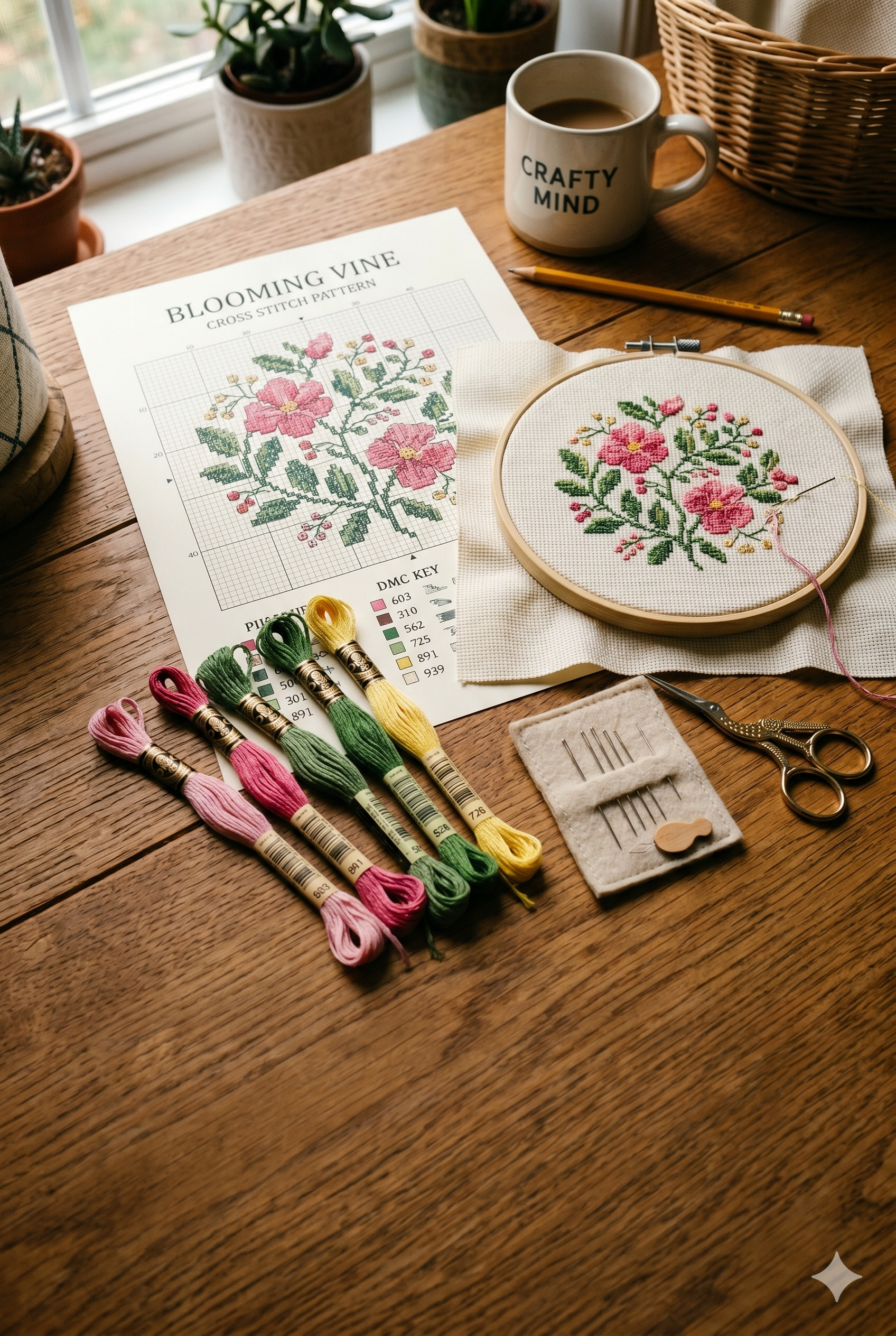
The same questions come up again and again — here are the real answers.
By Tracey Kramer • • 11 min read
Cross stitch attracts a specific kind of question from beginners — questions that feel almost embarrassingly basic but are actually getting at something important. What am I getting into here? Is this too hard for me? What will I have at the end of it?
These are good questions. They deserve real answers, not the glossy "anyone can do it!" response you'll find in most beginner guides. Below are the questions I hear most often, along with honest answers built from over twenty years of stitching and designing.
What Can You Make From Cross Stitch?
The short answer: almost anything pictorial. The longer answer is more interesting.
Cross stitch's output is a flat, textile-based image built from an even grid of X-shaped stitches. That constrained structure is actually its creative power — because every stitch occupies a specific, uniform square in a precise grid, a designer can chart virtually any image into a cross stitch pattern and a stitcher can reproduce it with great fidelity. The result is a textile equivalent of a painting.
The traditional outputs — framed wall art, pillows, table linens, samplers — are still the most popular. A large, detailed cross stitch piece in a nice frame is genuinely beautiful and often indistinguishable at a glance from a painting or print. This is what draws people to the craft who want their work to function as art.
But cross stitch has also moved into contemporary spaces: ornaments, book covers, clothing embellishments, tote bags, greeting cards, gift tags, and framed miniatures. The scale flexibility is remarkable — you can stitch a 2-inch ornament and a 24-by-36-inch masterwork using the exact same technique. Only the count of the fabric, the size of the canvas, and the patience of the stitcher change.
What cross stitch doesn't do well is three-dimensional form. It's fundamentally a flat surface medium. You can add textural interest with specialty stitches like satin stitch or metallic thread highlights, but the core of the craft lives in the plane of the fabric. For dimensional work, embroidery, needlepoint, or weaving offer more flexibility. For pictorial flat work that can be framed and hung, cross stitch is among the best needlework options available.
What Is the Difference Between Cross Stitch and Embroidery?
This question comes up constantly, and the confusion is understandable — cross stitch is, technically, a form of embroidery. But in common usage, the two terms describe quite different approaches.
Embroidery (as most people use the term) refers to freestyle surface embroidery: working on fabric with a variety of stitches — satin stitch, stem stitch, chain stitch, French knots, and dozens more — to create decorative designs. Freestyle embroidery is improvisational and expressive. The stitcher makes decisions about stitch direction, length, and placement based on the design. The result is textured and organic-looking, with visible variations in technique.
Cross stitch is counted needlework. Every stitch is the same: an X shape, occupying a specific square in the grid of the Aida cloth or evenweave linen. There is no improvisation in placement or size. The stitcher follows a chart, and every decision about color and placement has been made in advance by the designer. The result is precise and grid-structured, and the surface has a characteristic uniform texture.
The two traditions appeal to different temperaments. Freestyle embroidery rewards artistic intuition and the pleasure of making live design decisions. Cross stitch rewards the pleasure of execution — following a precise plan and watching it emerge correctly. Both are valid, deeply satisfying, and produce beautiful work. Many stitchers do both, and skills developed in one transfer easily to the other.
Is cross stitch harder or easier than embroidery? Neither. They have different learning curves. Cross stitch's single stitch is simpler to learn than embroidery's repertoire of techniques, but managing a 200-color chart at scale is a more complex organizational challenge than most freestyle embroidery projects. Embroidery gives you more creative freedom early on; cross stitch gives you a more defined path to a complex result.
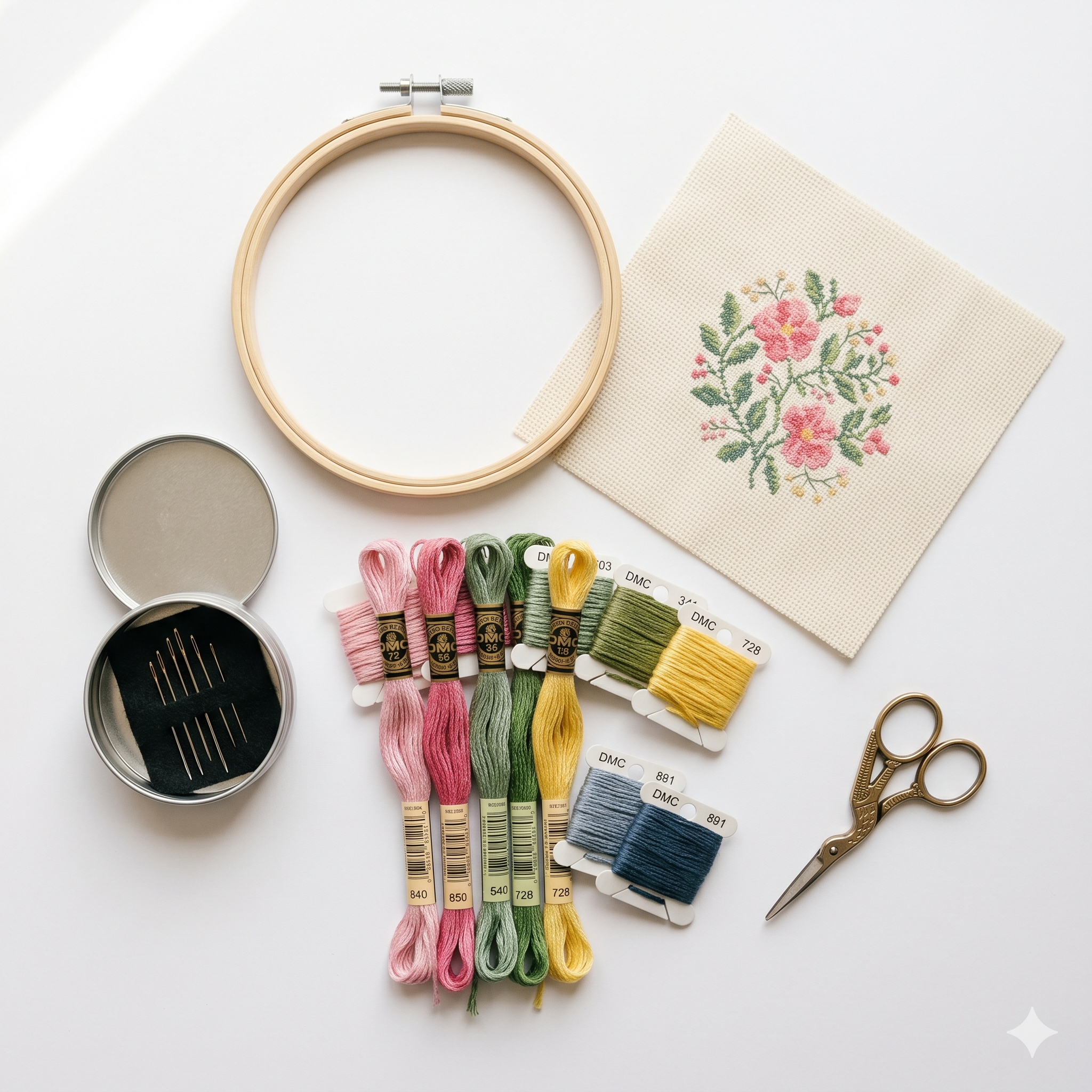
Best Way to Start
Cross Stitch Beginner Kit
A good starter kit gives you a hoop, pre-cut Aida cloth, a simple beginner pattern, and the needles and floss to complete it. Starting with a kit removes the supply-shopping decision from the learning process so you can focus on the stitch itself.
See on Amazon"Cross stitch rewards the pleasure of execution — following a precise plan and watching it emerge correctly from a blank piece of fabric. That specific satisfaction is unlike anything else in needlework."
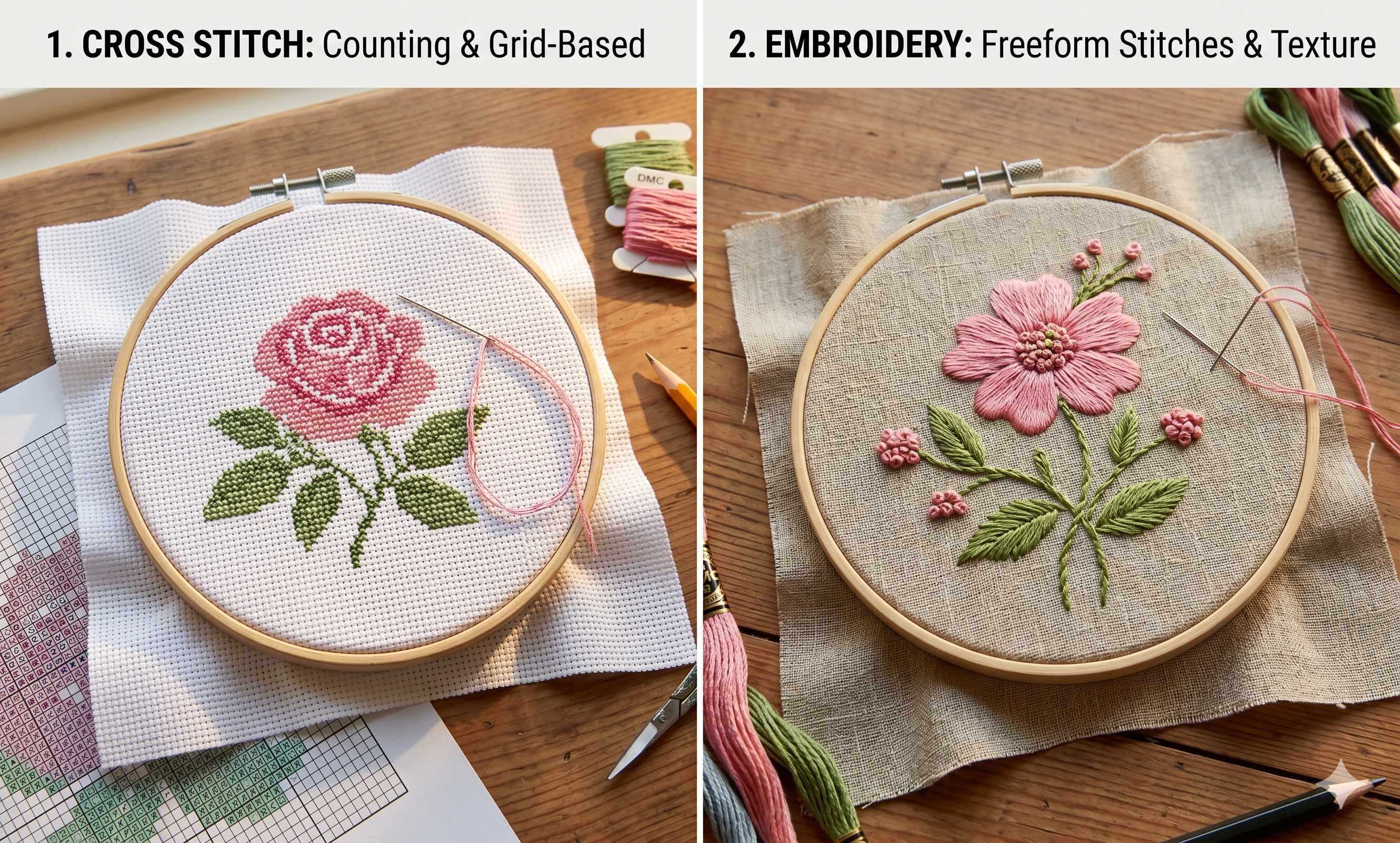
Cross stitch (left) versus freestyle embroidery (right) — same fabric, very different approaches.
Is Cross Stitch Difficult to Learn?
The stitch itself? No. Cross stitch is built on a single motion repeated thousands of times: push the needle up through one hole in the Aida grid, down through the hole diagonally opposite, up through the next hole, down through its diagonal opposite, then go back and cross them in the other direction. An eight-year-old can learn this in twenty minutes.
The complexity in cross stitch doesn't come from the stitch — it comes from the scale and the organization. A large, detailed pattern may involve 150 colors, 50,000 stitches, and a chart printed on multiple pages that need to be read in sequence. Managing all of that — tracking your position, keeping colors organized, maintaining consistent tension across a large piece, avoiding miscount errors — is where experience matters.
Here's a more useful way to think about the learning curve: the stitch is simple; the craft is deep. You can stitch your first project within an hour of picking up a needle. You can still be developing as a stitcher twenty years later, because the craft has layers — technique, color theory, pattern selection, framing, finishing — that reveal themselves gradually as your skills grow.
What separates an experienced stitcher from a beginner isn't some mysterious physical skill. It's mostly habits: consistent thread management, reliable counting methodology, good lighting, a well-organized work space. All of these are learnable. None require talent. Cross stitch is more like a discipline than a gift — almost anyone who approaches it with patience and attention will improve steadily.
What Fabric Should I Use for Cross Stitch?
For beginners, the answer is 14-count Aida cloth. Aida is a specially woven fabric with a regular, visible grid of holes — the holes guide your needle placement without any counting of individual fabric threads. The "count" number tells you how many squares fit in one inch. 14-count is the most popular choice for good reason: the grid squares are large enough to see clearly, but small enough that finished pieces look proportional and elegant.
More experienced stitchers often move to evenweave linen or other specialty fabrics, which require counting individual threads rather than working in the pre-formed holes of Aida. These fabrics produce finer detail and a more textile-like surface quality, but they're more demanding to work with. Start with Aida and move on when you feel ready, not before.
How Long Does It Take to Finish a Cross Stitch Project?
Enormously variable, depending on the stitch count and your pace. A small beginner project — 3,000 stitches or fewer — can realistically be completed in a weekend of focused stitching or a week of evening sessions. A medium project in the 15,000–25,000 stitch range typically takes a few months for a regular stitcher. A large, masterwork-level piece might take a year or more.
What surprises most new stitchers is how quickly the stitches accumulate once you get into a rhythm. An evening session of 90 minutes can produce 600–900 stitches for an experienced stitcher in a good flow. The time that feels "slow" at the beginning — when your hands aren't yet automatic — passes within your first ten hours of stitching. After that, the pace picks up significantly.
The useful mental shift is to stop measuring a cross stitch project's progress by percentage and start measuring it by sessions. If you stitch five evenings a week and average 700 stitches per session, a 20,000-stitch piece takes about six weeks. That's a very achievable timeline for something beautiful enough to frame.
Do You Need Special Tools Beyond the Basics?
No — but certain tools make the experience meaningfully better. The four absolute essentials are a pattern, Aida cloth, DMC floss, and a size-24 tapestry needle. You can start with nothing else.
The tool that makes the biggest quality-of-life difference in practice is a good daylight lamp. If you stitch in the evenings, proper lighting prevents eye strain, helps you distinguish similar symbol shapes on the chart, and keeps colors accurate. A proper OTT light or any daylight-balanced lamp with a CRI of 90 or above makes a night-and-day difference — literally.
The other tools worth having once you're committed: a frame or hoop for consistent tension, a magnetic line finder for chart navigation, small sharp embroidery scissors for thread management, and a floss organizer for keeping your DMC colors sorted. None of these are expensive, and all of them directly improve the stitching experience.
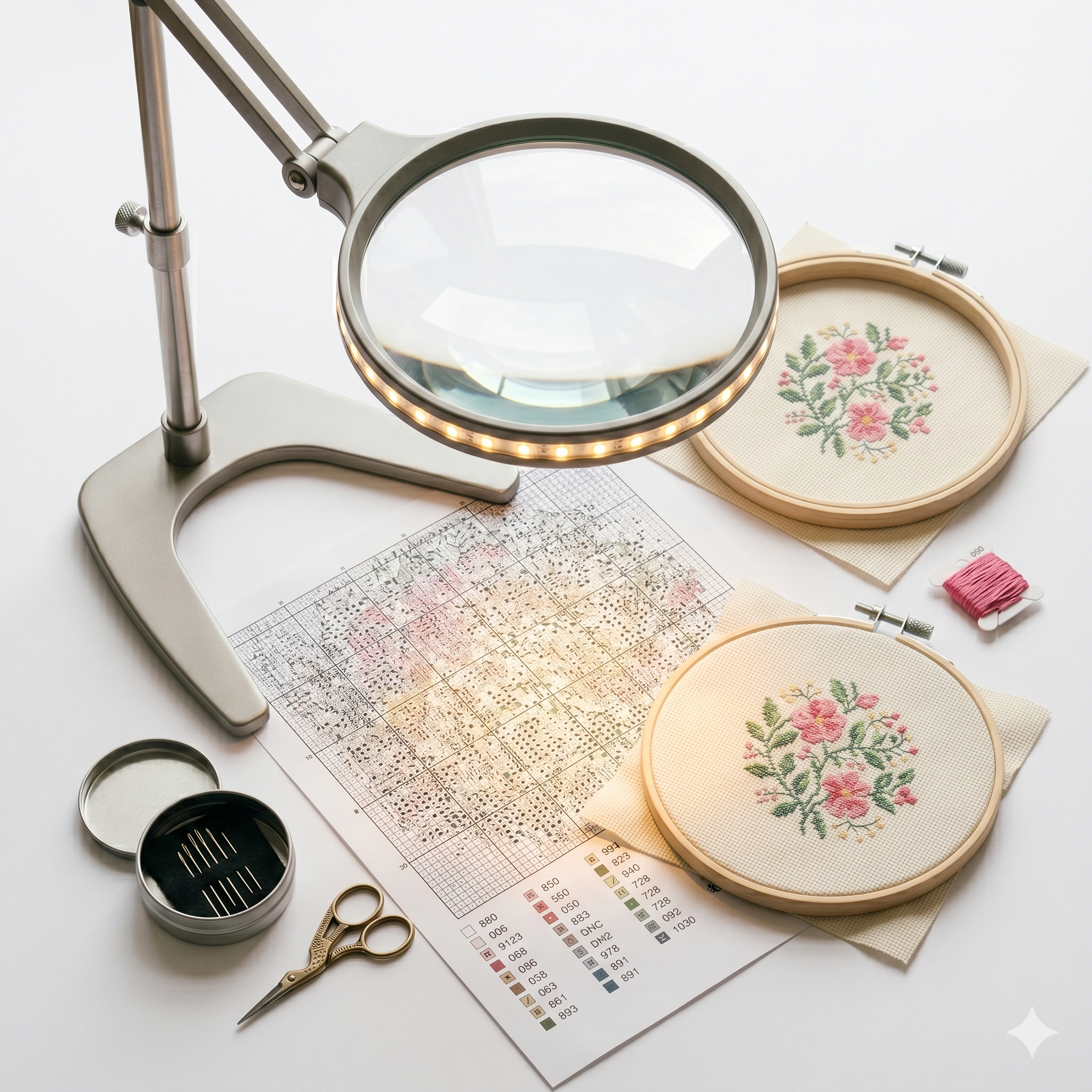
For Detail Work & Higher Counts
Lighted Floor Magnifier Stand
Once you move beyond 14-count Aida or start working from complex, densely-printed charts, a lighted floor magnifier stand becomes less of a luxury and more of a necessity. Illuminates and magnifies simultaneously — both hands stay free.
See on AmazonGet More Stitching Guides from Tracey
New patterns, honest technique advice, and occasional VIP-only offers — straight from our Marysville studio.
No spam. Unsubscribe any time.
What Makes a Cross Stitch Pattern Good or Bad?
After two decades as a designer, I have strong opinions here. A good cross stitch pattern is legible. The grid should be large enough to read clearly, the symbols should be distinct from each other, and the color key should be organized and accurate. Poor-quality patterns often fail on one or more of these basics: blurry or small printing, symbols that look identical under lamplight, or color keys with errors.
A good pattern also reflects thoughtful design decisions about the subject. Choosing which image to chart, how to translate its colors into available DMC thread numbers, where to simplify and where to preserve detail — these are craft decisions that separate a well-designed pattern from a mechanical conversion. You can often feel the difference even before you stitch it. The color choices look intentional. The stitch count feels right for the complexity of the image. The finished piece looks like it was designed to be cross stitched, not just converted from a photograph.
For beginners especially, pattern quality matters enormously because you don't yet have the experience to compensate for a poorly made chart. A good pattern is patient teaching. A bad pattern is a frustrating obstacle course. Choose patterns from designers who take their craft seriously — it's one of the most important supply decisions you'll make.
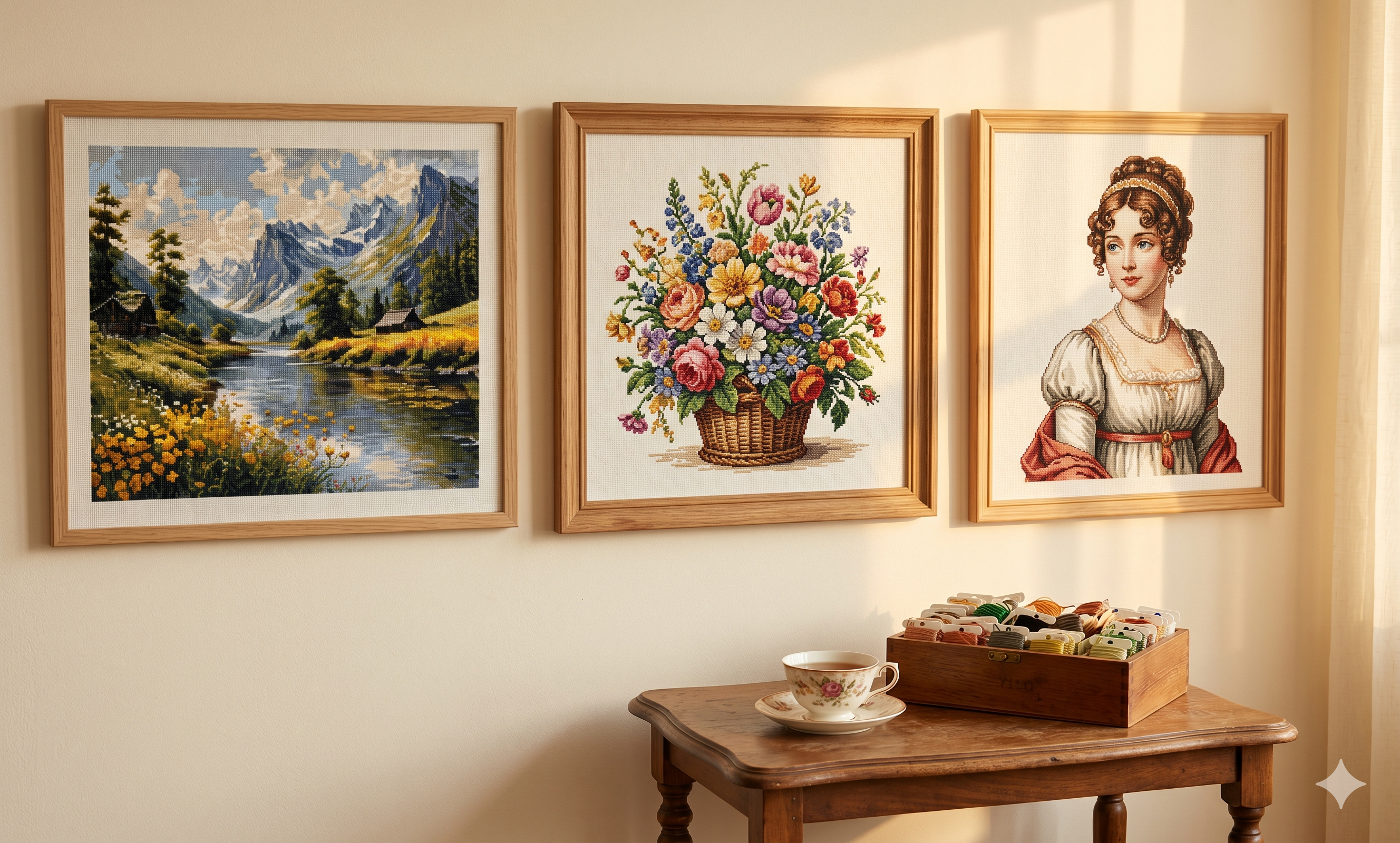
The range of what cross stitch can produce — from intimate florals to room-commanding landscapes.
Ready to stitch your first real design? Browse beginner-accessible Sunrays patterns or explore the Owner's Choice collection — curated by Tracey for stitchers who want something worth the hours.
Keep Reading
What Do You Need to Cross Stitch? The Complete Beginner's Supply List
Now that you know what cross stitch is — here's exactly what to buy before you sit down to stitch for the first time. The honest list, from someone who has used every item on it.
READ THE GUIDETips for Stitching on Dark Aida Cloth
Dark fabric opens up dramatic finished pieces — but it comes with its own challenges. The lighting and technique tips that make stitching on black, navy, or dark green Aida manageable.
READ THE GUIDEThe Types of Cross Stitch Patterns I Prefer (and Ones I Avoid)
What makes a pattern worth 200 hours? Tracey's honest take on the qualities she looks for and the ones that make her put a design back on the shelf.
READ THE ARTICLEFrequently Asked Questions
What can you make with cross stitch?
Almost any pictorial image — framed wall art, pillows, samplers, ornaments, table linens, book covers, and clothing embellishments. Cross stitch excels at flat, detailed, pictorial work and produces results that can be mistaken for paintings when framed.
What is the difference between cross stitch and embroidery?
Cross stitch is a form of counted needlework — every stitch is identical, occupying a specific grid square. Freestyle embroidery uses a variety of stitches and allows improvisation in placement and size. Cross stitch follows a precise charted design; embroidery is more expressive and varied.
Is cross stitch hard for beginners?
The stitch itself is simple and can be learned in under an hour. The complexity in cross stitch comes from scale and organization — managing many colors, following a detailed chart, maintaining consistent tension. These skills develop naturally with practice. Most people who are patient and attentive can produce attractive work within their first project.
What is the best fabric for beginner cross stitchers?
14-count Aida cloth is the standard recommendation. The pre-formed holes make needle placement straightforward, and the 14-count size is large enough to see clearly without magnification but fine enough that finished pieces look proportional.
How long does it take to complete a cross stitch project?
Highly variable. A small beginner piece can be completed in a weekend. Medium projects typically take a few months of regular stitching. Large, detailed pieces can take a year or more. An experienced stitcher in good flow produces roughly 500–900 stitches per hour-long session.
Is cross stitch the same as needlepoint?
No, though both are counted canvas needlework. Cross stitch uses Aida cloth or evenweave linen with embroidery floss and is built on a uniform X-shaped stitch. Needlepoint uses canvas mesh with wool or silk and allows a wider variety of stitches. Needlepoint canvases are often hand-painted; cross stitch patterns are grid-charted.
— Tracey Kramer
Founder & Designer, Sunrays Creations Needlearts
Hand-charted designs since 2004 • Marysville, Ohio