
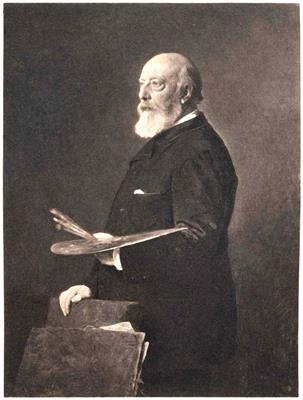
Andreas Achenbach (1815–1910) was a towering figure in the Düsseldorf School of Painting and is widely considered the father of 19th-century German landscape painting. A child prodigy, he began his formal training at the Düsseldorf Academy at just 12 years old under Wilhelm von Schadow. Unlike many of his contemporaries who favored idealized scenes, Achenbach was a pioneer of German Realism and Romanticism, traveling extensively through Norway, Italy, and the Low Countries to study the raw power of nature. While he lacked a single lifelong patron, his work was feverishly collected by the European elite and international galleries. His famous works, such as "The Polar Sea" and his numerous "Clearing in the Westphalian Forest" scenes, showcase the hallmarks of the Düsseldorf School: meticulous detail, dramatic light, and a palpable sense of atmosphere. Translating an Achenbach landscape into a counted cross stitch design allows the stitcher to explore a sophisticated palette of stormy grays, deep forest greens, and luminous horizons. Every stitch captures the "sublime"—the mixture of awe and fear inspired by the untamed natural world. Stitching his work is an immersive experience, offering the meditative calm of a forest path or the exhilarating spray of a North Sea gale.