
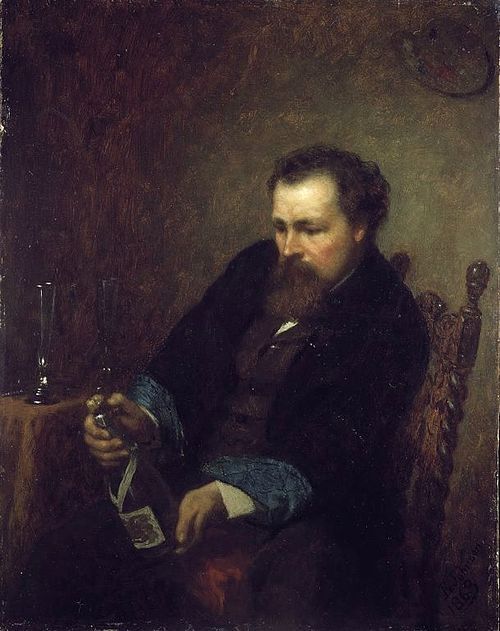
Jonathan Eastman Johnson was a prominent American painter who lived from 1824 to 1906. Known in his day as "The American Rembrandt," Johnson was a co-founder of the Metropolitan Museum of Art and one of the most influential American realists of the 19th century. He received rigorous training in Europe, studying in Düsseldorf, Paris (with Thomas Couture), and spending four years in The Hague, where he immersed himself in the techniques of 17th-century Dutch Masters like Rembrandt. This gave his American subjects a profound technical sophistication.
Johnson's career spanned three main subjects:
Genre Scenes: He gained immediate fame with works like Negro Life at the South (1859) and his Civil War-era painting, A Ride for Liberty – The Fugitive Slaves. His genre paintings focused on everyday American life, ranging from complex narratives involving racial and social issues to more idyllic depictions of rural life, such as the Nantucket cranberry harvest and Maine maple sugaring camps.
Portraits: He was a highly sought-after portraitist, capturing the likenesses of many leading figures, including Presidents and literary giants like Abraham Lincoln and Nathaniel Hawthorne.
New England Life: Scenes of Nantucket and Maine, often depicting honest labor or family gatherings, cemented his reputation as a vital chronicler of American culture.
Our counted cross stitch designs based on Eastman Johnson's work allow you to reproduce his rich realism and dramatic use of light and shadow (known as chiaroscuro). Stitching these patterns is a rewarding experience, as it requires you to capture the subtle textures of period clothing and the deep, atmospheric backgrounds that give his figures such a distinguished presence.