
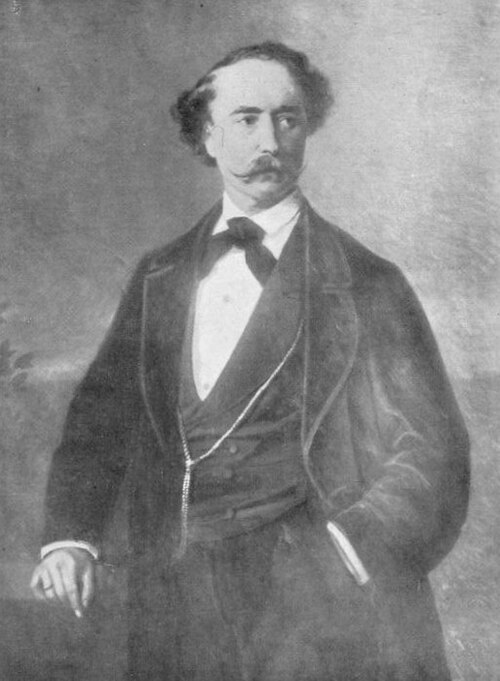
József Borsos — Hungarian portrait painter and photographer of the Biedermeier style. Self-portrait — Public Domain.
József Borsos (1821–1883) began his artistic journey in Veszprém before moving to the Imperial capital of Vienna to complete his studies. In the refined studios of Vienna, he quickly garnered attention for his technical precision and his ability to capture the dignified ease of the Biedermeier era. His early success was marked by an elite clientele among the Austrian aristocracy, where his portraits became essential status symbols for the burgeoning middle class and nobility alike. Borsos possessed a rare gift for imbuing his sitters with a sense of quiet, domestic nobility, a hallmark of the period's preference for harmony over high-octane drama.
Technically, Borsos was renowned for his remarkable use of light and shadow to define form. He excelled in the rendering of luxurious materials, particularly velvet and silk, which he handled with a combination of realistic strength and delicate glazing. His compositions are characterized by a harmonic balance, often placing figures in richly detailed interiors that provide a window into 19th-century domestic life. He was a master of the "genre" painting — narrative scenes of daily life such as *Girls after the Ball* — where he used a vibrant yet controlled palette to tell stories of social interaction and private reflection. Shop Amazon to purchase prints of Borsos's masterworks and see the intricate details and vibrant Biedermeier colors that make his compositions so rewarding to stitch.
Despite his financial triumphs in Vienna, Borsos faced a dramatic turning point when he lost his fortune on the stock market. Returning to Budapest in 1861, he demonstrated a characteristic versatility by opening a high-end photography studio. This shift from brush to lens allowed him to continue exploring the human face, though he eventually retired from the arts to run a popular restaurant, the *Szép Juhászné*. Today, his primary works, including the celebrated *Emir of Lebanon*, are held at the Hungarian National Gallery in Budapest, with other pieces residing in the Museum of Fine Arts and the Ottó Herman Museum. Borsos died in 1883, leaving a legacy of paintings that remain definitive examples of Central European realism.
Stitching a József Borsos heirloom-quality needlework study offers a captivating focal point for any collector of historical art. His Biedermeier style, with its focus on realistic textures and harmonic compositions, translates into patterns that are both technically engaging and visually sophisticated. The intricate details of his portrait sitters — from the sheen of a velvet pelisse to the soft shadows of a parlor — provide a rewarding journey for the artisan. Shop Amazon for a color-sorted DMC floss set — this comprehensive range is perfect for managing the subtle, strong, and delicate color shifts that define Borsos's popular aesthetic. Only full cross stitches are used in our patterns. No blended colors are used. Instead, we use a variety of solid colors to achieve a more realistic effect. Our charts are in black and white only.
Prints & Books on Amazon
Add this stunning print to your library and explore the hidden symbolism and color palettes of Hungary's foremost Biedermeier master.
József Borsos prints Biedermeier art books Hungarian portraitsFurther Reading & Historical Context
Borsos's works are held at the Hungarian National Gallery, the Museum of Fine Arts in Budapest, and the Ottó Herman Museum.
Wikipedia National Gallery ArtveeAffiliate Disclosure
Sunrays Creations is a participant in the Amazon Services LLC Associates Program, an affiliate advertising program designed to provide a means for sites to earn advertising fees by linking to Amazon.com. Some links in this post are affiliate links — if you click through and make a purchase, we earn a small commission at no extra cost to you. We only recommend products we genuinely use and love. Thank you for supporting Sunrays Creations!
|
22+ Years
Designing Patterns
|
Satisfaction
Guaranteed
|
Family-Owned
Since 2003
|
Loved by Stitchers
Worldwide
|