
Christmas Cross Stitch Patterns: Designs That Become Cherished Family Traditions
Posted by Tracey M. Kramer on 27th Oct 2026
A Note from Tracey Kramer
I have been designing counted cross-stitch patterns since 2004, and in that time I have watched my customers stitch everything from wedding gifts to heirloom samplers. This is everything I know about this topic -- from real experience, not theory.
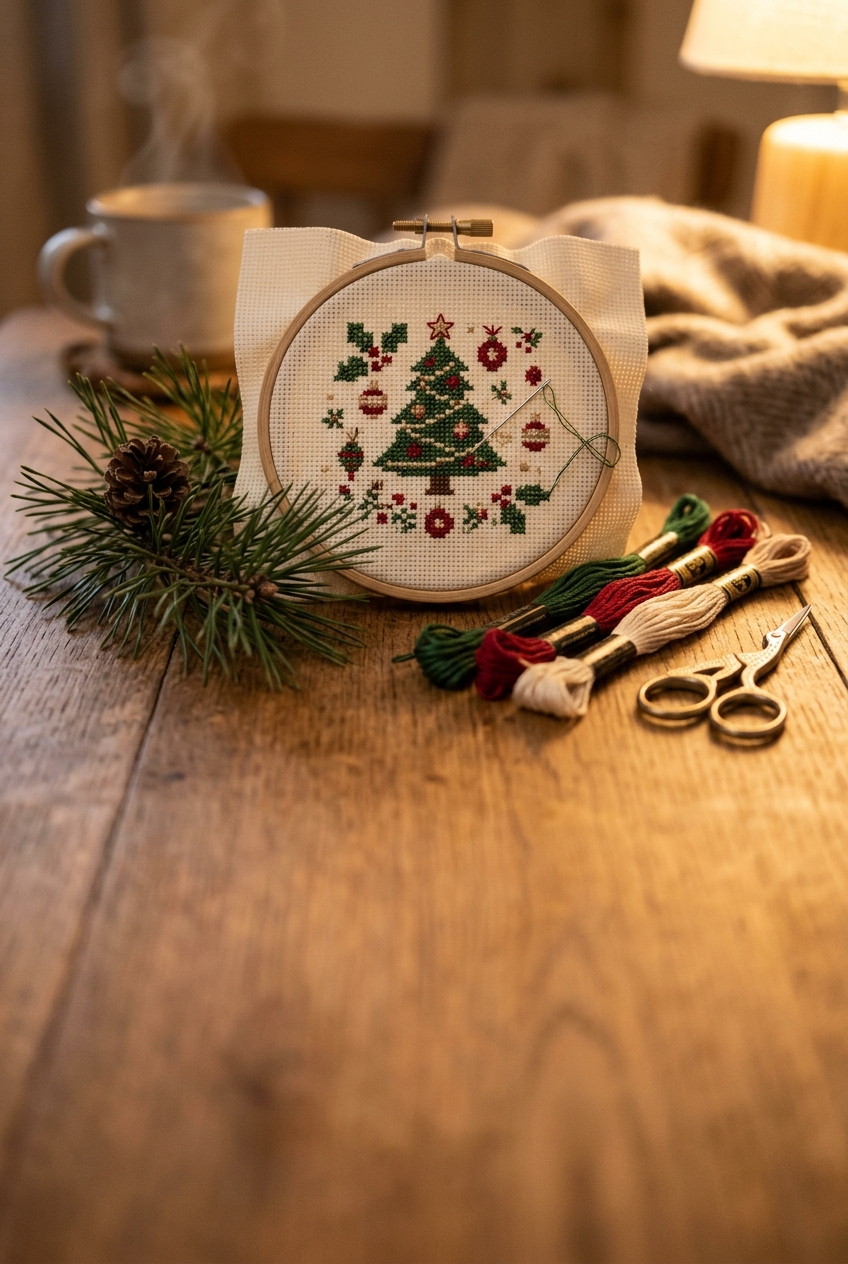
Christmas cross stitch pattern in progress on Aida in a hoop with pine and floss
By Tracey Kramer • • 12 min read
Christmas cross stitch patterns hold a different kind of weight than almost anything else you can stitch. A finished holiday piece doesn't go in a drawer when the project is done, it comes back out every single December, gets hung in the same spot, and slowly turns into the thing the family looks for when the boxes come down from the attic. That's the real reason to pick one up in November: not because the holiday is coming, but because you're starting something that will outlast the season by about forty years.
What Makes a Christmas Pattern Worth Stitching
Not every holiday design earns a permanent place in a home. Some are charming for one year and tired by the next. The difference usually comes down to whether the design says something, or just decorates. A chart with a nativity scene, a Dickens-era carol moment, a sleigh crossing a snowfield, a verse about light or evergreen hearts has a point of view. A generic snowflake grid does not. Both stitch up fine. Only one gets hung in the same place every December for the next thirty years.
The second test is whether the design will still read well on a wall across a room. Christmas pieces tend to live in high-traffic places like a mantel, an entry hall, a stairway landing. A design with clear shapes, strong contrast and a readable focal point holds up at a distance. One that depends entirely on tiny tonal shading disappears unless you're standing two feet away.
Holiday red, green and gold are harder than they look
Christmas palettes lean heavily on reds and greens, and those two families include a lot of DMC shades that look nearly identical in the skein. On 18-count Aida with two strands of DMC floss (find on Amazon), the difference between two neighboring reds shows up beautifully in the finished piece, but it's easy to mix them up at the working stage. Sort them before you start and label them, rather than trusting yourself to tell them apart under lamp light at nine at night.
Gold is its own conversation. A lot of holiday charts call for metallic accents on stars, halos, ribbon and ornaments. Metallic thread is genuinely more fiddly than cotton, and it's worth knowing what you're walking into before you commit to a chart that uses it heavily. If a design calls for gold, that's not a reason to avoid it, just a reason to work in shorter lengths and go in with patience.
Size Versus Time: The Honest Math Before You Start
Here's the piece of advice that matters most in November. Pick a project that fits the time you actually have, not the time you wish you had. Stitching speed varies enormously between people, between fabric counts, and between a quiet evening and a chaotic one. Anybody who hands you a tidy stitches-per-hour number is guessing. What you can do is measure yourself: stitch for one timed hour on the actual chart, count what you covered, and multiply from there. That single hour will tell you more than any estimate from a stranger.
Once you know roughly how fast you move, look at three things on the chart before you buy or print it.
Stitch count, not finished size
Finished dimensions mean nothing without the count. The same chart worked on 14-count comes out noticeably larger than on 18-count Aida, which is the standard these designs are drafted for. What determines your hours is total stitches, so look at the grid dimensions on the chart and multiply. A chart that's 100 by 140 is a very different commitment from one that's 250 by 300, even if they both sound like wall art.
How much of it is background
This is the question most stitchers skip, and it changes everything. A design with a fully stitched sky, snowfield or deep blue night background takes dramatically longer than one where the motif floats on unstitched fabric. Full-coverage backgrounds are gorgeous and they're also where holiday projects go to die in late December. If time is short, favor charts that let the Aida stand in for snow or air. The white or cream fabric reads as winter light all on its own.
The color count tells on the chart
A twelve-color chart moves fast. A sixty-color chart with heavy shading means constant thread changes, more sorting, and almost certainly confetti, those scattered single stitches of one color sitting alone in a field of another. Confetti is not hard, it's just slow, and it will stretch a project well past what the stitch count suggests. Check the floss key before you commit. If the key runs to several dozen shades with a lot of near-neighbors, treat the chart as a long-haul project and start it in January for next Christmas rather than this one.

Tracey Recommends
Dimensions, 8778, Santa Claus, Gold Collection Personalizable Counted Cross Stitch Christmas Stocking Kit, 16" Long, 16 Cnt. Dove Grey Aida
This is a kit from Dimensions, not a Sunrays pattern, but it's a solid pick if you want a holiday project that arrives ready to go. It's a personalizable counted cross stitch Christmas stocking, 16 inches long, worked on 16 count dove grey Aida. Good choice for someone who wants everything in one box rather than sourcing floss and fabric separately.
Check Current Price →A finished Christmas piece doesn't go in a drawer when the project is done. It comes back out every December, gets hung in the same spot, and slowly turns into the thing the family looks for when the boxes come down.
Ornaments: The Easy Win Nobody Regrets
If you're starting in November and want something finished by the holiday, ornaments are the answer. They're small, they're fast, and they give you the one thing a big project can't deliver in six weeks, which is the satisfaction of an actual FFO before the tree comes down.
Small holiday motifs also work beautifully as a batch project. Stitch four or five little designs from the same palette across one piece of fabric, leaving a couple of inches between them, then cut and finish them separately. You get a matched set that looks intentional, and you only dress the hoop once.
There's a nice byproduct here too: ornaments are low-stakes practice. A chart you've never attempted, a technique you've been avoiding, a metallic accent you're nervous about, all of it is much easier to try on something two inches square. If it goes sideways, you've lost an evening, not a season.
Finishing small pieces so they last
Ornaments get handled. They get packed, unpacked, bumped by the cat, and hung by children. Whatever finishing method you choose, the edges need to be secured so the Aida doesn't fray over years of storage. Small framed roundels and flat-mounted pieces both hold up well. Keep them out of direct sun during the weeks they're on display, and store them flat rather than crushed in a bin with the glass bulbs.
A quick note on stockings, since they come up every year: they're their own project with their own finishing considerations, and they're covered thoroughly in a separate guide rather than squeezed in here.
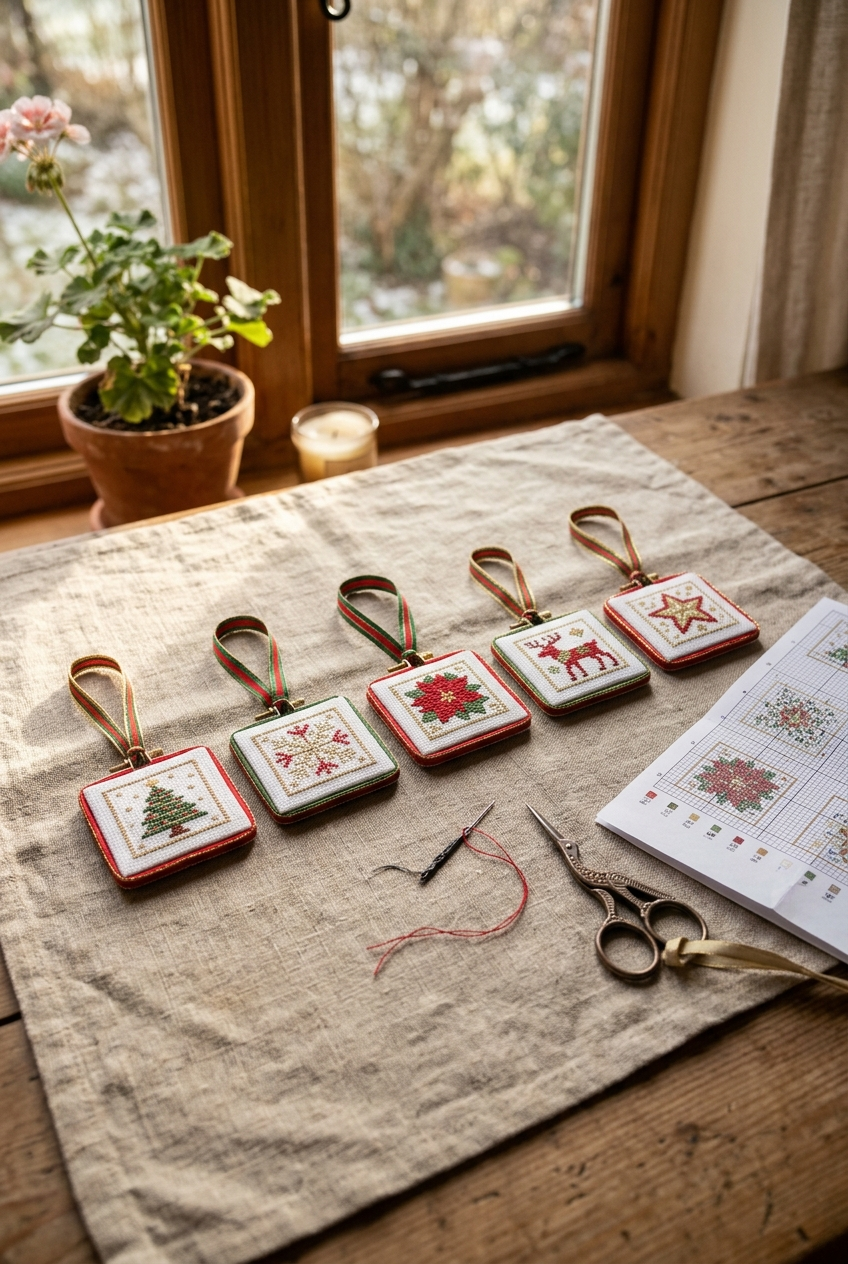
Row of small finished Christmas cross stitch ornaments beside a chart and scissors on linen
Framed Wall Art: The Keepsake Version
The framed Christmas piece is the one that becomes the tradition. It's bigger, it takes real time, and it earns a permanent hook on the wall. These are the designs worth starting in January for the following December, and worth doing properly on 18-count Aida where the detail can actually show.
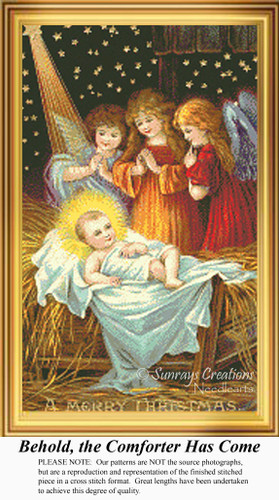
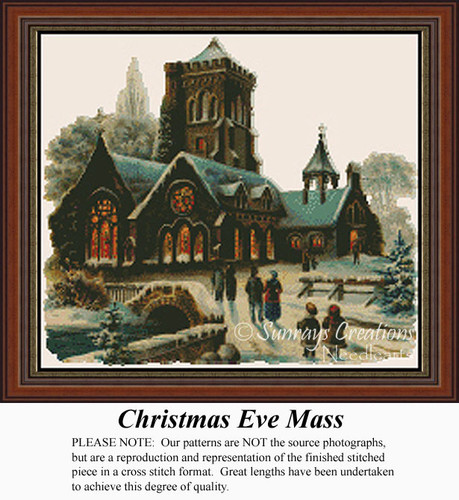
Nativity and religious scenes, Victorian and Dickens-era vignettes, winter landscapes and lettered verse pieces all sit squarely in this category. They're the designs that get asked about by guests and remembered by grandchildren. They're also the designs where it genuinely matters that you took the time: the shading in a robe, the glow behind a star, the detail in a snow-covered village only exists because somebody put the hours in.
Set yourself up before stitch one
Larger holiday pieces benefit from a little front-end work. Gridding the fabric in removable lines before you begin prevents the kind of miscount that only surfaces thirty hours in, which is the single most demoralizing way to lose a Christmas project. A 5 or 6 inch wooden or plastic embroidery hoop (find on Amazon) keeps tension even and moves easily around a large design. Good light matters more than most people admit, especially on reds and dark greens where the holes in the fabric are hardest to see.
Frame it for a long life
A piece that goes up and comes down every year needs framing that can take it. Mount it properly rather than gluing it down, use acid-free materials behind the fabric, and think about where it will hang relative to a window. Twelve months of storage and one month on display, repeated for decades, is a gentler life than year-round hanging, which is part of why Christmas pieces often outlast everything else in the house.
|
Patterns from the Sunrays Collection Tracey's Picks, designing cross stitch patterns since 2004 | |||||
| |||||
| Browse the full Sunrays collection → |
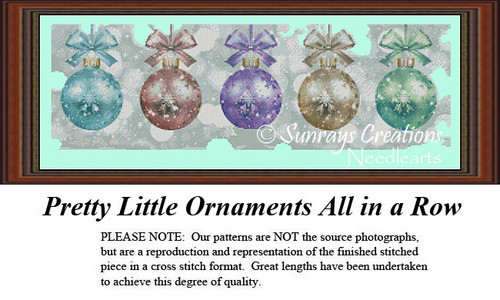
Choosing Something That Comes Out Every Year
The traditions that stick are the ones with a slot in the routine. A piece that goes up on the same day each year, in the same spot, becomes a marker. Children notice it before they notice anything else about the decorating. That's the whole payoff, and it's worth being deliberate about.
Think in sets rather than one-offs. A single framed scene is lovely. The same scene joined by a second piece the following year, and a third after that, becomes a collection that tells the story of your stitching alongside the story of your Decembers. Keeping the palette loosely consistent across years makes the group read as intentional rather than accumulated.
Date the back. Write the year and your name in pencil or permanent fabric pen (find on Amazon) on the reverse of the mount before it goes in the frame. It costs nothing at the time and means everything to whoever inherits it. The same applies to ornaments, where a tiny tag with the year turns a decoration into a record.
Storage is part of the tradition
Finished Christmas pieces spend most of their lives in a box. Keep framed work upright and padded, keep small pieces flat, and avoid attics and basements where temperature swings and damp can do slow damage over the years. A labeled box that lives with the rest of the holiday decorations means the pieces actually get used instead of forgotten in a closet.
Get Stitching Tips & New Patterns from Tracey
Honest advice, new Sunrays designs, and occasional VIP-only offers. No fluff.
No spam. Unsubscribe any time.

Tracey Recommends
Bucilla Tiny Stockings Counted Cross Stitch Ornament Kit, 30 Pieces | 14 count Aida cloth, felt backing, cotton floss, floss separator, needle, instructions, miniature Christmas decorations
Another maker's kit, not ours, and a genuinely practical one for ornament season. The set includes 30 pieces worked on 14 count Aida with felt backing, cotton floss, a floss separator, needle and instructions. Small finishes are the easy win when you're starting in November.
Check Current Price →Giving a Finished Christmas Piece
Gifting hand-stitched work is its own small act of nerve. You've spent dozens of hours on something, and you hand it over without knowing whether the recipient will understand what it represents. Most do, once they hear the hours involved.
If you're stitching for someone else, give yourself more runway than you think you need. Finishing and framing takes time after the last stitch goes in, and framers get busy in December. A piece finished in October is a gift. A piece finished on December 23rd is a stressful week you didn't need.
Include a small card with the piece. The pattern name, the year, the fabric count, and a line about why you chose that design. It takes five minutes and it converts a nice gift into something the recipient keeps records on. Years later, that card is how anyone knows who made it.
Charts versus kits
It's worth being clear about the difference, because both have a place. A chart gives you the design and leaves the materials to you, which means you choose your fabric color, buy DMC floss in the shades you like, and control the finished size. Sunrays sells charts, both as instant downloads and as printed patterns mailed to you, along with full kits for some designs.
Kits from other makers bundle everything in one bag, which is genuinely useful if you're buying for someone who doesn't already have a stash, or if you want a holiday project with no shopping attached. Two of those are mentioned below and they're not Sunrays products, just honest options for a specific kind of gift. If what you want is design and control over materials, go with a chart. If what you want is a ready-to-go package, a kit does that job.
Starting in November: A Realistic Plan
Six weeks is enough for something, just not for everything. Be honest about what that something is.
If you want a finished piece under the tree this year, choose small. Ornaments, a modest framed motif, a single-color-family design with minimal background. Keep it under a few thousand stitches and keep the floss key short. You'll finish, and finishing is the whole point.
If you've fallen in love with a large design, start it anyway, and set the deadline for next Christmas. There's no rule that says a holiday project has to be a December sprint. Big pieces stitched calmly across a year come out better than big pieces rushed in six weeks, and you'll avoid the frogging that comes with tired, hurried counting.
Either way, get your supplies in order before you start. Fabric cut with a margin on all sides, floss sorted and labeled, a sharp pair of embroidery scissors (find on Amazon) within reach, and a decent light on the work. Christmas stitching done well is one of the quieter pleasures of the season. Christmas stitching done in a panic on the 22nd is not.
And if a project doesn't make it this year, it isn't a failure. It's a WIP with a deadline that moved. Put it in a bag, label it, and pull it out next November with eleven months of runway ahead of you. That's how most of the best heirloom pieces actually get made.
Pick the Christmas design that makes you want to sit down with it tonight, then match it honestly to the weeks you actually have. That's the whole trick, and everything after it is just stitching. Browse the Sunrays Christmas patterns whenever you're ready, whether you're after a quick ornament or a framed piece worth starting now for next December.
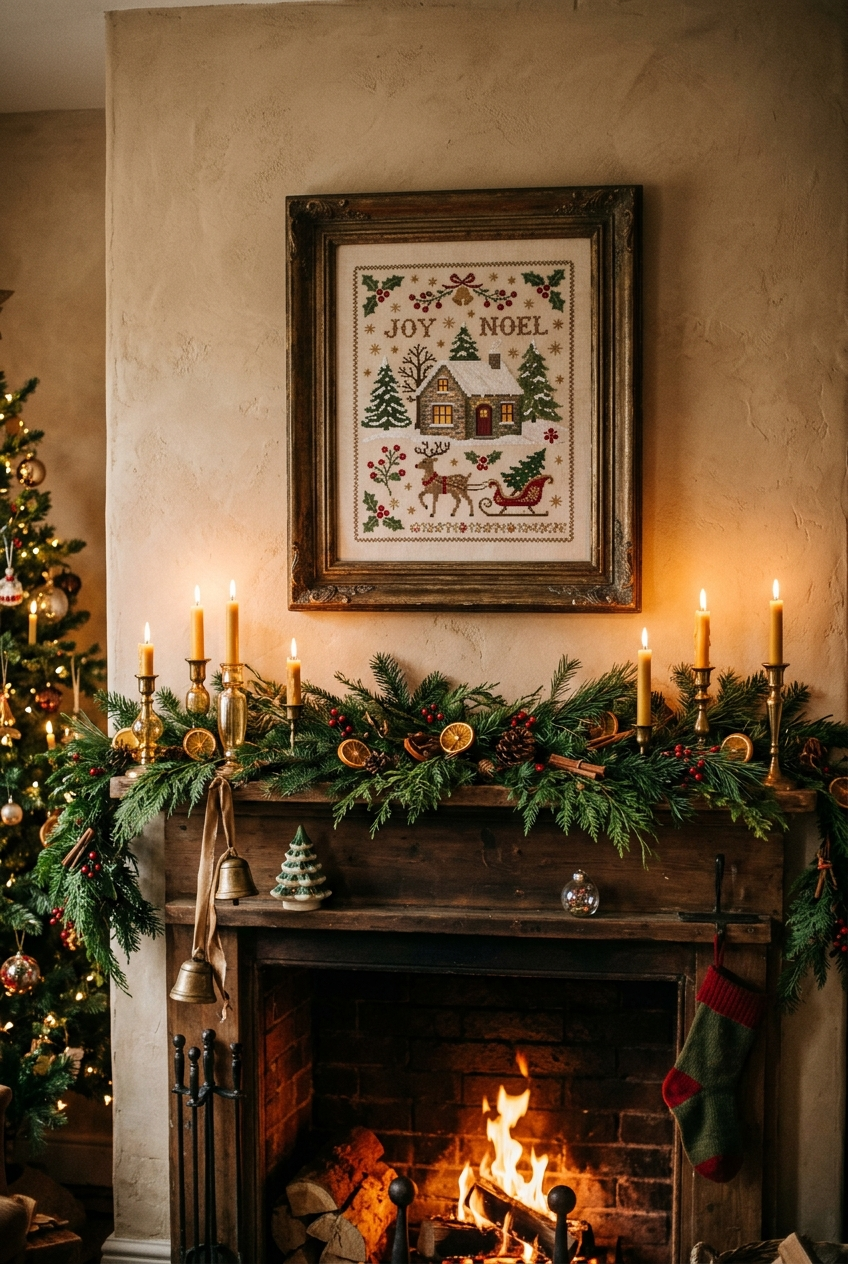
Framed Christmas cross stitch wall art hanging above a mantel with garland and candles
Keep Reading
Start Stitching a Handmade Heirloom: Your Cozy Christmas Stocking Tradition
Stockings are their own project with their own finishing questions. This guide covers making and finishing one properly.
Read the Stocking GuideCross Stitch Metallic Thread: How to Actually Use It Without Losing Your Sanity
Holiday charts love gold accents on stars, halos and ribbon. Read this before you commit to a design that uses metallics heavily.
Tame Metallic ThreadHow to Grid Your Cross Stitch Fabric (And Why It Changes Everything)
Gridding before you start is the cheapest insurance against a miscount that surfaces thirty hours into a big Christmas piece.
Learn GriddingFrequently Asked Questions
What is the best Christmas cross stitch pattern for a beginner?
Start small and keep the floss key short. Ornament-sized designs and simple framed motifs with minimal stitched background are the easy win, especially if you're starting in November. They finish fast and give you a real result before the holiday.
How long does a Christmas cross stitch piece take?
It depends entirely on stitch count, how much of the design is fully stitched background, and your own speed. The honest way to find out is to stitch for one timed hour on the actual chart, count what you covered, and multiply from there.
What fabric count should I use for Christmas cross stitch patterns?
Sunrays designs are drafted for 18-count Aida with two strands of DMC floss. That count holds detail well in shading and small motifs, which matters in nativity scenes and winter landscapes where the fine work is the whole point.
Can I finish a large Christmas pattern if I start in November?
Usually not, and that's fine. If you've fallen for a big design, start it anyway and set the deadline for next Christmas. Big pieces stitched calmly across a year come out better than big pieces rushed in six weeks.
Should I buy a Christmas chart or a full kit?
A chart gives you the design and lets you choose fabric color, floss and finished size. A kit bundles everything in one bag, which is useful as a gift or when there's no stash to work from. Sunrays sells charts as instant downloads and printed patterns, plus full kits for some designs.
How do I store finished Christmas cross stitch so it lasts?
Keep framed pieces upright and padded, store small ornaments flat rather than crushed in a bin, and avoid attics and basements where temperature swings and damp cause slow damage. A labeled box with the rest of the holiday decorations means the pieces actually get used.
Why do holiday reds and greens cause problems?
Christmas palettes use a lot of neighboring DMC shades that look nearly identical in the skein. The difference shows beautifully in the finished work, but it's easy to grab the wrong one at the working stage. Sort and label your floss before you begin.
-- Tracey Kramer
Founder & Designer, Sunrays Creations Needlearts
Hand-charted designs since 2004 • Marysville, Ohio