
Craft Room vs. Craft Closet: Which One Do You Need?
Posted by Tracey M. Kramer on 19th Nov 2020
A Note from Tracey Kramer
I've been stitching for over thirty years and my supplies have lived in baskets, totes, a spare bedroom, and everything in between. This one's for every crafter who has ever tripped over a bag of fabric on the way to the couch.
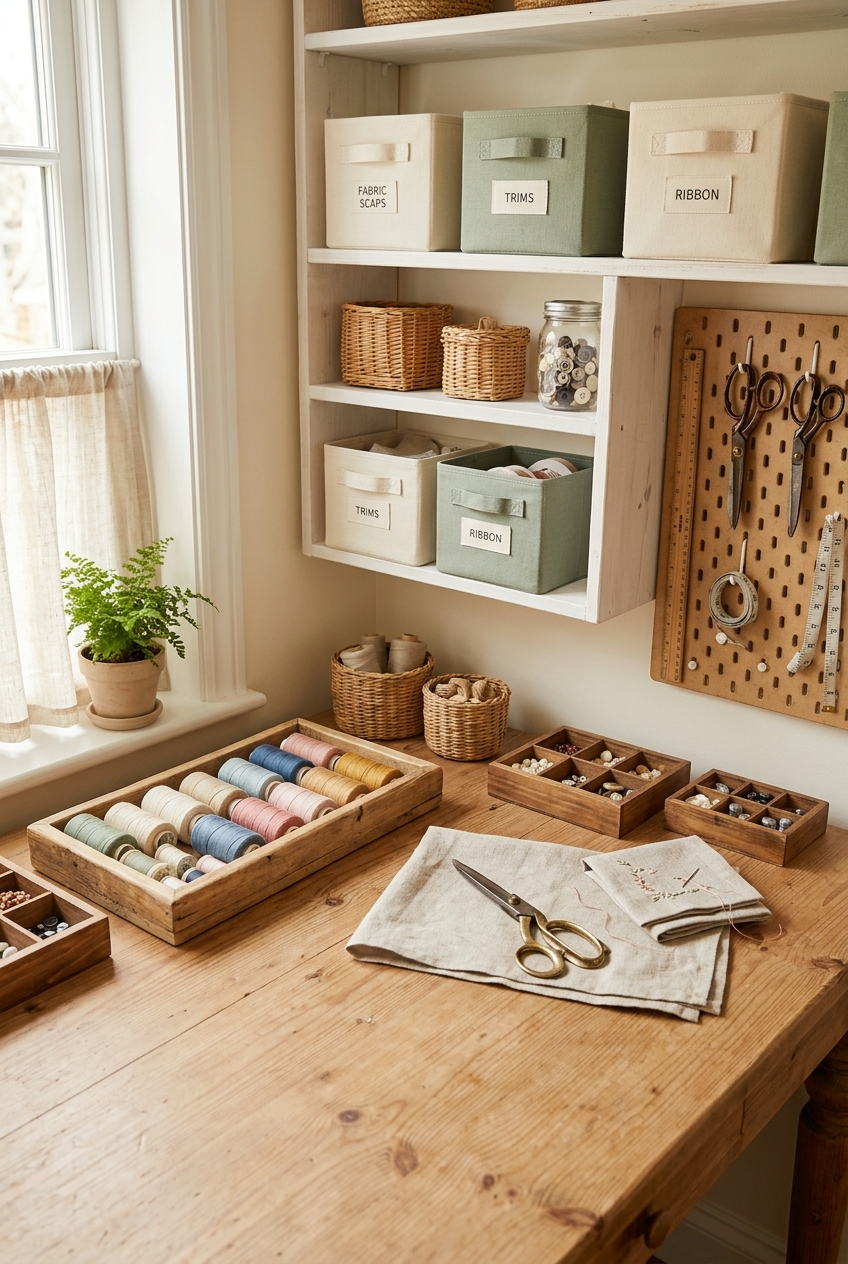
Cozy craft room corner with organized thread, wooden shelves, and pegboard storage in natural light
By Tracey Kramer • • 12 min read
Let me paint you a picture. There's a project bag on the dining room table, a box of thread on the bookshelf, a half-finished piece stretched on a hoop sitting on the arm of the sofa, and somewhere — somewhere — there is a skein of DMC 321 that I know I bought last fall and have not been able to locate since December. Sound familiar? If you're a crafter of any kind, I suspect it does. We accumulate. It's what we do. The supplies multiply quietly in corners and closets and the back seat of the car, and before you know it, your whole house is the craft room.
I don't say that as a criticism. Being this absorbed in what you love is honestly a gift. But there comes a point — usually when you can't find that skein of red or you've lost a needle in the carpet for the third time — when you realize that a dedicated space would change everything. Not just for the tidiness of your home, but for your own creative energy. When your supplies are organized and your workspace is yours, something shifts. You sit down to stitch and you actually stitch, instead of spending twenty minutes hunting for scissors. That's what a real craft space does for you. So the question isn't really whether you need one. The question is: what kind of space makes sense for where you are right now?
That's what this article is about. Whether you have a spare bedroom to convert into a full craft room or you're working with a single closet in the hallway, there is a solution that fits your life. Let's talk through both options honestly — what they require, what they cost, and how to make either one work beautifully.
Craft Room or Craft Closet — How to Decide
The first question to ask yourself is brutally simple: what space do you actually have? Not what you wish you had. Not the room you're going to clear out someday. What is available to you right now, today, that could become your creative haven? For some of us, the answer is a whole room — a guest bedroom that gets used twice a year, a finished basement, a room that became available when the kids moved out. For others, the answer is a closet, a corner, or the end of a hallway. Both are real answers and both can work.
If you have an entire room, even a small one, the craft room route is almost always worth pursuing. A dedicated room gives you the freedom to leave projects out between sessions, which is genuinely life-changing when you're in the middle of a complex piece. You don't have to pack everything up when company comes. You can have a design wall, a proper light source, a table big enough to actually spread out on. The psychological benefit of having a room that is just yours — just for making things — is hard to overstate. I believe God gave us the impulse to create for a reason, and having a space that honors that impulse matters more than people admit.
On the other hand, if you live in a smaller home, rent an apartment, or simply don't have a spare room to sacrifice, a craft closet is not a consolation prize. Done right, a craft closet can hold an impressive amount of supplies in a very compact footprint, and when it's closed, your living space looks completely normal. For crafters who share their home with people who do not necessarily share their enthusiasm for fabric and thread, this is a significant advantage. You can have everything organized and accessible without your supplies visually taking over shared spaces.
The honest truth is that most crafters I know have used both at different seasons of life. When my kids were young and space was tight, a closet setup kept me sane. As life changed and a room opened up, I transitioned to a full craft room. Neither was wrong for its season. Think about where you are right now and build for that, not for a hypothetical future you can't predict.
Designing a Dream Craft Room
If you have the room, here is how I'd think about building it out. Start with the bones before you buy a single piece of furniture. Look at the room and identify your light sources — natural light from windows is your best friend as a crafter. If the room has a good window, orient your primary work surface toward it. I would always rather sit near a window than under a fluorescent overhead light, especially when I'm trying to match thread colors accurately.
Next, think about your cabinetry. The walls don't all have to be covered — in fact, I'd caution against that impulse. Covering every wall with shelving can make a room feel cluttered and oppressive, which is the opposite of what you want in a creative space. Instead, choose two or three walls for storage and leave one relatively open, either for displaying finished work or simply for breathing room. When it comes to cabinet color, muted tones — white, soft gray, natural wood — are always the right call in a craft room. Your materials are the star of the show. Your cabinetry is just the frame. Bright or bold cabinetry will fight with your supplies visually, and you'll feel it even if you can't articulate why.
You have two real choices in cabinet style: closed doors and drawers, or open shelving. Closed storage looks cleaner and protects supplies from dust, which matters more than people think if you're storing fabric, canvas, or delicate fibers. Open shelving is more accessible — you can see everything at a glance — but it requires more discipline to keep tidy. I've done both and I personally lean toward a mix: closed cabinets for supplies I don't use daily and open shelves for the things I reach for all the time. A wire shelving unit (find on Amazon) is a great addition along one wall for bulkier items — bins of fabric, extra hoops, rolled canvas — because you can see through the shelves and they hold a surprising amount of weight.
Once your storage is sorted, the centerpiece of any good craft room is the table. This is not the place to compromise. A craft table needs to be large enough to spread out a full-size project, sturdy enough that it doesn't wobble when you're working, and ideally positioned so light falls across it from the side rather than directly overhead, which creates glare. I'd place a big table in the center of the room if space allows — it gives you access from all sides, which is genuinely useful when you're laying out a large piece or cutting fabric. If you can find a table with a pegboard wall organizer (find on Amazon) mounted above it or built-in storage below, even better. Finally, don't forget to leave some wall space for displaying finished pieces. A craft room that shows off completed work is an inspiring place to create in. It reminds you why you do this.
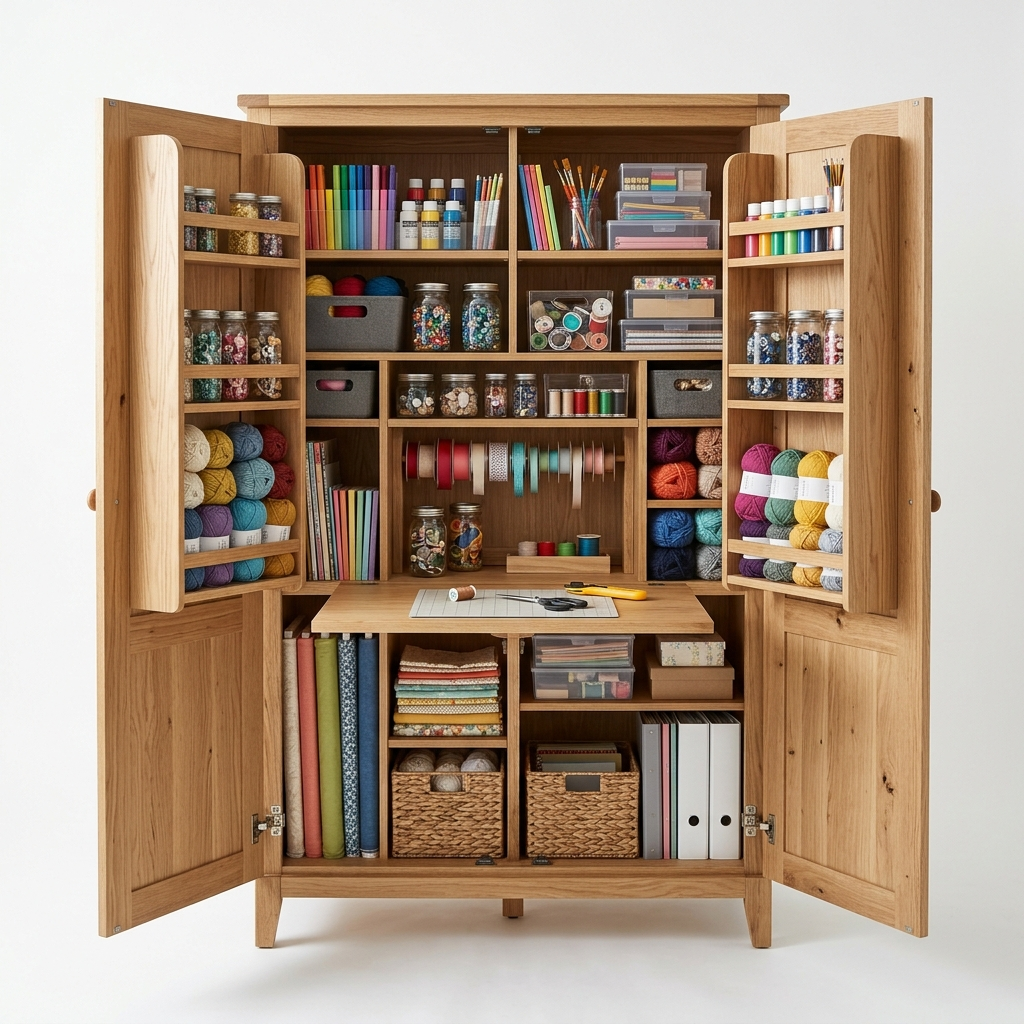
Budget-Friendly Alternative
Foldout Craft Storage Cabinet
Love the Dreambox concept but not the $2,199 price tag? These foldout armoire-style craft cabinets on Amazon deliver the same idea — a contained craft station that opens into a full workspace and closes into something that looks like real furniture — at roughly a third of the cost. Perfect for small rooms, shared spaces, or anyone who wants their supplies hidden in plain sight.
See on AmazonA small, well-organized space will serve you better every single time than a large, chaotic one. The goal isn't a beautiful craft room — the goal is to spend more time making beautiful things.
The Dreambox — The Cadillac of Craft Closets
Now I want to tell you about something that genuinely delighted me the first time I saw it, because it is exactly the kind of thing a crafter would design if a crafter were given a serious engineering budget and no limits on ambition. It's called the Dreambox, and the name is not an exaggeration.
From the outside, the Dreambox looks like a large, beautifully made wardrobe cabinet — the kind of substantial piece of furniture that looks intentional and expensive in any room. You wouldn't look at it and think 'craft storage.' You'd think it belonged there. Then you open the trifold doors, and the whole thing unfolds into a fully equipped craft station. Floor-to-ceiling shelves line all of the doors. There is built-in lighting in the ceiling of the unit. A pullout table swings out to give you a work surface. And the interior is filled with specialized compartments — not just generic shelf space, but thoughtfully designed storage for the specific kinds of things crafters carry: ribbon, thread, tools, accessories, small supplies that would otherwise vanish into a bin and never be seen again.
What makes the Dreambox genuinely brilliant is the flexibility. It can go in a bedroom, a living room, a hallway, a basement — anywhere there is enough floor space for it to unfold. When you're done crafting, everything folds back in, the doors close, and you have what looks like a fine piece of furniture. No one walking through your living room knows that your entire creative world is behind those doors. For people who live in smaller spaces or share their home with people who appreciate tidiness, this is not a small thing.
The starting price is approximately $2,199, and yes, that is a real number that will make most of us blink. They do offer a payment plan, which helps. You can also save money by choosing to assemble it yourself rather than paying for the prebuilt option, which ships ready to open and organize. Is it an investment? Absolutely. Is it worth it if you have the budget and you are serious about your craft? I think for the right person, it absolutely is. But I also know that most of us need something that delivers a similar concept at a price that doesn't require a conversation with our bank.
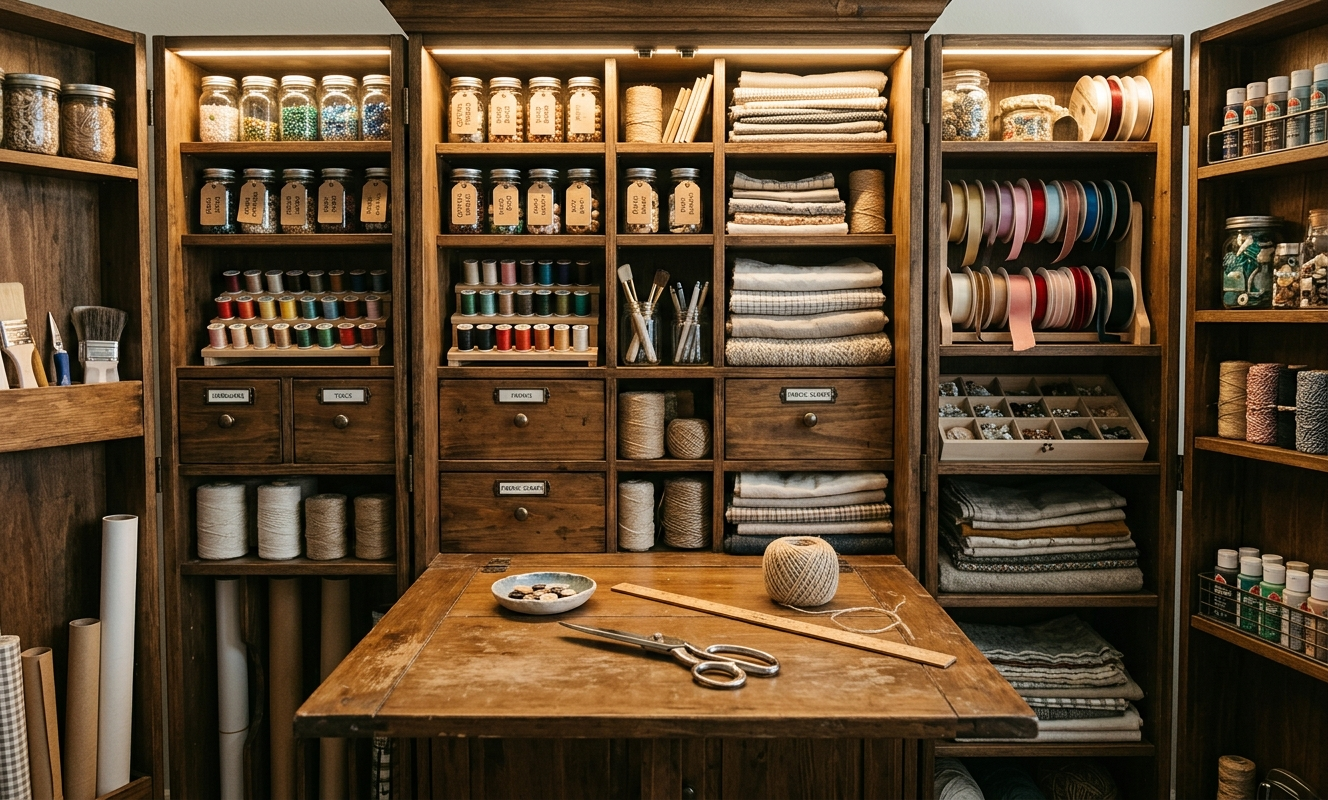
Open armoire craft cabinet with floor-to-ceiling shelves, ribbon, bins, and fold-out work table inside
Amazon Alternatives to the Dreambox
Here is the good news: the core concept behind the Dreambox — a foldout or armoire-style cabinet that contains an entire craft station and closes up neatly when you're done — is not exclusive to one product at one price point. There are foldout craft storage cabinets available on Amazon that deliver a very similar experience at roughly a third of the Dreambox price, sometimes less. They won't have every specialized compartment or the built-in lighting, but they will give you that same transformation: a piece of furniture that opens into a real workspace and closes into something that looks perfectly at home in your living space.
If you've been eyeing the Dreambox but the price isn't realistic right now, I'd genuinely encourage you to search for comparable options before you give up on the concept entirely. Look for foldout desk cabinets, craft armoires, or sewing cabinet stations with fold-out tables. Read the reviews carefully — specifically look for reviewers who mention the sturdiness of the fold-out surface and the quality of the hinges, because that's where cheaper versions sometimes disappoint. But a well-chosen mid-range option can serve you beautifully for years.
Inside whatever closet or cabinet system you choose, the organization is what makes it functional. A good ribbon and thread organizer (find on Amazon) keeps your fibers from tangling into a mess every time you open the door. A small set of stackable storage bins (find on Amazon) lets you sort supplies by category — holidays, florals, backgrounds, whatever your system is — without taking up much depth. And I will tell you from personal experience: a label maker (find on Amazon) is one of the best investments a crafter can make. Label your bins, your drawers, your boxes. When you can find what you need in under thirty seconds, you actually make things instead of organizing things.
|
Patterns from the Sunrays Collection Tracey's Picks, designing cross stitch patterns since 2004 |
|||||
|
|||||
| Browse the full Sunrays collection → |



Build Out Your Craft Room on a Budget
If you're going the full craft room route but you don't have a furniture budget that allows for custom cabinetry, the DIY build-out approach is genuinely satisfying and very achievable. You don't need a step-by-step project guide to do this well — you just need to know which components to invest in, and there are endless ideas online once you start looking.
Start with a cube storage organizer (find on Amazon) along one or two walls. These modular units — the kind that hold fabric bins or open cubbies — are incredibly versatile, reasonably priced, and can hold a shocking amount of material. You can mix open cubbies with fabric bins to create the visual effect of closed storage without the cost of real cabinetry. Stack them floor-to-ceiling if you have the height, and use the top surface for displaying finished pieces or housing larger items.
Add a pegboard wall organizer above your primary work surface and you've solved the small tools problem entirely. Scissors, rulers, hole punches, seam rippers, rotary cutters — everything that would otherwise end up in a drawer you have to root through — can hang visible and accessible right where you work. Pegboards are inexpensive, easy to mount, and infinitely customizable with hooks and baskets. I wish I had done this sooner than I did. Once you've got your wall storage sorted, consider a wire shelving unit in a corner or along a secondary wall for bulkier items that don't fit in cubbies — bins of canvas, rolls of interfacing, stacks of hoops. Wire shelving is sturdy, affordable, and because you can see through it, nothing gets lost in the back.
And then — the table. Always the table. This is where I'd put the money if I had to choose one place. A large craft table with storage built in underneath gives you both a proper work surface and additional organization in one piece. Look for something with drawers or shelves below, a surface large enough to lay out a good-sized project, and enough sturdiness that it doesn't shift when you lean on it. Set it near your window. Put your best light above it. And then actually use it. A craft room only becomes a craft room when you make things in it.
Get Stitching Tips & New Patterns from Tracey
Honest advice, new Sunrays designs, and occasional VIP-only offers. No fluff.
No spam. Unsubscribe any time.
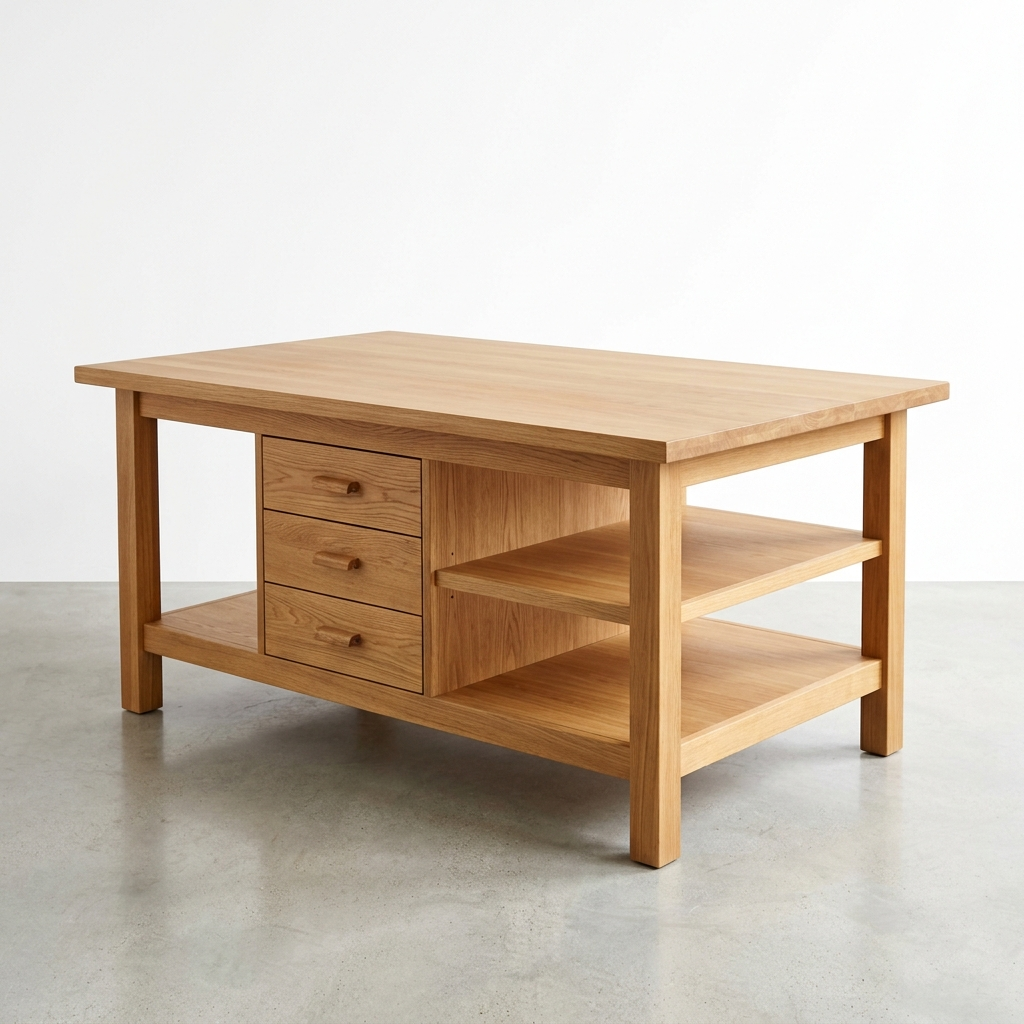
Tracey Recommends
Large Craft Table with Storage
Every real craft room needs a proper work surface — something big enough to spread out, sturdy enough to lean on, and smart enough to pull double duty with built-in storage below. A large craft table with storage is the centerpiece that makes the whole room work. Don't skimp here. Get the table you'll actually want to sit at.
See on AmazonMaking Any Space Work — Small Spaces, Big Creativity
I want to close this section with something that I think gets lost in the excitement of planning a dream craft space: the space does not make the crafter. I know women who produce absolutely stunning work from a TV tray beside a recliner. I know stitchers who have a dedicated room and still feel like they can't get organized. The space matters, yes — but your mindset and your systems matter more. A small, well-organized space will serve you better every single time than a large, chaotic one.
If you're working with genuinely limited space — a small apartment, a shared bedroom, a house with no spare room — start by getting serious about what you actually use. Most crafters carry supplies for five crafts when they actively practice two. Edit your materials down to what you really use and love, and then organize what remains. You will be amazed how little space you actually need when you're not storing things you've outgrown or supplies for a project you abandoned in 2019.
A single well-chosen closet, a good foldout cabinet, or even a sturdy set of shelves in a corner can function as your creative haven if you treat it that way. Come to your space with intention. Keep it tidy not because tidiness is a virtue in itself but because a tidy space lets you see what you have, find what you need, and get to the actual work of creating faster. The goal isn't a beautiful craft room for its own sake. The goal is to spend more time making beautiful things.
Whatever your space looks like right now — a full room, a closet, a corner of a bedroom — I hope you carve something out for yourself and protect it. Creativity needs a home. You deserve a place where you can sit down, pick up your needle and thread or your scissors or your paintbrush, and lose yourself in making something. That kind of joy is worth organizing for.
Whether you end up with a dedicated craft room, a beautifully organized closet system, or a well-chosen corner of a shared space, what matters most is that you have somewhere to go and create. Make it yours, keep it tidy enough to find what you need, and then actually use it. If you're a cross stitcher looking for patterns worth making a permanent home in your new space, come browse the designs at Sunrays Creations — there's always something worth stitching.
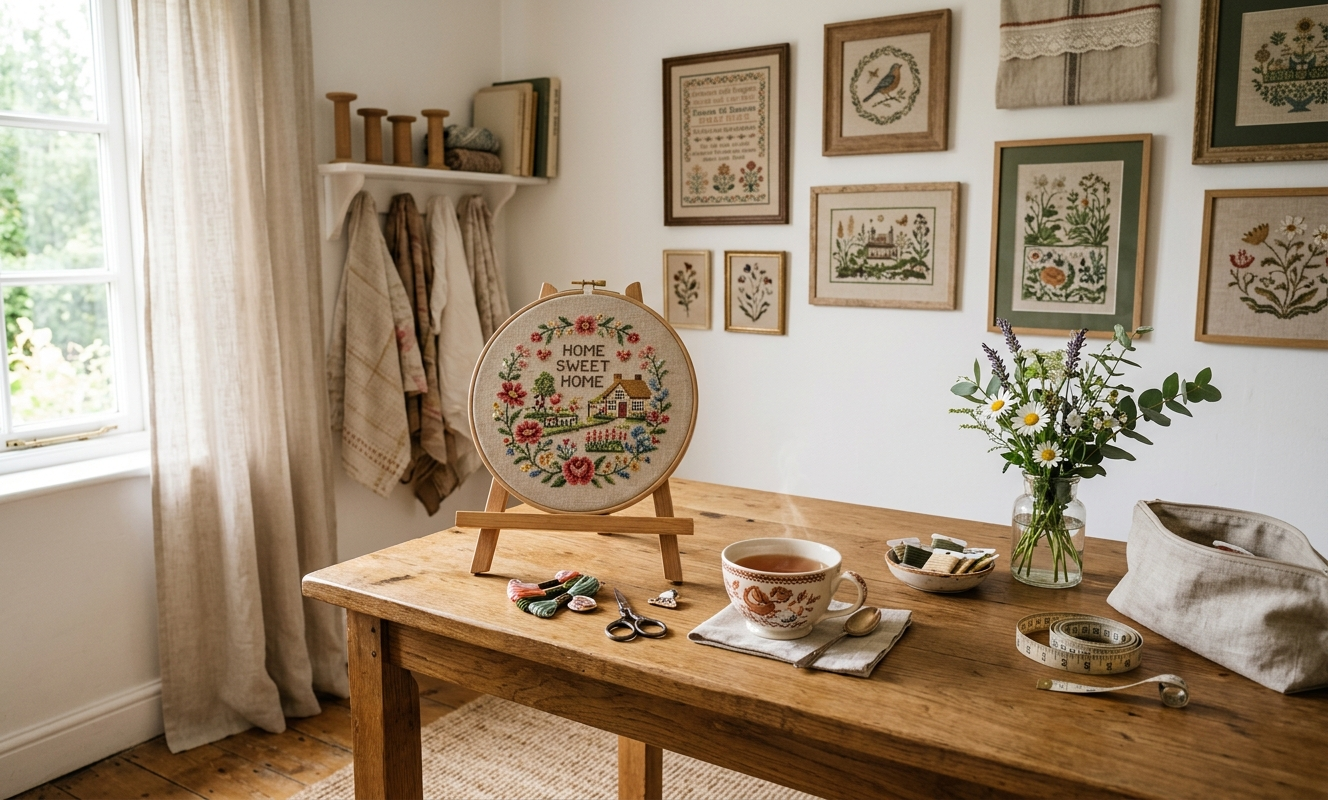
Sunlit craft room with wooden worktable, finished cross stitch on easel, framed needlework on wall
Keep Reading
What Do You Need to Cross Stitch?
If your craft room is going to be a stitching space, start with the essentials. This guide covers exactly what tools and supplies you need to get set up properly.
READ THE GUIDEWhy Buy From Sunrays Creations?
Learn what makes Sunrays patterns different — hand-charted, original designs that are worth giving a good home in your new craft space.
READ THE ARTICLECross Stitch FAQs
New to stitching or just getting organized? This FAQ answers the questions that come up most often for beginners and returning stitchers alike.
READ THE GUIDEFrequently Asked Questions
What is the difference between a craft room and a craft closet?
A craft room is a dedicated room in your home used exclusively for crafting — it typically has a full work table, wall storage, and enough space to leave projects out between sessions. A craft closet is a more compact solution, usually a converted closet or foldout cabinet system, that contains all your supplies in a small footprint and closes up when not in use. Both work well depending on your available space and lifestyle.
How much does a Dreambox craft cabinet cost?
The Dreambox starts at approximately $2,199. The company offers a payment plan for those who can't pay the full amount upfront. You can also save money by choosing the self-assembly option rather than the prebuilt version, which ships ready to organize. There are no affiliate links to the Dreambox here — just an honest mention as a benchmark product in the foldout craft cabinet category.
What are good alternatives to the Dreambox at a lower price?
Foldout armoire-style craft cabinets and sewing cabinet stations available on Amazon offer a very similar concept at significantly lower price points — often one-third the cost or less. Look for units with a fold-out table surface, interior shelving, and sturdy hinges. Read reviews carefully for feedback on durability, especially the fold-out work surface. Searching 'craft storage cabinet foldout' or 'craft armoire' on Amazon will surface several solid options.
What furniture do I need to set up a craft room?
The four core components of a functional craft room are: a large work table, wall shelving or cabinetry for storage, a pegboard or vertical organizer above the work surface for small tools, and good lighting. A cube storage organizer along one wall can replace expensive built-in cabinetry at a fraction of the cost. Start with those four elements and add specialty storage as you identify specific needs.
How do I organize a craft closet on a budget?
Start by editing your supplies down to what you actually use — most crafters discover they're storing far more than they need. Then invest in stackable storage bins, a label maker, and a ribbon or thread organizer to keep fibers tangle-free. Clear bins and labeled drawers make everything findable in seconds. A foldout desk cabinet from Amazon can transform a single closet bay into a complete craft station without major renovation.
Can I have a craft space in a small apartment?
Absolutely. The key in a small space is containment — everything your craft needs should live in one defined area, ideally in a piece of furniture that closes up when you're not using it. Foldout desk cabinets, wall-mounted fold-down tables, and a single well-organized shelving unit can give you a fully functional craft station in a studio or one-bedroom apartment. Edit your supplies ruthlessly and organize what remains, and you'll be surprised how little space you actually need.
-- Tracey Kramer
Founder & Designer, Sunrays Creations Needlearts
Hand-charted designs since 2004 • Marysville, Ohio