
Cross Stitch and Mental Health: Why Stitching Is Good for Your Brain
Posted by Tracey M. Kramer on 21st Sep 2026
A Note from Tracey Kramer
I have been designing counted cross-stitch patterns since 2004, and in that time I have watched my customers stitch everything from wedding gifts to heirloom samplers. This is everything I know about this topic -- from real experience, not theory.
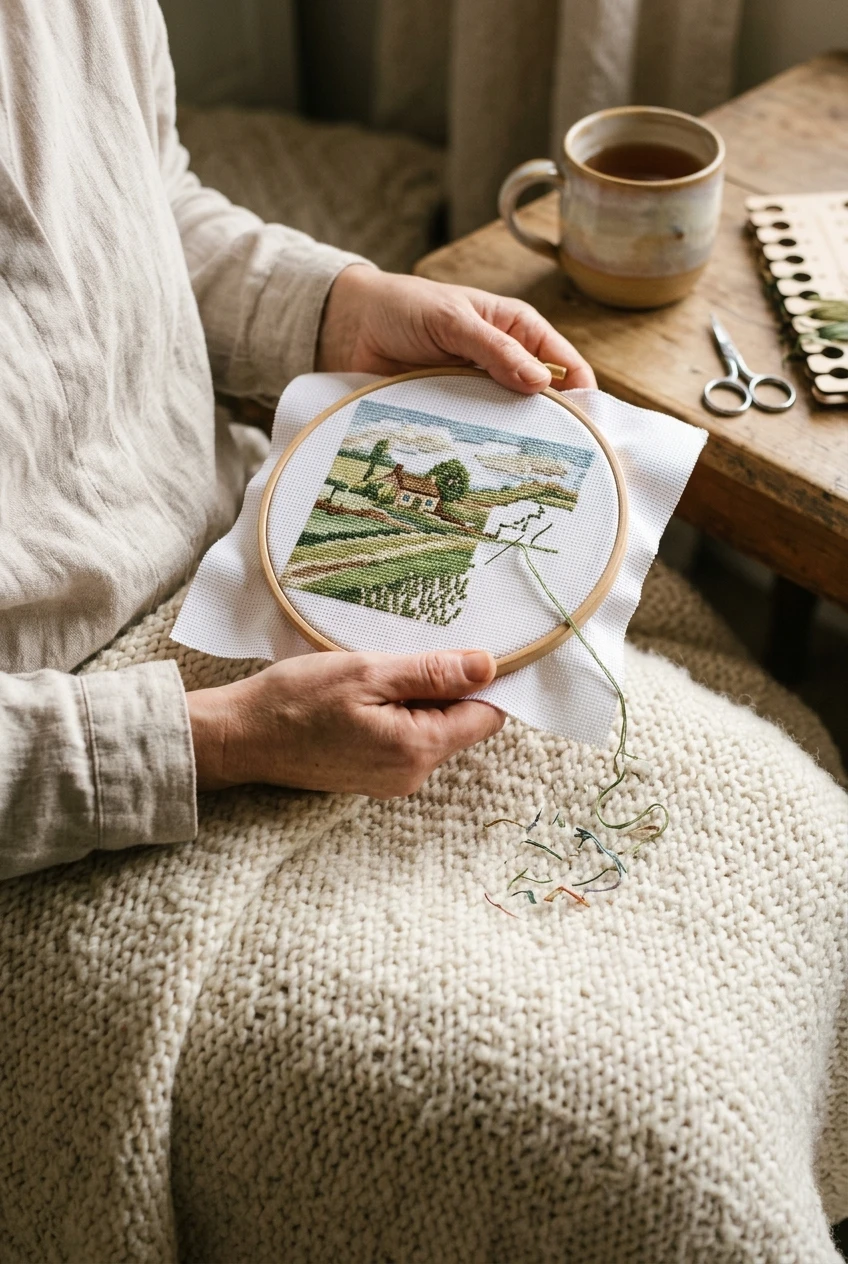
Hands stitching on 18-count Aida in a wooden hoop, cross stitch and mental health calm moment
By Tracey Kramer • • 12 min read
People ask me all the time whether cross stitch really helps when your head is a mess, and after 22 years of designing patterns and stitching through some genuinely hard seasons, my honest answer is yes, though not in the way most articles claim. Cross stitch is good for your brain because it gives a busy mind one small, repeatable job with a visible result, and that steadies you enough to face the rest of your day. It does not fix anything. It just gives you somewhere quiet to stand while the noise settles.
What Actually Happens When You Sit Down to Stitch
A cross stitch session is one of the only things I do that asks for my full attention without demanding anything from me emotionally. Count four over, two up. Bring the needle up, cross it down. There is no debate, no decision that matters, no one waiting on an answer. The pattern tells you what comes next and you do it. For a mind that has been spinning all day on things it cannot solve, that narrow little task is a relief.
I think that is the real heart of the cross stitch mental health question. It is not that the craft carries some secret power. It is that counted cross stitch occupies exactly the part of your brain that has been running in circles. You cannot count squares and catastrophize at the same time. One of them has to give, and after a few minutes of steady stitching, it is usually the spinning that quits first.
The rhythm matters too. Two strands of DMC floss on 18-count Aida makes a small, even stitch, and once you settle into a block of a single color, your hands find a tempo and keep it. Many stitchers describe that stretch as the closest thing they get to quiet. It is repetitive without being mindless, because you still have to keep your place. That combination of occupied and calm is hard to find anywhere else, and it is why so many people come back to the needle night after night.
The other piece is that stitching gives you proof. Anxiety is very good at telling you that nothing you do makes a difference. Then you look down and there are two hundred stitches on fabric that were not there an hour ago. You can see them. You can count them. That is a small, undeniable fact in a day that may not have offered you many, and I have never underestimated what that does for a person.
The Loop Nobody Warns You About: Heavy Head, Messy Room
Here is the part I wish more people said out loud. When your mental health is rough, everything gets heavy, and being organized is one of the first things to slide. Not because you stopped caring, but because every small task suddenly costs more than you have. The dishes wait. The mail piles. And if you are a stitcher, the floss goes in a bag, the bag goes in a chair, and the chair becomes a monument to the week you had.
Then the clutter starts talking back. A tangled pile of thread is not neutral when you are already overwhelmed. It reads as evidence. You walk past it and it says you are behind, you are failing at this too. So you avoid the room, which means the pile grows, which makes the room harder to enter. Clutter feeds overwhelm and overwhelm feeds clutter, and once that loop is running it is genuinely difficult to break from the outside.
Most advice tries to break it from the outside anyway. Clean first, then you will feel better. Organize your supplies and you will be inspired to stitch. I have found that backwards, and I have lived it. On the weeks when I could barely make a decision, telling myself to sort a drawer of floss was the same as telling myself to move a mountain. The mountain was not the drawer. The mountain was that I did not have the capacity to start anything that had no clear end.
So the loop does not get broken by discipline. It gets broken by finding the one task in the house that still feels possible, and for me that has always been picking up a hoop. Stitching is the small thing you can still do when you cannot do the big things. And because it settles your head, it hands you back just enough capacity to look at the mess afterward without flinching.

Tracey Recommends
Bisley 5-Drawer Steel MultiDrawer Cabinet - Doulton Blue
This is where my floss lives, and it has earned its spot. Everything in its place, visible the second the drawer opens, which is the opposite of overwhelm on a full-head day. Built like a tank and it will outlast every plastic bin you have ever bought.
Check Current Price →Stitching is the small thing you can still do when you cannot do the big things. And because it settles your head, it hands you back just enough capacity to look at the mess afterward without flinching.
Why the Organizing Comes After, Not Before
This is the order that has held true for me for two decades. I stitch first. Not because my supplies are tidy, but because they are not. I pull the hoop out of whatever bag it landed in, I work a small block of color, and I do not look at the rest of the room. Half an hour later something has loosened. And with that looseness comes the thing I could not manufacture an hour earlier, which is the willingness to open a drawer and deal with it.
A settled mind can face a tangle. An overwhelmed one cannot. That is the whole mechanism, and the reason I get frustrated when organization is sold as a prerequisite for creativity. It is not the entry fee. It is the byproduct. The tidying I do on a Sunday afternoon is almost always the tail end of a good stitching session, never the warm-up act.
It also helps that the payoff is immediate in a way most chores are not. When you wind a few floss bobbins (find on Amazon) and drop them into place, you are not just cleaning. You are setting up your next quiet hour. The task has a purpose your brain actually believes in, which is a very different thing from cleaning because you should. I am not going to teach you the method here, because I have already written it down in detail. If you want the how, my guide to cross stitch floss storage and my piece on craft supply organization cover the systems that have survived in my studio.
One more practical note that belongs to this same idea. Keeping each project in its own bag means a heavy week does not turn into a merged pile of three half-finished WIPs and a fistful of loose thread. I wrote about that in my post on cross stitch project bags, and it is the single easiest thing you can do to keep future-you from walking into a mess she did not make on purpose.
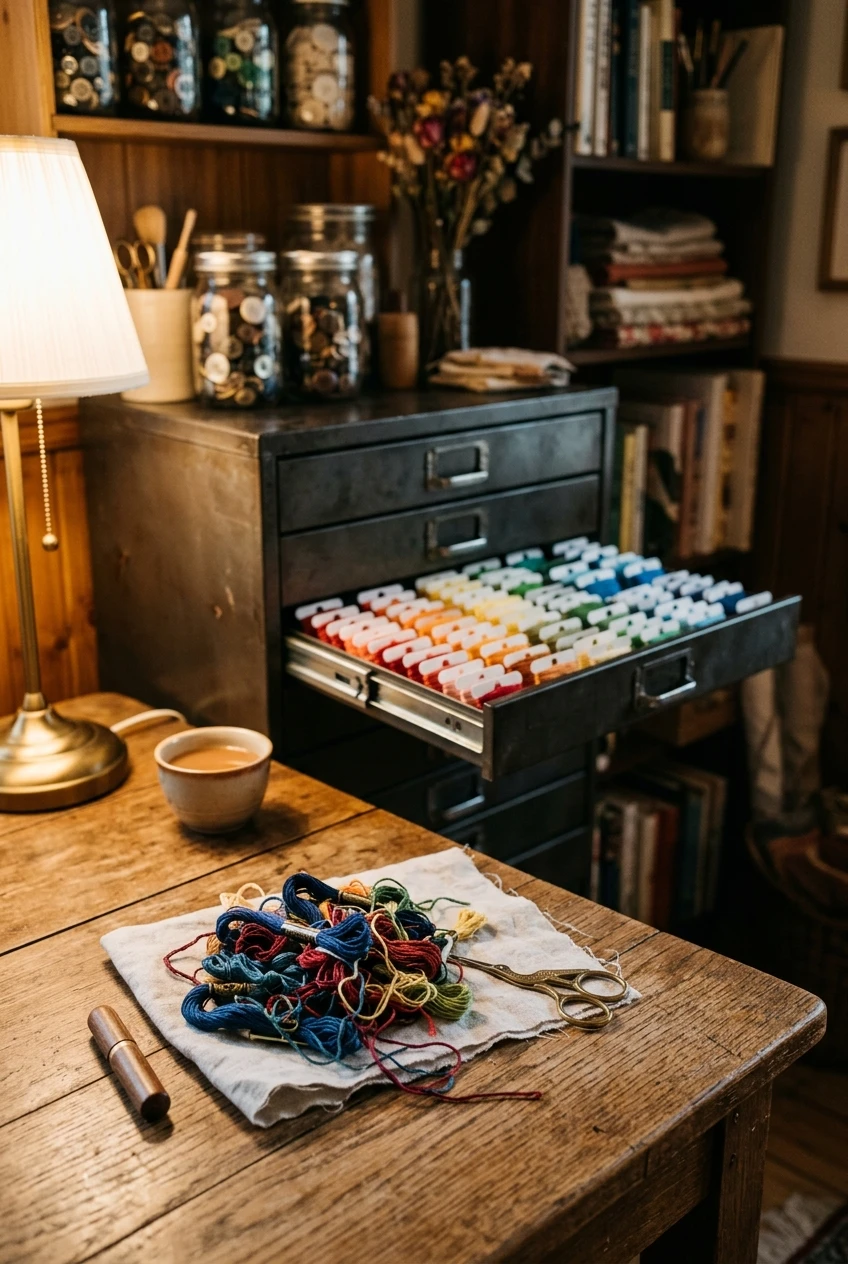
Tangled loose floss in front of an open drawer of neatly sorted cross stitch floss bobbins
My Own Setup, and Why I Keep It
I use a Bisley multi-drawer cabinet for my floss. It is a solid steel thing, not pretty in a farmhouse way, and it is the best purchase I have made for my studio. Inside the drawers I use bobbin insert trays that hold around 300 bobbins between them, and they drop straight into the Bisley drawers like they were made for each other. Both are in the cards below because I actually own them and use them every single day.
The reason I keep them is not efficiency. It is what happens when my head is full. I pull open a drawer and every color is sitting in its place, in order, visible at a glance. Nothing is hiding. Nothing is tangled. For a mind that has spent all day trying to hold too many things at once, that drawer is the exact opposite of overwhelm. I have stood there and just looked at it before I picked up a needle, and I am not embarrassed to say it helped.
That is what a good cross stitch floss organizer (find on Amazon) buys you, and it is worth being clear about it. You are not paying for neatness. You are paying for the absence of a decision. When the colors are visible, starting is free. When they are in a knotted bag, starting costs you twenty minutes and whatever patience you had left, and on a bad day that gap is the difference between stitching and not stitching.
The small tools work the same way. A needle minder (find on Amazon) on the fabric means I am not hunting for a needle in the couch cushion. A magnetic chart holder (find on Amazon) means I am not losing my row every time I set the chart down. None of those things are luxuries. They remove the little friction points that feel like nothing on a good day and feel enormous on a bad one, and removing friction is most of what a workable craft space is for.
|
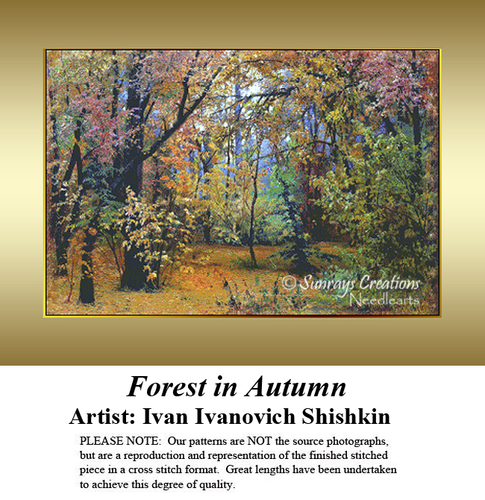
Patterns from the Sunrays Collection Tracey's Picks, designing cross stitch patterns since 2004 | |||||
| |||||
| Browse the full Sunrays collection → |


Some Days It Does Nothing, and That Is Allowed
I am not going to pretend every session lands. There are evenings I sit down, stitch for ten minutes, frog half of it, and feel exactly as raw as when I started. The needle is not a switch. Some nights the craft is just a craft, and the fabric goes back in the bag unchanged. That is not a failure of the stitching or of you. It is a bad night, and bad nights exist.
What I have learned is not to demand results from a session. The moment I sit down expecting to be fixed, I have turned a quiet thing into a test I can fail. Better to sit down with no requirement at all. Work a few stitches. If it helps, stay. If it does not, put it down without a story about what that means. The pattern will still be there tomorrow, and cross stitch is one of the few things in life that waits patiently.
I will say one thing plainly, because it matters more than any tip in this article. If you are really struggling, the needle is not a substitute for talking to someone, and reaching for a person is never the weaker choice. Cross stitch is a craft that many of us find steadying. It is good company and it is honest work for your hands. It is not a treatment, and it should not be carrying weight that belongs to a real conversation.
Held in that frame, though, it gives back a lot. A session that calms you a little is worth having. A finished piece on the wall is worth more than the floss it cost. And the reason the craft has held me for 22 years has less to do with the finished pieces than with the ten thousand ordinary evenings in between.
Get Stitching Tips & New Patterns from Tracey
Honest advice, new Sunrays designs, and occasional VIP-only offers. No fluff.
No spam. Unsubscribe any time.

Tracey Recommends
3 Packs DIY-Cut EVA Foam Insert with 300PCs Embroidery Floss Bobbins, Embroidery Floss Organizer for Bisley MultiDrawer Cabinet or 15*11-inch Multi-drawer Cabinet, Cross Stitch Storage, Set of Sewing
These trays drop straight into my Bisley drawers and hold around 300 bobbins between them. Every color sits in order where I can see it at a glance, so starting a session costs me nothing. I use these and the cabinet together every day.
Check Current Price →Choosing a Project That Actually Steadies You
Not every pattern is calming, and this is where a lot of stitchers accidentally make things harder on themselves. If you are stitching for steadiness, you want a design with reasonable color blocks and a manageable size, not a chart with confetti scattered across every row. Confetti has its place and I design plenty of it, but single stitches in fifteen colors per row is concentration work, not calming work. Know which one you are reaching for tonight.
I design everything for 18-count Aida, worked with two strands of DMC six-strand floss, and I use a five or six inch wooden or plastic embroidery hoop. That hoop size keeps the fabric drum-tight where I am working, sits comfortably in one hand, and does not fight me. Q-snaps exist and some stitchers swear by them, but the hoop is my tool and it has been for two decades. Good light and a comfortable chair matter more than most people expect, too.
If you want the practical mechanics of making a session feel calm, I have written that up separately in my guide to mindful cross stitching. This article is the why. That one is the how: pace, breathing, putting the phone in another room. There is no point in me repeating it here when it already exists in more detail than I could fit in a paragraph.
And choose something you actually want on your wall. That is not a small detail. Framed cross stitch is the finish line for every pattern I design, and knowing where a piece is going to hang gives the whole project a quiet momentum. A cottage garden, a bare winter tree, a New England snowscape. Something you will walk past for the next thirty years and remember the season of your life when you stitched it. That is the part no other craft does quite the same way.
If your head has been full and your studio has slid sideways, do not start with the mess. Start with a needle, a hoop, and half an hour where the only thing you owe anyone is the next stitch. When you are ready to pick out something worth hanging on your wall, come browse the Sunrays Creations patterns and find the one you want to spend your quiet evenings with.
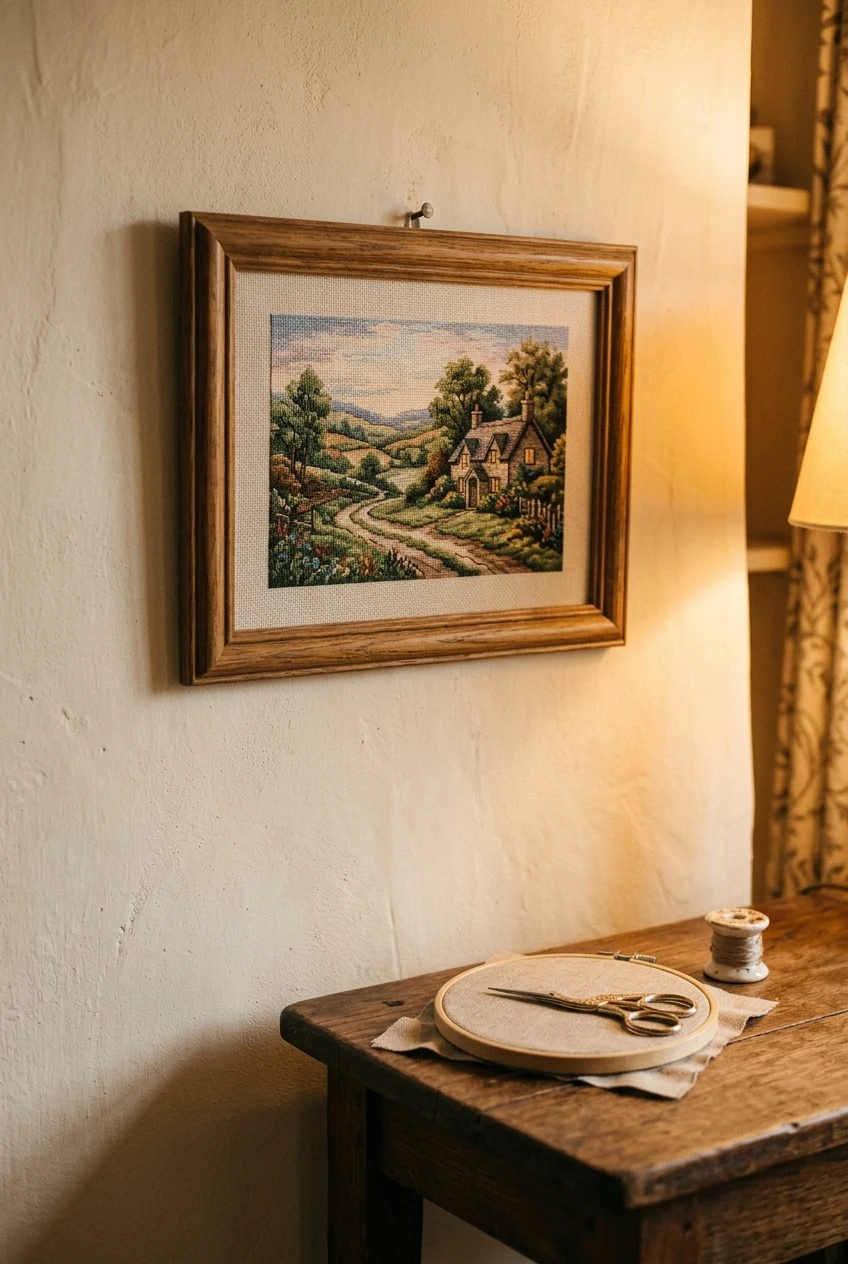
Framed finished cross stitch landscape on a warm wall with hoop and scissors nearby
Keep Reading
Mindful Cross Stitching: Make Every Session Calm
This article explains why stitching steadies you. That one gives you the actual mechanics of a calm session, from pace to putting the phone away.
Read the GuideCross Stitch Floss Storage: What Actually Works
When a session has settled your head and you are finally ready to tackle that drawer, this is the method I use in my own studio.
See My SystemWhy Cross Stitch Is So Addictive (A Love Letter)
If you want the personal side of why this craft holds people for decades, I wrote it all out here.
Read the Love LetterFrequently Asked Questions
Is cross stitch good for anxiety?
Many stitchers, myself included, find it steadying. Counted cross stitch occupies the same part of your mind that has been spinning, because you cannot count squares and catastrophize at the same time. It is not a treatment for anything, but it gives a busy head one small, repeatable job with a visible result.
Why does cross stitch feel calming when other crafts do not?
It is repetitive without being mindless. You settle into a rhythm with two strands on 18-count Aida, but you still have to keep your place, so you stay occupied rather than drifting. That combination of occupied and calm is hard to find elsewhere.
Should I organize my supplies before I start stitching again?
No, and I would gently argue the opposite. When your head is heavy, sorting a drawer of floss feels like moving a mountain. Stitch first. A settled mind can face a tangle, and the organizing usually shows up as the tail end of a good session rather than the warm-up.
What if a stitching session does not help at all?
That happens, and it is allowed. Some nights I stitch ten minutes, frog half of it, and feel exactly as raw as when I sat down. The needle is not a switch. Put the fabric back in the bag without building a story about what it means.
What kind of pattern is best if I am stitching to settle my mind?
Look for reasonable color blocks and a manageable size rather than heavy confetti. Single stitches in fifteen colors per row is concentration work, not calming work. Both have their place, just know which one you are reaching for on a given evening.
What supplies make stitching easier on a bad day?
Anything that removes friction. Floss you can see at a glance, a needle minder so you are not hunting in the couch cushions, a chart holder so you do not lose your row. Those things feel like nothing on a good day and feel enormous on a hard one.
Can cross stitch replace talking to someone?
It cannot, and I would never suggest it. Cross stitch is a craft many of us find steadying and good company for our hands. If you are really struggling, reaching for a person is never the weaker choice.
-- Tracey Kramer
Founder & Designer, Sunrays Creations Needlearts
Hand-charted designs since 2004 • Marysville, Ohio