
Cross Stitch Metallic Thread: How to Actually Use It Without Losing Your Sanity
Posted by Tracey M. Kramer on 27th Oct 2026
A Note from Tracey Kramer
I have been designing counted cross-stitch patterns since 2004, and in that time I have watched my customers stitch everything from wedding gifts to heirloom samplers. This is everything I know about this topic -- from real experience, not theory.
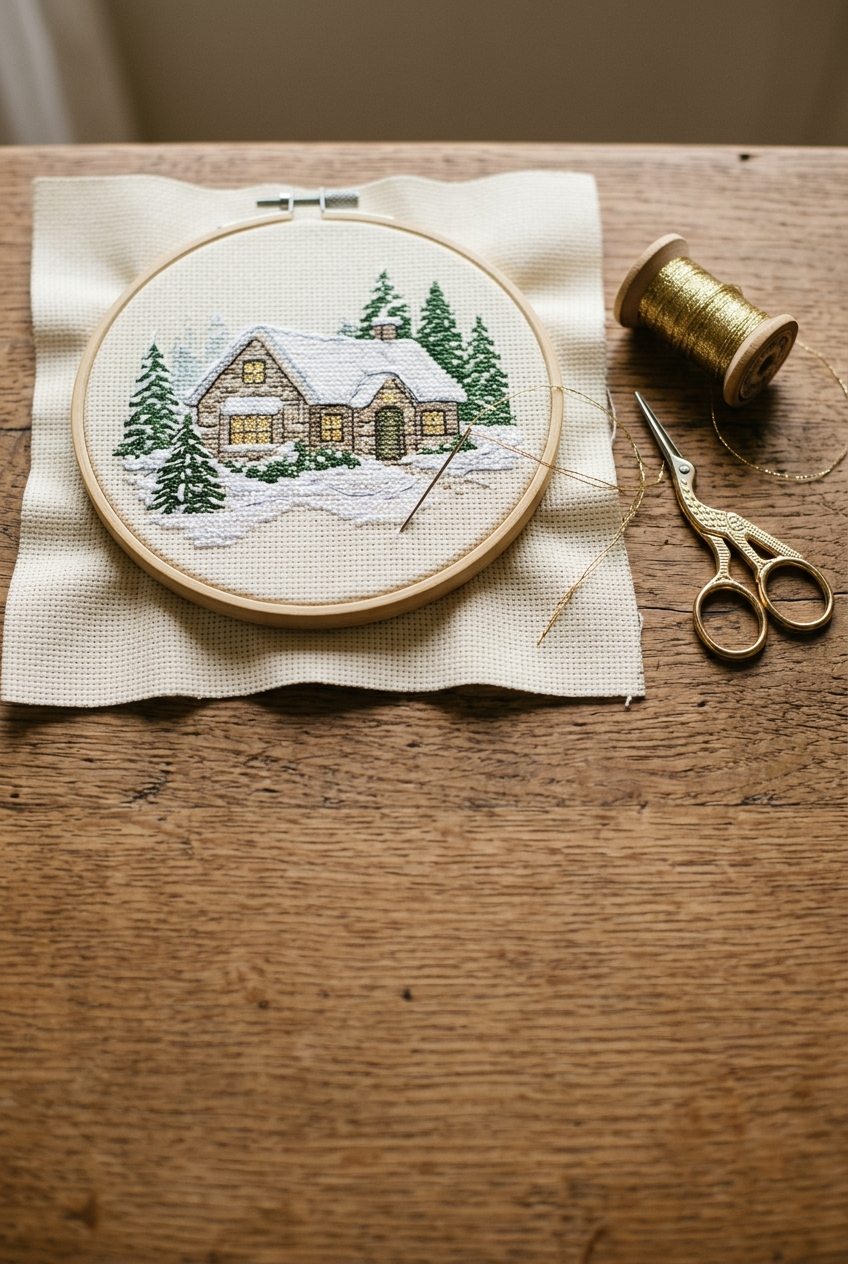
Cross stitch metallic thread and gold spool beside hooped Aida with sparkling winter cottage design
By Tracey Kramer • • 12 min read
If you've ever cut a length of metallic thread, pulled it through 18-count Aida three times, and watched it shred into a frizzy little mess, I promise you didn't do anything wrong. Metallic thread frays, twists, and kinks because of what it's made of and how it's built, and the fix isn't brute force but a handful of small habit changes: shorter lengths, a bigger needle eye, slower passes, and using it for accents instead of whole sky sections. Used in the right places, metallic earns its keep. Used everywhere, it will eat your evening alive, so this guide is as much about where to use it as how.
Why Metallic Thread Fights You (It's Not Your Technique)
Let's start with the thing nobody tells beginners: regular DMC six-strand cotton is forgiving. It's spun, it's soft, it has a little stretch and a lot of give. Metallic thread is a different animal entirely. Most metallics are built by wrapping or twisting a thin reflective filament around a core, and that reflective layer is what catches light beautifully on your finished piece. It's also what catches on the edges of every single Aida hole you drag it through.
Every pass through the fabric is an abrasion event. The metallic layer scuffs, lifts, and eventually separates from its core. That's the fraying you see about two-thirds down a length of thread, right when you were starting to feel good about things. It isn't a sign you're pulling too hard or holding the needle wrong. It's friction doing what friction does.
The twisting is a separate problem with a separate cause. Metallic threads tend to hold more memory than cotton. They come off the spool with a curl already baked in, and then your own stitching motion adds a quarter turn of twist with every stitch. Cotton absorbs that and relaxes. Metallic coils up on itself, forms those tight little loops near the needle, and knots before you've noticed it happening.
The 18-Count Factor
Most of what follows is about 18-count Aida, the size Sunrays kits come in, and that finer count does not make metallics easier. Smaller holes mean more friction per stitch. On 18-count, a metallic strand has to squeeze through a tighter opening than it would on 14-count, and the thread notices. This is exactly why metallic works best as an accent thread rather than a workhorse. A crown, a star, frost on a window, the glint on a lantern. Not a whole background.
Once you stop expecting metallic to behave like cotton, the whole thing gets easier emotionally. You're not failing. You're using a material that trades convenience for shine, and you get to decide when that trade is worth it.
The Fixes That Actually Help
Here's what actually helps. None of these are magic, and I won't tell you any of them works every single time, because thread brands and even individual skeins vary. But stacked together, they turn metallic from a fight into a manageable task.
Cut Shorter Lengths. Much Shorter.
This is the single biggest change you can make. With cotton, 18 inches is fine. With metallic, cut 12 inches, and on frayed days, 10. Yes, you'll be ending and restarting more often. That trade is worth it, because the last third of a long metallic length is almost always the frayed, unusable third anyway. You're not wasting thread by cutting short. You're skipping the part you were going to throw in the ORT jar regardless.
Size Up Your Needle
If you normally stitch 18-count with a size 26 tapestry needle, go up to a 24 or even a 22 for metallic work. A larger eye means less compression on the thread where it folds, and a slightly fatter needle opens the Aida hole a hair wider just ahead of the thread. Less squeeze, less abrasion. Keep a dedicated tapestry needle size 24 (find on Amazon) in its own spot just for metallic passes, so you're never hunting for it mid-project.
Some stitchers swear by a chenille needle for metallics because of the big eye. Others find the sharp point too eager to split existing stitches on Aida, but that's preference, not gospel. Try both on a scrap and keep whichever one annoys you less.
Let the Needle Hang
Every eight or ten stitches, drop your needle and let it dangle free below your work. The weight of the needle will spin the thread back out of its accumulated twist. It takes maybe four seconds. With cotton this is a nice habit. With metallic it's the difference between smooth stitching and a knot you'll be picking at with the point of your scissors for ten minutes.
Slow Down, and Pull Straight
Metallic rewards a deliberate pace. Pull the thread through at a steady, even speed, perpendicular to the fabric, rather than yanking it sideways at an angle. Angled pulls grind the thread against the rim of the hole. Also stop pulling the moment the stitch seats, rather than giving it that extra little tug most of us do by habit. That extra tug is where a lot of metallic damage happens.
On strand count, I'm going to keep this short because I've covered it elsewhere: metallic is typically worked with a single strand on 18-count, which is different from the two strands I recommend for standard cotton. If you want the full reasoning on strand counts across fabric types, I wrote a whole piece on it.

Tracey Recommends
DMC Diamant Metallic Thread 38.2yd-Light Gold
A natural pick when a design calls for a warm gold glint rather than a cold silver one. Light Gold sits beautifully against snow scenes and candlelit windows, and a single 38.2 yard spool goes a remarkably long way when you're using metallic as an accent. Cut short lengths and it behaves.
Check Current Price →Metallic thread is a seasoning, not a main ingredient. Thirty stitches of gold will transform a piece. Thirty thousand will transform you into someone who hates cross stitch.
Conditioner, Wax, and Other Things That Might Help
Thread conditioner comes up constantly in metallic conversations, and it's worth talking about honestly rather than selling it as a cure.
A beeswax conditioner works by coating the thread lightly, which smooths down lifted fibers and reduces how much the thread grabs at itself. For metallics that are fraying and tangling, a light pass can genuinely calm things down. On tricky lengths, it can be a real relief.
But here's the part I want you to hear clearly: use it sparingly, and test on a scrap first. Wax can leave residue on fabric. On a piece you plan to frame and keep for decades, that residue matters. Run the thread through once, lightly, not four times. Avoid heavy application anywhere the thread will sit against light-colored Aida. And if you're working a piece you intend to wash before framing, test the wash on your scrap too, not on the project.
Some stitchers won't use wax at all on heirloom work, and I respect that position. It's genuinely a preference call, not a right-answer situation.
A Damp Finger Trick
Before reaching for wax, some stitchers simply run slightly damp fingers down a length of metallic. It relaxes some of the spool memory and takes the worst of the curl out. Barely damp, not wet. This costs nothing and works often enough that it's worth trying before you buy anything.
Starting and Ending Metallic
Metallic doesn't bury as obligingly as cotton. It's slick and it wants to slide back out of the stitches you've woven it under. Run the tail under four or five stitches instead of the usual three, and sometimes loop it back on itself once for security. Avoid knots on the back if you can, because metallic knots are bulky and will show as a bump when the piece is stretched for framing.
If you're hiding metallic tails under areas that are already stitched in cotton, you're in good shape. If you're working an isolated metallic accent with nothing around it, stitch it after the surrounding cotton so you have something to anchor into.
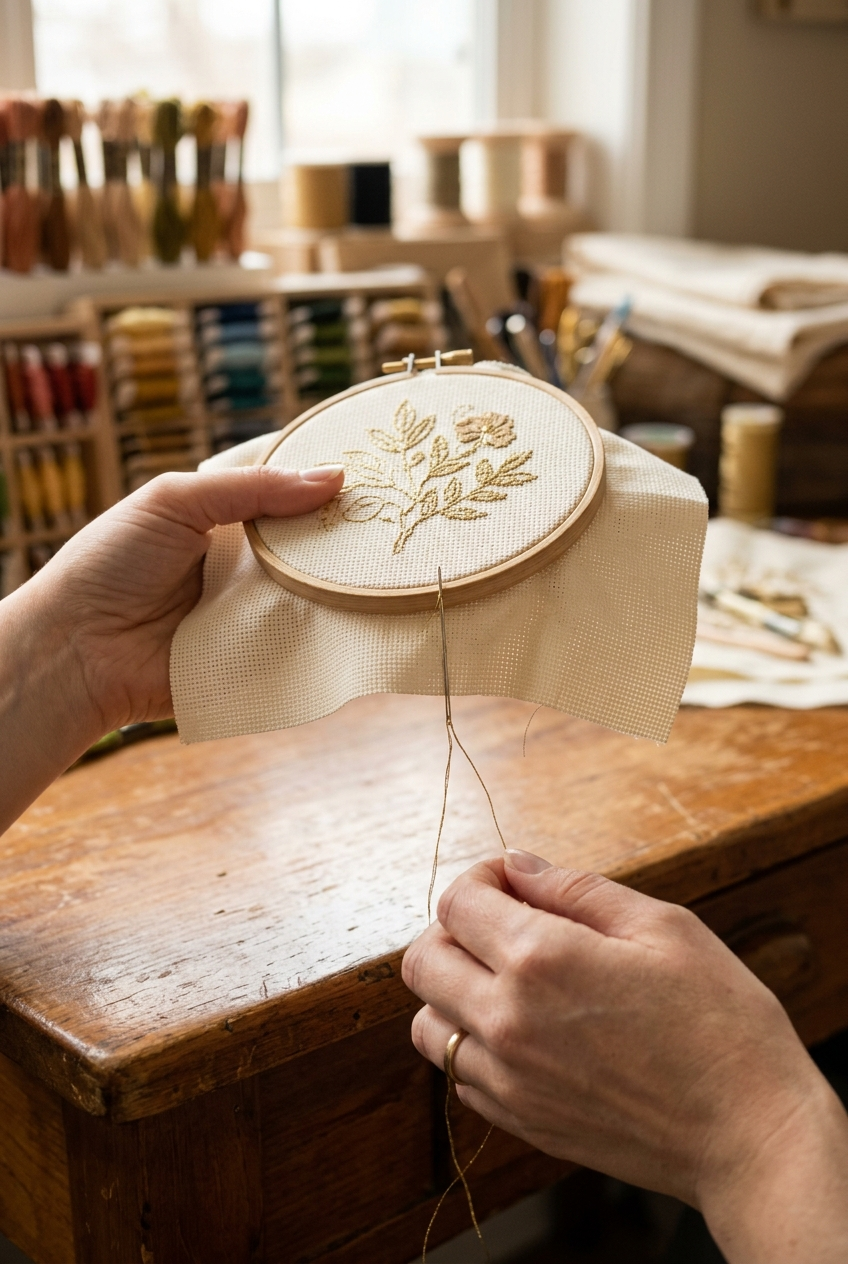
Hands letting a needle hang to untwist gold metallic thread below hooped Aida fabric
Where Metallic Belongs on a Chart
This is the part I feel strongest about after two decades of designing. Metallic thread is a seasoning, not a main ingredient.
Think about where a tiny amount of shine does the most work: frost crystals on a window frame, the gold rim of an ornament, candlelight in a cottage window, the sparkle on fresh snow in a village scene, a halo, a star, the buckle on a boot. Those are places where three or four metallic stitches transform a piece. Nobody needs an entire metallic sky. The shine stops reading as special when it covers everything, and you will hate your life for the forty hours it takes.
Winter Pieces Are the Sweet Spot
Snow scenes are where metallic earns its keep most. A village street under snow with a few gold-glinting windows, or a frozen waterfall with scattered highlights catching the light, is exactly the kind of piece metallic was made for. You're adding maybe thirty stitches of gold or silver to a design with thousands of cotton stitches, and the effect in a frame under good light is genuinely lovely.
Blending Instead of Solid Metallic
Another option worth knowing about: pairing one strand of metallic with one strand of cotton in the same needle. You get a subtle shimmer woven through a color rather than a hard glint, and the cotton strand gives the metallic something to hold onto, which cuts down on fraying. This works nicely for things like a gold-touched sunset or a slightly frosted roofline. It's not right for every design, but it's a tool in the box.
Save It for Last
Stitch metallic accents at the very end of a project, after everything else is done. Two reasons. First, metallic doesn't love being crushed in a hoop for weeks, and it picks up grime faster than cotton. Second, doing it last means you're adding sparkle to a nearly-finished piece, which is a lovely reward instead of a slog in the middle.
|
Patterns from the Sunrays Collection Tracey's Picks, designing cross stitch patterns since 2004 | |||||
| |||||
| Browse the full Sunrays collection → |



Hooping, Handling, and the Setup That Makes It Bearable
A small 5 to 6 inch wooden embroidery hoop (find on Amazon) keeps fabric taut, and metallic work is where that pays off. Good even tension on the fabric means the Aida holes stay open and round rather than collapsing, which gives your metallic strand a clearer path through. Slack fabric pinches the holes shut and multiplies friction.
Move your hoop so you're never stitching metallic right at the hoop edge where the fabric is compressed. If you have to, reposition. It's worth the extra minute.
Light Matters More Than You'd Think
Metallic thread is hard to see while you're stitching it, which sounds backwards for something designed to be shiny. It reflects light in ways that can hide where the thread has split or where you've skipped a hole. Strong, direct task light (find on Amazon) angled across your work makes the problem visible before you've stitched twenty wrong ones. Better to frog two stitches than twenty.
Protect Your Hands and Your Floss Storage
Metallic ends are sharp enough to catch on dry skin and on the edges of cardboard bobbins. Keep metallics on their original spools or in a small zip bag rather than wound on bobbins, because winding adds another round of abrasion before the thread ever reaches your needle. If you've got a bin of thread organizers (find on Amazon), give metallics their own compartment so they aren't rubbing against everything else.
Expect to Frog, and Make Peace With It
Frogging metallic is rougher than frogging cotton. The thread doesn't pull back out cleanly and it tends to shed little metallic flecks. When you have to undo metallic stitches, cut rather than un-stitch, pull the pieces out with tweezers, and start fresh with a new length. Trying to reuse a frogged metallic strand is almost always a false economy.
None of this is meant to scare you off. Metallic is genuinely worth using. It just asks for a different set of habits than the cotton we all learned on, and once those habits are automatic, the dread goes away.
Get Stitching Tips & New Patterns from Tracey
Honest advice, new Sunrays designs, and occasional VIP-only offers. No fluff.
No spam. Unsubscribe any time.

Tracey Recommends
Miss Abi's Beeswax Thread Conditioner - Thread Wax, Beeswax for Sewing & Embroidery Thread, Thread Magic Conditioner, Waxed Thread for Cross Stitch & Sewing, Beeswax Thread Wax
When a metallic strand is fraying and tangling faster than you can stitch it, a light pass of beeswax conditioner can calm things down noticeably. Use it sparingly and test on a scrap first, because wax can leave residue on fabric. It's an option worth having in the drawer, not a cure-all.
Check Current Price →A Realistic Practice Plan
If metallic has beaten you before, don't start with a project you care about. Here's how I'd ease back in.
Cut a 10 inch length of metallic. Thread a tapestry needle size 24. On a scrap of 18-count Aida, stitch a small block, maybe four by four. Let the needle hang every eight stitches. Pull straight and stop when the stitch seats. Notice how far you get before the thread starts to look tired. That number is your personal working length, and it's useful information.
Then do it again with a light pass of conditioner on a second scrap and compare. Look at both under good light, and look at the back too. The back tells you more about thread health than the front does.
Once you know your working length and whether conditioner helps you, pick a pattern with a small metallic accent and go. Thirty stitches of gold is a very achievable goal, and finishing that one accent will do more for your confidence than reading another article about it. Including this one.
One last thing. Keep the leftover bits. Metallic ORTs are the prettiest things in the jar, and a jar full of mixed cotton with gold and silver threaded through it is a little piece of art on its own shelf.
Metallic thread isn't difficult so much as it's honest about what it needs: shorter lengths, a bigger needle, a slower hand, and a small place to shine. Give it those things and it'll give you the one detail people lean in to look at when your piece is on the wall. If you're ready to put a little gold in a snowbank, come browse the Sunrays pattern library and find a winter scene worth sparkling.

Framed snowy village cross stitch with gold metallic window accents above an ORT jar
Keep Reading
How Many Strands of Floss for Cross Stitch?
Metallics are typically a single strand, but the full strand-count reasoning across fabric counts lives here. Worth reading before your next project.
Read the GuideCross Stitch Thread Guide: Everything You Need to Know About Embroidery Floss
This article goes deep on metallics only. For the broader picture of thread types, brands, and when to use what, start here.
See the Thread GuideWhat Is Frogging in Cross Stitch? (And How to Do It Without Losing Your Mind)
Frogging metallic is rougher than frogging cotton. Here's the full rundown on removing stitches without wrecking your fabric or your mood.
Learn to FrogFrequently Asked Questions
Why does my metallic thread keep fraying?
Metallic thread is built with a reflective layer wrapped around a core, and every pass through the Aida scuffs that layer until it separates. It's friction, not your technique. Cutting shorter lengths of around 10 to 12 inches is the single biggest fix.
How many strands of metallic thread should I use on 18-count Aida?
Metallic is typically worked with a single strand, which is different from the two strands I recommend for standard DMC cotton on 18-count. I've covered the full strand-count reasoning in a separate article if you want the detail.
What needle size is best for metallic thread?
Size up from whatever you normally use. If you stitch 18-count with a size 26, try a 24 or 22 for metallic work. A larger eye means less compression where the thread folds, and a slightly thicker needle opens the hole just ahead of the thread.
Does thread conditioner really help with metallic thread?
A light pass of beeswax conditioner can calm fraying and tangling by smoothing down lifted fibers. Use it sparingly and always test on a scrap first, because wax can leave residue on fabric. Some stitchers avoid it entirely on heirloom pieces, and that's a fair preference.
How do I stop metallic thread from twisting and knotting?
Drop your needle and let it hang free below your work every eight to ten stitches. The weight spins the accumulated twist back out in about four seconds. Metallic holds more memory than cotton, so it won't relax on its own the way cotton does.
Should I use metallic thread for large areas of a pattern?
I wouldn't. Metallic works best as an accent on small areas like frost, candlelight, stars, or a gold rim. Large metallic sections are exhausting to stitch and the shine stops reading as special once it covers everything.
When should I stitch the metallic parts of my project?
Save metallic accents for the very end. Metallic picks up grime faster than cotton and doesn't love being crushed in a hoop for weeks, and finishing a nearly-done piece with sparkle is a much better experience than slogging through it in the middle.
-- Tracey Kramer
Founder & Designer, Sunrays Creations Needlearts
Hand-charted designs since 2004 • Marysville, Ohio