
Cross Stitch Project Bags: Organize Your WIPs in Style
Posted by Tracey M. Kramer on 12th Sep 2026
A Note from Tracey Kramer
I have been designing counted cross-stitch patterns since 2004, and in that time I have watched my customers stitch everything from wedding gifts to heirloom samplers. This is everything I know about this topic -- from real experience, not theory.
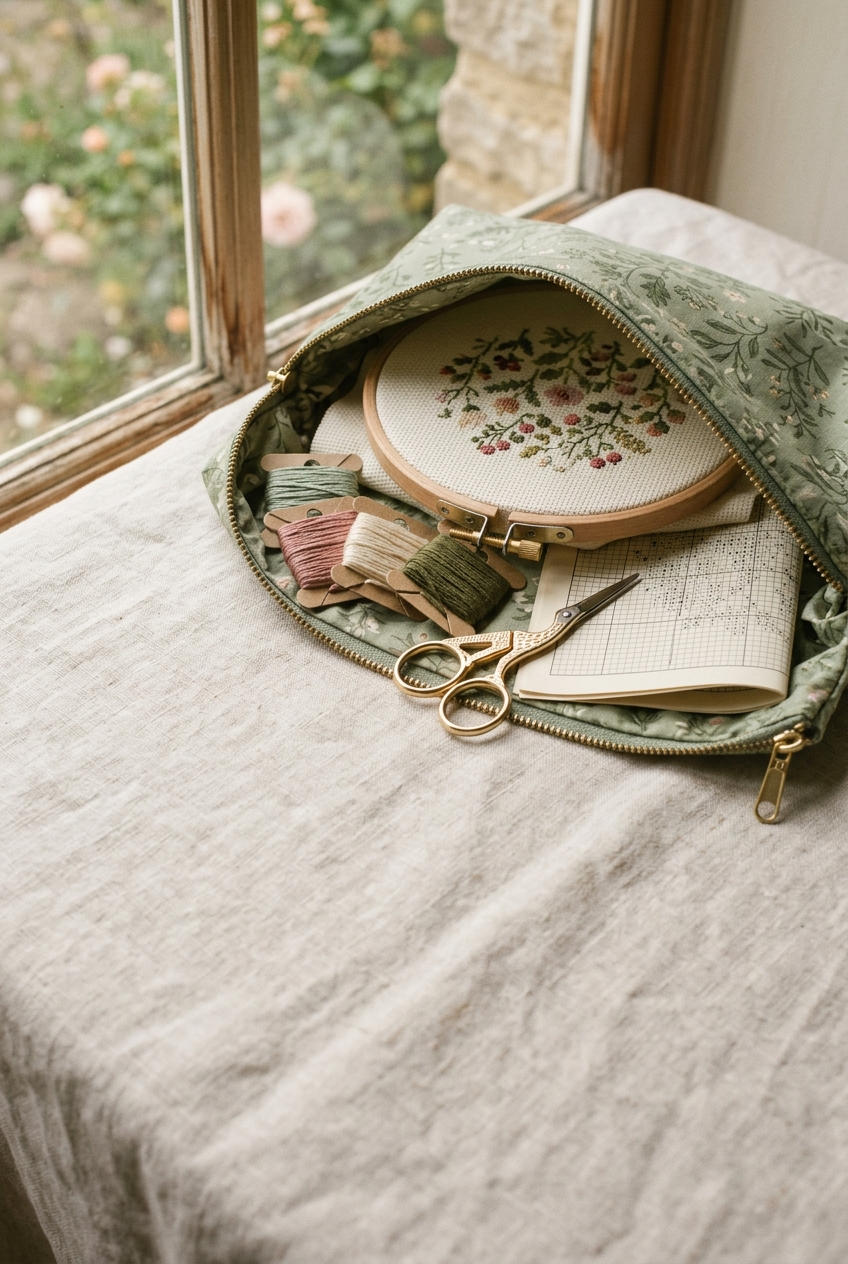
Cross stitch project bag open showing hooped Aida, chart, floss bobbins and embroidery scissors
By Tracey Kramer • • 12 min read
If you have three projects going and you keep pulling a length of DMC 3799 out of the wrong bag, the problem isn't you. The fix is one bag per project: a dedicated cross stitch project bag that holds the fabric, the hoop, the chart, and only the floss colors that design needs. After 22 years of designing and stitching, I can tell you that nothing has saved me more frogging, more lost needles, and more late-night hunting than giving every WIP its own zippered home.
Why One Bag Per Project Is the Whole Trick
Let me describe a scene I know you've lived. You sit down with your autumn landscape, reach into the tote, and pull out a tangle of floss that belongs to the snow scene you started in January. Half the bobbins have migrated. The needle you left threaded is now buried somewhere in the bottom seam. Twenty minutes later you've untangled everything, rethreaded, and lost the stitching mood entirely.
That is what happens when multiple WIPs share one container. Floss migrates. Charts get creased under a hoop. Loose needles find fabric they were never meant to touch. And the project you actually wanted to work on becomes the one you avoid, because starting it costs you twenty minutes of sorting before a single stitch goes in.
One bag per project ends that instantly. Everything a single design needs lives together and travels together. When you pick up the bag, you're picking up a finished decision. The fabric is in the hoop, the chart is where you left it, the six colors you're currently working are the only six in the pouch. You can be stitching in thirty seconds.
This is a different job from storing your stash. Your full floss collection, your fabric cuts, your spare hoops, all of that belongs in a system at home, and I've written about that separately. A project bag is small on purpose. It holds one design, in progress, ready to go. Think of it as the working desk rather than the filing cabinet.
There's a quiet benefit too. When every WIP has a bag, you can see exactly how many you have. Three bags on a shelf is a system. Eleven bags on a shelf is a conversation with yourself about which ones you actually intend to finish. I'd rather have that conversation than keep pretending the pile in the closet is fine.
What Actually Goes Inside
A project bag should hold everything you need for one design and nothing you don't. Here's what lives in mine, and why each piece earns its spot.
The fabric, already hooped. I work on 18-count Aida in a 5 or 6 inch wooden hoop, and I leave the hoop on between sessions. That means the bag has to be deep enough and wide enough to take a hooped project without crushing it. If you have to pop the fabric out of the hoop every time you pack up, you've added friction, and friction is what turns a WIP into a UFO.
The chart. A flat outside pocket or an interior sleeve is worth more than people realize. A printed pattern crammed in beside a hoop comes out wrinkled and dog-eared, and a creased chart is genuinely harder to read when you're counting confetti. If I'm working from a digital pattern on a tablet, that tablet goes in the same flat pocket. Either way, the chart never rides loose at the bottom.
Only the floss in play. This is the part people resist. You do not need all 42 colors in the bag. You need the six to ten you're currently stitching, wound on bobbins or clipped to a floss ring, and the rest can stay home in your storage. Carrying the whole palette is how tangles start and how colors go missing.
Scissors, needles, and a needle home. Small sharp embroidery scissors, a couple of spare size 26 tapestry needles, and somewhere safe to park the one you're using. A needle minder (find on Amazon) on the hoop or on the bag's fabric keeps that threaded needle from vanishing into a seam and reappearing in your thumb. I lost a needle inside a bag lining once and found it three months later with my hand. Once was enough.
A small comfort or two. A thimble if you use one, a laying tool, a magnet for ORTs, a little zip bag for thread ends. Keep it lean. The bag should close easily with everything inside. If you're sitting on the zipper, something in there belongs in your stash instead.

Tracey Recommends
LUXJA Embroidery Project Carrying Bag, Purple
A zippered pouch with room for a hooped project and a flat sleeve for your chart is the single best organizing purchase you can make. The closure keeps dust and pet hair off your Aida between sessions. Grab one for each WIP and the floss tangles stop overnight.
Check Current Price →One bag per project means you never open it and think about what to work on, because it only contains one answer.
What to Look For When You Choose One
Not every pretty pouch works for counted cross stitch. Here's what I check before I buy.
Room for the hoop, flat. The single most important dimension. Measure your hoop, add two inches, and don't go smaller. A square or rectangular bag that lies flat holds a hooped project far better than a rounded tote that squeezes it into an oval. If you use Q-snaps, and plenty of stitchers do, the same rule applies with a bigger footprint. Square bags win here.
A real closure. Zippers keep dust, cat hair, and stray crumbs off your fabric. Drawstrings look lovely and let everything fall out when the bag tips over in the car. I want a zipper or a solid snap flap. Your Aida is going to be handled for months before it ever gets framed, and the cleaner you keep it, the less you'll have to wash it at the end.
At least two pockets, one of them flat. The flat pocket is for the chart. The second pocket, ideally mesh or clear, is for scissors and the floss in use. Mesh matters more than it sounds like it should, because you can see what's in there without emptying it onto the couch.
Light color inside, or clear. A black lining makes finding a dark needle or a dropped bobbin genuinely difficult. Pale interiors are kinder. This is also the argument for a vinyl project bag (find on Amazon): you can see the entire contents without opening anything, which is wonderful when you have four WIPs stacked on a shelf and you're trying to remember which one holds the forest design.
Structure that stands up. A bag that slumps lets the hoop press against the chart. A bit of stiffness in the base or sides keeps the shape and protects everything inside. This is where a boxy embroidery project pouch (find on Amazon) beats a soft drawstring sack every time.
A handle you'll actually use. Not for hauling groceries. Just enough to carry the bag from the craft room to the living room chair without tucking it under your arm. The bag also travels well, and I've covered what you can and can't bring through security in a separate post, so I won't repeat that here.
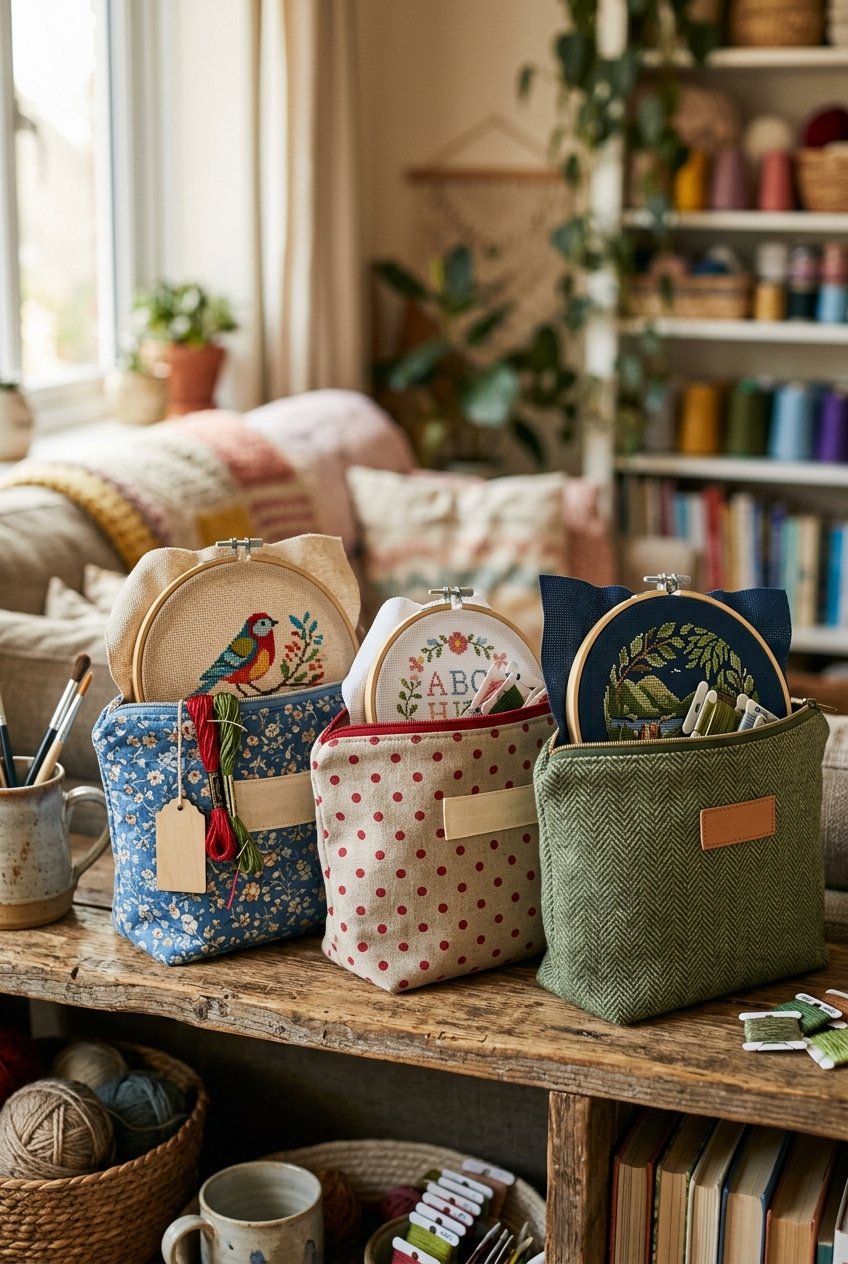
Three labeled cross stitch project bags on a wooden shelf holding separate works in progress
Project Bag vs. Craft Tote: Not the Same Thing
People use the terms interchangeably and then wonder why their system doesn't work. A craft tote is a container for supplies. A project bag is a container for one project. Those are opposite jobs.
The tote holds your floss box, spare hoops, fabric scraps, the little scissors you keep losing, and whatever else you carry to a stitching group. It's wide, open, and general purpose. Nothing in it belongs to any particular design.
The project bag holds a specific design mid-flight. Its whole value is that the contents are decided. You never open it and think about what to work on, because it only contains one answer. That's why a large multi-compartment tote makes a poor substitute: the open space invites cross-contamination between projects, which is the exact problem you were trying to solve.
In practice, most stitchers I know end up with both. A tote for the trip to the guild meeting or the stitching retreat, with two or three project bags inside it. That layering works beautifully. Each bag stays closed until it's that project's turn.
One more distinction worth naming. Project bags are also how you handle a BAP honestly. If you're working a big piece that will take a year, the bag becomes that project's permanent address until it's an FFO. And if you find a bag you haven't opened in eighteen months, that's useful information about whether the piece is still yours to finish.
|
Patterns from the Sunrays Collection Tracey's Picks, designing cross stitch patterns since 2004 | |||||
| |||||
| Browse the full Sunrays collection → |



Setting Up Your Bags So the System Actually Holds
Buying bags is the easy part. Making the habit stick takes about two weeks and a few small rules.
Pack the bag the moment you start a new design. Cut your Aida, prepare the edges, hoop it, wind the floss for the first section, print or load the chart, and put all of it in the bag before you stitch the first X. Starting a project and packing it are the same action. If you stitch for a week off the kitchen table and then try to gather it up afterward, something will already be missing.
Label the outside. A luggage tag, a stitched initial, a strip of masking tape with the pattern name. When you have four bags of the same style, you will not remember which is which. I write the design name and the fabric count, because future me always wants to know whether it's 18-count or something else before she opens it.
Repack every single time you stop. Needle parked on the minder, scissors in the mesh pocket, chart in the flat sleeve, zip. Ten seconds. This one habit prevents almost every problem in this article. The bag you closed properly is the bag you'll happily open next week.
Refresh the floss as you move through the chart. When you finish a color block, take those bobbins out and put them back with your stash, and add the colors for the next section. The bag stays lean. This also gives you a natural progress check, which is satisfying in a way I didn't expect until I started doing it.
Keep an ORT catcher inside. A small zip pouch or a tiny tin for thread ends means you're not shaking clippings out of the bag onto the floor. It also keeps stray ORTs from getting caught in your work and stitched over, which happens more than anyone admits.
Cap your number. Mine is three active bags. One easy design for tired evenings, one detailed piece for good light and a clear head, one seasonal project that needs to be done by a date. More than three and I stop finishing things. Your number might be two or five, but pick one and let the bags enforce it. When every WIP needs a bag and you've run out of bags, the system tells you the truth.
Get Stitching Tips & New Patterns from Tracey
Honest advice, new Sunrays designs, and occasional VIP-only offers. No fluff.
No spam. Unsubscribe any time.

Tracey Recommends
LoDrid Embroidery Project Bag, Square Supplies Storage Tote, Totem
The square shape is the whole point here, because it lets a hooped project lie flat instead of getting squeezed into an oval. Mine holds a 6-inch wooden hoop, the chart, and the working floss without crowding. If you only buy one bag, make it a boxy one.
Check Current Price →Give every project its own bag and the tangles, the lost needles, and the twenty-minute hunt before stitching simply stop happening. It's the smallest change with the biggest return I've made in 22 years at this. If you're ready to fill a fresh bag with something beautiful, come browse the Sunrays Creations pattern collection and pick the design that's going to keep you company this season.
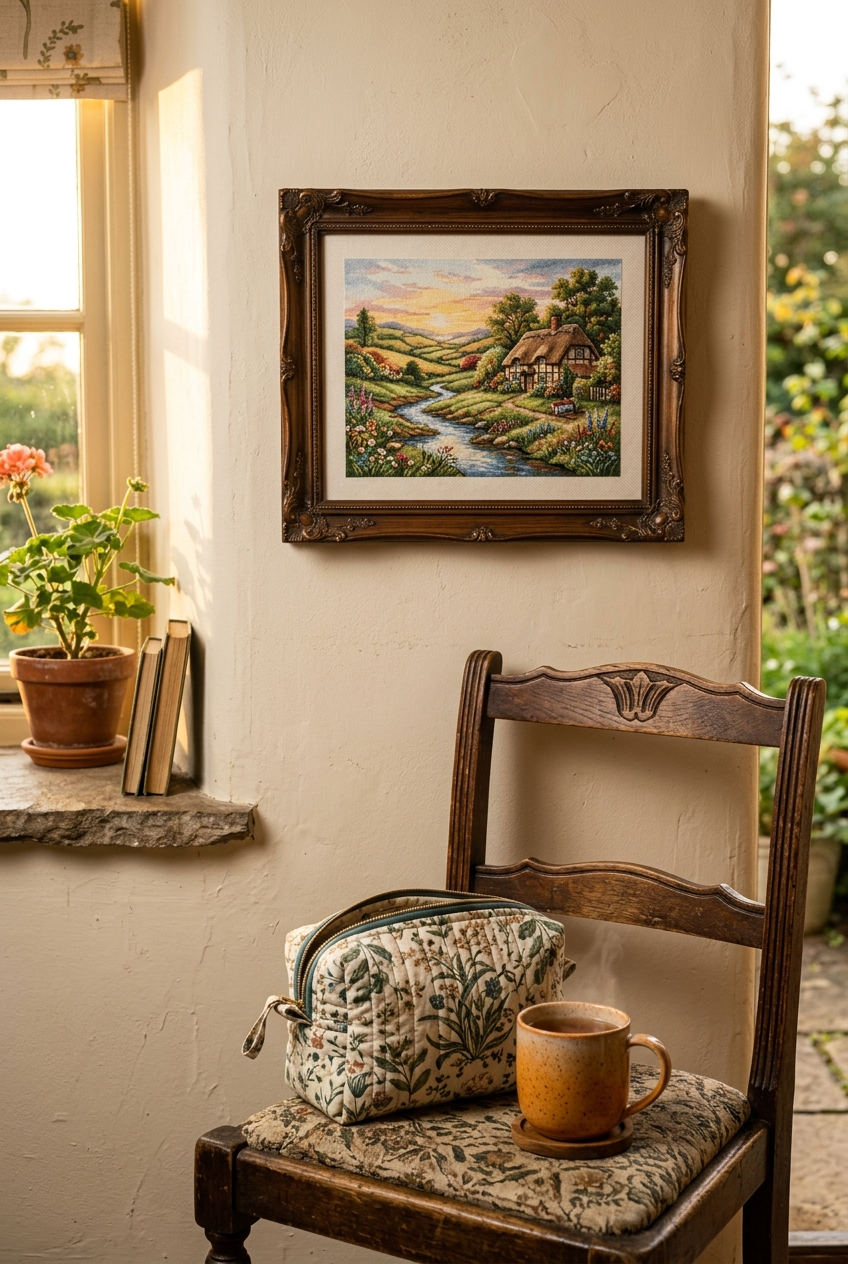
Framed finished cross stitch landscape above a zipped project bag and warm mug of tea
Keep Reading
Can You Take Cross Stitch on a Plane? Needles, Scissors and Snips
Your project bag is also your carry-on bag. This post covers what actually makes it through security and how to pack needles and snips.
Read the GuideUnfinished Cross Stitch Projects: When to Quit or Push On
If you've got more bags than you can count, this one helps you decide which WIPs deserve your next hour and which are done being yours.
Decide What StaysCross Stitch Hoop vs. Q-Snap vs. Scroll Frame — Which Should You Use?
The frame you choose sets the size of bag you need. Here's how hoops, Q-snaps, and scroll frames compare for everyday stitching.
Compare Your OptionsFrequently Asked Questions
What is a cross stitch project bag?
It's a small zippered bag that holds one in-progress design and everything that design needs: the hooped fabric, the chart, the floss currently in use, scissors, and needles. It's different from a craft tote, which holds general supplies rather than one specific project.
Do I really need a separate bag for every project?
If you have more than one WIP going, yes. Sharing a container is how floss from one design ends up tangled in another and how needles get lost in the lining. One bag per project means you can sit down and start stitching in thirty seconds.
What size project bag should I buy?
Measure your hoop and add about two inches. I use 5 to 6 inch wooden hoops on 18-count Aida, and a square bag that lets the hooped fabric lie flat works better than a rounded tote that squeezes it. Q-snap users need the same rule with a larger footprint.
Should I keep all my floss in the project bag?
No. Only carry the six to ten colors you're actively stitching, wound on bobbins or clipped to a ring. The rest stays in your storage at home. Carrying the whole palette is exactly how tangles and missing colors start.
Zipper or drawstring for a project bag?
Zipper. A drawstring lets everything spill when the bag tips over, and it doesn't keep dust or pet hair off your fabric. Your Aida gets handled for months before it's framed, so a real closure saves you cleaning later.
How many active project bags should I have?
Mine is capped at three: one easy design, one detailed piece, and one with a deadline. Pick your own number and let the bags enforce it. When every WIP needs a bag and you're out of bags, that's the system telling you the truth.
-- Tracey Kramer
Founder & Designer, Sunrays Creations Needlearts
Hand-charted designs since 2004 • Marysville, Ohio