
Cross Stitch vs. Embroidery: What's the Difference and Which Should You Learn?
Posted by Tracey M. Kramer on 17th Aug 2026
A Note from Tracey Kramer
I have been designing counted cross-stitch patterns since 2004, and in that time I have watched my customers stitch everything from wedding gifts to heirloom samplers. This is everything I know about this topic -- from real experience, not theory.
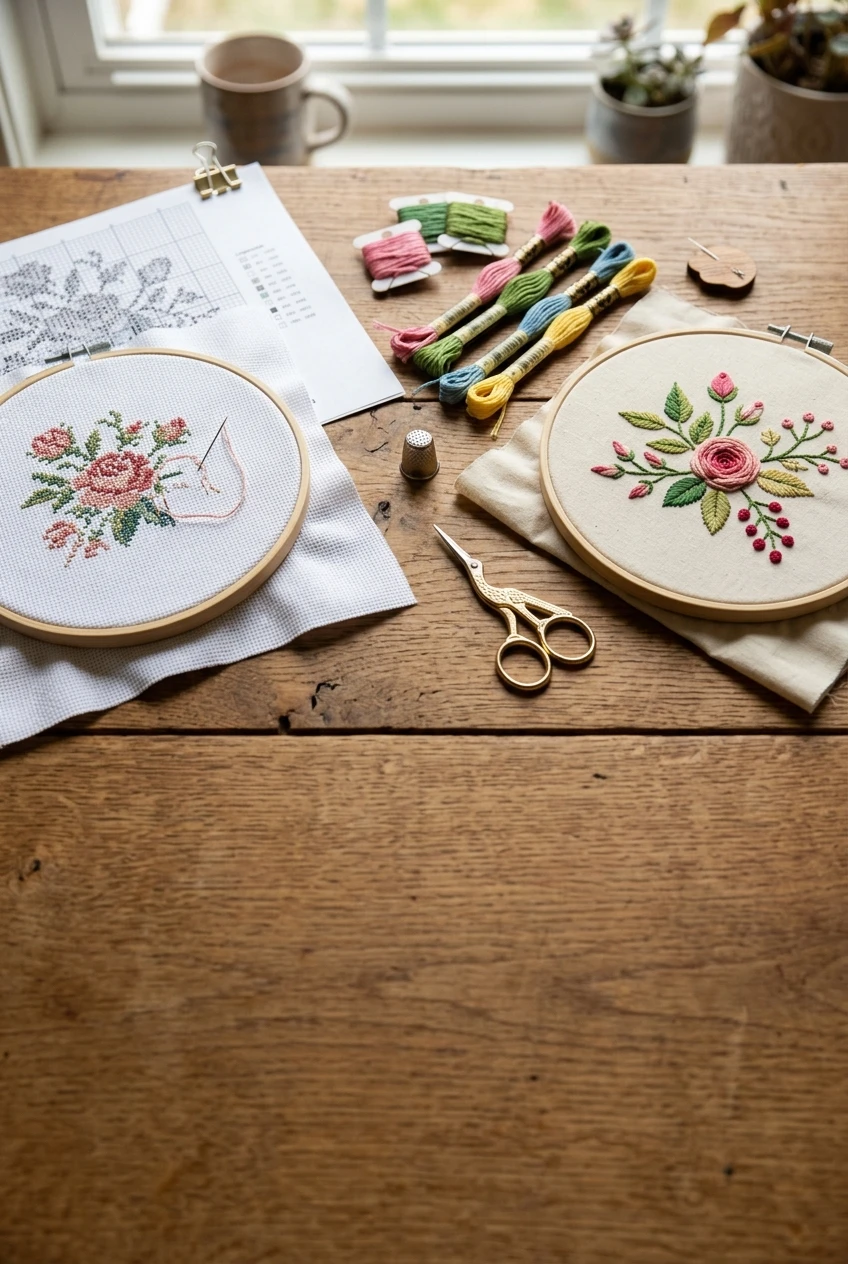
Cross stitch vs embroidery comparison with counted Aida hoop and freehand embroidered floral hoop
By Tracey Kramer • • 12 min read
If you've been scrolling craft videos wondering why one person is counting little squares while another is stitching freehand flowers onto a plain piece of cotton, you've spotted the real difference already. Cross stitch is counted work: you make identical X stitches on an evenweave grid, following a chart, and the fabric itself tells you where every stitch goes. Surface embroidery is freehand: you trace a drawn line onto almost any fabric and use dozens of different stitches to fill it. After 22 years of designing counted charts, I'll give you a straight answer on which one to learn first, and I'll be fair about where the other one wins.
The One Difference That Explains Everything Else
People ask me constantly whether cross stitch is just a type of embroidery. Technically, yes, cross stitch lives under the big umbrella of needlework, and the cross stitch itself is an embroidery stitch. But in practice they are two different experiences, and the difference comes down to a single word: counted.
In counted cross stitch, the fabric does half the thinking for you. Aida cloth is woven in a regular grid of tiny squares, each one with a clean hole at every corner. You come up at one hole, down at the opposite corner, and you have half a stitch. Do the mirror image and you have a full X. Every stitch on the piece is the same size, the same shape, and the same angle as every other one. The pattern is a chart, a grid of colored symbols where one square equals one stitch, and your job is to put the right color in the right square. There is no drawing, no tracing, no judging whether a curve looks right.
Surface embroidery flips that. The design gets transferred onto the fabric as a drawn line, and you stitch along that line using whatever stitch the design calls for: stem stitch for a vine, satin stitch for a petal, French knots for the center of a flower, long and short stitch for shading. The fabric is usually a plain woven cotton or linen with no visible grid, so nothing is guiding your needle except your own eye and hand. You decide how long the stitch is, how steep the angle is, how densely you pack the fill.
That is the whole thing. Counted on a grid versus drawn and stitched freehand. Once you understand that, everything else falls into place: why the fabrics are different, why the learning curves feel different, why cross stitch charts look pixelated and embroidery designs look painterly, and why one of these crafts is easier to start on a Tuesday night with zero experience.
What the Two Crafts Share, and Where the Supplies Split
Here's the good news for anyone worried about buying two entire sets of supplies. The overlap is bigger than most beginners expect.
The floss is identical. DMC six-strand floss (find on Amazon) serves both crafts. The same skein of 321 red can sit in a counted chart or fill a freehand rose. Six strands twisted together, and you separate out however many you need. For my designs on 18-count I always recommend two strands, because two gives you full, even coverage without crowding the holes. Embroiderers might use three, four, or all six depending on the stitch and the effect they want. Same product, different portioning. If you already have a floss box, you already have half of what either craft requires.
The hoop is mostly the same too. A 5 to 6 inch wooden or plastic embroidery hoop (find on Amazon) works beautifully for both. I use one for every project I stitch. It keeps the fabric drum-tight so your tension stays consistent, and a smaller hoop is easier on your hands over a long evening. Some stitchers prefer Q-snaps or scroll frames, and those are perfectly valid options, but the humble hoop has never let me down in 22 years. Both crafts also want a pair of small sharp scissors (find on Amazon) close at hand, and both benefit enormously from good lighting.
The needles split. This is where the supplies diverge. Cross stitch uses a tapestry needle with a blunt tip, because you are aiming for existing holes in the weave and you do not want to pierce the threads of the fabric. Embroidery uses a sharp crewel needle, because it has to punch through solid cloth wherever the design line goes. A size 24 or 26 tapestry needle covers most counted work.
The fabric splits hard. This is the real supply difference. Counted cross stitch needs an evenweave fabric with a countable grid. Every pattern I design is charted for 18-count Aida cloth (find on Amazon), which means 18 stitches per inch and a finished piece with lovely detail without being punishing to see. Surface embroidery does not care about thread count at all. It goes on quilting cotton, on linen, on denim, on whatever holds a stitch. That freedom sounds appealing until you realize the fabric is no longer helping you place anything.

Tracey Recommends
ETSPIL Embroidery Kit for Beginners, 4K Step-by-Step Video, Adults, Gift
If you want to test the freehand side before committing, this is the cheapest honest way to do it. Pre-printed designs, a hoop, floss, and needles all in one box. Spend an evening with it and you'll know instantly whether stitching without a grid feels freeing or frustrating.
Check Current Price →Cross stitch is counted on a grid. Embroidery is drawn and stitched freehand. That single difference explains the fabric, the tools, the learning curve, and which one is going to suit you.
Which Is Easier to Learn? My Honest Answer
I'm not going to give you a diplomatic non-answer here. For most complete beginners, cross stitch is the easier place to start. I say that as someone who designs counted charts for a living, so take the bias into account, but the reasoning holds up.
The grid removes freehand judgment. When you sit down with a chart and a piece of Aida, you never have to ask whether your stitch is the right length or whether that curve looks natural. The answer is already decided. You are matching symbols to squares. That sounds mechanical, and honestly it is, but that is exactly what makes it approachable when you've never held a needle. You cannot make a stitch that is subtly the wrong size, because there is only one size.
Progress is visible right away. Twenty minutes into a first cross stitch project you have a recognizable patch of color sitting on the fabric, and your brain rewards you for it. Twenty minutes into a first freehand embroidery you may still be fussing with a satin stitch fill that looks lumpy, and you might not know why it looks lumpy. That gap in early feedback is the reason a lot of people quit embroidery and stick with cross stitch.
The mistakes are also easier to diagnose. In counted work, if something's wrong, you miscounted. Frogging a few stitches and recounting fixes it. In freehand work, if something's wrong, it might be your stitch length, your angle, your tension, your thread count, your transfer line, or your fabric choice, and untangling which one takes experience you don't have yet.
There is one genuine hurdle on the cross stitch side, and it's fair to name it: you have to learn to read a chart and keep your place. That trips people up in week one. Gridding your fabric before you start, and starting from the center, solves most of it. It is a skill you learn once and then own forever.
So if you have no craft background at all and you want to feel successful this week, start with counted cross stitch. Get a small kit or a simple chart, work it start to finish, and let the win build your confidence.
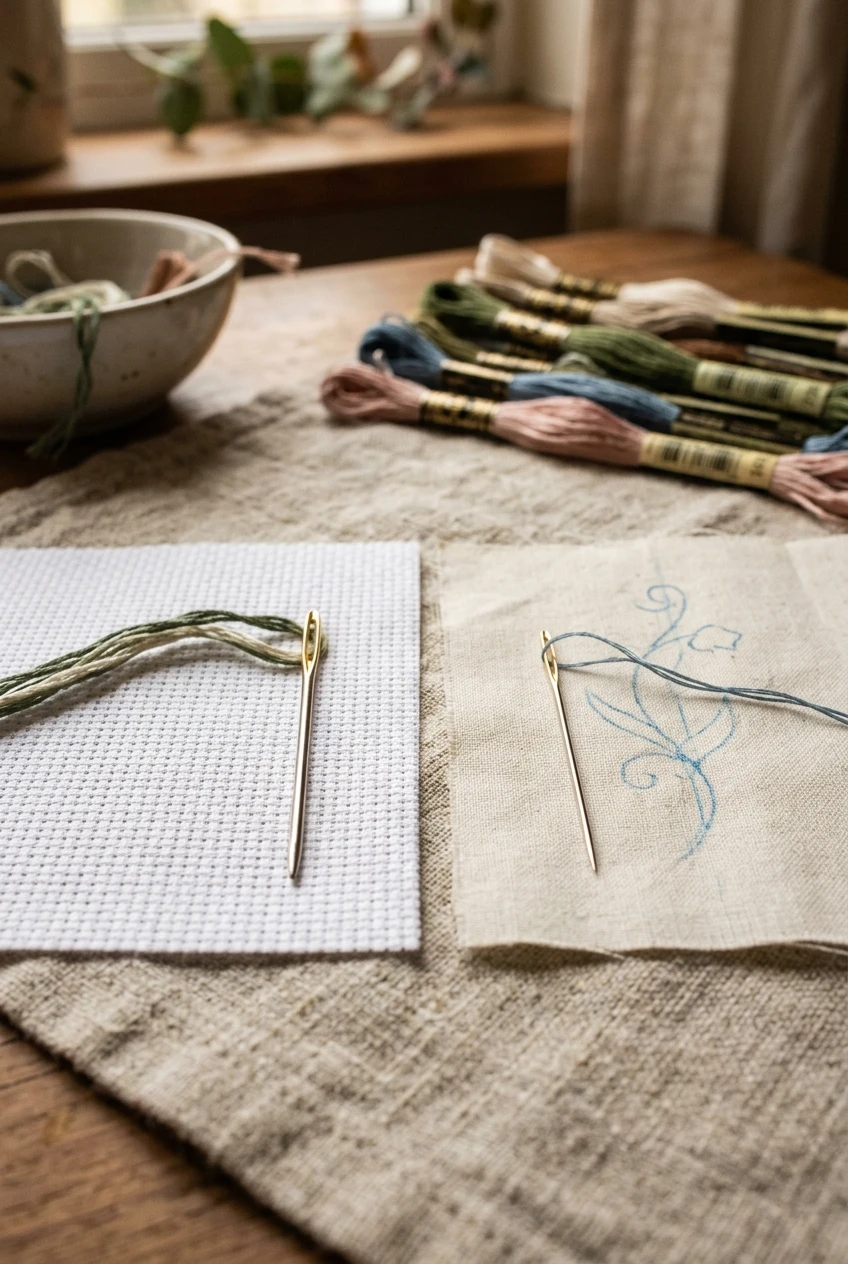
Blunt tapestry needle on Aida grid beside sharp crewel needle on plain cotton fabric
Where Surface Embroidery Genuinely Wins
Being honest about cross stitch means being honest about its limits, and it does have them.
Smooth curves and organic shapes. Cross stitch renders everything as squares. On 18-count that pixelation is fine and often beautiful, but a single flowing line, a delicate script signature, a wispy strand of hair, those things are the natural territory of a stem stitch worked freehand. A curve in counted work is a staircase of tiny squares that reads as a curve from a few feet away. A curve in embroidery is actually a curve.
Blended shading. Long and short stitch lets an embroiderer fade one color into another with no visible boundary. Counted work achieves shading through careful color placement and blending two strands of different colors in the needle, which I love and use constantly in my fine art designs, but it works by optical mixing rather than by literal gradient.
Texture and dimension. Bullion knots, woven picots, raised satin work, all of it gives embroidery a physical relief that flat X stitches simply cannot produce. A cross stitch piece is uniform in height. An embroidery piece can be sculptural.
Speed on sparse designs. A simple line drawing of a bouquet might take an embroiderer an evening. Charting that same bouquet as full coverage counted work could take weeks. Cross stitch trades time for precision and repeatability, and that trade is worth it when the goal is a detailed piece of framed wall art, but it is a real trade.
Where cross stitch wins in return is consistency and reproducibility. Ten stitchers working the same chart on the same count produce ten pieces that look essentially the same. Ten embroiderers working the same design produce ten pieces with ten personalities. Neither of those is better. They're different goals.
|
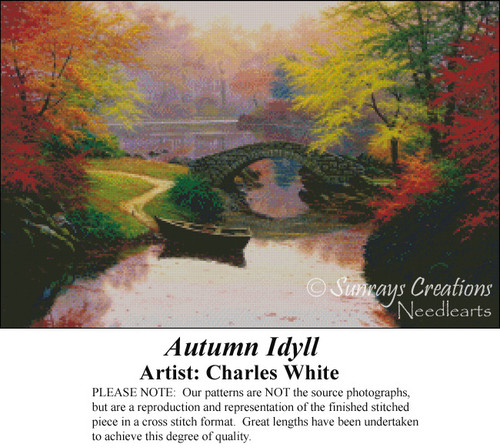
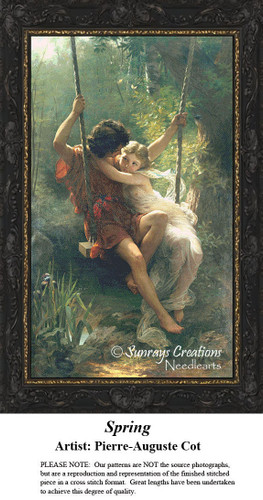
Patterns from the Sunrays Collection Tracey's Picks, designing cross stitch patterns since 2004 | |||||
| |||||
| Browse the full Sunrays collection → |

Can You Combine Both in One Piece? You Already Are
Here's the part that surprises new stitchers most. If you've done any cross stitch at all, you have already done surface embroidery without calling it that.
Backstitch is the obvious example. Almost every counted chart I publish includes backstitch outlining, and backstitch is a surface embroidery stitch. You are running a line along the fabric to define an edge, sharpen a face, or separate two similar colors. It is not an X, it is not confined to a single grid square, and it transforms a piece from soft and blocky to crisp and finished. French knots are the same story: pure embroidery, used constantly inside counted designs for eyes, berries, flower centers, and snow.
Then there are the specialty stitches that show up in counted work all the time. Half stitches, three-quarter stitches, quarter stitches, long stitches for whiskers and wire and grass. Every one of those is a small step out of the grid and into freehand territory, done with the grid as a safety net.
So the honest framing is not cross stitch versus embroidery. It's that counted cross stitch is a structured discipline that borrows freehand stitches whenever it needs them. Learning cross stitch first hands you thread control, tension, needle handling, floss separation, and hoop technique. All of that carries straight over the day you decide to try a freehand piece. The reverse is also true, though the counting is a genuinely new skill either way.
Most stitchers I know, including me, end up doing both. Counted charts for the big framed pieces I want to hang on a wall for thirty years, and the occasional freehand accent when a design asks for something the grid can't give it.
Get Stitching Tips & New Patterns from Tracey
Honest advice, new Sunrays designs, and occasional VIP-only offers. No fluff.
No spam. Unsubscribe any time.

Tracey Recommends
ORIGACH 6 Pcs Flower Cross Stitch Bookmark Kit for Beginner with Backing Felt Floss Instruction Sunflowers Tulip DIY Stamped Embroidery Bookmark Kit for Starter Adults Book Lovers
A bookmark is the perfect first counted project because it finishes fast and teaches chart reading without a big commitment. You get the full experience of matching symbols to squares and watching a design appear. Finish one and you'll understand why counted work hooks people for decades.
Check Current Price →How to Decide Without Guessing: Try Each One Cheaply
If you're still torn, don't agonize. Spend fifteen or twenty dollars and let your hands tell you which one you like. This is genuinely the best advice I can give someone stuck between the two, and it costs less than one nice skein-hoarding trip to the craft store.
Buy a small beginner embroidery starter kit with a pre-printed design, a hoop, floss, and needles included. Work it in an evening or two. Notice whether the freehand aspect feels liberating or stressful. Some people find it delightful that nothing is dictating their stitch placement. Others feel unmoored by it. There is no wrong reaction, and you'll know within about half an hour which camp you're in.
Then buy a small counted cross stitch project, something like a bookmark kit, and do the same. Notice whether following a chart feels calming or tedious. Notice how you feel when a block of color emerges exactly the way the chart said it would. That satisfaction is the engine that keeps cross stitchers going for decades.
Whichever one you fall for, start small and finish it. A finished bookmark beats an abandoned masterpiece every single time. Once you have a completed piece in your hands, move up to a real chart that you actually love looking at, because loving the picture is what carries you through the middle third of a project when the novelty has worn off.
And if you land on counted cross stitch, which I hope you do, come look at what I design. My charts are all worked for 18-count Aida cloth and finished as framed wall art, because that's what I believe this craft does best: a piece good enough to hang, made stitch by stitch, that outlives everyone who watched you make it.
The two crafts aren't rivals, and most of us end up with both in the rotation eventually. But if you want to sit down this weekend and finish something you're proud of, counted cross stitch is where I'd point you. Browse the Sunrays Creations pattern shop when you're ready for a design worth framing, and pick the picture you can't stop looking at.
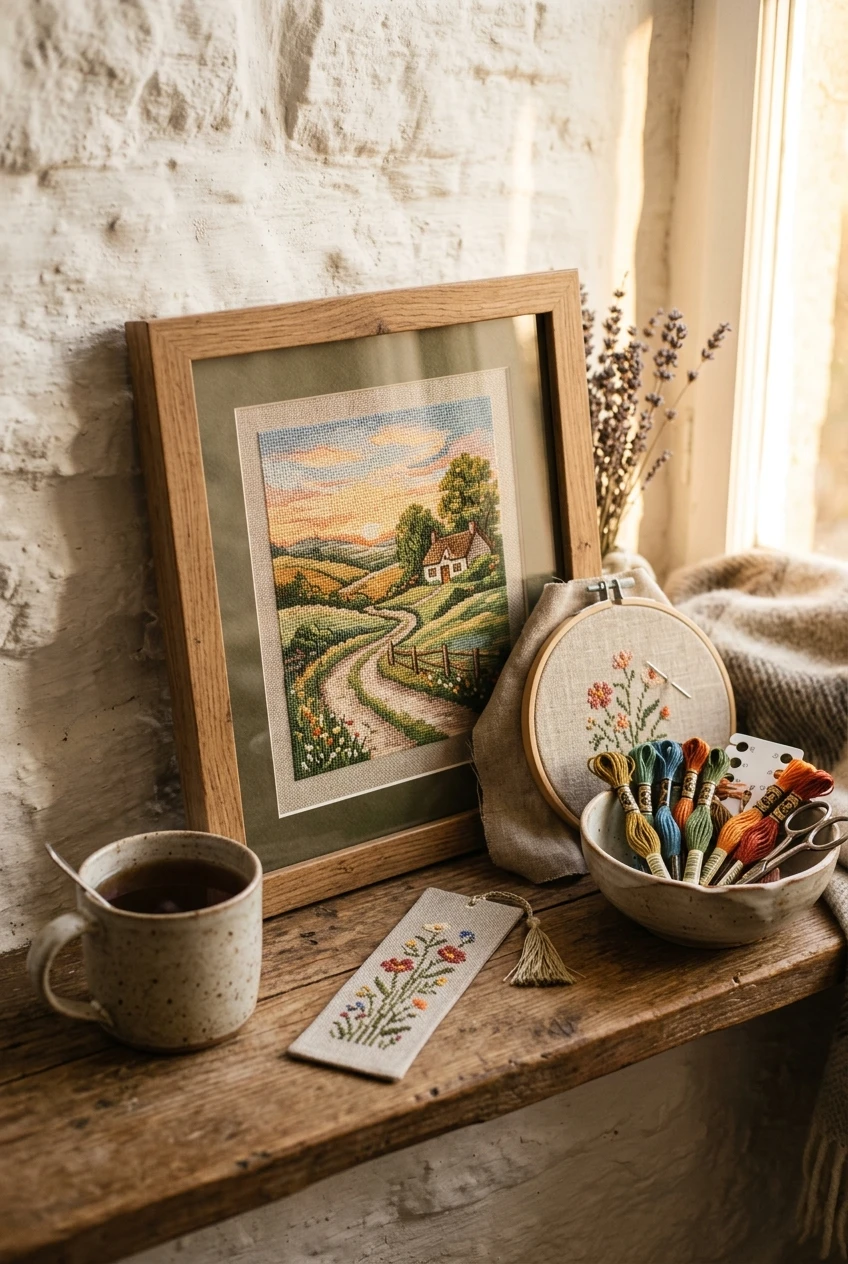
Framed finished cross stitch wall art with bookmark, hoop, and floss in warm cottagecore light
Keep Reading
Cross Stitch vs Needlepoint: More Similar Than You Think
Embroidery isn't the only craft people confuse with cross stitch. Needlepoint is a different comparison entirely, and this one breaks it down.
Read the ComparisonBackstitch in Cross Stitch: The Outlining Technique That Transforms Your Work
Backstitch is the surface embroidery stitch that lives inside almost every counted chart. Here's how to use it well.
Learn BackstitchCross Stitch for Beginners: Everything You Need to Start Your First Project Today
Decided on counted work? This walks you through supplies, fabric, and your very first stitches from scratch.
Start HereFrequently Asked Questions
Is cross stitch the same as embroidery?
Cross stitch sits under the broad umbrella of needlework, and the cross stitch itself is an embroidery stitch. But counted cross stitch is a distinct discipline: you work identical X stitches onto a grid fabric from a chart. Surface embroidery is freehand stitching along a drawn line using many different stitch types.
Which is easier, cross stitch or embroidery?
For most complete beginners, cross stitch is easier. The grid removes freehand judgment about stitch length, angle, and curve, so you can't accidentally make a stitch the wrong size. Progress is also visible within the first twenty minutes, which keeps new stitchers going.
Can you use the same floss for both crafts?
Yes. DMC six-strand floss serves both. The only difference is how many strands you separate out. I use two strands on 18-count Aida, while embroiderers might use three to six depending on the stitch and the effect.
Do cross stitch and embroidery use the same needles?
No, and this is the main tool split. Cross stitch uses a blunt tapestry needle because you're aiming for existing holes in the weave. Embroidery uses a sharp crewel needle because it has to pierce solid fabric wherever the drawn line goes.
Can you combine cross stitch and embroidery in one piece?
You already do. Backstitch outlining and French knots are surface embroidery stitches, and they appear in nearly every counted chart I publish. Half stitches, quarter stitches, and long stitches are all small steps out of the grid with the grid still there as a safety net.
What fabric do I need for each one?
Counted cross stitch needs an evenweave fabric with a countable grid, and every pattern I design is charted for 18-count Aida cloth. Surface embroidery doesn't care about thread count and goes on quilting cotton, linen, denim, or almost anything that holds a stitch.
Which should I learn first if I've never crafted at all?
Start with counted cross stitch. Buy a small bookmark kit, finish it, and let that win build your confidence. The thread control, tension, and hoop technique you learn carry straight over if you later try freehand embroidery.
-- Tracey Kramer
Founder & Designer, Sunrays Creations Needlearts
Hand-charted designs since 2004 • Marysville, Ohio