
DMC Discontinued Floss Colors: List & Replacements | Sunrays Creations
Posted by Tracey Kramer on 12th Apr 2026
DMC discontinued floss colors are one of the most frustrating surprises in cross stitch — you're mid-project and a color number simply doesn't exist anymore. Over the years DMC has quietly retired dozens of colors from their range, leaving stitchers working from older patterns stranded with no official replacement list. After 22 years of designing patterns at Sunrays Creations, I've been there more times than I can count — so I built this complete guide, plus a free Delta-E color matcher, to take the guesswork out of it entirely.
DMC discontinued floss colors — what to do when your pattern calls for a number that no longer exists.
Why Does DMC Discontinue Colors?
DMC doesn't publicize their reasoning when they retire a color, but after years of watching the range evolve, several patterns emerge.
Low sales volume is the most common reason. DMC produces hundreds of colors, and the bottom-sellers in the range get cut in periodic reviews. If a color isn't moving, it's a candidate for discontinuation regardless of how much stitchers love it.
Dye chemistry changes also play a role. Environmental regulations have tightened significantly over the decades, and some dye formulations used for earlier colors are no longer viable under modern standards. When the dye can't be reproduced to DMC's quality standards, the color goes away.
Range consolidation happens when DMC feels they have too many similar colors clustered in one area of the spectrum. You'll sometimes see two neighboring shades disappear and a new one appear roughly between them.
Whatever the reason, the result is the same: stitchers holding patterns that call for colors they can no longer buy new. It's particularly acute with vintage patterns — anything published before 2000 is likely to have at least one or two numbers that have since been retired. I've worked through dozens of these situations with customers over the years, and the good news is that a close match almost always exists. You just need the right method to find it.
The Discontinued DMC Colors — What We Know
The most significant wave of discontinuations hit the variegated 100-series — colors numbered 101 through 126. These were multi-tonal variegated threads that shaded through two or more colors along the skein. They were beloved for the organic, painterly effects they created, particularly in floral and landscape patterns. DMC phased them out entirely and hasn't replaced them with anything comparable in the same numbering range.
The discontinued variegated colors include:
- DMC 101 — Variegated Pink
- DMC 102 — Variegated Lavender
- DMC 103 — Variegated Coral Rose
- DMC 104 — Variegated Carnation
- DMC 105 — Variegated Summer Sky
- DMC 106 — Variegated Sunrise
- DMC 107 — Variegated Forget-Me-Not
- DMC 108 — Variegated Cobalt Blue
- DMC 111 — Variegated Mustard
- DMC 112 — Variegated Sunrise Yellow
- DMC 113 — Variegated Pastel Peach
- DMC 114 — Variegated Sunrise Red
- DMC 115 — Variegated Garnet
- DMC 116 — Variegated Dusty Rose
- DMC 117 — Variegated Blue Bonnet
- DMC 118 — Variegated Forget-Me-Not Dark
- DMC 119 — Variegated Purple Haze
- DMC 120 — Variegated Wisteria Blue
- DMC 121 — Variegated Daffodil
- DMC 122 — Variegated Apple Green
- DMC 123 — Variegated Sailor Blue
- DMC 124 — Variegated Wild Violet
- DMC 125 — Variegated Mellow Yellow
- DMC 126 — Variegated Coral
Beyond the 100-series, various individual colors have been retired across the standard range over the years. Some were "A" variants — alternate versions of existing colors — and some were standalone colors that simply didn't survive successive range updates. If you're ever unsure whether a number is current or discontinued, our Floss Conversion Tool will tell you immediately and show you the closest active replacement.
It's also worth noting that DMC's Color Variations range — the four-digit numbers like 4010, 4020, and so on — are a separate variegated line that is currently active. These are sometimes confused with the discontinued 100-series, but they're distinct products. If a pattern calls for a four-digit DMC number, that thread is still available.
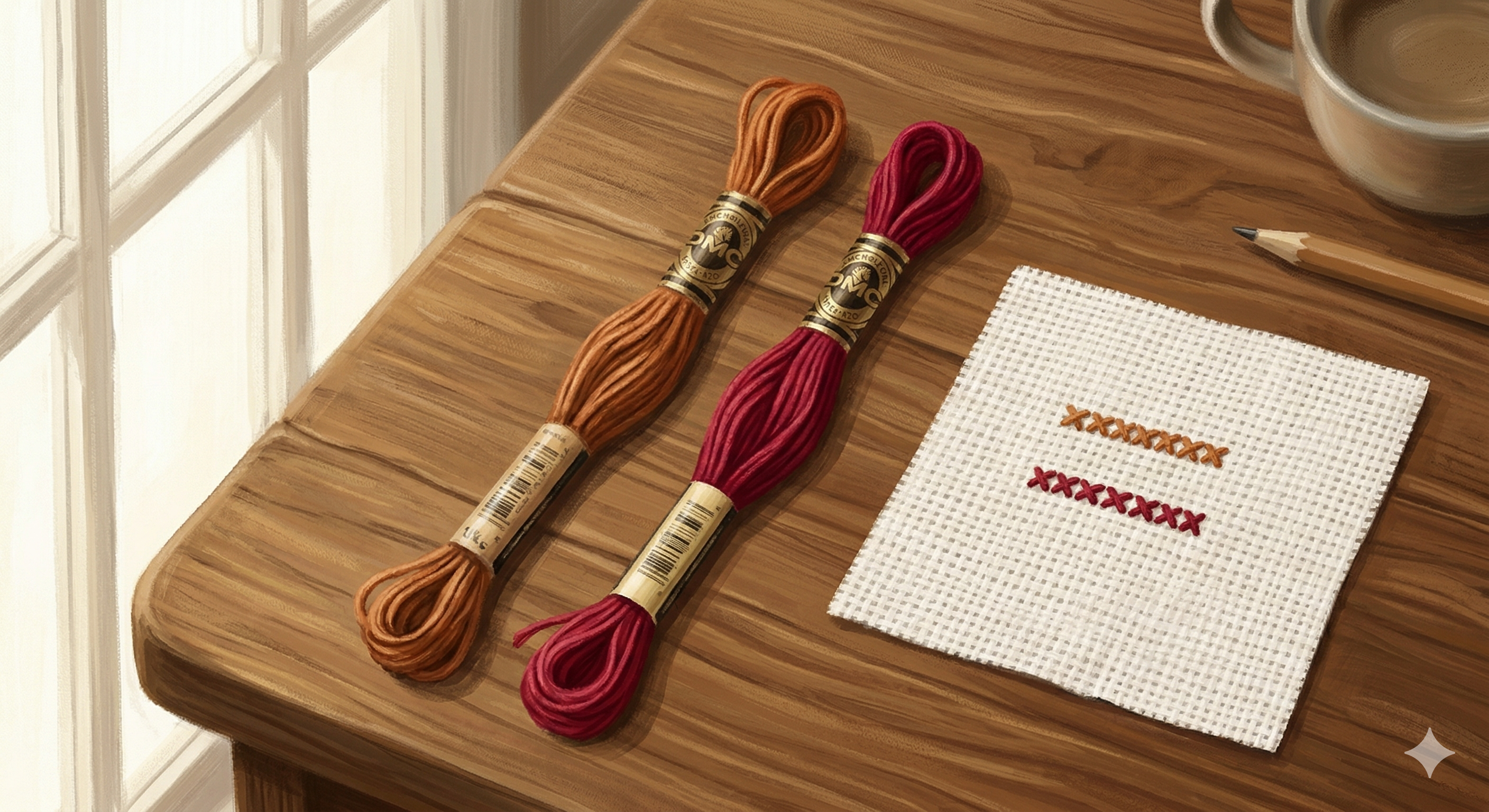
A small test section on scrap Aida is the best way to confirm a substitution before committing to a full project.
Finding the Closest Replacement: The Right Way to Do It
Here's where most guides fall short. They give you a rough conversion chart — "DMC 115 is close to DMC 815" — without explaining how that comparison was made or how accurate it really is. Eyeballing two skeins next to each other is subjective. Comparing color names is even less reliable. What you need is a way to compare colors the way your eye actually perceives them.
That's where Delta-E color science comes in.
Delta-E (ΔE) is the standard measurement used by color scientists, textile manufacturers, and print professionals to quantify how different two colors appear to the human eye. It works in the Lab color space — a model designed specifically to match human visual perception rather than the way screens or printers represent color. A ΔE value below 2 is considered imperceptible to the human eye. Between 2 and 10 is a close but noticeable match. Above 10, the colors are clearly different.
We've built a free DMC Discontinued Color Matcher directly into our Floss Conversion Tool that uses exactly this method. You enter your discontinued DMC number, and it runs Delta-E calculations against every current DMC color in the range, returning the top 5 closest matches ranked by perceptual similarity — not guesswork. It also converts across Anchor, Madeira, and J&P Coats, so if you find a Madeira color that's a closer match than any current DMC option, you'll know.
Free DMC Discontinued Color Matcher
Enter any discontinued DMC number and find the closest current replacements using Delta-E perceptual color science. Also converts across Anchor, Madeira, and J&P Coats.
Open the Floss Conversion Tool →When the Variegated Effect Matters
For the discontinued 100-series variegated colors, finding a "closest match" is more complicated — because you're not just matching a single color, you're trying to replicate a color that shifts along the thread.
Here's how I approach it when a pattern calls for a discontinued variegated DMC:
Option 1: Use a current variegated thread. DMC still produces their Color Variations range (4-digit numbers like 4010, 4100, etc.) which are multi-tonal. They won't be identical, but they preserve the variegated effect. Match by dominant color family.
Option 2: Blend two solid colors. Pull two strands of one color and one strand of a close neighbor to create a subtle blend effect in the needle. This works beautifully for backgrounds and large fill areas where the transition is gradual anyway.
Option 3: Use the closest solid. For detailed areas where the variegated color appears in small amounts, the closest solid match is often indistinguishable in the finished piece. Our color matcher will give you that solid match, ranked by Delta-E score so you know exactly how close it is.
Option 4: Hunt for the discontinued thread itself. This is more work, but it's possible. Check eBay, Etsy vintage sellers, local needlework shop clearance bins, and cross stitch destash sales on Facebook groups and Reddit's r/CrossStitch. Old stock does turn up — especially for the popular 100-series colors that stitchers have been hoarding since the discontinuation.
My honest recommendation is to start with Option 1 or 3 depending on how prominent the color is in the design. Reserve the hunt (Option 4) for heirloom pieces where the original color really matters. And whatever you choose, always test on scrap 18-count Aida → Shop Amazon before committing to the full piece.
What About Your Existing Stash?
If you have discontinued DMC floss already in your stash — keep it. Thread doesn't expire. Properly stored floss lasts indefinitely, and the color remains stable as long as it's kept away from direct sunlight and humidity. The only time discontinued thread becomes a problem is when you need more of it mid-project.
This is actually one of the strongest arguments for planning your thread purchases before starting a project: buy more than you think you need. Running out of a color mid-project is frustrating with any thread, but running out of a discontinued one means you're either hunting for old stock or making a substitution mid-piece — and mid-piece substitutions are the hardest kind, because the color has to match not just the pattern spec but your existing stitches.
A good floss bobbin organizer → Shop Amazon helps enormously here — when your discontinued colors are properly labeled and stored with your current stash, you always know exactly what you have and how much is left before you start a new project.
For large projects especially — what stitchers call a BAP (Big Ass Project) — I always recommend buying at least one extra skein per color beyond your calculated needs. The time and emotional investment in a large project isn't worth the risk of a dye lot mismatch or a discontinued color crisis halfway through. If you're tackling a big piece, read my guide on managing large cross stitch projects before you start.
The DMC Range Today
The current active DMC stranded cotton range runs to over 450 colors, covering an extraordinary spectrum from the palest whites through deep, saturated jewel tones. It's one of the widest color ranges in any embroidery thread brand — which is part of why the discontinuations sting. With that many colors available, it seems like nothing should ever need to disappear.
The current range is organized around logical color families — pinks and roses, blues and teals, greens, neutrals, earth tones — with multiple light-to-dark values within each family. For most discontinued colors, a close match exists somewhere in the current range. The question is just finding it accurately, which is exactly what Delta-E matching is designed to do.
Our Floss Conversion Tool covers the full current range with color swatches and conversions across Anchor, Madeira, and J&P Coats — so you can search by any brand number and find the equivalent in any other brand. That cross-brand conversion matters when you're pattern-matching: if you find a Madeira color that matches your discontinued DMC better than any current DMC option, you should absolutely use it. The goal is the best visual result, not brand loyalty.
Tips for Working With Older Patterns
If you work frequently from vintage patterns — particularly those published before 2000 — here are the practices I've settled on over 22 years of designing and stitching:
Check the color list before purchasing anything. Run every color number through a current DMC list before buying thread. A five-minute check before you start saves hours of frustration mid-project. Our Floss Conversion Tool will flag any discontinued numbers immediately.
Note substitutions directly on your pattern. If you're using DMC 892 as a replacement for discontinued DMC 104, write it directly on your pattern copy next to the original number. Future you will thank present you — especially if you set the project down and pick it back up six months later.
Use the parking method for complex color areas. When you're working through a section with multiple substituted colors, the parking method keeps your substituted threads organized and lets you compare colors in context as you work. It's particularly valuable when you're uncertain whether a substitution looks right — you can see how the color sits next to its neighbors before fully committing to a section.
Test before committing. If you're unsure about a substitution, stitch a small test section before proceeding. A few stitches on scrap Aida can save you from frogging an entire section. Color looks different stitched than it does on the skein — always test.
Keep a substitution log. If you stitch from vintage patterns regularly, keeping a running document of substitutions you've successfully used is one of the most underrated time-savers in cross stitch. When the same discontinued color comes up in a future pattern, you already have a tested replacement waiting.
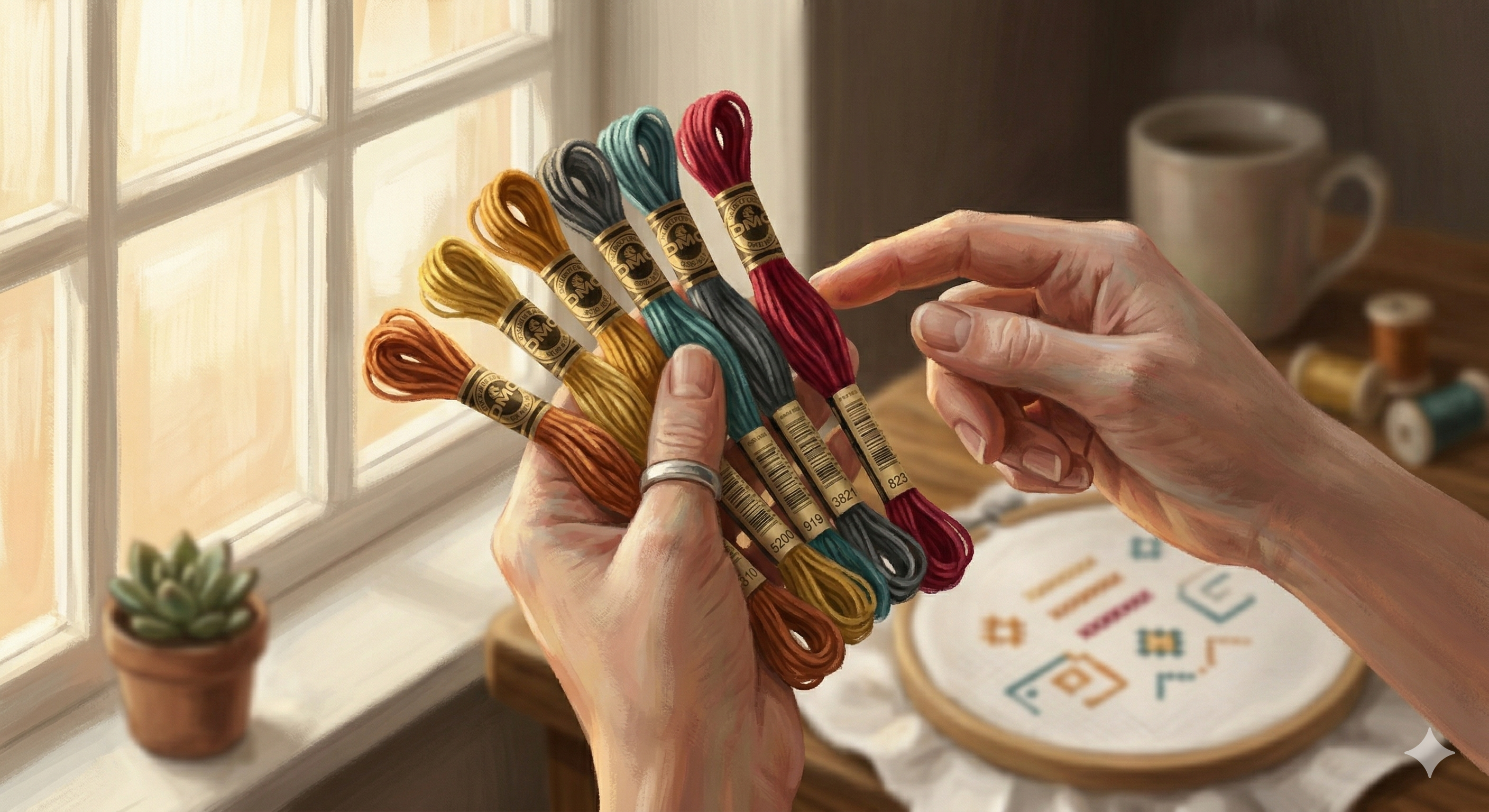
Natural light is the best judge — always compare your substitution candidate to your existing stitches before committing.
Get New Patterns & Stitching Tips
Join the Sunrays Creations community. New designs, seasonal guides, and exclusive offers — delivered to your inbox.
A Note From Tracey
I designed my first Sunrays Creations pattern over 22 years ago, and I've watched the DMC range change a lot in that time. Colors I reached for without thinking are gone. Colors I didn't expect have become indispensable.
The thing I've learned is that the discontinuations, frustrating as they are, rarely ruin a pattern completely. The human eye is remarkably forgiving in context. A substitution that looks alarmingly different on a thread card often disappears into a finished piece because color is perceived relative to its neighbors, not in isolation.
That said — use the best tool you can to find the closest match. Don't guess if you don't have to. Our color matcher is there to give you the most scientifically accurate answer we can, and then your eye makes the final call.
Happy stitching. ?
About Tracey Kramer
Tracey Kramer is the co-owner and lead designer at Sunrays Creations, a cross stitch pattern business she co-owns with her business partner TK Kramer. With over 22 years of pattern design experience, Tracey specializes in floral, Victorian, and seasonal cross stitch designs stitched on 18-count Aida cloth and finished as framed wall art. She writes about cross stitch technique, supplies, and the creative life on the Sunrays Creations blog.
Frequently Asked Questions
Keep Reading
|
|
|
Must-Have Floss Supplies
Products we recommend at Sunrays Creations
Stock up on current DMC colors before starting your next project — especially useful when substituting for discontinued shades. Shop Amazon → |
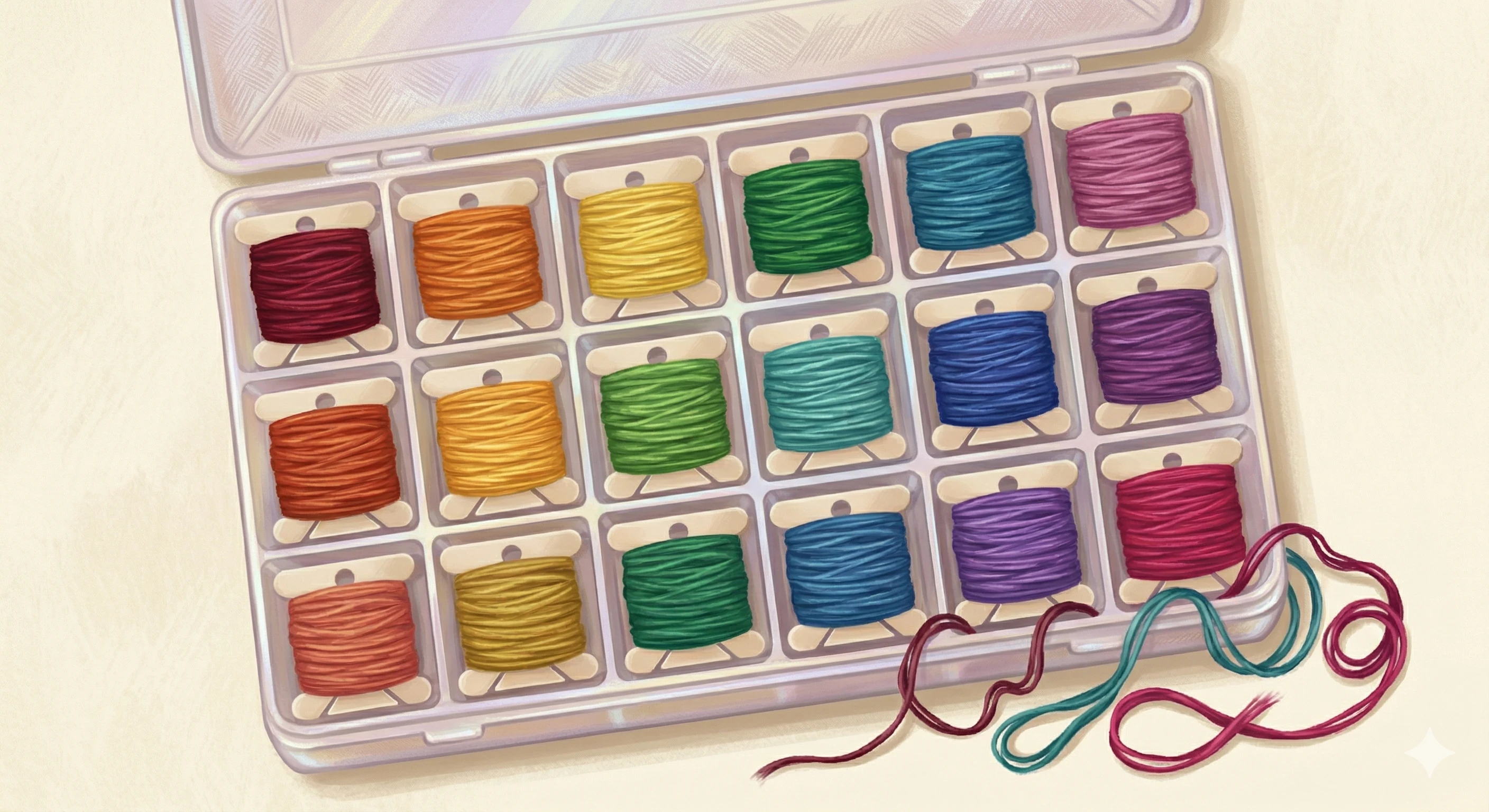
Label your bobbins by DMC number — including discontinued colors in your stash — so you always know exactly what you have and how much is left. Shop Amazon → |
Affiliate Disclosure: This post contains affiliate links. If you purchase through our links, Sunrays Creations may earn a small commission at no extra cost to you. We only recommend products we genuinely use and trust. Thank you for supporting our small business.