
ORT Jars: The Cross Stitch Tradition That Turns Leftover Thread Into Art
Posted by Tracey M. Kramer on 27th Oct 2026
A Note from Tracey Kramer
I have been designing counted cross-stitch patterns since 2004, and in that time I have watched my customers stitch everything from wedding gifts to heirloom samplers. This is everything I know about this topic -- from real experience, not theory.
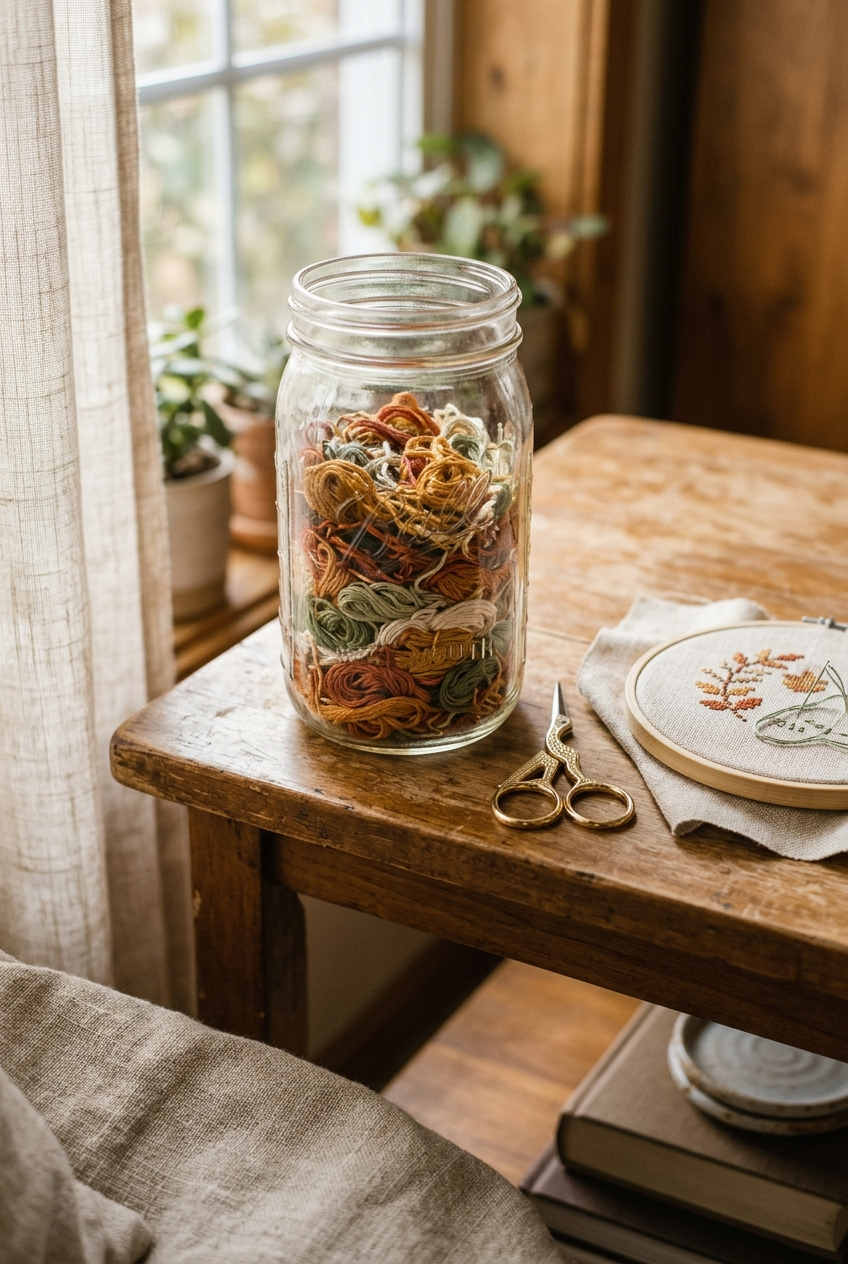
ORT jar cross stitch tradition: glass jar filled with colorful leftover thread beside hoop and scissors
By Tracey Kramer • • 12 min read
If you've spent any time on FlossTube, you've seen a glass jar on the corner of someone's stitching table filled with a soft tangle of colored thread ends. That's an ORT jar, and it's simply a container where stitchers collect their ORTs, the Old Remaining Thread snippets too short to use, instead of dropping them in the trash. After 22 years of designing patterns, I can tell you it's the cheapest, prettiest keepsake in this entire hobby: a jar that slowly fills with the colors of everything you've made.
What an ORT Jar Actually Is
An ORT jar is a jar. That's the whole thing. You put it near your chair, and every time you finish a length of floss and clip the tail, the leftover bit goes in the jar instead of in a wastebasket or stuck to the arm of the couch. Over weeks and months it fills with a fluffy, layered mess of color, and at some point you look at it and realize you're looking at a record of your stitching.
The word ort is an old English word for a scrap or a leftover, usually a bit of food left on a plate. Stitchers borrowed it, which makes perfect sense for the two-inch ends we cut loose a hundred times a project. You'll also see people say it stands for "Old Remaining Thread" or "Odd Remnants of Thread." Those are popular backronyms more than documented origins, and I'd treat them as charming rather than factual. Nobody needs a certified etymology to enjoy a jar of pretty thread.
The difference between an ORT and usable floss
This matters, because an ORT jar is not a storage system. Usable leftover floss belongs on a bobbin or a floss drop, sorted by DMC number, ready to pull out when you need three more stitches of 310. An ORT is what's left when a length has been worked down to the point where threading it again would be a fight you'd lose. I'm not going to re-argue the keep-versus-toss question here because I've already written a full piece on where that line falls and how to store the keepers.
If you're brand new and the acronyms are flying past you faster than you can catch them, ORT sits alongside WIP, UFO, FFO, BAP, and frogging in the community vocabulary. You'll pick them up quickly, usually by context, and usually while someone on video is dropping thread into a jar mid-sentence.
Why Stitchers Keep Them: The Jar as a Visual Diary
I've been asked more than once why anyone would save garbage in a jar, and I understand the question until you've had one going for a year. Then it stops being thread and starts being a timeline.
Here's what happens. You spend six weeks on an autumn landscape and the jar fills with rust, gold, burnt orange, and nine shades of brown you'd never be able to name on sight. Then you switch to a winter piece and a layer of pale blue, silver, and white settles on top of it. Come spring you're deep in florals and suddenly there's pink and sage and butter yellow. The jar stratifies like sediment. You can point at a band of color and say exactly which project that was and roughly when you stitched it.
That's the real pleasure of it, and it's why I think the ORT jar outlasts most crafting fads. It costs nothing, it takes no time, and it rewards you later for a habit you built without effort.
It's also a quiet progress tracker
On a big project, especially a BAP where the pattern seems to stall out no matter how many hours you log, the jar gives you evidence. The chart may look barely dented, but the jar climbed an inch this month. On days when progress feels invisible, that inch is worth something. I've had stitchers tell me the jar is the only thing that kept them from shelving a project into UFO territory.
There's a tidiness benefit too. Thread ends are static-clingy little menaces. They end up on the dog, in the carpet, woven into the couch cushions. Having one designated landing spot within arm's reach means they stop traveling through the house, which my vacuum appreciates more than I can express.

Tracey Recommends
COYACOOL Overnight Oats Containers with Lids, 16oz Wide Mouth Mason Jars with Lids, 9 Pack Glass Jars with Airtight lid for Chia Pudding Yogurt Salad, Meal Prer Oatmeal Jars
These are sold as overnight-oats meal-prep containers, not a craft product, and I'm telling you that straight. But they're clear wide-mouth glass with airtight lids at 16 ounces, which is exactly the size and shape that works as an ORT jar. Nine of them means a jar per year or one per big project. Plain mason jars from your kitchen do the same job just as well, so only buy these if you want a matching set.
Check Current Price →The jar stratifies like sediment. You can point at a band of color and say exactly which project that was and roughly when you stitched it.
How to Start an ORT Jar This Afternoon
You don't need to buy anything. Go to your kitchen, find a clean jar with a lid, and set it next to your chair. You've started. Everything past that is preference.
Pick a jar you can actually see through
Clear glass is the whole point. A ceramic crock hides the thing you're collecting it for. I like wide mouth glass jars (find on Amazon) because you can drop a tangle in one-handed without threading it through a narrow neck while holding a needle in your other hand. A pint-size jar fills in a reasonable number of months and feels satisfying. A gallon jar is a beautiful ambition and a very long wait.
Mason jars are the classic choice and they are genuinely perfect for this. Quart or pint, regular or wide mouth, lid or no lid, it doesn't matter. If you already own them, you're done shopping.
Lid or no lid
I'd use a lid. Thread catches dust, and an open jar sitting on a shelf for three years turns slightly gray at the top. A lid you can flip off easily is the compromise. Some stitchers cut a slot in a plastic lid so ORTs drop in like a piggy bank, which is clever and keeps dust out almost entirely. If your jar lives on a desk with a cat who considers every surface a runway, a lid is not optional.
Put it where your hands already go
This is the part people get wrong. If the jar is across the room on a shelf, you will not use it. The jar belongs within the arc of your clipping hand, on the side table where your small embroidery scissors (find on Amazon) live. I keep mine right next to the scissors because the two actions are the same action: snip, drop. Build it into the motion and you'll never think about it again.
Some stitchers use a small dish or bowl as a staging area during a session, then tip it into the jar when they pack up. That works well if you stitch in a chair with no side table, or if you travel between rooms. A tiny magnetic dish does double duty holding your needle.
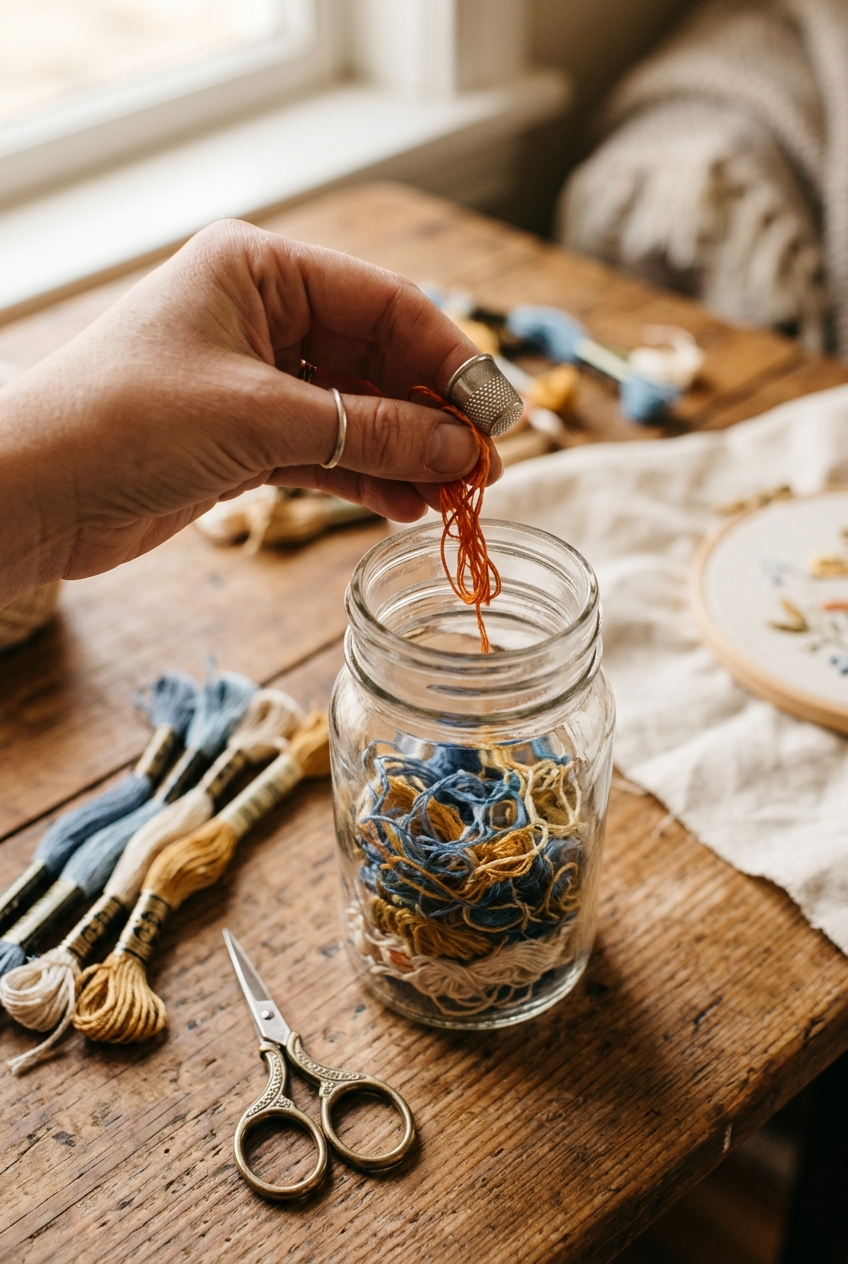
Hand dropping a leftover floss snippet into a glass ORT jar layered with colorful thread
What Goes In the Jar and What Stays Out
A good ORT jar is mostly floss ends and nothing else. The more you let other debris in, the less it looks like a color story and the more it looks like a wastebasket with a glass wall.
Yes to these
Clipped tails from finishing a length of DMC six-strand floss (find on Amazon). The short end left after a loop start. Frogged thread, which is honest and earns its place. Separated strands you pulled off a six-strand length and never used. Stray fibers you comb out when a thread goes fuzzy. Little trimmed bits of backstitch tails. Metallic thread ends go in too, and they glitter through the glass in a way I genuinely enjoy.
No to these
Aida trimmings. Fabric scraps mat down and turn the jar beige. Paper, chart bits, sticky note corners, label backing. Bent or broken needles, which should go in a dedicated sharps container instead, not loose where you'll reach in later. Pins. And no floss long enough to actually use. If you can still thread it and get a few stitches out of it, it belongs on a bobbin, not in the jar.
One jar or several?
Most stitchers run one jar continuously and let it become a mixed record of years. Others start a fresh jar per year and line them up on a shelf, which makes a beautiful run of color. A few keep a small jar per major project and label it, then tuck it beside the framed finish as a companion piece. I've seen a stitcher keep a 4-inch jar next to each finished piece in her sewing room, and the effect was lovely. There's no wrong answer, only how much shelf space you're willing to give it.
|
Patterns from the Sunrays Collection Tracey's Picks, designing cross stitch patterns since 2004 | |||||
| |||||
| Browse the full Sunrays collection → |


Displaying, Dressing Up, and Gifting an ORT Jar
At some point the jar stops being a tool and starts being decor. That's when people start fussing with it, and it's the fun part.
The simplest upgrade is tying something around the neck. A length of chiffon silk ribbon in a color that pulls from the thread inside makes a kitchen jar look intentional in about four seconds. I keep a handful of ribbon rolls in mixed shades on hand for exactly this, and for wrapping finished pieces when I give them away. A rustic twine wrap works too if your style runs more farmhouse.
A paper tag with the year on it, or the name of the project, turns the jar into something anyone can read at a glance. Handwriting is better than printing here. Twenty years from now, your handwriting on a tag is going to matter more than you think.
Where to put it
A full ORT jar sits beautifully near your framed finishes. My work is designed for 18-count Aida and finished as framed wall art, so the jar on the shelf beneath a framed landscape works as a little behind-the-scenes note to the main event. Backlit shelves make the glass glow. A windowsill works, though direct sun over years will fade the brightest colors, so I'd avoid a south-facing window if you want the reds to stay red.
Giving one away
An ORT jar from a project you stitched specifically for someone is a thoughtful companion gift. You hand over the framed piece and a small jar holding every scrap that came off it, with a tag naming the piece and the year. It costs you nothing and says you spent months on this.
ORT jars also make an easy gift for a stitching friend when you fill them the other way around: a clean empty jar, a lid, a ribbon, and a handwritten tag explaining what it's for. For a new stitcher just learning the vocabulary, it's a small welcome into the community.
I'd skip the craft-project ideas you see floating around for stuffing ORTs into ornaments or clear baubles unless you genuinely want to. The jar itself is the finished object. Let it be one.
Get Stitching Tips & New Patterns from Tracey
Honest advice, new Sunrays designs, and occasional VIP-only offers. No fluff.
No spam. Unsubscribe any time.

Tracey Recommends
Vitalizart 1" x 27 Yd Chiffon Silk Ribbon Mixed Color Ribbons Set 9 Rolls | 3 Yd Fringe Fabric Rustic Soft Thin For Flower Bouquet Gift Wrapping Bridal Baby Shower Wedding Invitations Crafts Bows
Nine rolls of soft chiffon ribbon in mixed shades, which is all you need to dress a plain jar up for a shelf or a gift. I tie a length around the neck in a color that echoes the thread inside, and it instantly stops looking like a kitchen jar. The leftover rolls get used wrapping finished pieces too.
Check Current Price →Keeping the Habit (and What to Do When It's Full)
The hardest part of an ORT jar is the first three weeks, when dropping thread in the jar isn't automatic yet and half your snips still land on the floor. Give it a month. After that your hand goes to the jar without consulting you.
A few things that help. Keep the jar in the same spot every single session, because the habit is spatial more than anything. Empty your lap before you stand up, every time, since standing is when ORTs migrate into the carpet. If you stitch in multiple rooms, a small travel tin that empties into the main jar keeps you from losing a week of color.
Traveling with ORTs
If you stitch on the road, a zip bag inside your project bag catches everything and comes home with you. Airplane tray tables and hotel rooms swallow thread ends. Bringing them home keeps the record complete, which is the only reason to bother.
When the jar is full
Cap it, tag it with the span of years it covers, and put it on the shelf. Then start a new one. Do not dump a full jar to reuse the glass. That's a years-long record and glass is cheap.
If you'd rather not keep them forever, loose natural-fiber thread scraps are welcome at some wildlife rescues and are often set out for nesting birds, though opinions vary on that and many people prefer to keep short pieces out of yards entirely. I keep mine. After 22 years I have jars I wouldn't trade, and not one of them cost me a dollar.
A wooden embroidery hoop (find on Amazon), good light, a pattern you love, and a jar by your elbow. That's a whole setup, and the jar is the only part that gets better the longer you leave it alone.
Go find a jar in your kitchen tonight and set it next to your chair. In a year you'll have something no store sells, built entirely out of what you were already throwing away. If you need a project worth filling it with, come browse the Sunrays Creations pattern collection and pick the colors you want to look at on that shelf.
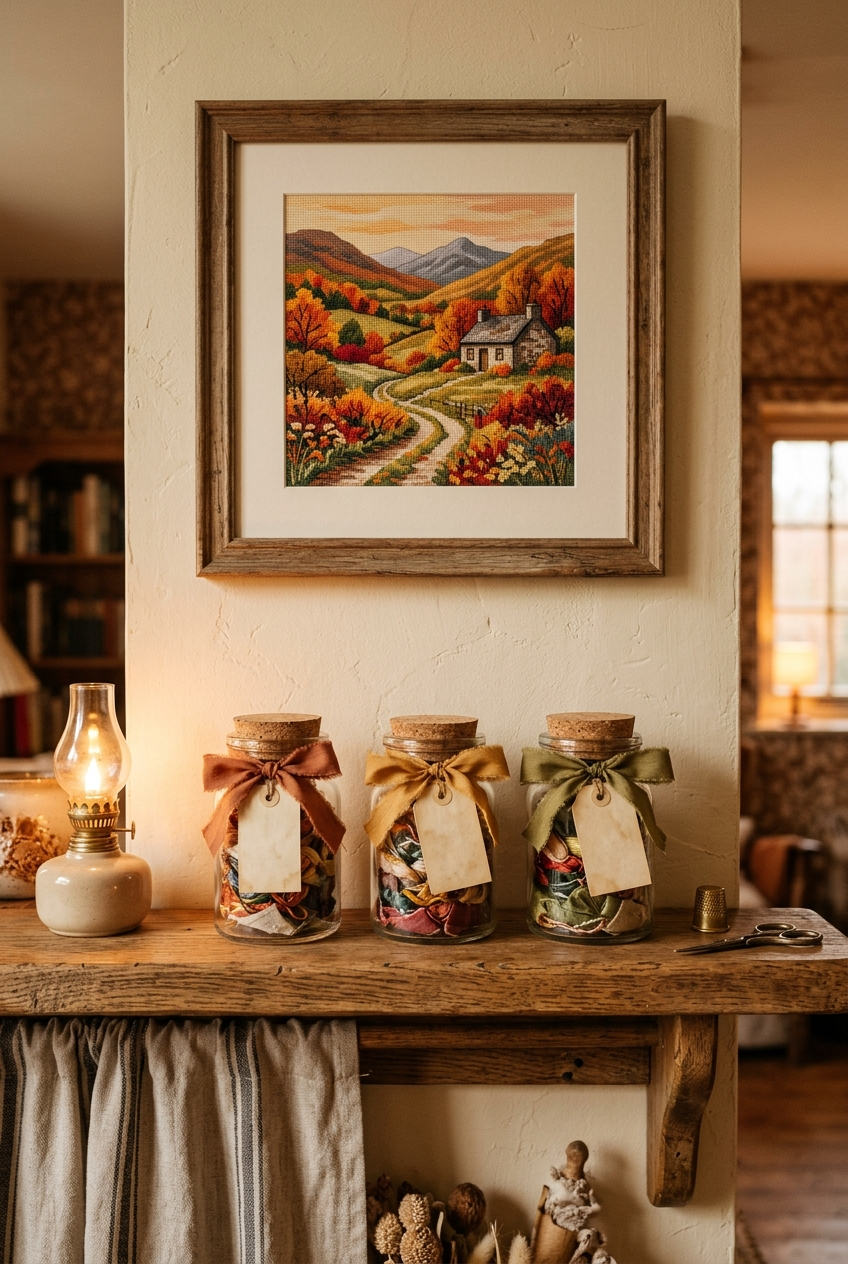
Three full ORT jars with ribbon and year tags on a shelf below framed cross stitch art
Keep Reading
What to Do With Leftover Cross Stitch Floss
Before anything goes in the jar, it helps to know which leftovers are still worth keeping. This guide covers the length test and how to store the keepers.
Read the GuideThe Complete Cross Stitch Glossary: 50 Terms Every Stitcher Needs to Know
ORT, WIP, UFO, FFO, BAP. If the acronyms are flying past you, this is the cheat sheet that sorts them all out.
See the GlossaryCross Stitch Floss Storage: What Actually Works
An ORT jar is for the scraps. This is where the usable floss goes, with real systems I've tested over the years.
Organize Your FlossFrequently Asked Questions
What is an ORT jar in cross stitch?
An ORT jar is a clear glass jar where stitchers collect the short thread ends left over after stitching, instead of throwing them away. ORT is commonly said to stand for Old Remaining Thread, though the word "ort" is also just an old term for a scrap or leftover. Over months the jar fills with the colors of everything you've stitched.
What should I put in an ORT jar?
Clipped floss tails, frogged thread, leftover separated strands, fuzzy fibers you comb out, and trimmed backstitch ends. Metallic thread ends look wonderful in the glass. Keep out fabric scraps, paper, pins, and broken needles, which belong in a sharps container.
What kind of jar works best for ORTs?
Clear glass so you can see the color layers, with a lid to keep dust out. Wide mouth is easier to drop thread into one-handed. A pint or quart mason jar is ideal and most people already own one.
Where should I keep my ORT jar?
Within arm's reach of where you stitch, right next to your scissors. If the jar is across the room you won't use it. The habit is spatial, so keeping it in the same spot every session is what makes it automatic.
Should I save floss that's still long enough to use?
No, that goes on a bobbin or floss drop with its DMC number, not in the ORT jar. The jar is for pieces too short to thread and use. I've written a separate guide on where that line falls.
What do you do when the ORT jar is full?
Cap it, add a handwritten tag with the years it covers, and set it on a shelf near your framed finishes. Then start a fresh jar. Don't empty a full one to reuse the glass, since it's a record of years of stitching.
Can you give an ORT jar as a gift?
Yes, and it's one of my favorites. Pair a small jar of the scraps from a project with the framed finished piece, tagged with the name and year. An empty jar with a ribbon and a tag also makes a sweet welcome gift for a new stitcher.
-- Tracey Kramer
Founder & Designer, Sunrays Creations Needlearts
Hand-charted designs since 2004 • Marysville, Ohio