
DMC Satin Embroidery Floss: Beauty vs. Reality
Posted by Tracey M. Kramer on 28th Mar 2016
A Note from Tracey Kramer
I have a complicated relationship with satin floss — I love how it looks and I will not pretend otherwise. But after thirty years of stitching I have learned exactly when to reach for it and when to walk away.
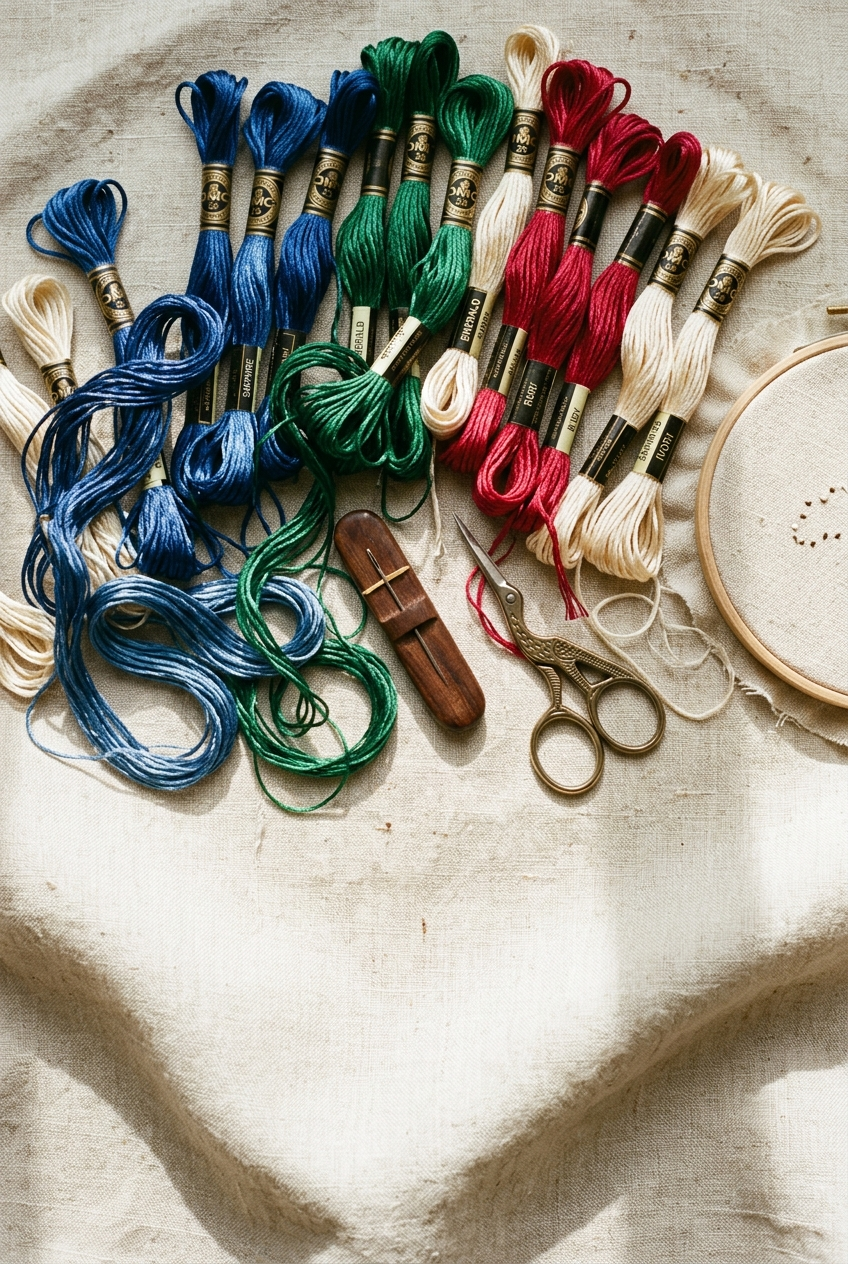
Satin embroidery floss skeins in jewel tones arranged on natural linen with embroidery scissors and hoop
By Tracey Kramer • • 12 min read
You have seen it on the shelf. Maybe at your local craft store, maybe scrolling through Amazon at eleven o'clock at night when you were supposed to be sleeping. Those little skeins of DMC satin embroidery floss, catching the light like they were lit from within. The colors are electric — deep jewel tones, bright whites that look almost luminescent, blues and greens that seem to shift as you move them in your hand. There is a reason they call it satin. It looks like something you should be stitching a wedding gown with, not running through the tiny holes of an Aida cloth. And yet there you are, dropping three or four skeins into your cart before you have thought the decision all the way through.
I understand completely. I have done it too. The allure of DMC satin floss is real and I am not going to lecture you about it. What I am going to do is tell you the truth — the full truth, not just the glittering surface — because this thread is beautiful and it is also demanding in ways that will catch you completely off guard if you go in unprepared. Satin floss made from rayon is not the same animal as your standard six-strand cotton embroidery floss, and treating it like it is will leave you with a pile of fuzzy wreckage and a very short temper. So let us talk about what this thread actually is, what it does well, what it does badly, and how to set yourself up for success when you decide the shine is worth the effort.
Because sometimes it is worth it. I want to be clear about that. There are moments in a stitched piece where nothing else will give you that particular pop of light, that liquid shimmer that satin catches so perfectly. The secret is knowing when to use it, how to handle it, and what to do when things go sideways — because with satin floss, at some point, things will go sideways.
What DMC Satin Floss Actually Is (And Why That Matters)
DMC satin embroidery floss is made from rayon, not cotton. That distinction matters more than most beginners realize when they pick up a skein. Rayon is a manufactured fiber that is designed to mimic the look and feel of silk — it has that gorgeous drape, that almost-wet sheen, and a silkiness that cotton simply cannot replicate. Those qualities are exactly what makes it so appealing under a needle. When it catches the light in a finished piece, it genuinely looks like a different category of needlework.
But rayon has a trade-off, and the trade-off is tensile strength. Or rather, the lack of it. Cotton embroidery floss, even the thinnest strand, has a fibrous grip that allows it to take some tension and abuse as you pull it through fabric repeatedly. Rayon does not. It is smooth, which sounds like a benefit, but that smoothness means the fibers have less structural integrity when they encounter friction. And cross stitch, by its very nature, involves pulling thread through fabric holes dozens and sometimes hundreds of times on a single project. Every single one of those passes is a moment of potential stress on the thread.
DMC currently offers their satin line in about 60 colors, which is a significant limitation compared to the thousands of shades available in their standard six-strand cotton floss. If you are designing a project or adapting a pattern, that limited palette means you may find yourself making substitutions more often than you would like. The colors that do exist tend to be vivid and saturated — these are not subtle, dusty shades. They read bright, which is another reason to think carefully about where in a design you deploy them.
Understanding what rayon is helps you understand everything else about working with this thread. The fraying, the knotting problems, the threading challenges — none of them are defects in the product. They are the predictable behavior of this specific fiber under stitching conditions. Once you accept that, you stop fighting the thread and start working with its actual nature instead of the nature you wish it had.
Satin Floss vs. Six-Strand Cotton: An Honest Comparison
If you have been stitching with standard DMC or Anchor cotton floss for any length of time, you have built up a set of habits and instincts that serve you well. Those habits will betray you the moment you switch to satin without adjusting. This is not a thread where you can just swap it in and stitch exactly the way you always have. It requires a different approach, and understanding where it sits relative to cotton will help you figure out how to use both to their best advantage.
Cotton six-strand floss is a workhorse. It is durable, forgiving, and consistent. You can pull it through fabric hundreds of times and it holds its structure. You can gently tug a knot loose in most cases. It comes in an enormous range of colors, it threads reasonably well without a threader, and it behaves predictably enough that you can stitch for hours without having to think too hard about the thread itself. For fill work, background areas, large pattern sections, and anything where coverage and consistency matter more than shimmer, cotton is what you want.
Satin floss is a specialist. It shines — literally — in specific situations. Lettering details where you want the text to catch light differently from the background. Floral centers or highlight petals on botanical designs. The eyes of an animal portrait where a single or double strand of satin creates a lifelike glimmer that cotton cannot produce. Christmas ornament patterns where the metallic shimmer quality reads as festive and deliberate. Small focal accent areas in Victorian portraits, exactly the kind of work I do at Sunrays Creations, where a tiny application of satin in a brooch or a ribbon detail elevates the entire piece.
The key word is accent. Satin floss is an accent thread, not a fill thread. The moment you try to use it for large sections of coverage is the moment you start to understand why your temperament is being tested. Use cotton as your foundation and your workhorse. Reach for satin the way a painter reaches for a fine detail brush — deliberately, for specific effect, and then set it back down.
Tracey Recommends
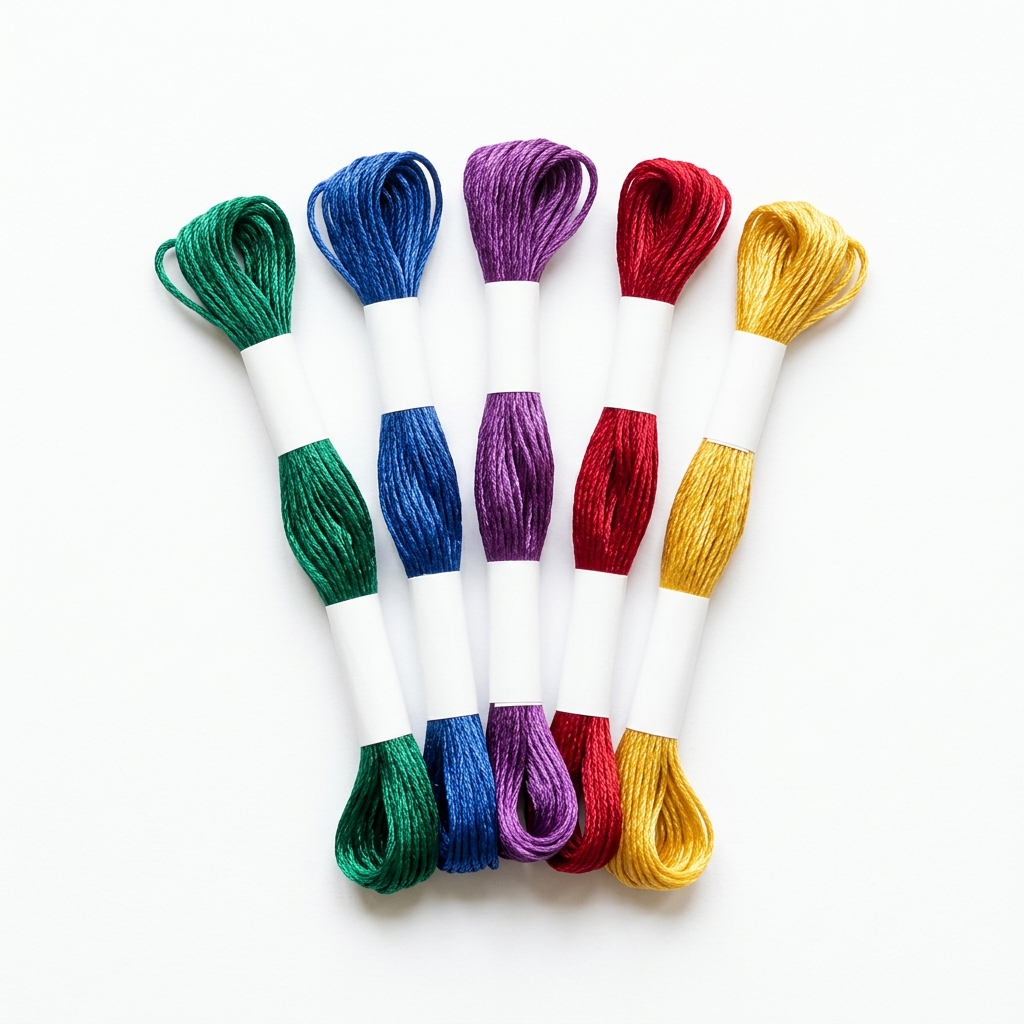
DMC Satin Embroidery Floss Collection
The full shimmer of DMC satin rayon floss in a range of vivid colors. Perfect for accent stitches, portrait details, florals, and holiday designs where you need that liquid shine. Buy individual colors or a sampler assortment to explore the palette.
See on AmazonSatin floss is a specialist, not a workhorse. Use it like a painter uses a fine detail brush — deliberately, for specific effect, and then set it back down.
The Honest Truth About What Goes Wrong
Let me tell you what actually happens when you stitch with rayon floss unprepared. You pull the thread through the fabric and it moves beautifully at first — smooth and almost effortless, which is part of the seduction. But the fabric, no matter how soft your Aida or evenweave is, has texture. Every hole has edges. And with each pass, those edges are doing microscopic damage to the rayon fibers. After enough passes, the thread begins to fray. Then it shreds. Then it essentially disintegrates into a puff of fuzz that probably matches your temperament by now. That is not an exaggeration. I have watched this happen with my own hands and the only thing you can do in the moment is laugh or cry, and usually I choose to laugh because the alternative is not productive.
Knotting is the other major hazard, and with satin it is categorically different from knotting with cotton. When you get a knot in standard cotton floss, you have options. You can often work the knot out slowly, use a pin to ease it loose, and save your thread. It is frustrating, but it is recoverable. With satin floss, a knot is a death sentence for that piece of thread. The fibers are too smooth and too delicate to allow you to manipulate the knot without destroying the thread in the process. You are not untying a knot so much as tightening it with every attempt until the thread tears. It is simply gone.
If you have ever had to frog stitches out of a standard cotton project you know how frustrating that is. With satin floss, a knot does not give you the option to recover — the thread is simply gone. Which is exactly why prevention matters more here than anywhere else. I always recommend reading our complete guide to frogging before you tackle any project with specialty threads, because understanding how to minimize mistakes before they happen is far better than trying to undo them after.
When things do go wrong with satin — and they will, at least until you develop a feel for it — you will need the right tools to address the damage without making it worse. A seam ripper for embroidery (find on Amazon) is something I keep within arm's reach any time I am working with satin, because trying to remove stitches with scissors or a standard tool risks cutting your fabric. Reverse-action tweezers are extraordinarily useful for pulling out individual stitches without the jaw-fatigue of standard tweezers, since you squeeze to open them rather than to close them. And do not underestimate the lint roller (find on Amazon) sitting next to your project. Satin sheds fibers when it frays, and those microscopic rayon wisps will work their way into your fabric and make a real mess of things if you do not address them as you go.
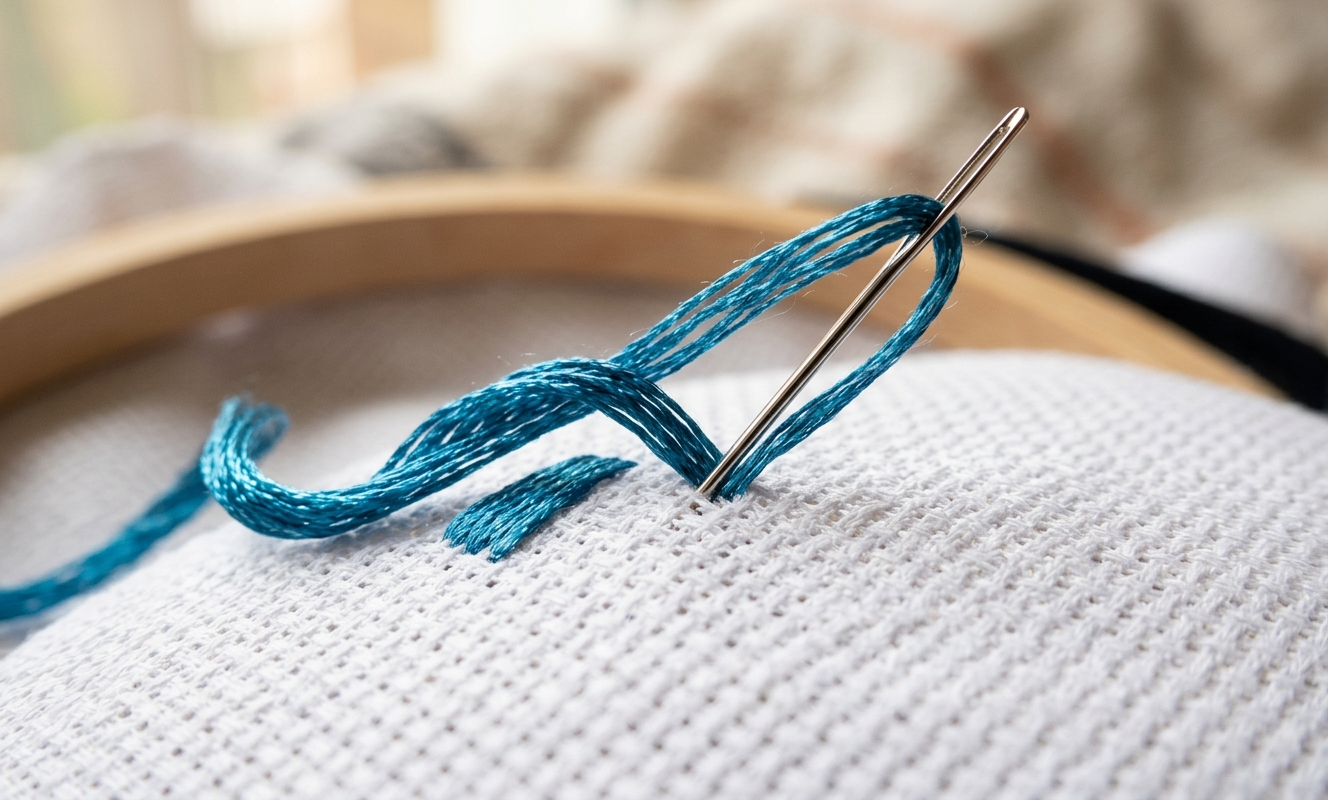
Close-up of shimmering satin embroidery thread pulled through white Aida fabric by silver needle
Practical Tips for Working with Satin Floss Successfully
The number one thing I can tell you about working with satin embroidery floss is this: keep your lengths short. I mean genuinely short. With cotton I might work with a strand of 24 to 36 inches depending on my mood and the project. With satin, I will not go beyond 18 inches, and honestly I prefer 14 to 16 inches. Every inch of additional length is additional opportunity for the thread to tangle with itself, rub against the fabric, and begin the slow process of destruction I described above. Short lengths feel inefficient but they are not — they keep you stitching cleanly instead of stopping every few minutes to fight with the thread.
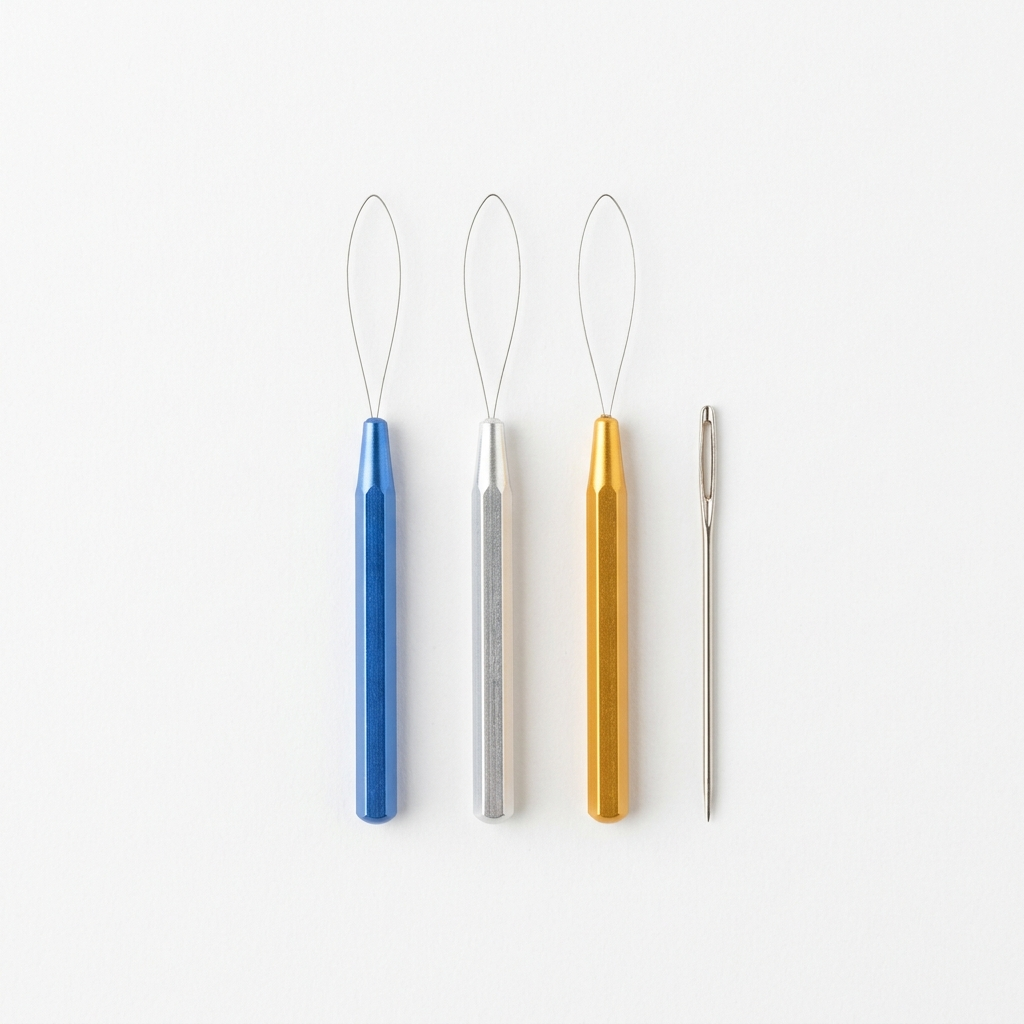
Threading the needle is a genuine challenge with satin floss. The silkiness of the fiber makes it almost impossible to push through the eye of a needle by the standard fold-and-push method. I have tried this dozens of times over the years out of stubbornness and I am here to tell you it does not work. You need a needle threader — not sometimes, not when you are having a bad day, but always, every single time. A good needle threader set designed for embroidery, one with a fine enough wire to pass through small needle eyes, is non-negotiable when you are working with satin. Do not attempt this thread without one on your table.
Thread conditioner is another tool that earns its place in your kit when you work with satin. Products like Thread Heaven or similar thread conditioner (find on Amazon)s work by coating the fibers lightly and reducing the friction between the thread and the fabric. Less friction means less fraying, which means your thread survives longer. I run my satin lengths through conditioner before I begin stitching and it makes a measurable difference in how the thread behaves. Thread conditioner is one of those supplies that seems optional until you use it regularly and then you wonder how you ever got along without it.
Some stitchers also lightly spritz their satin thread with water before working with it. The theory is that a tiny amount of moisture causes the fibers to swell very slightly and grip each other better, which reduces the shredding. I have tried this and I think it helps modestly — not dramatically, but it is not harmful and costs you nothing to try if you are having a rough day with a particular skein. What I would not do is soak the thread, just a light mist and then blot it gently.
Your embroidery scissors (find on Amazon) matter more with satin than with any other thread. When you cut satin, you want a clean, precise cut — not a frayed or compressed end that is already damaged before it goes through the needle. Sharp, small embroidery scissors designed specifically for needlework will give you that clean cut. Dull scissors or general purpose craft scissors compress the fibers as they cut, and a compressed end will fight you at the needle and start fraying from the very first stitch. I also keep my floss bobbin organizer (find on Amazon) well organized when I am working with satin so I am not pulling strands from a tangled mass — which is just another invitation to knotting and damage.
|
Patterns from the Sunrays Collection Tracey's Picks, designing cross stitch patterns since 2004 |
|||||
|
|||||
| Browse the full Sunrays collection → |



When Satin Is Absolutely Worth It
I do not want to leave you thinking this thread is more trouble than it is worth, because that is not my honest opinion. There are moments in cross stitch where DMC satin floss does something that nothing else can do, and when you finish a piece with those accents properly placed, you remember why you reached for the skein in the first place.
Animal portrait work is one of my personal favorite applications. When I am designing or stitching a cat or a dog with realistic fur tones, the eyes are everything. A single strand or two of satin in the right color, placed in the eye highlight area, creates a depth and life that stops people in their tracks. Cotton in the same spot just sits flat. Satin catches the ambient light of the room and shifts, and suddenly the animal looks present in a way that is difficult to explain but impossible to miss.
Botanical designs with flowers benefit enormously from strategic satin placement as well. A few stitches of satin in the center of a flower, or along the edge of a petal that you want to read as catching light, adds dimension to what would otherwise be a flat graphic. Victorian portrait designs — which are my specialty at Sunrays Creations — often feature jewelry, ribbons, and fabric details where a touch of satin reads as completely intentional and historically appropriate to the ornate aesthetic of the era.
Holiday patterns are another natural home for satin. Christmas ornaments, candles, gift ribbons — anywhere the design concept involves something that is meant to be shiny in real life, using satin thread is a design choice that reinforces the theme of the piece. It is not just a technical decision, it is a narrative one. The shimmer serves the story the piece is trying to tell.
The framework I use when deciding whether to reach for satin is this: Will this thread be carrying most of the work in this area, or will it be a highlight in an area that cotton is already handling? If it is the workhorse, use cotton. If it is the highlight, satin is worth every bit of the extra care it requires. That single question has saved me more frustration — and more thread — than any other rule I have developed over thirty years of stitching. God gave me patience through practice, not through natural temperament, and satin floss was one of His more creative teaching tools.
Get Stitching Tips & New Patterns from Tracey
Honest advice, new Sunrays designs, and occasional VIP-only offers. No fluff.
No spam. Unsubscribe any time.
Don't Skip This One
Needle Threader Set for Embroidery
Threading satin floss without a proper needle threader is an exercise in pure frustration — the silky fibers will not cooperate with the fold-and-push method. A fine-wire needle threader set designed for embroidery needles is mandatory when you work with satin. Keep one on your table at all times.
See on AmazonWhere to Find DMC Satin Floss and How to Store It
One genuine advantage of DMC satin floss over some specialty threads is availability. DMC makes their satin line accessible through a wide range of retailers, which means you are not hunting down an obscure supplier or waiting weeks for an international shipment. You can find it through Amazon, through needlework-specific retailers like Herrschners, and it has even appeared in Walmart stores depending on your location, though the selection there tends to be limited to the most popular colors.
When you do get your skeins home, storage matters with satin in a way that it matters slightly less with cotton. Rayon fibers can tangle and damage each other if they are stored loosely together in a bag or bin. I wind my satin floss onto a floss bobbin organizer system as soon as I bring it home, labeling each bobbin with the DMC color number. This keeps individual skeins protected, prevents the threads from rubbing against each other in storage, and makes it much easier to pull a clean, untangled length when you are ready to stitch. It takes ten minutes to set up and it saves you far more than that in frustration later.
If you are purchasing satin floss specifically to match colors in a pattern, keep in mind that the 60-color range means you may not find an exact match to every cotton color you want to accent. I have occasionally purchased a DMC satin skein in a related color rather than an exact match and used it as a deliberate highlight — slightly lighter or slightly more saturated than the base cotton color — and the effect can actually be more interesting than a perfect match would have been. Limitations sometimes push you toward creative solutions you would not have found otherwise.
Satin embroidery floss is one of those supplies that rewards the stitcher who takes the time to understand it before they use it. Go in with your eyes open, your lengths short, your needle threader ready, and a realistic sense of where this thread will shine and where cotton will serve you better — and you will produce work that genuinely stops people in their tracks. If you are ready for your next project, come browse the patterns at Sunrays Creations Needlearts. I design with exactly these kinds of decisions in mind, and there is always something waiting that will make you reach for your hoop.
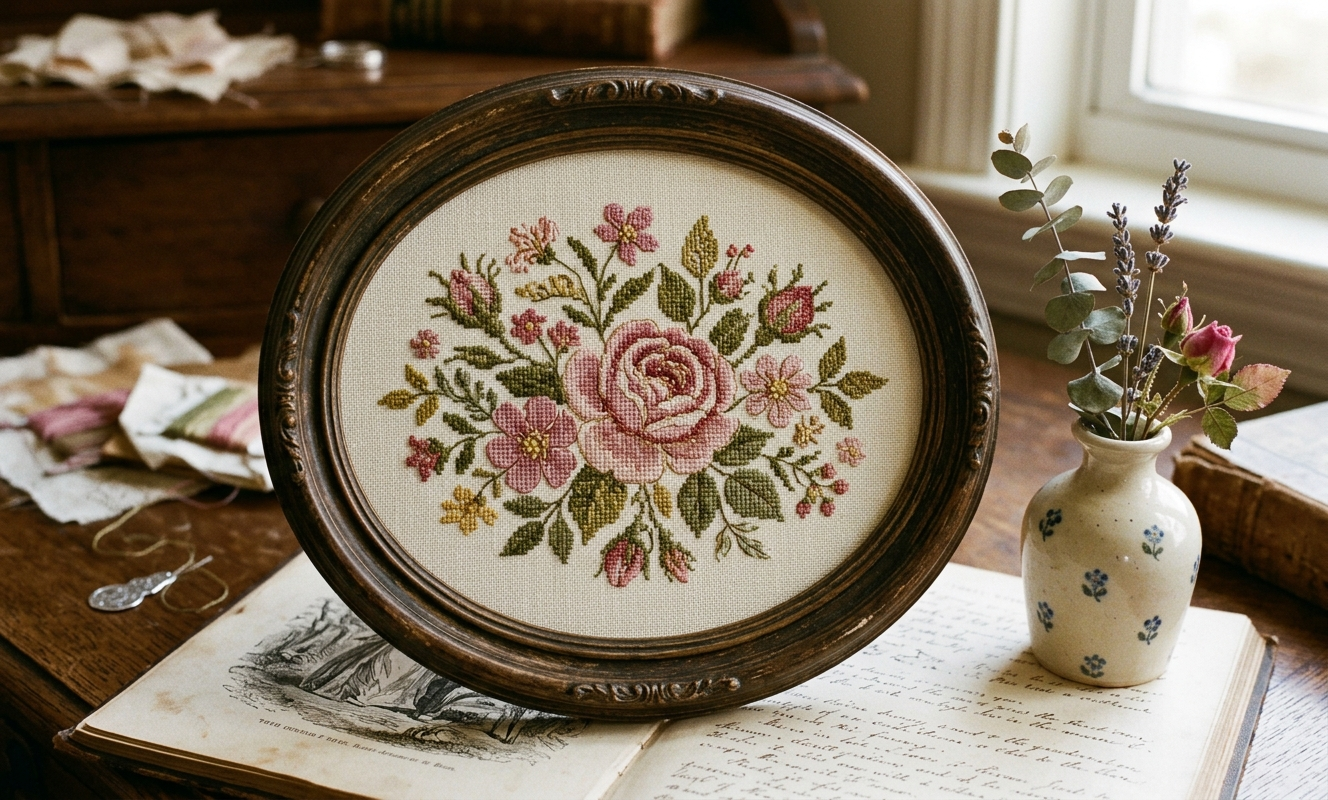
Finished cross stitch botanical in oval frame showing satin shimmer accents among cotton fill stitches
Keep Reading
What Do You Need to Cross Stitch?
New to specialty threads and not sure what tools belong in your kit? This complete supply guide walks you through everything you need before you start your first — or next — project.
READ THE GUIDECross Stitch FAQs
Have questions about thread types, fabric choices, and technique decisions? The answers to the most common cross stitch questions are all in one place.
READ THE ARTICLEWhy Buy from Sunrays Creations?
If you are looking for original counted cross stitch patterns designed with specialty threads and accent details in mind, here is what sets Sunrays Creations apart from the pack.
READ THE ARTICLEFrequently Asked Questions
What is DMC satin embroidery floss made of?
DMC satin floss is made from rayon, which gives it a silk-like sheen but less tensile strength than cotton. The body section on fiber types covers this in detail.
Why does my satin floss keep fraying and shredding?
Rayon fibers have low resistance to friction, so repeated passes through fabric gradually destroy the thread. Shorter lengths, thread conditioner, and working slowly all help — see the practical tips section.
Can I get a knot out of satin embroidery floss?
In most cases, no. Unlike cotton, a knot in satin floss is nearly impossible to recover — attempting to untangle it usually destroys the thread. Prevention through short lengths is the best strategy.
Do I really need a needle threader for satin floss?
Yes, always. The silky surface of rayon makes it almost impossible to thread a needle by hand — a fine-wire needle threader designed for embroidery is non-negotiable with this thread.
When should I use satin floss instead of cotton floss?
Satin works best as an accent thread in small, deliberate areas — eye highlights in portraits, floral centers, lettering details, or holiday shimmer effects. The comparison section has the full framework.
How many colors does DMC satin floss come in?
DMC satin floss is available in approximately 60 colors, which is significantly more limited than their cotton range. The availability section discusses how to work creatively within that palette.
-- Tracey Kramer
Founder & Designer, Sunrays Creations Needlearts
Hand-charted designs since 2004 • Marysville, Ohio