
Best Cross Stitch Frame & Stand for Every Project
Posted by Tracey Kramer on 12th Mar 2016
A Note from Tracey Kramer
I've been setting up stitching corners in my home for thirty years, and I've learned the hard way that the wrong frame will chase you out of the craft faster than a tangled skein of floss. Here's everything I know about getting this right.
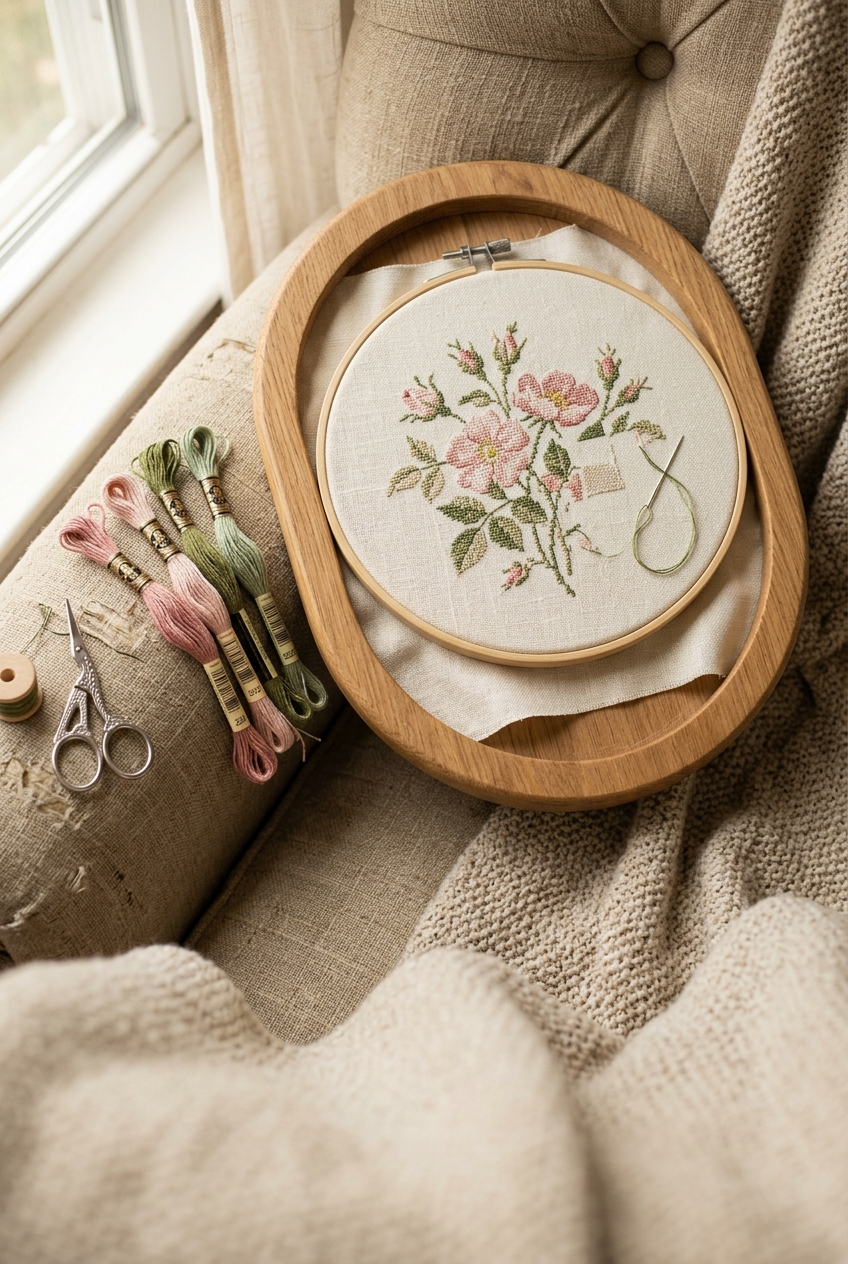
Wooden cross stitch lap frame stand holding floral needlework on cream linen in warm natural light
By Tracey Kramer • • 12 min read
Let me be plain about something most beginners don't hear until they've already spent a miserable evening hunched over a hoop: your frame matters more than almost any other tool in your stitching kit. I'm not talking about whether your stitches are neat or your thread tension is perfect — I'm talking about whether you'll still be stitching six months from now. The wrong frame creates an awkward angle. That awkward angle becomes a sore neck. The sore neck becomes a sore back. By the end of the evening you've done maybe forty stitches and you feel like you went ten rounds with something heavier than a needle. I've been there, and I don't wish it on anyone.
I've accumulated quite a few frames over the years — hand-held hoops in several sizes that I lend to my daughters when they want to stitch, multiple setups in different rooms of my house, and a couple of specialty frames that I've adapted for projects that don't fit the standard mold. Every single one of them was chosen with a specific purpose in mind. A frame for a small floral motif is not the same animal as a frame for a massive tapestry you're planning to hang over your fireplace. Knowing which type of frame you need before you buy is what this article is about.
I'm going to walk you through two main categories — lap frames for small to medium work, and floor-standing frames for large to very large projects — and I'll tell you what I actually use, what I genuinely recommend, and where to get it. I'll be honest about wait times and logistics, too, because some options require patience I don't always have. Let's get into it.
Why the Right Frame Changes Everything
When I talk about a frame 'making or breaking' a project, I mean that literally. I've watched new stitchers give up — not because they didn't love the craft, not because the pattern was too hard — but because they were uncomfortable every single time they sat down to stitch. Discomfort is insidious. It sneaks up on you. You don't notice it the first night. But after a week of sitting in a bad position, tilting your head at an awkward angle, holding tension in your shoulders, you start to associate stitching with feeling bad. And then you stop. I've seen it happen. It breaks my heart every time.
The frame solves the posture problem by holding your work so your hands are free to move naturally. With a hoop or frame locked in place — whether on a stand on your lap or on a floor frame beside your chair — both of your hands can work in tandem. One hand on top to push the needle down, one hand underneath to push it back up. This two-handed technique is faster, more accurate, and infinitely easier on your body than trying to manage the work with one hand while the other one holds a floppy piece of fabric.
There's also a quality argument for frames. When your fabric is held taut and even, your stitches lie flat and consistent. When you're wrestling with a floppy hoop or a frame that keeps slipping, you're fighting the material instead of stitching it. Tension matters. I've had to re-stitch sections because the fabric shifted mid-project. Trust me, you want a frame that holds.
I also believe — and this might sound a little simple, but stay with me — that having a good setup makes you want to sit down and stitch. When I walk past my stitching corner in the bedroom and I see my floor frame set up, my OTT lamp ready, my pattern on the board, I feel a pull toward it. It's inviting. That matters. The craft is supposed to bring you joy. Give yourself a setup that feels good.
Lap Frames: My Go-To for Small and Medium Projects
For anything in the small to medium range — which covers a surprising number of the patterns I design and sell at Sunrays Creations — a lap frame is my first choice. It's portable, easy to set up, and lets me stitch anywhere in the house without committing to a big floor frame installation. Right now I'm working on my Lovely Lotus Flower pattern (FL-37), which I'm stitching as a special gift for a family member. It's a beautiful, intricate floral design, and it's exactly the kind of project that's well-suited to a lap setup.
Here's what I actually use for that project, and I think it's a clever solution worth sharing: I had a hand-held frame I already loved and didn't want to give up. But holding it for hours at a stretch wasn't working for my back anymore. So instead of buying a whole new lap frame system, I bought just the base — a universal lap base with a clamp — and attached my existing frame to it. Simple, effective, and far cheaper than starting over. The base sits on my lap, the clamp holds my frame of choice at whatever angle I need, and my hands are completely free to stitch.
For years I've pointed stitchers toward K's Creations for quality lap frames. They make beautiful, solid frames — I've owned mine for years and not a single one has cracked, split, or broken, which is more than I can say for some discount frames I've tried over the years. The craftsmanship is genuinely excellent. However — and this is an honest caveat you deserve to hear — K's Creations frames are custom-made to order. There's no online shopping cart where you can click and ship. You call them, you place your order, and you wait. For some stitchers, that's perfectly fine. For others, especially if you've just found a pattern you're burning to start, that wait is genuinely frustrating.
If you need a lap frame in your hands this week, there are solid options available on Amazon that ship quickly and perform well. Look for a lap frame stand that holds a standard scroll frame or hoop, adjusts to different angles, and sits stably on your lap without tipping. These aren't custom work, but they're reliable and they'll get you stitching without delay. I've listed one I'd feel comfortable recommending below. Don't let the perfect be the enemy of the stitched.
One more thing about the lap setup: think about where you're sitting. A lap frame works best when you're in a chair with a firm base — your couch might feel comfortable, but if you're sinking into cushions and your lap angle is off, the frame won't sit right. I stitch in a firm-bottomed chair near good light whenever possible, and that combination makes a real difference.
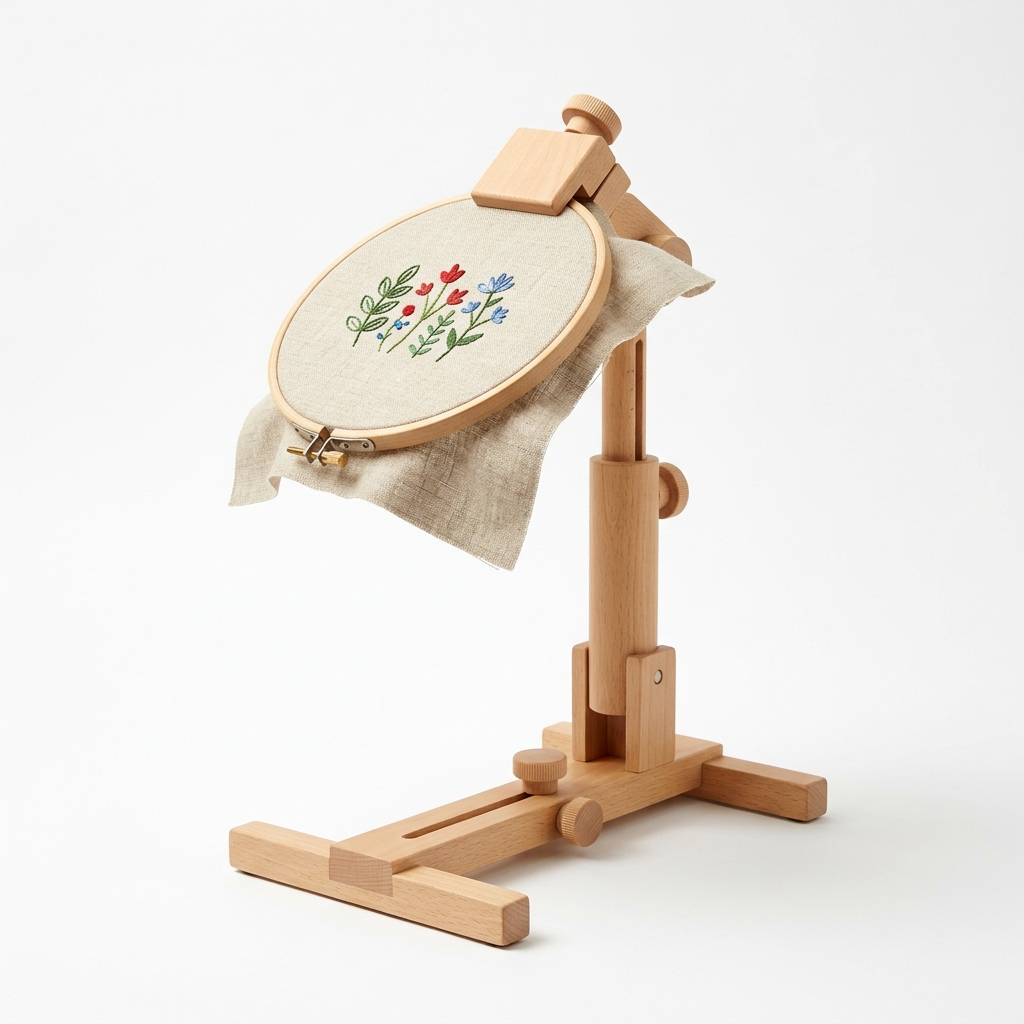
Tracey Recommends
Cross Stitch Lap Frame Stand
A sturdy, adjustable lap frame stand holds your hoop or scroll frame hands-free while you stitch. Great for small to medium projects — no drilling, no installation, just clip and go. Ideal if you can't wait for a custom order.
See on AmazonThe frame that fits your actual life is the right frame. Give yourself a setup that feels good — because the craft is supposed to bring you joy.
Floor Frames: For the Big, Ambitious Projects
If lap frames are the practical everyday tool, floor frames are the investment piece — the thing you buy when you're serious about a project and you know it's going to take you months. I have two large floor frames set up in my home, and both of them get regular use. The one I reach for most often for large cross stitch work is the Stow-Away model from K's Creations. This thing is built like a piece of furniture. It's sturdy, completely adjustable, and handles large fabric pieces without so much as a wobble.
What I love about the Stow-Away specifically is how thoughtfully it's designed for real stitching life. If I need to move it — even just across the room — I can tighten down my settings and roll or carry it without disassembling anything. If I'm moving it a greater distance, it folds down flat. Either way, I'm not dismantling my project to transport the frame, which means I'm not losing my place or disturbing my fabric tension. For a project I've been working on for months, that matters enormously.
My floor frame lives in a little dedicated stitching corner in my bedroom. I've set it up intentionally: there's an OTT-Lite floor lamp for stitching (find on Amazon) positioned to give me clear, even light without shadows, a magnetic pattern board (find on Amazon) mounted nearby to hold my chart at eye level, and my project box close at hand with my floss, scissors, and needle case. The whole setup took some time to arrange, but once it was in place, stitching in that room became genuinely pleasurable. When everything is where it should be, you can just sit down and stitch. That's what you want.
Again, the same honest caveat applies to K's Creations floor frames as to their lap frames: custom-made, call-to-order, wait time included. If you've got a large project waiting and you can't hold off, there are floor frame stands available on Amazon designed specifically for needlework and cross stitch that are worth considering. Look for one with adjustable height, a sturdy base that won't tip under the weight of a large frame, and scroll rods for frame (find on Amazon) compatibility so you can mount your fabric properly. I've got a recommendation in the product section below for exactly that.
One thing I want to say about committing to a floor frame: don't let the size intimidate you. I know stitchers who have been putting off their big ambitious projects for years because they don't have the right setup. Here's what I want to tell them: get the frame. Set it up. Start the project. God gave you that creative desire for a reason, and you shouldn't leave it sitting in a pattern folder indefinitely because the equipment feels like too much of a commitment. It's not. It's just a frame. And once it's up and your fabric is on it, you'll wonder why you waited.
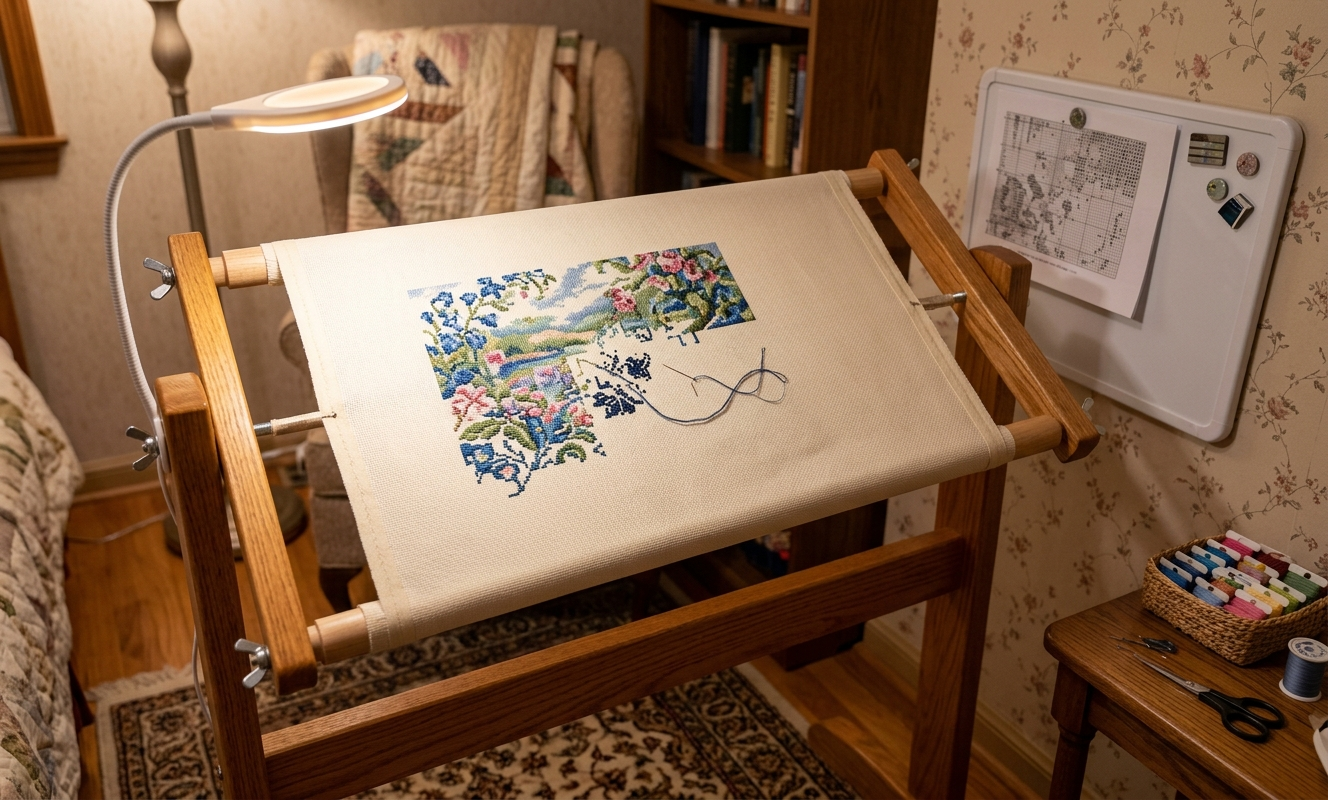
Large floor standing cross stitch frame with scroll rods in a cozy stitching corner with daylight lamp
Adapting Frames for Specialty Projects
Not every project fits neatly into the 'small cross stitch' or 'large cross stitch' categories, and I want to talk about that for a minute because I think a lot of stitchers limit themselves by assuming a frame has to be used for exactly the purpose it was marketed for. My third major frame is a perfect example of this. It's actually a frame made for rug hooking — large, wide, and designed to handle heavy fabric under tension. I adapted it for needlepoint tapestry work, and it's been one of the best stitching decisions I've ever made.
The project I have on that frame right now is 'Exotic Garden,' a stunning pattern from what used to be called Stitcher's World magazine — now published as Cross-Stitch & Needlework. I've been working on it in needlepoint rather than cross stitch, not to use it as a rug but to create a wall tapestry large enough to hang over my fireplace. A piece at that scale needs a frame that can hold the full width without the fabric sagging in the middle, and my repurposed rug hooking frame handles it beautifully.
The practical lesson here is: look at what a frame can do, not just what it's labeled for. If you see a large adjustable frame at a craft sale or estate auction, think about whether it could be adapted to your work. The mechanism for holding fabric taut is more universal than manufacturers sometimes imply. I've also used large artist stretcher bars for some needlepoint pieces, and they work surprisingly well for anything that doesn't need to be removed from the frame mid-project.
What I've also found with larger specialty setups is that the surrounding environment matters as much as the frame itself. Having a portable television in the room where my tapestry lives has made a real difference to how often I sit down to work on it. Before the TV arrived, that room was quiet — just birdsong through the window, which is not unpleasant, I'll grant you — but I missed having company in the background while I worked. Now I can put on something familiar and stitch for hours without noticing the time. Find what makes your stitching environment feel like a place you want to be.
|
Patterns from the Sunrays Collection Tracey's Picks, designing cross stitch patterns since 2004 |
|||||
|
|||||
| Browse the full Sunrays collection → |



What Else You Need in Your Stitching Corner
A great frame is the foundation, but a well-equipped stitching corner has a few other essentials that make a significant difference to your experience. The first and most important after the frame itself is lighting. I will not stitch without good light. I've been using OTT-Lite technology for years, and the difference between stitching under a standard incandescent lamp and stitching under a proper daylight bulb is not subtle. Colors read correctly. Dark fabrics become manageable. Your eyes don't ache after an hour. An OTT-Lite floor lamp for stitching is, in my opinion, non-negotiable if you're doing this seriously.
The second thing I want to mention is a magnetic pattern board. I use one religiously. It holds my printed chart at eye level, keeps my place with a magnetic line guide, and means I'm not constantly looking down at a sheet of paper on my lap or trying to remember where I left off. When your chart is at the right height and well-lit, you make fewer mistakes. Fewer mistakes means less frogging. Less frogging means more actual stitching. The logic is simple. A magnetic pattern board is a small investment that pays back in hours of saved frustration.
Organization is the third piece. I keep everything I need for a specific project together in one place — floss sorted and labeled, needles in a case, scissors on a clip, the pattern accessible. For moving between my different stitching setups around the house, I use a needlework project bag (find on Amazon) that's large enough to hold a scroll frame and all my supplies. A good bag protects your work in progress, keeps your threads from tangling, and means you can pick up a project and carry it to the couch or the porch without losing anything. Mine has held up to years of daily use.
I also keep a padded fold-up chair in my bedroom stitching corner for now — I haven't found the perfect dedicated stitching chair for that space yet, and I'm particular enough about it that I'd rather wait than settle for something that puts my back out of alignment. But the point is: think about your chair almost as seriously as you think about your frame. Your sitting position determines your stitching position. A chair that's too low, too soft, or too deep will undermine even the best frame setup.
Put these things together — the right frame for your project size, good light, a chart holder, an organized project bag, a proper chair — and you have a stitching corner that invites you in. That's not a luxury. That's the setup that keeps you stitching year after year. I know stitchers who have been at this craft for decades, and every single one of them has invested in their workspace. It shows in their work, and it shows in their joy.
Get Stitching Tips & New Patterns from Tracey
Honest advice, new Sunrays designs, and occasional VIP-only offers. No fluff.
No spam. Unsubscribe any time.
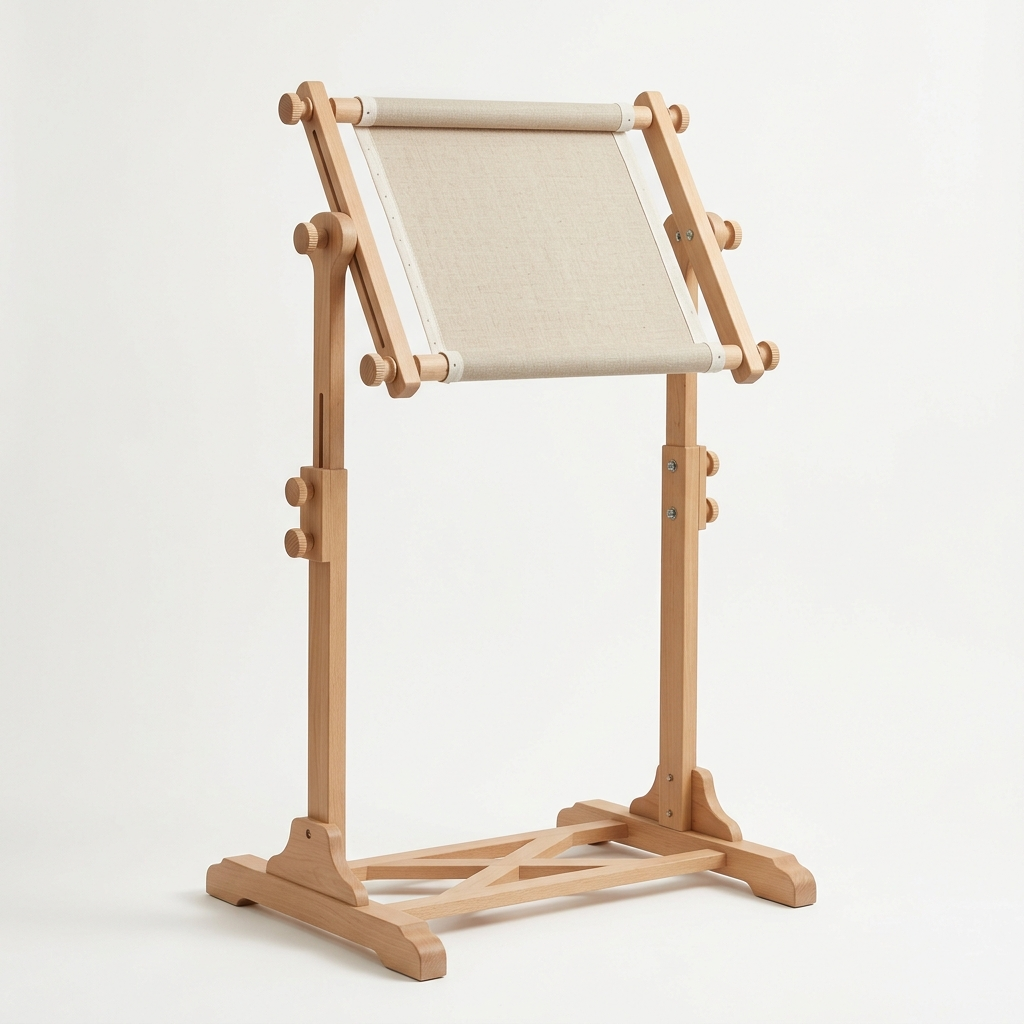
Tracey Recommends
Large Floor Frame Stand for Needlework
For big, ambitious cross stitch or needlepoint projects, a solid floor-standing frame makes all the difference. Look for adjustable height, a wide scroll rod span, and a base that won't tip under a loaded frame.
See on AmazonMaking the Right Choice for Where You Are Right Now
Here's the honest summary: if you're working on smaller or medium-sized patterns — the kinds of pieces that might take a few weeks to a few months — start with a quality lap frame or a lap base with a clamp that holds your existing frame. It's flexible, portable, and won't require you to dedicate a corner of your bedroom to it. The Lovely Lotus Flower pattern I mentioned, for example, is exactly the kind of project that works beautifully on a lap setup. You can stitch it at the kitchen table, in the living room, or on the porch on a nice afternoon.
If you've got a large project calling your name — a big sampler, a portrait, a tapestry — don't put it off by telling yourself you'll get to it when you have the right setup. Get the floor frame first, set it up, and then start. The project won't happen without the right foundation, and 'I'll do it when I have the right frame' is a sentence that turns into years of waiting if you let it.
K's Creations remains my top recommendation for anyone willing to wait for quality custom work. Call them, ask questions, and place your order. The wait is worth it, and the frames last for years — mine have. But if you need to get stitching now, don't let the lead time stop you. There are good options available on Amazon for both lap frames and floor frames that will serve you well while you wait, or serve you just as well if a wait simply isn't in the cards.
Whatever you choose, choose intentionally. Think about the size of the projects you love most, think about where in your home you want to stitch, and think about how much time you realistically want to spend setting up and packing down your work. The frame that fits your actual life is the right frame. Full stop.
I hope this gives you a clearer picture of what to look for and how to think about putting your stitching space together. A good frame, good light, and a little intentionality go a long way toward making this craft something you return to again and again. If you're looking for a project worthy of a great new setup, I'd love for you to browse the patterns at Sunrays Creations — there's something there for every skill level and every kind of stitching space.
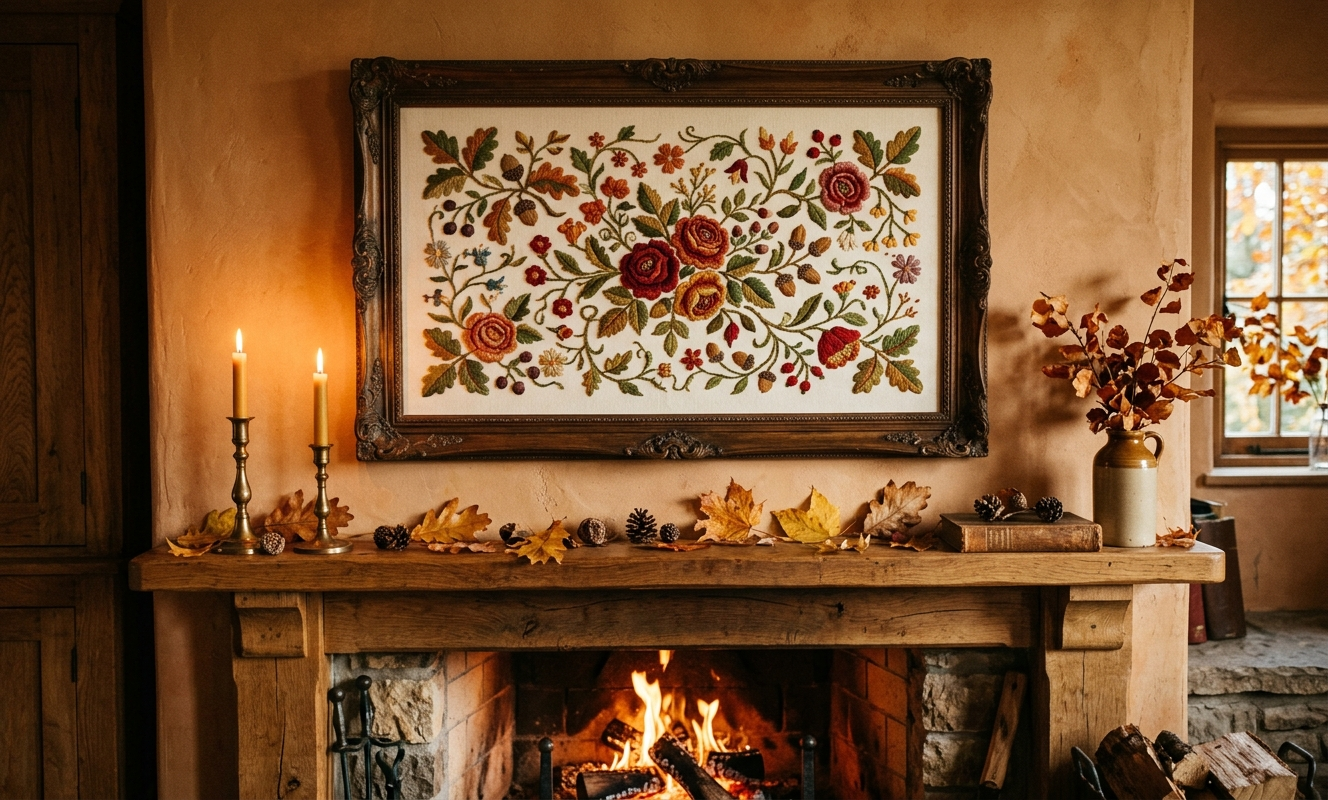
Finished needlepoint tapestry with floral design displayed above a fireplace mantle in warm heirloom setting
Keep Reading
What Do You Need to Cross Stitch?
New to the craft or refreshing your supplies? This complete beginner's guide covers every tool and material you need to get started on the right foot.
READ THE GUIDETips for Stitching on Dark Cloth
Dark fabric is beautiful but it comes with unique challenges — especially when it comes to lighting and frame setup. Read how Tracey handles it.
READ THE ARTICLECross Stitch FAQs
Got questions about technique, tools, or getting started? Tracey answers the most common questions she hears from stitchers at every level.
READ THE GUIDEFrequently Asked Questions
What is the difference between a lap frame and a floor frame for cross stitch?
A lap frame sits on your legs and is best for small to medium projects; a floor frame is freestanding and designed for large or long-term work. The article covers both in detail.
Do I need a stand for my cross stitch frame?
A stand holds your frame hands-free so both hands can work the needle, which is faster and easier on your body. Tracey explains why this matters in the opening sections.
Is K's Creations a good brand for cross stitch frames?
Yes — Tracey has used K's Creations frames for years with no cracking or breaking, but they are custom-made to order with a wait time, as noted in the article.
What lighting do I need for a cross stitch stitching corner?
Tracey recommends a daylight OTT-Lite floor lamp for stitching — the article explains how proper lighting reduces eye strain and makes colors easier to read.
Can I use a rug hooking frame for needlepoint or cross stitch?
Yes — Tracey adapted a large rug hooking frame for needlepoint tapestry work and it handles the wide fabric beautifully. The article covers this creative workaround.
What else do I need besides a frame for my stitching setup?
A magnetic pattern board, good lighting, an organized needlework project bag, and a supportive chair are the key additions Tracey recommends in the final sections.
-- Tracey Kramer
Founder & Designer, Sunrays Creations Needlearts
Hand-charted designs since 2004 • Marysville, Ohio