
Cross Stitch on Linen: The Complete Guide to Stitching on Natural Fabric
Posted by Tracey M. Kramer on 22nd Aug 2026
A Note from Tracey Kramer
I have been designing counted cross-stitch patterns since 2004, and in that time I have watched my customers stitch everything from wedding gifts to heirloom samplers. This is everything I know about this topic -- from real experience, not theory.
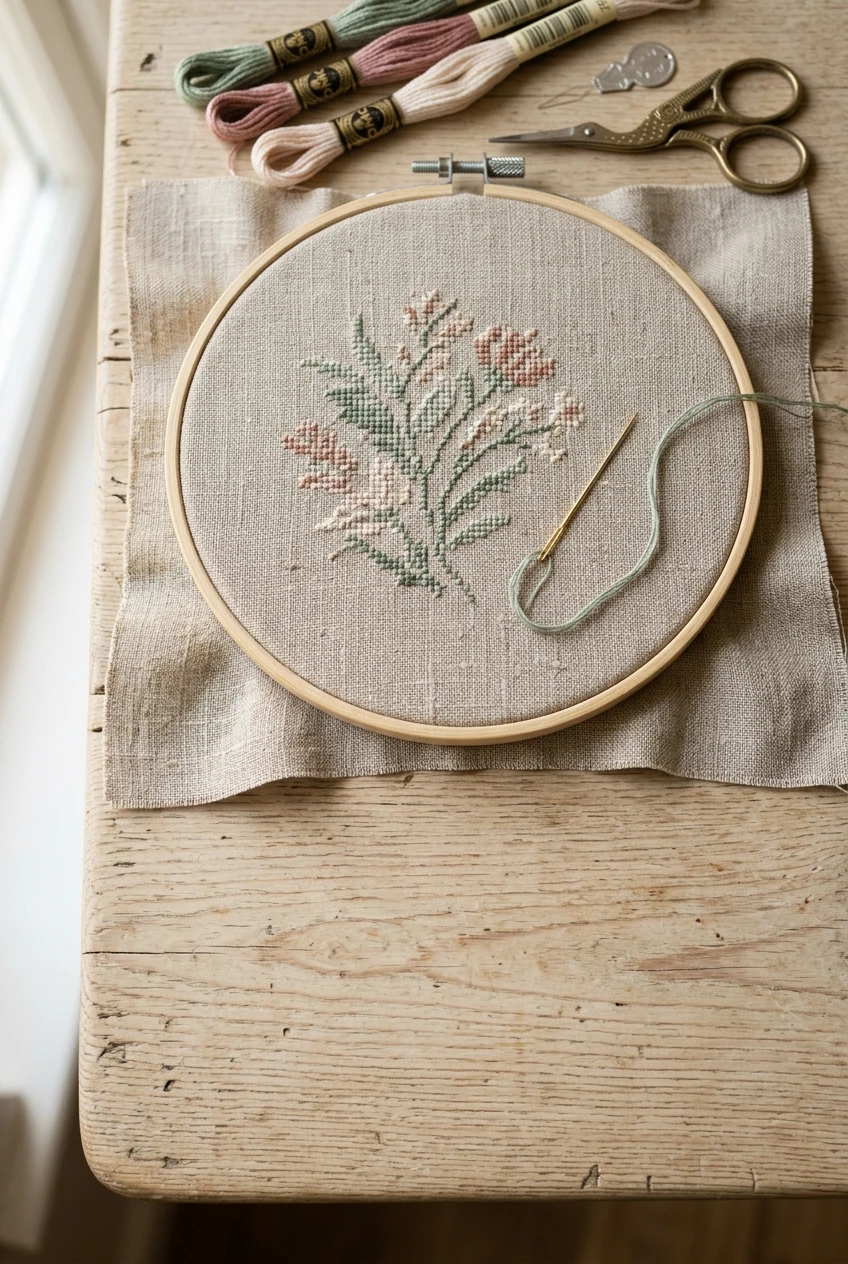
Cross stitch on linen in a wooden hoop showing stitches worked over two fabric threads
By Tracey Kramer • • 12 min read
If you've decided to try linen and you're staring at a piece of it wondering where on earth the holes went, you're in exactly the right place. Cross stitch on linen works differently from Aida because you stitch over two fabric threads instead of into obvious square holes, and once that clicks the whole fabric stops feeling like a puzzle. After 22 years of designing charts and stitching them myself, I can tell you the first hour on linen is genuinely slower than Aida, and I can also tell you most stitchers who push through that hour end up loving what linen does to a finished, framed piece.
Stitching Over Two: The One Thing That Makes Linen Make Sense
Here is the central technique, and honestly, it's the only real hurdle. On Aida you stitch into holes. The fabric is woven in tidy little blocks with a visible hole at every corner, and your needle basically tells you where to go. Linen has no blocks. It's a plain weave of single threads running over and under each other, so instead of counting holes you count threads. You take your needle up, skip two vertical threads and two horizontal threads, and come back down. That's one stitch worked "over two."
Why over two and not over one? Because linen threads are not uniform. They're spun from a plant fiber and they vary in thickness along their length. If you worked over a single thread, every irregularity in the weave would show up as a lopsided stitch. Working over two averages out that variation. Two threads together are far more consistent in width than any one thread on its own, so your stitches sit square and even. That's the whole reason the convention exists. It isn't tradition for tradition's sake.
Now the math, because this is where people buy the wrong fabric. Linen is sold by how many threads per inch it has. Divide that number by two and you get your stitches per inch. So 28 count linen worked over two gives you 14 stitches per inch, which is exactly the same finished size as 14 count Aida. 32 count linen over two gives 16 stitches per inch. 25 count Dublin linen over two lands at roughly 12.5 stitches per inch, so a chart works up a touch larger than it would on 14 count Aida.
The rule to memorize: linen count divided by two equals the Aida count it matches. My charts are designed for 18-count Aida, which means if you want the same finished dimensions on linen you're looking for 36 count worked over two. That's fine linen and I'd not send a first-timer there. Most people trying linen for the first time should size up deliberately. Take one of my charts, work it on 28 count over two, and it'll finish larger than the stated size on the pattern. Bigger stitches, easier hands, a piece you can actually see. Recalculate before you cut: divide your stitch count by your stitches per inch, then add at least three inches on every side for framing.
One more thing that trips people up. "Over two" means over two threads in both directions. Not two threads across and one down. Every stitch, every time, the same. Get sloppy about that on a single row and the whole row shifts by half a stitch and you'll be frogging it back out.
Slubs Are Not Flaws (And How to Stitch Right Over One)
The first time a stitcher opens a piece of good linen, there's often a moment of panic. There are thick spots. There are thin spots. There's a lumpy bit right in the middle where a thread swells to twice its usual thickness for half an inch. People email me asking whether they should return it.
Don't. Those are slubs, and they are the character of linen, not a defect. Flax fiber isn't extruded to a uniform diameter the way polyester is. It's a plant. It has thick and thin along its length, and the spinning process leaves those variations in the yarn. A linen with zero slubs has usually been heavily processed to get there, and it loses the soft irregular light that makes linen worth stitching on in the first place. When a finished piece is framed and hanging on a wall, those subtle variations in the ground fabric are precisely what makes it look like handwork instead of a print.
The practical problem is real though. When you hit a slub, the two threads you're supposed to be stitching over suddenly aren't the same width as the two threads next door, and your stitch can look fat or crooked or slightly off-grid. Here's what I do, and it's simpler than you'd think: count threads, not distance. Your eye wants to keep stitches visually the same width. Ignore your eye. If you always cross exactly two threads regardless of how thick they happen to be, the grid stays true and the piece stays square. A stitch over a slub sits slightly wider than its neighbors, and once the area is filled in nobody sees it. Not you, not the person looking at the framed piece.
If a slub is genuinely enormous and sits somewhere critical, like a face, you have options before you start. Move the design. Shift your starting point two or three inches so the slub lands in the background or in the margin you'll trim for framing. This is one of the reasons I hold off on gridding and centering until I've held the fabric up to a window and had a good look at it.

Tracey Recommends
Linen Evenweave for Embroidery 25ct Dublin, Natural Raw 52
This is where I'd start anyone new to linen. Dublin 25 count worked over two gives you roughly 12.5 stitches per inch, which is generous enough to see clearly while you learn the two-thread rhythm. The natural raw color is warm and forgiving, and it frames beautifully.
Check Current Price →Count threads, not distance. If you always cross exactly two threads regardless of how thick they happen to be, the grid stays true and the piece stays square.
Tension Is Not Optional on Linen
This is the part that separates linen that looks gorgeous from linen that looks like a first attempt. Aida is stiff. It's woven in blocks and starched, and it holds its shape whether or not you support it. You can hand-hold Aida, stitch a whole project in your lap, and get away with it. Linen will not extend you that courtesy.
Linen is floppy. It's a plain weave with drape built in, and the moment you hold it in your hand and pull a stitch, the fabric moves with the thread. You end up with puckered spots, distorted grid lines, and stitches that read as uneven even though your thread tension was consistent. The fabric moved, not your hand. And unlike Aida, linen doesn't bounce back and hide it.
So the fabric goes under tension. Always. I use a 5-6 inch wooden hoop for almost everything I stitch, and it's what I reach for on linen without thinking about it. The wood grips better than plastic on a slippery weave, and a smaller hoop means I can reposition often and keep the tension drum-tight in the working area. Wrap the inner ring with a strip of cotton twill tape (find on Amazon) if your linen wants to slide, and never leave the piece hooped overnight. Linen creases hard, and a hoop ring left in place for a week will leave a mark that takes real effort to press out.
Plenty of stitchers on linen prefer a Q-Snap frame for exactly this reason. The square PVC frame clamps the fabric with grip clips instead of squeezing it between two rings, so you get even tension across a larger working area and no ring crease at all. It isn't my personal tool of choice, but it's a legitimate answer to the tension problem on linen and a lot of experienced linen stitchers swear by it. What matters is that something is holding the fabric taut. What matters is that it isn't your left hand.
If you find yourself gripping harder to compensate, that's a signal your setup is wrong rather than your technique. Sore hands after an hour usually trace back to a frame that isn't doing its job.
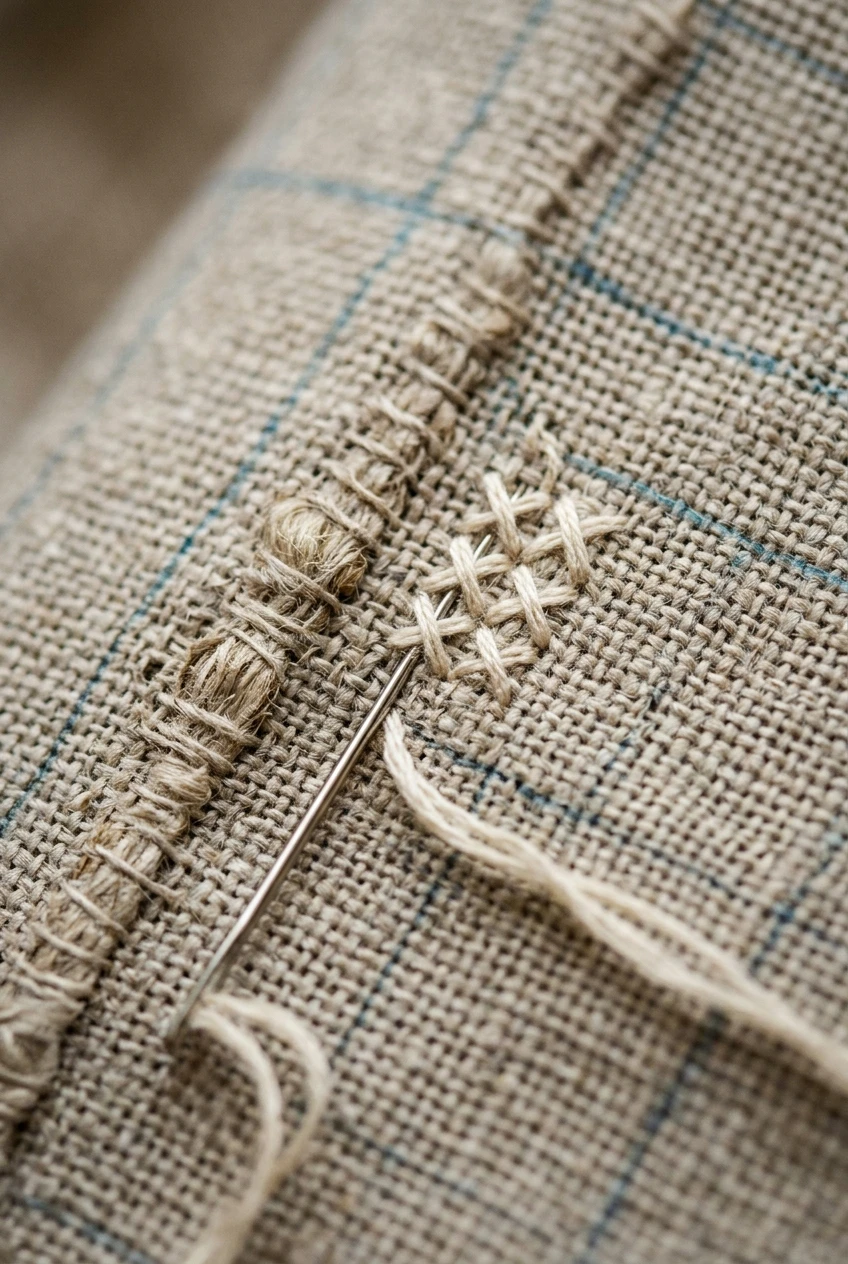
Macro view of linen weave with a slub, gridding lines and stitches worked over two threads
Finding Your Place Without Holes to Follow
On Aida you can look down and see exactly where you are. Rows of blocks, obvious holes, easy counting. Linen gives you a soft grid of fine threads that all look alike, and the honest truth is that miscounting is the number one reason new linen stitchers end up frogging. Two threads look a lot like three threads at eleven at night under a bad lamp.
Two things fix this, and neither is optional in my book. The first is gridding. Marking your fabric in 10x10 squares with a water-soluble marking pen (find on Amazon) or fine sewing thread before you start is helpful on Aida and close to essential on linen. On linen you're gridding every twenty threads, which corresponds to ten stitches over two, and once that grid is laid in you're never more than a few stitches from a checkpoint. If you drift, you catch it inside one block instead of three rows later.
The second is light. Genuinely good, direct, daylight-balanced light on the fabric. Linen threads are fine and pale and low-contrast against each other, and warm overhead light flattens them into a blur. A daylight lamp (find on Amazon) positioned over your shoulder makes the individual threads pop into view and cuts your counting errors dramatically. This is the single upgrade that makes linen feel manageable for most people.
A blunt tapestry needle also helps more than you'd expect. Because you're not aiming for a pre-punched hole, a rounded tip lets the needle find the natural gap between threads and slide through instead of splitting a thread and putting your stitch in a place the chart never intended. If you feel resistance, back the needle out and try again a hair over. Don't force it.
|
Patterns from the Sunrays Collection Tracey's Picks, designing cross stitch patterns since 2004 | |||||
| |||||
| Browse the full Sunrays collection → |



Needles, Floss, Fractionals, and Prepping the Fabric
Needle size. Yes, you'll usually want to size up in number, which means down in thickness. On 18-count Aida I use a size 26 tapestry needle (find on Amazon). On 28 count linen over two, a 26 or 28 is right. On finer linen go to a 28. A needle that's too fat forces the fine threads apart and leaves visible gaps around your stitches, and on linen those gaps don't close back up the way they do on stiffer fabric. A slightly finer needle glides.
Floss. DMC six-strand is what I chart with and what I stitch with, and the strand count follows your stitches per inch, not the fabric type. 28 count linen over two is 14 stitches per inch, so two strands gives good coverage, and some stitchers prefer three on 28 for a fuller look. On 32 count over two, two strands. On coarser 25 count Dublin, two or three depending on how dense you want the coverage. Stitch a small test area in a corner before you commit to a whole project. Ten minutes of testing saves a lot of regret.
Fractional stitches. Here's the pleasant surprise. Quarter and three-quarter stitches are easier on linen than on Aida, and this is a genuine reason to make the switch. On Aida a quarter stitch requires you to stab your needle through the middle of a solid woven block, which is unpleasant and often lands slightly off. On linen, the center point of your stitch is just the gap between the two threads you're working over. It's already there. Your needle drops straight into it. If you stitch charts with a lot of shading and blended detail, fractionals on linen will make you very happy.
Preparing the fabric. Linen frays faster and creases harder than Aida, so prep matters more. Before anything else, finish the edges. Machine zigzag around the perimeter, run a line of overcast stitching, or fold a narrow hem and baste it. Masking tape is a bad idea on linen because it leaves adhesive residue in a loose weave. Then press the fabric with a warm iron before you hoop it, because linen holds fold lines from packaging with real determination and it's far easier to press them out before stitching than after. Find your center by folding in quarters and marking with a tacking stitch rather than a pen crease. And add generous margins. I want at least three inches of clear fabric on every side for framing, more on a big piece.
If you're still weighing whether linen is the right move for you at all, I've written a full fabric comparison elsewhere and I'd rather point you there than re-argue it here.
Get Stitching Tips & New Patterns from Tracey
Honest advice, new Sunrays designs, and occasional VIP-only offers. No fluff.
No spam. Unsubscribe any time.

Tracey Recommends
Q-Snap Needlework Frame Bundle: 11x11, 8x8, 6x6, and Extension Kit
Linen will not forgive hand-holding, and a Q-Snap solves that with clip-on grip bars instead of ring pressure. It isn't my personal go-to over a wooden hoop, but for a larger linen piece it keeps tension even across the whole working area and leaves no ring crease.
Check Current Price →The Honest Learning Curve (And Why Stitchers Don't Go Back)
I'm not going to oversell this. Your first hour on linen will be slower than your last hour on Aida, and it will probably be a little frustrating. You'll count twice and get two answers. You'll put a stitch over three threads and not notice until you're four stitches along. You'll wonder why anyone bothers. That's normal and it is not a sign you've chosen the wrong craft or the wrong fabric.
What changes is that around hour three, your hands start reading the fabric instead of your eyes. The two-thread rhythm becomes automatic. You stop counting consciously and start feeling where the needle goes. Most stitchers describe it as a switch flipping rather than a gradual improvement, and after that the speed comes back fast.
And then there's the payoff, which is why I'm writing this at all. A finished piece on linen looks different framed. The ground fabric has softness and depth instead of a rigid grid, so the stitches read as the image rather than as rows of X's on a mesh. Fine detail holds better. Fractionals are cleaner. Shaded areas in a landscape or a fine art reproduction blend rather than stepping. On a large, detailed chart, that difference is the difference between a nice cross stitch and a piece that people ask about.
Start small. Take a chart you already understand, buy a piece of forgiving mid-count linen, and treat the first project as a practice run rather than a masterpiece. Grid it. Hoop it properly. Light it well. Give it three hours before you decide anything. That's the honest advice I'd give a friend sitting at my kitchen table, and it's what I'd give you.
Linen asks a little more of you at the start and then gives it all back in how the finished piece looks hanging on a wall. Grid it, hoop it properly, light it well, and let your hands learn the rhythm. When you're ready to put a real design under that needle, come browse the Sunrays Creations pattern library and pick something you'll be glad to frame.
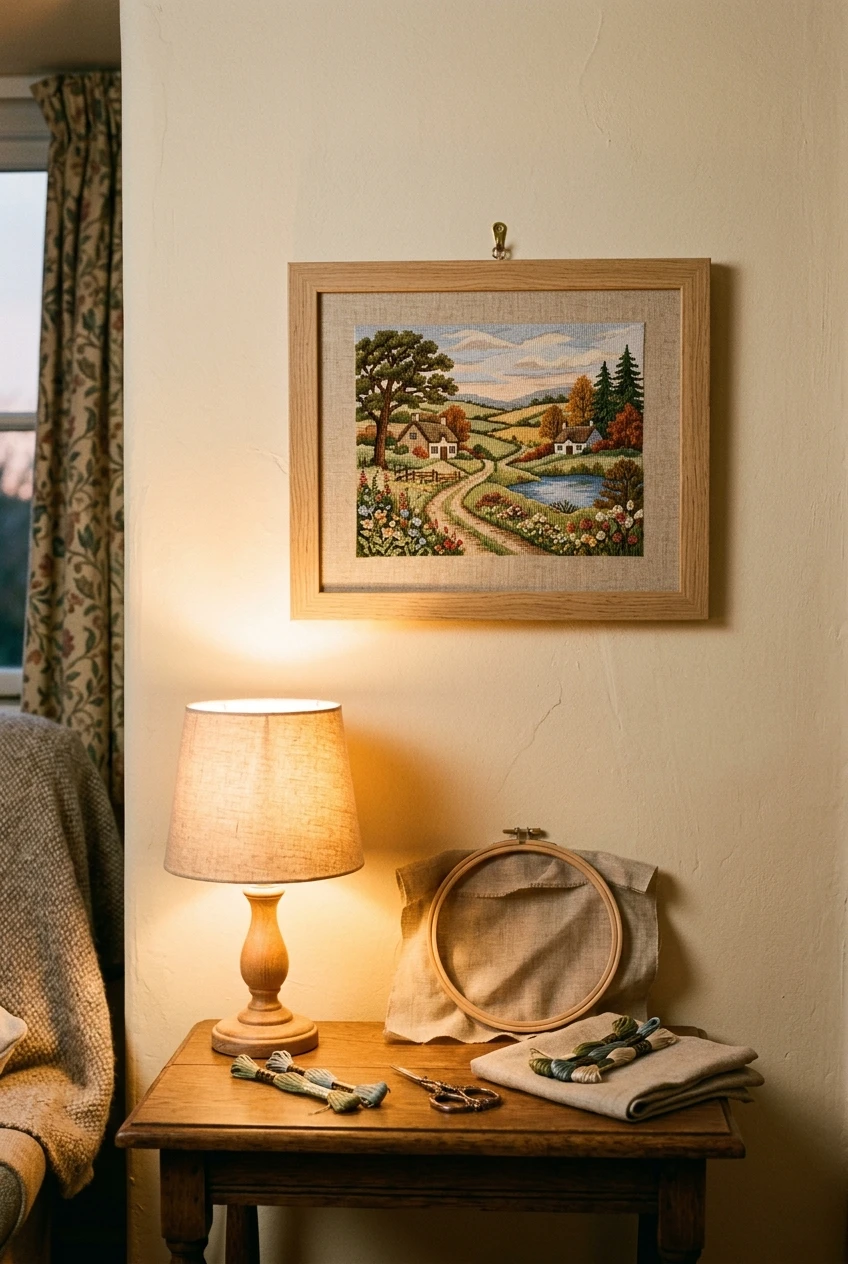
Framed cross stitch landscape stitched on linen hanging on a warm cottage wall
Keep Reading
Cross Stitch Fabric Guide: Aida vs. Linen vs. Evenweave — Which Is Right for You?
Still deciding whether linen is the right move? This guide covers the full comparison so you can pick your fabric with confidence before you learn the technique.
Compare FabricsHow to Grid Your Cross Stitch Fabric (And Why It Changes Everything)
Gridding is helpful on Aida and close to essential on linen. Here's exactly how to lay in a 10x10 grid before you start stitching over two.
Read the GuideHow to Prepare Cross Stitch Fabric Before You Stitch
Linen frays and creases more than Aida, so edge finishing and pressing matter more. This walks through prep step by step.
Prep Your FabricFrequently Asked Questions
What does it mean to cross stitch over two on linen?
It means each stitch crosses two fabric threads in both directions rather than going into a pre-formed hole. Linen is a plain weave with no obvious blocks, so you count threads instead. Working over two averages out the natural thickness variation in linen threads so your stitches sit square and even.
What count linen equals 14 count Aida?
28 count linen worked over two gives you 14 stitches per inch, the same finished size as 14 count Aida. The rule is simply linen count divided by two equals the matching Aida count. 25 count Dublin over two comes out at roughly 12.5 stitches per inch.
Are the thick and thin spots in my linen a defect?
No, those are slubs and they're the natural character of flax fiber. They're what gives linen its soft irregular light and makes a framed piece look like handwork. Just keep counting exactly two threads regardless of thickness and the grid stays true.
Do I need a hoop or frame for linen?
Yes. Linen is floppy and moves with your thread if you hand-hold it, which produces puckering and uneven-looking stitches. I use a 5-6 inch wooden hoop for almost everything. A Q-Snap frame is a legitimate alternative that some linen stitchers prefer.
Do I need a different needle for linen?
Usually a slightly finer one. On 28 count linen over two, a size 26 or 28 tapestry needle works well, and finer linen calls for a 28. A needle that's too thick forces the fine threads apart and leaves visible gaps that don't close back up.
Are fractional stitches harder on linen?
They're actually easier. On Aida a quarter stitch means stabbing through the center of a solid woven block. On linen the center point is just the gap between the two threads you're working over, so your needle drops straight in.
How long does it take to get comfortable stitching on linen?
The first hour is genuinely slower and mildly frustrating for most people. Around hour three the two-thread rhythm becomes automatic and your speed comes back. Give it three hours before you decide anything.
-- Tracey Kramer
Founder & Designer, Sunrays Creations Needlearts
Hand-charted designs since 2004 • Marysville, Ohio