
Cross Stitch vs Needlepoint: More Similar Than You Think
Posted by Thomas J. Kramer on 5th Oct 2016
A Note from Tracey Kramer
I have been stitching for over thirty years and I still cannot pick just one craft — and honestly, I have stopped trying. This article is my love letter to all of them.
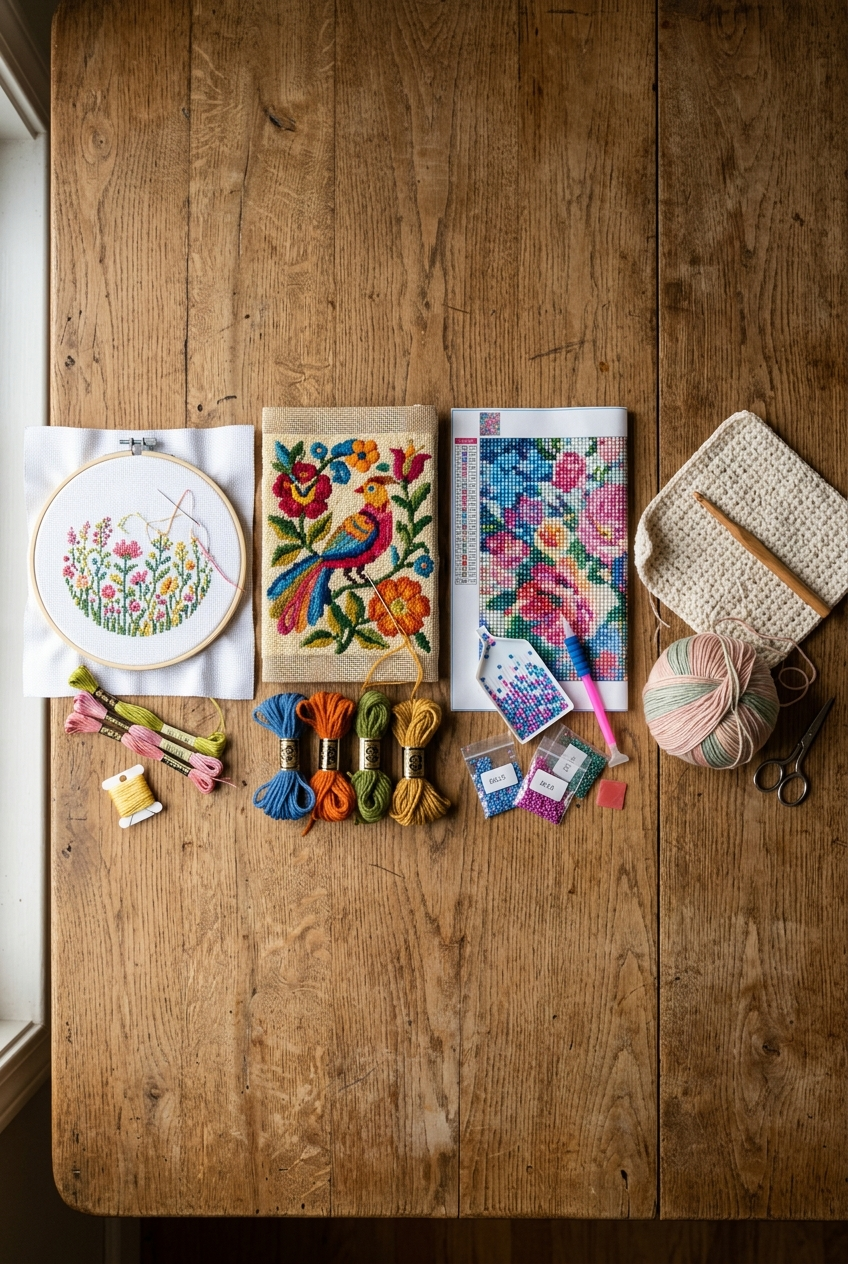
Flat lay of cross stitch, needlepoint, diamond painting, and crochet projects on wooden table
By Tracey Kramer • • 12 min read
Right now, as I type this, I have four projects set up in different corners of my house. There is a counted cross stitch piece on my hoop stand in the living room — a botanical I have been working on for weeks. There is a needlepoint canvas on the coffee table that I pick up when I just want something to fill in without thinking too hard. There is a diamond painting kit in a zippered bag by the couch for evenings when I want something that feels almost meditative. And somewhere under a pile of craft magazines is a crochet project I keep meaning to get back to. This is not chaos. This is just how my creative brain works.
People ask me all the time: which is better, cross stitch or needlepoint? Which one is harder? Which one should a beginner start with? I understand why they ask — when you are new to needle arts, the options can feel overwhelming and the differences between crafts are not always obvious from the outside. But after thirty-plus years of stitching, designing my own patterns through Sunrays Creations, and moving between needlepoint, diamond painting, and crochet like a person who cannot commit to a single hobby, I want to offer a different answer: these crafts are more similar than you think. And if you love one, there is a very good chance you will love them all.
So let me walk you through each of them — the real differences, the surprising overlaps, the beginner questions, and the reasons why needle artists like me tend to collect crafts the way other people collect houseplants. By the end of this, you might just find yourself adding a new project to your own corner of the house.
Cross Stitch and Needlepoint: The Real Differences
Let me start with the two crafts that get compared most often, because people do mix them up and the differences are real — they are just not as dramatic as some people make them sound. Cross stitch and needlepoint share the same DNA: you are pushing a needle and thread through a gridded fabric in a deliberate, repetitive pattern to build an image. The tools look similar, the results can look similar from a distance, and both require you to sit down, slow down, and pay attention. But the specifics matter, especially if you are trying to decide where to start.
The fabric is the most obvious difference. Cross stitch is worked on Aida cloth or evenweave — a woven fabric with a clear, regular grid of holes that you count to place each stitch. The number of holes per inch is the count: 14-count Aida has 14 squares per inch and is the most common starting point for beginners, while 28-count evenweave is finer and used for more detailed work. Needlepoint, on the other hand, is worked on canvas — a stiffer, open-weave material that comes in mesh sizes called gauge. A 13-mesh canvas has 13 holes per inch, similar to 14-count Aida, but the canvas is much more rigid and the thread has to completely cover the entire surface. There is no visible background fabric left in needlepoint — every hole gets filled.
The thread tells a similar story. Cross stitch is almost always worked with cotton embroidery floss — typically six-strand floss that you separate into two or three strands depending on the count of your fabric. You can also use satin floss for sheen or metallic floss for highlights, and I use both in my own designs. Needlepoint uses a wider range of thread weights. On smaller mesh canvases, you can use cotton floss, but the traditional material is tapestry wool for needlepoint (find on Amazon) — a thicker, woolen thread that gives the finished piece a rich, textile quality that cotton simply cannot replicate. Some high-end needlepoint kits include silk thread, hand-dyed wools, and specialty fibers that make the finished piece feel almost sculptural.
The stitch itself is where the names diverge. In cross stitch, every stitch forms an X — a diagonal stroke in one direction, then a diagonal stroke crossing back over it in the opposite direction. That cross is the whole point. In needlepoint, the basic stitch is the tent stitch: a single diagonal stroke from one corner of a canvas square to the opposite corner. No cross. Just one diagonal repeated across the entire canvas. Some needlepoint stitchers use a half cross stitch while others use the continental or basketweave method, which covers the back of the canvas more thoroughly and prevents distortion on larger pieces. Neither is wrong, but they produce slightly different results in terms of durability and canvas tension.
Finally, the design approach is different in a way that significantly affects the stitching experience. In counted cross stitch, you work from a chart — a grid of symbols or colors on paper or screen, where each symbol represents one stitch in one color. You are counting constantly, finding your place, tracking where you are on the chart versus where you are on the fabric. In needlepoint, the canvas is usually pre-printed or hand-painted with the design already on it in full color. You are not counting — you are filling in color areas the way you might paint by number. Some people find this enormously relaxing. Others miss the puzzle-solving aspect of counted work. I happen to love both for exactly that reason.
Which Is Easier for Beginners? It Depends on What You Mean
This is the question I get more than almost any other, and my honest answer is: it depends on what kind of easy you are looking for. If you are asking which craft is cheaper and simpler to get started with, cross stitch wins without much contest. A basic cross stitch starter kit — Aida fabric, a few skeins of DMC floss, a small embroidery hoop, and a needle — can cost anywhere from five to twenty dollars. My patterns at Sunrays Creations are designed to be printed at home, so the barrier to entry is genuinely low. You can sit down with ten dollars and a few hours and have something finished and framed on your wall. That kind of accessible success matters when you are deciding whether a craft is for you.
Needlepoint startup costs are a different story. A printed canvas needlepoint kit with enough tapestry wool included to complete the project can run anywhere from thirty to well over a hundred and fifty dollars, depending on the size and the quality of the canvas. Hand-painted canvases from boutique needlepoint shops — the kind you see in specialty stores — can cost several hundred dollars before you have even bought the thread. That said, needlepoint kits do tend to include everything you need in a single purchase, which removes some decision fatigue for a beginner. And a good needlepoint painted canvas (find on Amazon) does all the hard counting work for you: the colors are already on the canvas, and your job is simply to fill them in.
For a beginner who is nervous about counting and pattern reading, a printed needlepoint canvas can actually be the gentler entry point from a confidence standpoint. There is no chart to lose your place on. You look at the canvas, you match your thread color to what is painted there, and you stitch. It is deeply satisfying in a low-pressure way. I have recommended needlepoint to stitchers who felt intimidated by counted cross stitch charts and watched them fall completely in love with the craft before eventually circling back to cross stitch with much more confidence. The relaxation factor of needlepoint is real, and it should not be underestimated.
Cross stitch does have a gentler learning curve when it comes to the actual stitch itself. One X, repeated. Once you know how to make a clean cross stitch — consistent direction on your top diagonal, consistent tension — you have the fundamental skill mastered. Needlepoint has more stitching variation because the craft has a rich tradition of what are called specialty stitches: Hungarian ground, Gobelin stitch, Rhodes stitch, and dozens more that create texture and dimension across the canvas surface. These are advanced techniques, and a beginner absolutely does not need to know them on day one. But they are part of why experienced needlepoint artists get so deeply absorbed in the craft — the stitching itself becomes the artwork, not just a means to fill in a picture.
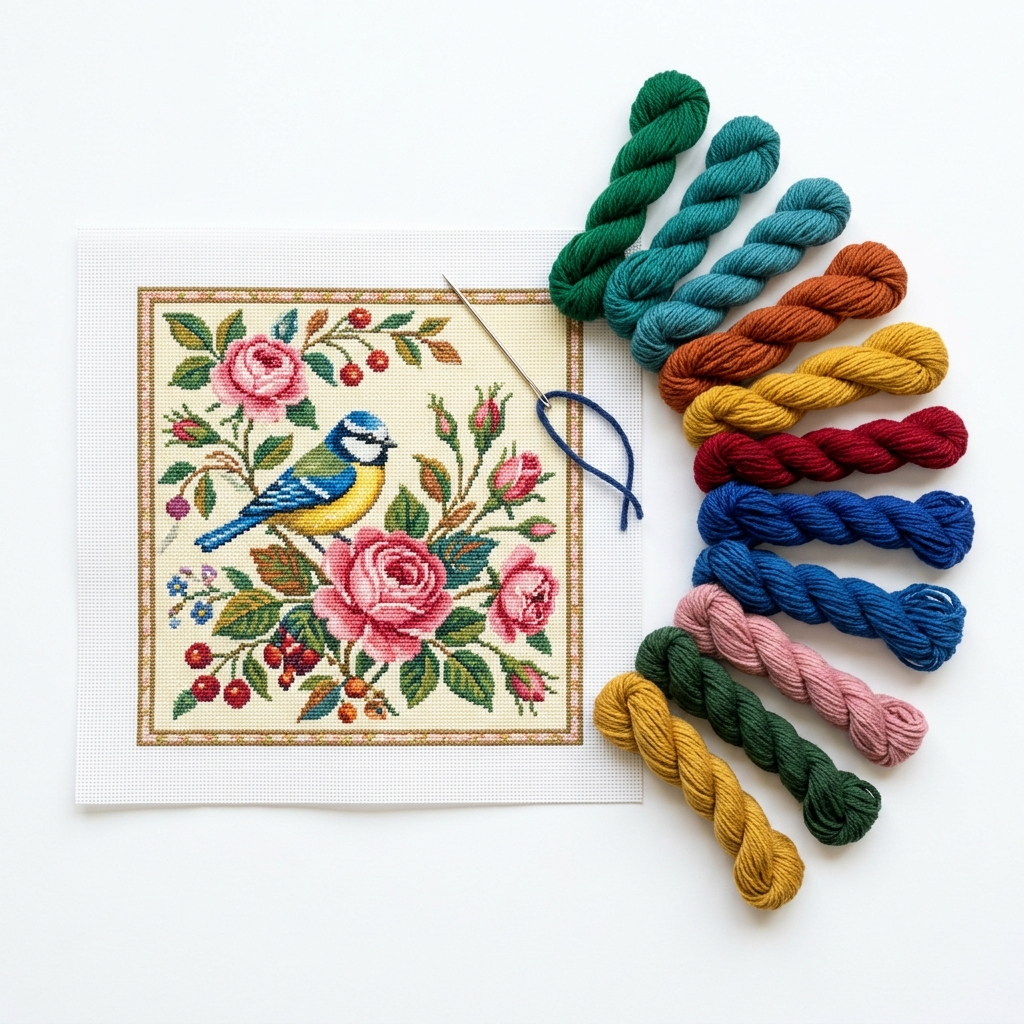
Tracey Recommends
Needlepoint Starter Kit for Beginners
If you have never tried needlepoint, a printed canvas kit with wool thread included is the gentlest possible entry point. Everything you need is in the box — no counting required, just pick up your needle and start filling in color.
See on AmazonCross stitch, needlepoint, diamond painting, and crochet are not competing hobbies. They are different expressions of the same creative impulse — color-driven, repetitive, portable, and deeply satisfying to finish.
Which Takes Longer? Busting the Myth About Needlepoint Being Faster
Here is something I hear a lot: needlepoint is faster than cross stitch because each stitch is simpler — one diagonal instead of two. And technically, that is true at the individual stitch level. A tent stitch takes less hand movement than a full cross stitch. But this logic breaks down completely when you zoom out to the project level, and I want to clear this up because it surprises a lot of people.
In cross stitch, the background is optional. Most of my designs at Sunrays Creations — and most counted cross stitch patterns in general — leave the fabric background unstitched. The Aida or evenweave fabric provides the neutral background tone, and you only stitch the design itself. This means a typical cross stitch project covers maybe thirty to sixty percent of the fabric surface. In needlepoint, every single hole on the canvas gets filled. One hundred percent coverage, no exceptions. That is a massive amount of additional stitching, and it adds hours — sometimes dozens of hours — to the total project time.
A moderately complex 8x10 cross stitch piece might take me forty to sixty hours depending on the color changes and technique complexity. A comparable-sized needlepoint canvas with full coverage can easily take twice that time, sometimes more if specialty stitches are involved. So if someone tells you needlepoint is faster than cross stitch, they are thinking about individual stitches and not about the whole picture. Both crafts reward patience. Neither is a quick weekend project once you get into intermediate or advanced work. And both are worth every single hour.
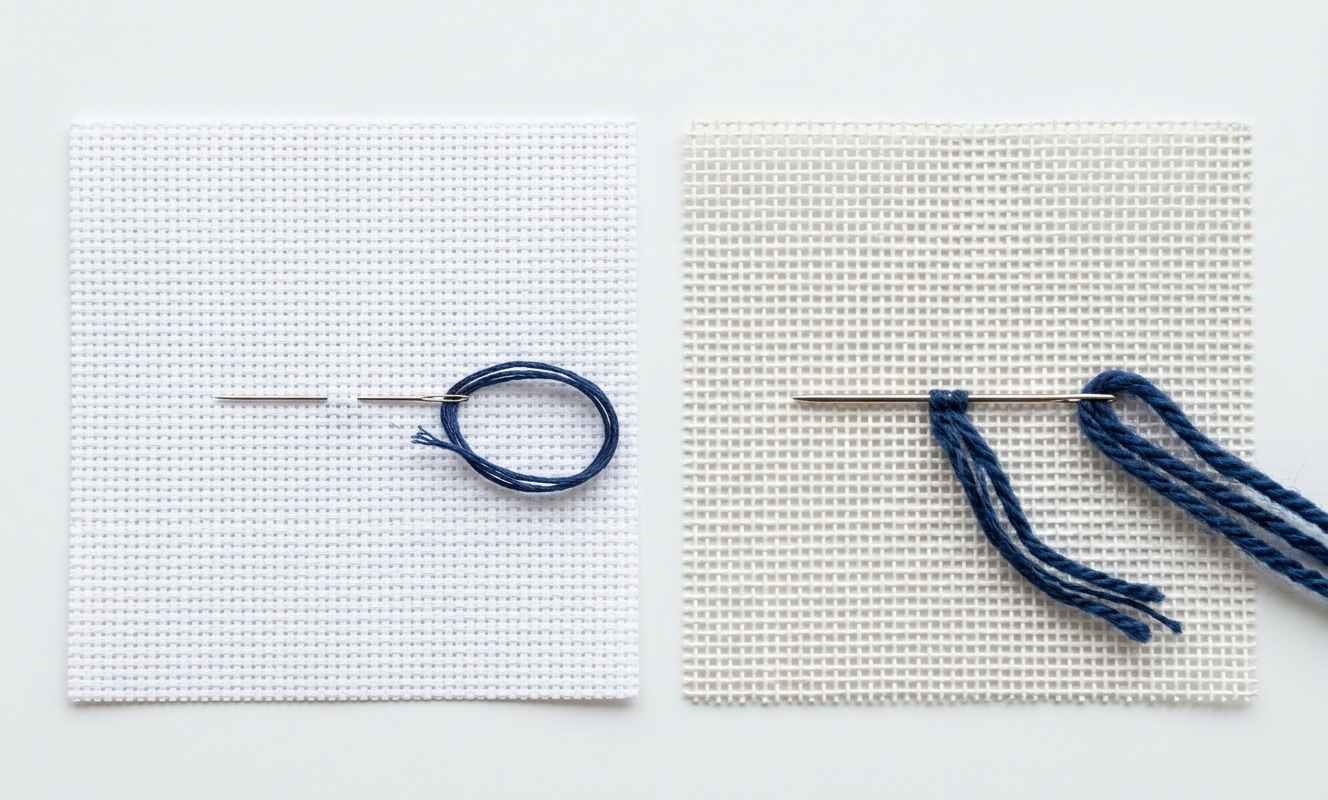
Side-by-side close-up of Aida cross stitch fabric and needlepoint canvas showing grid difference
A Quick Note for UK Stitchers: Needlepoint Is Also Called Tapestry
If you are reading this from the UK or have British stitching friends, you may never have heard the word needlepoint at all. In the United Kingdom, this craft is most commonly called tapestry — same craft, different regional name. When a British stitcher talks about working on a tapestry kit, they mean exactly what an American stitcher means when they say needlepoint: a canvas with a pre-printed design, worked with wool thread using the tent stitch. The kits you find in UK craft shops labeled as tapestry are functionally identical to what American shops sell as needlepoint kits. If you have been Googling needlepoint book for beginners (find on Amazon) and coming up empty, try searching tapestry kits — and vice versa. Same craft, same community, just a different accent.
This naming distinction matters practically, because it affects which search results, which YouTube tutorials, and which shop inventories are going to be most useful to you depending on where you are shopping. I want UK readers to feel at home in this conversation, because the needle arts community is wonderfully international and we are all working toward the same thing: a beautiful finished piece and a few quiet hours of creative calm along the way.
|
Patterns from the Sunrays Collection Tracey's Picks, designing cross stitch patterns since 2004 |
|||||
|
|||||
| Browse the full Sunrays collection → |


Needlework and Arthritis: Keeping Your Hands in the Game
I want to take a moment to talk about something that comes up more and more as our stitching community ages — because I have readers and customers who have been stitching for decades and are starting to feel the effects in their hands and fingers. Arthritis, stiffness, reduced grip strength: these are real challenges, and they do not have to mean the end of your needle arts practice.
Both cross stitch and needlepoint are generally considered good for keeping hands active and mobile. The repetitive fine motor movements help maintain dexterity, and many occupational therapists recommend hand crafts precisely because they keep the joints moving in a gentle, purposeful way. That said, the specific choices you make within each craft can make a big difference in how comfortable the work feels.
In cross stitch, working on a lower count fabric — 14-count Aida instead of 28-count evenweave, for example — means bigger holes, larger stitches, and less strain on eyes and fingers. You do not have to thread a needle through a tiny hole as many times per inch, which matters when your hands are having a hard day. In needlepoint, the same logic applies: a larger gauge canvas (lower mesh number = bigger holes) is significantly easier on stiff fingers. A 10-mesh or 13-mesh canvas is much more manageable than an 18-mesh or 24-mesh canvas for anyone dealing with arthritis. Tapestry wool is also thicker and easier to grip and handle than fine cotton floss, which some stitchers find easier when fine motor control is an issue.
The bottom line: do not give up on the craft you love because your hands are changing. Adapt your materials, scale up your count or mesh, use a good quality needle with a large eye, and consider a needle minder or needle gripper if threading has become frustrating. The rhythm of stitching — the repetitive calm of it — is good for the soul at any age, and God willing, we will all still be pushing needles through fabric well into our golden years.
Get Stitching Tips & New Patterns from Tracey
Honest advice, new Sunrays designs, and occasional VIP-only offers. No fluff.
No spam. Unsubscribe any time.
Compare Side by Side
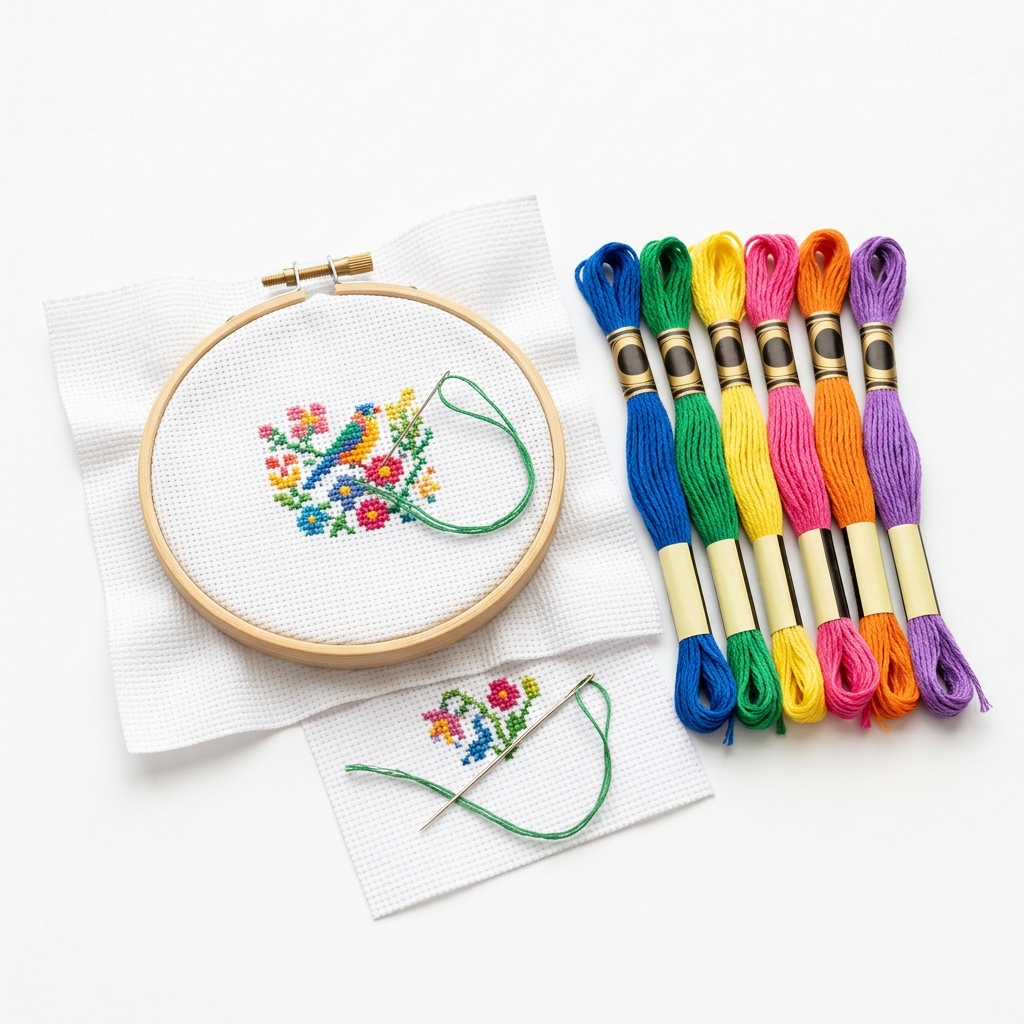
Cross Stitch Starter Kit
Here is what a comparable cross stitch starter kit looks like side by side with a needlepoint kit — Aida cloth, DMC floss, a small hoop, and a needle. Lower cost to start, and counting is part of the fun.
See on AmazonDiamond Painting: The Same Grid-Filling Itch, Different Tools
A few years ago, I started getting questions from cross stitch customers about diamond painting. Was it similar? Was it worth trying? Was it a craft or just a kit? My curiosity got the better of me, and I tried it. I wrote about that experience in Tracey's full piece on diamond painting as a creative diversion, and I will summarize it here: yes, it scratches exactly the same itch.
Diamond painting is a mosaic-style craft where you place small colored resin dots — called drills — onto an adhesive canvas that is pre-printed with a color-coded grid. Each dot placement corresponds to a grid square on the canvas, just like a cross stitch chart or a painted needlepoint canvas. The tools are different — you use a small stylus pen to pick up and place the drills rather than a needle and thread — but the mental process is almost identical. You are reading a grid, matching colors, filling in areas section by section, watching an image emerge from nothing. If you have ever lost three hours to a cross stitch project without realizing it, diamond painting will do the same thing to you.
What made diamond painting especially interesting for Sunrays Creations is that we actually converted one of our own original cross stitch patterns into a diamond painting design — something I believe very few independent cross stitch designers have done. Taking a hand-charted pattern and adapting it to the diamond painting format gave me a new appreciation for how closely these two crafts are related at the design level. The grid, the color placement, the relationship between symbol and color — it all translates. If you are a cross stitch fan who has been curious about diamond painting, a diamond painting kit for beginners (find on Amazon) is a very low-stakes way to try it without committing to a new hobby entirely.
Diamond painting is also genuinely accessible for people who find threading a needle difficult, for younger stitchers who are building fine motor skills, and for anyone who wants a creative project with a lower learning curve than counted cross stitch. I keep a diamond painting kit in my rotation specifically for evenings when my eyes are tired from detailed chart work but I still want the satisfaction of placing something in the right spot and watching a picture come together.
Crochet: A Different Tool, the Same Brain Chemistry
I know crochet is not a needle art in the traditional sense — you are using a hook, not a needle, and there is no fabric base to stitch onto. But I include it in my creative rotation for a reason, and I think most stitchers who try crochet understand immediately why it belongs in this conversation.
The brain chemistry is almost identical. Crochet is repetitive. It is rhythmic in a way that cross stitch is — stitch after stitch after stitch, your hands moving through the same motion until the motion becomes automatic and your mind is free to wander or to rest. There is tactile thread work involved: you are handling fiber, feeling the texture and weight of yarn, making decisions about color combination and project structure. And there is the same deeply satisfying project-based payoff at the end — a finished object, made by your hands, that did not exist before you sat down.
I pick up crochet the same way I pick up needlepoint: when I need a break from the intensity of counted cross stitch but I still want to be doing something creative and textile-based. Long car trips, evenings in front of the television, airplane travel — crochet fits all of those moments. The portability is comparable, the thread management is familiar if you have been handling embroidery floss, and the color sense you have developed from years of cross stitch or needlepoint transfers directly. If you can look at a cross stitch palette and choose harmonious colors, you can absolutely design a crochet color scheme.
Why Needle Artists Rarely Stop at Just One Craft
Here is what I really want you to take away from all of this: cross stitch, needlepoint, diamond painting, and crochet are not competing hobbies. They are different expressions of the same creative impulse. They are all color-driven. They are all repetitive in a way that quiets the noise in your head. They are all portable — you can take any of them with you on a trip, to a waiting room, to a friend's house. And they all deliver that specific, irreplaceable satisfaction of finishing something: a piece of work that you can hold in your hands, frame on your wall, give as a gift, or simply admire quietly before you start the next one.
The skills transfer more than people realize. The color sense you develop from years of choosing cross stitch thread colors makes you better at selecting needlepoint wools and diamond painting drill colors. The patience you build from following a counted cross stitch chart makes reading a crochet pattern less intimidating. The thread management habits you form — keeping your floss organized, your colors separated, your needles sorted — carry directly into needlepoint and beyond. You are not starting over when you try a new craft in this family. You are expanding.
I have been stitching for over thirty years, and I genuinely believe that God wired certain people to love this kind of work — the slow, careful, color-by-color building of something beautiful out of thread and patience. If that is you, I encourage you to not limit yourself to just one expression of it. Try the needlepoint canvas sitting at your local craft store. Order a small diamond painting kit for beginners and see what you think. Pick up a crochet hook and a skein of yarn and follow along with a YouTube tutorial. The worst that can happen is you discover it is not your thing. The best that can happen is you find another craft that fills your creative life in a different and wonderful way.
My origin story with cross stitch — how I fell into it, why I stayed, and what it has meant to me over the decades — is something I have written about in detail in It's in the Blood: My Love for Cross Stitch and How It All Began. If you want to understand why someone can spend thirty years devoted to a craft and still feel like they are just getting started, that piece will tell you everything.
Whether you are a lifelong cross stitcher, a curious needlepoint beginner, or someone who has three craft projects set up in different rooms of the house — welcome to the club. All of these crafts lead back to the same place: a quiet hour, a needle in hand, and something beautiful taking shape one stitch at a time. If you are ready to add a cross stitch project to your rotation, come browse the original hand-charted patterns at Sunrays Creations and find something worth stitching.
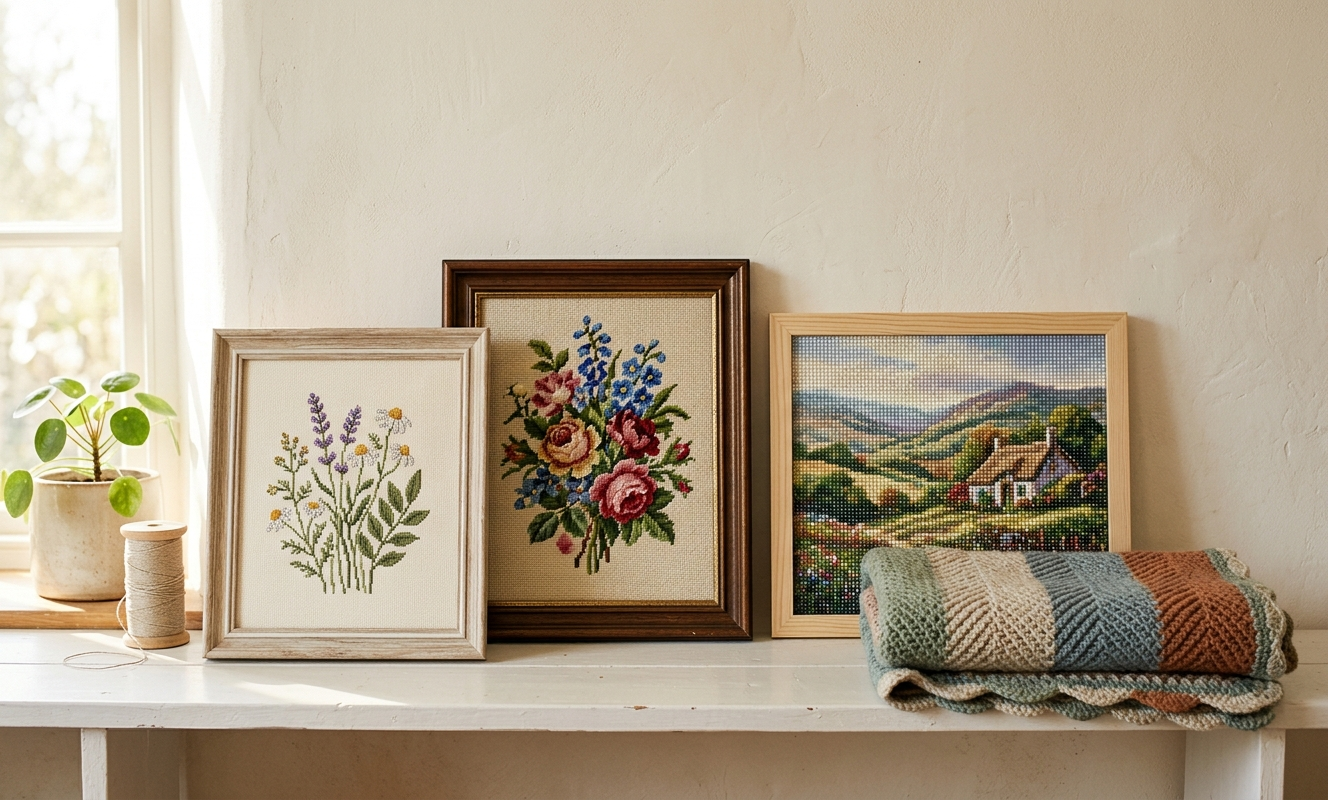
Four finished craft projects displayed on a white shelf — cross stitch, needlepoint, diamond painting, crochet
Keep Reading
It's in the Blood: My Love for Cross Stitch
Want to understand why someone can spend thirty years devoted to a single craft and still feel like they are just getting started? This is my origin story.
READ THE ARTICLEWhat Do You Need to Cross Stitch?
If this article made you want to try cross stitch for the first time, start here — a practical, no-fluff guide to every tool and supply you actually need.
READ THE GUIDETypes of Cross Stitch Patterns I Prefer
Not all cross stitch patterns are created equal. Here is how I think about pattern selection and what makes a design worth stitching.
READ THE ARTICLEFrequently Asked Questions
What is the main difference between cross stitch and needlepoint?
Cross stitch uses Aida fabric and forms an X stitch from a counted chart, while needlepoint uses a stiffer canvas with a pre-printed design and a single diagonal tent stitch covering every hole. See the deep-dive section above for full detail.
Is needlepoint called tapestry in the UK?
Yes — in the UK, the same craft is most commonly called tapestry. Same canvas, same wool thread, same tent stitch, just a different regional name. The UK section above covers this fully.
Which is easier for beginners, cross stitch or needlepoint?
Cross stitch wins on cost and stitch simplicity; a painted-canvas needlepoint kit wins on relaxation because there is no counting required. The beginner section above explains both paths in detail.
Is needlepoint faster than cross stitch?
Per stitch, yes — but needlepoint requires full canvas coverage while cross stitch leaves the background unstitched, making needlepoint projects significantly longer overall. The myth-busting section above breaks this down.
Is diamond painting similar to cross stitch?
Very much so — both use a color-coded grid and deliver the same satisfaction of building an image section by section. The diamond painting section above explains the overlap and mentions Sunrays Creations' own pattern conversion.
Are needlework crafts good for arthritis?
Yes — both cross stitch and needlepoint help keep hands active and joints mobile. Choosing a lower fabric count or larger canvas mesh makes the work easier on stiff fingers. Full guidance is in the arthritis section above.
-- Tracey Kramer
Founder & Designer, Sunrays Creations Needlearts
Hand-charted designs since 2004 • Marysville, Ohio