
Fall Cross Stitch Patterns: Pumpkins, Leaves, and the Coziest Season to Stitch
Posted by Tracey M. Kramer on 5th Oct 2026
A Note from Tracey Kramer
I have been designing counted cross-stitch patterns since 2004, and in that time I have watched my customers stitch everything from wedding gifts to heirloom samplers. This is everything I know about this topic -- from real experience, not theory.
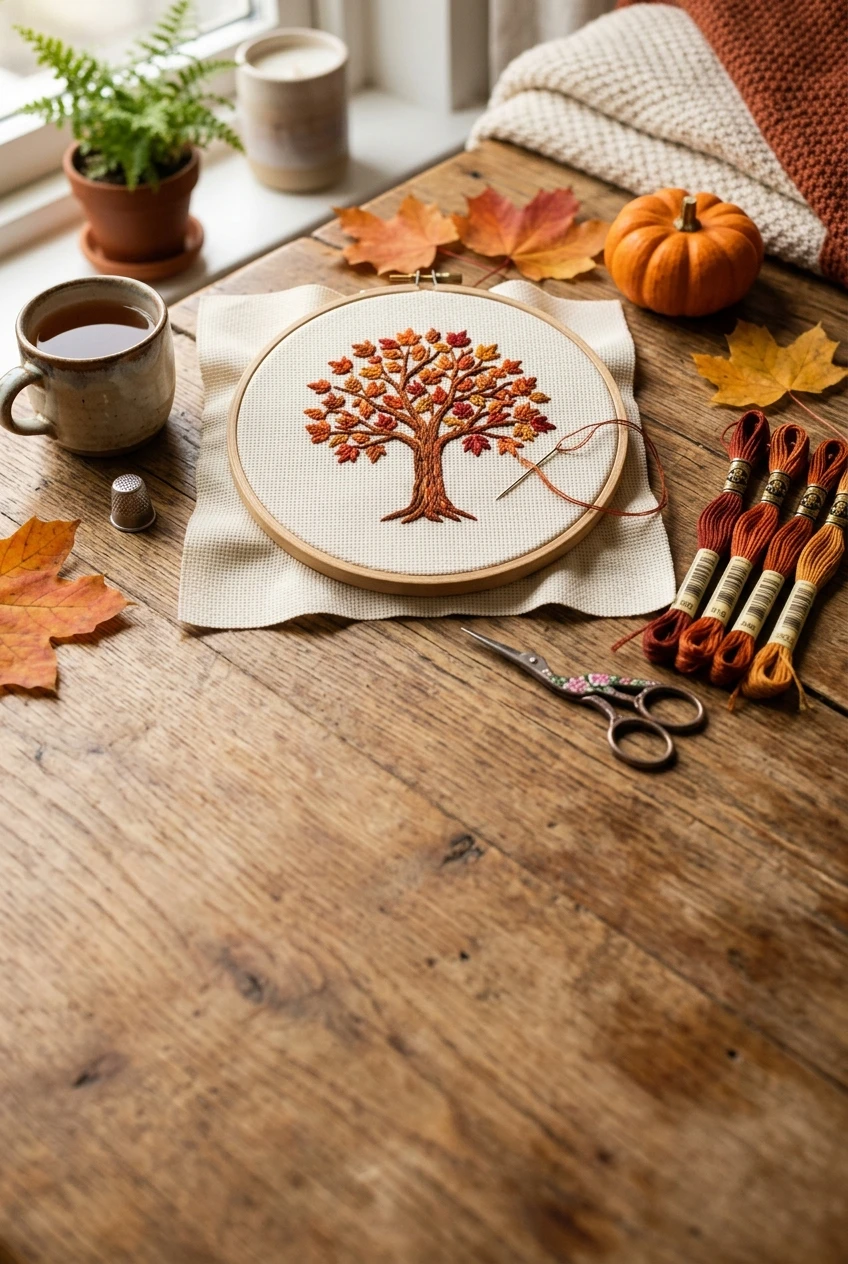
Fall cross stitch pattern of autumn maple on cream Aida in hoop with pumpkin and leaves
By Tracey Kramer • • 12 min read
The maples on my street turned over the weekend, and I've already got a WIP in my lap with eleven shades of orange on the floss board. Fall cross stitch patterns are the most beautiful designs I make and quietly the most demanding, because autumn palettes crowd together on the DMC range and autumn foliage means confetti stitching. If you want a pumpkin, a harvest scene, or a blazing hillside of maples hanging on your wall, this is how to pick the right design, the right fabric, and the right expectations for how long it will take.
Why Fall Palettes Are the Hardest Palettes in Cross Stitch
I'll say the unglamorous part first. After 22 years of charting seasonal work, autumn is the season where I get the most emails from stitchers saying their project looks muddy. It is almost never their stitching. It's the palette.
Spring gives you greens against pinks and blues. Winter gives you white against dark. Fall gives you russet, burnt orange, gold, ochre, rust, cinnamon, and six browns that all sit within a few numbers of each other on the DMC range. DMC 918, 919, 920, 921, 922 are a family. 975, 976, 977 are a family. 300, 301, 400, 420, 434, 435, 436 are a family. Pull three of those out of the drawer, lay them on a wooden table under a warm bulb, and I promise you will mis-sort at least one.
Two things fix this, and neither is complicated. The first is light. Warm household lighting shifts everything toward orange, which is exactly the direction your whole palette already leans. A daylight-balanced lamp separates 920 from 921 in a way a table lamp simply cannot. I keep a daylight floss lamp (find on Amazon) at my chair year round, and from September through November I do not stitch autumn work without it.
The second is sorting discipline before you start. I thread every color onto a labeled floss organizer with the DMC number written on it, and I check each one against the chart key before the first stitch goes in. Not after. Verifying mid-project means frogging, and frogging a half-stitched maple canopy is miserable work.
A trick for close-value browns
When two shades genuinely look identical to your eye, stitch a small test patch of each on a fabric scrap and look at them side by side the next morning in daylight. Value differences show up at distance even when they vanish up close. If you still cannot tell them apart after that, the design will not suffer much if you mix them, and you can stop worrying.
Fabric Color Matters More in Fall Than Any Other Season
I design everything for 18-count Aida and I'm not shy about it. The stitch count gives me room for the shading an autumn landscape needs without the piece growing to poster size. But the color of that Aida changes a fall design more than it changes anything else on my pattern shelf.
Stark white is the default in most people's stash, and for fall it is usually the wrong call. White has a cool blue cast. Put a warm gold leaf on it and the leaf looks dimmer than it should, because the fabric behind it is pulling the opposite direction. The unstitched sky or background in a landscape reads cold against warm foliage, and the whole piece loses the glow that made you buy the chart.
Antique white, cream, and light tan do the opposite. A cream ground sits in the same temperature family as your floss, so the oranges and rusts look richer and the browns look deeper rather than dirty. For a harvest scene with lots of exposed background, I reach for cream or ivory nearly every time. For a dense autumn landscape where almost every square is stitched, fabric color matters less, so stitch on whatever you have.
Hand-dyed and mottled fabrics are worth mentioning because they work beautifully for fall. A fabric with subtle variation in a wheat or oatmeal tone adds depth to sky and ground areas you never had to stitch. The one caution is that mottling can swallow light-value stitches, so if your chart has pale yellows or very light tans sitting on open background, test a corner first.
Darker grounds are a different conversation. Autumn oranges and golds sing on a dark ground, but counting on dark fabric is genuinely harder on the eyes, and I'd only send a stitcher there once they're comfortable. If the design calls for it, a cross stitch lap light pad (find on Amazon) that shines up through the fabric makes the holes visible and turns a frustrating project back into a pleasant one.

Tracey Recommends
INFUNLY 6pcs/Set Thanksgiving Cross Stitch Bookmarks Kit Fall Leaves Book DIY Stamped Embroidery Bookmark Vintage Pumpkin Handmade Cross Stitch Bookmarks with Backing Felt Instruction for Book Lover
Warm household bulbs push every autumn color further orange, which is exactly what you don't need when you're separating DMC 920 from 921. A daylight-balanced lamp solves the problem in one purchase. I keep mine on year round and never stitch fall work without it.
Check Current Price →Start a detailed autumn landscape in October and it is almost certainly a next-October piece. That is not a failure of ambition. It is arithmetic, and honestly it makes for a better year.
Autumn Foliage Means Confetti, and You Should Know That Going In
Here is the honest structural truth about fall designs. Dappled leaves are not blocks of color. A real maple canopy is forty shades of light hitting individual leaves, and to chart that convincingly I have to use scattered single stitches. Confetti. Lots of it.
Every detailed autumn landscape I've ever designed has confetti-heavy sections, and the ones with the most dramatic light have the most. That's not a flaw in the chart. It's what makes the piece look like light instead of like wallpaper. But you should know it before you commit, because confetti changes how a project feels to stitch. You work slower, you change thread more often, and progress looks like nothing for a long while and then suddenly looks like everything.
I'm not going to re-teach the technique here because I've already written it all out, but the short version is: work one color across a region rather than one small area in all its colors, consider the parking method for the densest sections, and grid your fabric before you start. Gridding is not optional on a confetti-heavy autumn piece. It is the difference between a satisfying weekend and a frogging weekend.
If you want the lighter-weight version of fall, look for designs built on larger shapes. Pumpkins, gourds, wreaths, barn scenes, and lettering-style harvest samplers use bigger blocks of color and far less confetti. They are the right starting point if autumn landscapes have intimidated you, and they finish faster, which matters if you're stitching for this season rather than next.
Managing the floss sprawl
Confetti means lots of colors open at once. I keep a floss organizer box with bobbins (find on Amazon) next to my chair with just the current project's palette in it, numbers facing up, so I'm never hunting. The ORT jar fills up fast on these pieces too, which I've always found strangely satisfying.
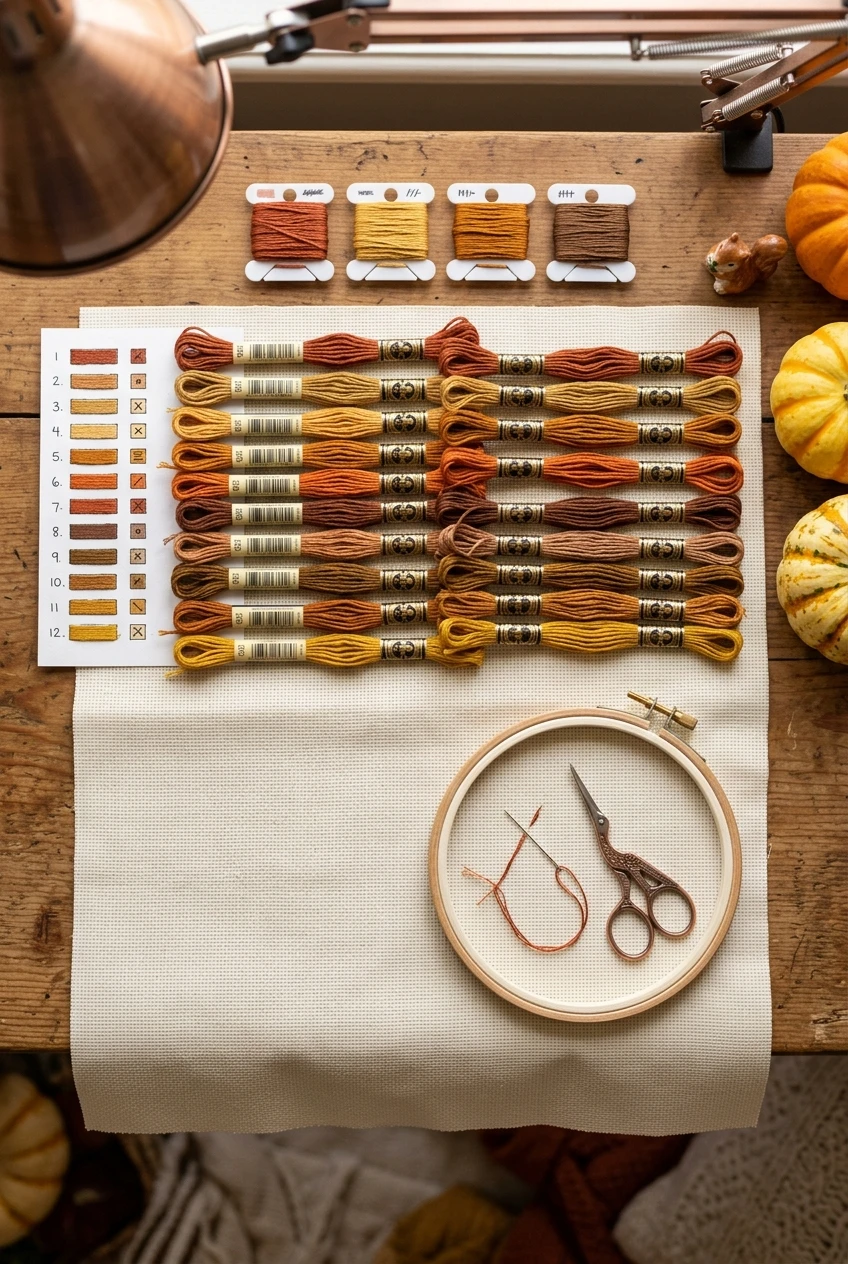
Close autumn DMC floss shades sorted on cream Aida with chart key under daylight lamp
Be Honest About Timing: October Starts Are Often Next-October Finishes
This is the part most seasonal pattern articles will not tell you, so I will.
If you start a detailed autumn landscape today, in early October, it will almost certainly not hang on your wall this autumn. A full-coverage fine art piece on 18-count, stitched at a realistic evening pace with a job and a family, is a project measured in months, not weeks. Some of my larger autumn charts are genuine BAPs. That's not discouragement. It's arithmetic.
And honestly, that's fine. I've come to love starting a fall piece in October knowing it's a next-October piece. You stitch it through the dark months with the colors of autumn in your hands, you finish it in spring, you frame it over summer, and when the maples turn again you hang something you spent a year on. That rhythm is far more satisfying than racing a deadline you were never going to beat.
If you do want something finished and framed before Thanksgiving, pick accordingly. A small pumpkin or acorn design, a modest harvest sampler, or a single-subject piece under about 100 stitches wide is doable in a few focused weeks. Match the project to the calendar honestly and you will finish it. Pick a BAP and pretend it's a quick one, and it becomes a UFO by November.
The same logic applies if you're thinking ahead to the holidays. I've written separately about the Christmas timeline and what's realistic there, so I won't rebuild that case here. Just know that an autumn project and a Christmas project started simultaneously in October means one of them is getting abandoned, and it is usually the one with more confetti.
What to do with the in-between time
Keep a small fall design going alongside the big one. The little piece gives you a finish, the big piece gives you depth, and swapping between them keeps the large project from feeling like a sentence. This is also the season I recommend a sturdy project bag, because fall stitching migrates to porches, bleachers, and in-laws' living rooms.
|
Patterns from the Sunrays Collection Tracey's Picks, designing cross stitch patterns since 2004 | |||||
| |||||
| Browse the full Sunrays collection → |
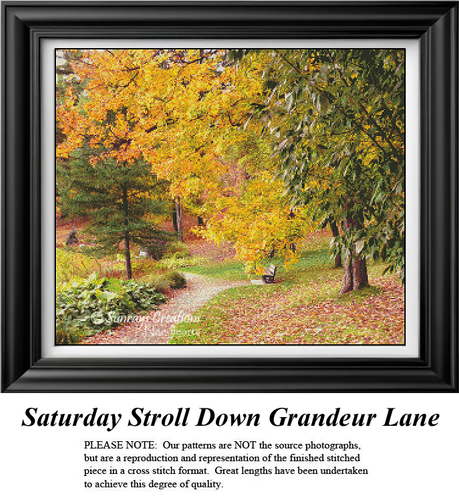


Choosing Your Fall Design: Landscapes, Harvest Scenes, and Pumpkins
My autumn catalog splits into a few clear families, and matching yourself to the right one saves a lot of grief.
Fine art landscapes are the showpieces. Hudson River valleys, New England hillsides, forest paths with light coming through. These are the pieces people stop in front of in a hallway. They are also the heaviest confetti and the longest timelines, and they reward a stitcher who already knows how to grid and park. If you've stitched a few mid-sized projects and want to step up, this is the step.
Tree and foliage studies sit in the middle. A single blazing maple or a stand of autumn birches gives you the drama of a landscape with fewer total stitches and a more forgiving color count. I think these are the sweet spot for most intermediate stitchers in fall.
Harvest and farm scenes bring in structure. Barns, fences, wagons, fields. Hard edges give your eye something to count from, which makes them easier than a pure foliage piece even at similar sizes. The backstitch on a weathered barn board is some of the most satisfying outlining there is.
Pumpkin and small seasonal designs are the beginner door into fall. Big simple shapes, maybe eight to twelve colors, finishable in a handful of sittings. If this is your first autumn project, start here and work up. There is no shame in a small piece. I've got a tiny pumpkin chart I stitched years ago hanging in my kitchen every October and I like it as much as anything larger.
One more thing about finishing. Everything I design is meant to be framed as wall art. Autumn pieces in particular benefit from a warm wood frame, which picks up the oranges and browns and makes the whole thing feel like it belongs in the room. If you stitched the spring companion to one of these, hanging them as a seasonal rotation on the same hook is a lovely way to mark the year.
Get Stitching Tips & New Patterns from Tracey
Honest advice, new Sunrays designs, and occasional VIP-only offers. No fluff.
No spam. Unsubscribe any time.

Tracey Recommends
RIOLIS 2146 Cozy Autumn Counted Cross Stitch Kit 7 x 9.5 in
Confetti-heavy autumn designs mean a dozen close shades open at once. Having the current project's palette sorted and labeled with DMC numbers facing up saves hours of hunting and prevents the mis-sorts that cause frogging.
Check Current Price →Setting Up Your Autumn Stitching Spot
The practical stuff, briefly, because fall stitching has its own setup needs.
Hoop first. I use a 5 or 6 inch wooden embroidery hoop (find on Amazon) and I've never seen a reason to change. It's light, it holds tension well, and it moves easily around a large piece. Q-snaps have their fans and they're a perfectly reasonable alternative if you prefer them, but the hoop is what's in my hand. Whatever you use, take the fabric out of it when you set the project down for the night so you don't set a crease into the work.
Floss: DMC six-strand, two strands on 18-count. That's the standard every chart I publish is built around, and it's what gives autumn colors their coverage without going bulky. If you're uncertain how many strands to use for a specific effect, that's a whole topic of its own.
Light, again, because it matters double this season. The days are getting shorter right as you're trying to tell 920 from 921. Position your lamp so it comes over your shoulder rather than straight at the fabric, and get the color temperature up around 5000K. Your eyes will thank you around hour three.
Lastly, give yourself a decent chair and a place to set things down. Autumn stitching for me is a long-session craft. Cooler evenings, early dark, a cup of something warm within reach. The setup is half of why I love this season at the frame.
Fall is my favorite season at the frame, cooler evenings and early dark and a lap full of color. Pick a design that matches the time you actually have, choose a warm fabric, and let the big ones take as long as they take. Come browse the autumn patterns at Sunrays Creations and find the one you want to spend this season with.
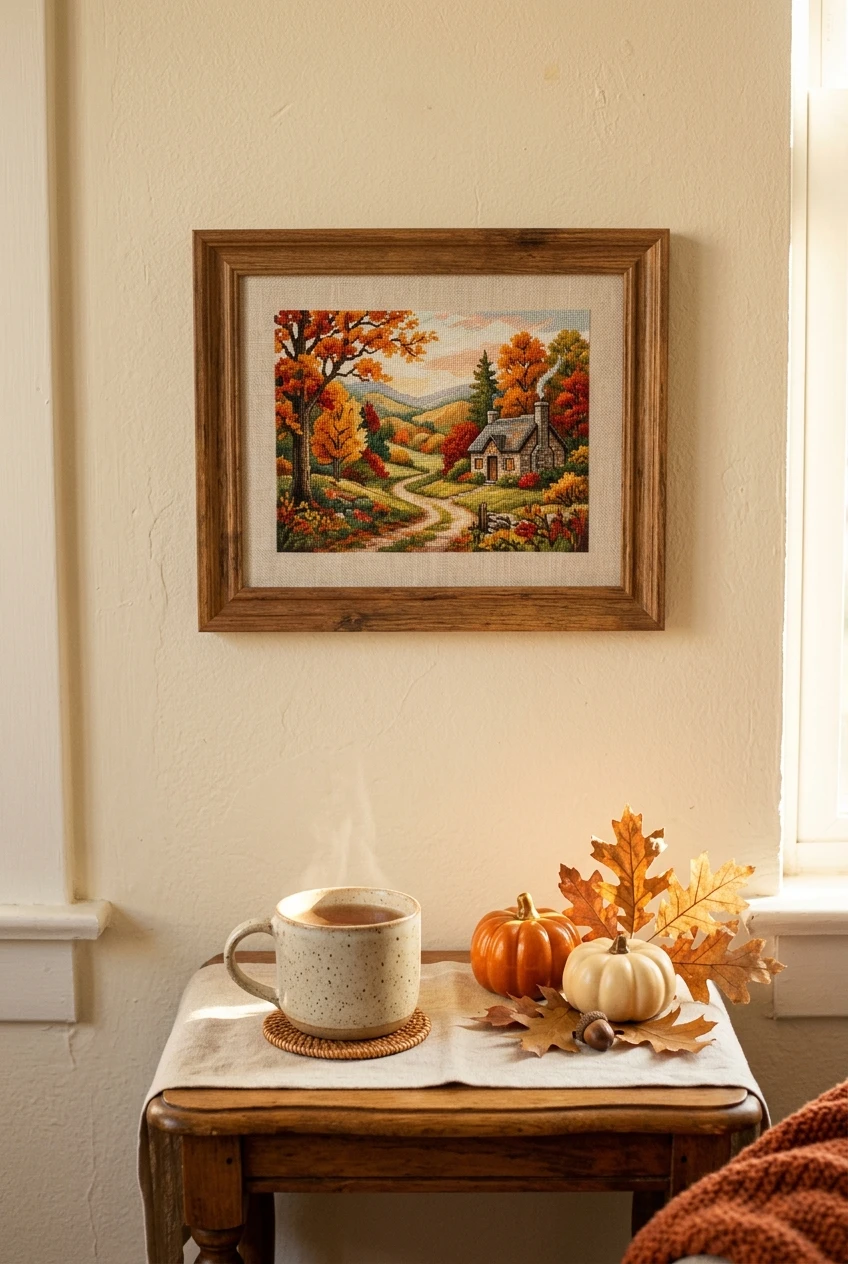
Finished autumn landscape cross stitch framed in wood hanging above cozy fall side table
Keep Reading
Confetti Cross Stitch: How to Handle Scattered Single Stitches
Autumn foliage is confetti by nature, and this is the full technique guide I didn't want to repeat here. Read it before starting a detailed landscape.
Read the GuideSpring Cross Stitch Patterns: Seasonal Florals | Sunrays Creations
The spring companion to this post, and a natural pairing if you want to rotate seasonal wall art on the same hook through the year.
See Spring DesignsHow to Grid Your Cross Stitch Fabric (And Why It Changes Everything)
Gridding is not optional on a confetti-heavy autumn piece. This walks through exactly how I do it before starting a large landscape.
Learn to GridFrequently Asked Questions
Why do my fall cross stitch colors look muddy?
It's almost always the palette, not your stitching. Russets, golds and browns sit within a few numbers of each other on the DMC range, and warm household lighting pushes everything further orange so the shades blur together. A daylight-balanced lamp and careful pre-sorting against the chart key fixes most of it.
What color Aida is best for fall cross stitch patterns?
Cream, antique white or light tan. Stark white has a cool blue cast that fights warm autumn tones and makes golds look dimmer than they should. If a design has lots of exposed background, fabric color matters a great deal; on a dense full-coverage landscape it matters much less.
Are autumn cross stitch designs harder than other seasons?
Generally yes, for two reasons. Fall palettes have many close-value shades that are easy to mis-sort, and dappled foliage requires scattered single stitches, or confetti, which slows you down and demands gridding. Pumpkin and harvest designs with larger shapes are much easier.
Can I finish a fall cross stitch pattern before Thanksgiving if I start in October?
A small pumpkin, acorn or modest harvest sampler under about 100 stitches wide, yes, in a few focused weeks. A detailed autumn landscape on 18-count, almost certainly not. Those are measured in months, and starting one in October makes it a next-October piece.
What fabric count should I use for autumn cross stitch patterns?
I design everything for 18-count Aida. It gives enough stitch count for the shading autumn foliage needs without the finished piece growing to poster size, and two strands of DMC six-strand floss covers it properly.
Do I need to grid my fabric for a fall landscape pattern?
For a confetti-heavy autumn landscape, yes. Scattered single stitches across dappled foliage give your eye nothing to count from, and gridding is the difference between a satisfying session and a frogging session. For a simple pumpkin design you can skip it.
What hoop do you use for fall projects?
A 5 or 6 inch wooden embroidery hoop. It's light, holds tension well, and moves easily around a large piece. Q-snaps are a reasonable alternative if you prefer them, but the hoop is what's in my hand. Take the fabric out of the hoop overnight so you don't set a crease.
-- Tracey Kramer
Founder & Designer, Sunrays Creations Needlearts
Hand-charted designs since 2004 • Marysville, Ohio