
Mindful Cross Stitching: Make Every Session Calm
Posted by Tracey M. Kramer on 15th Aug 2023
A Note from Tracey Kramer
I've been stitching for over thirty years, and I'll be honest—I didn't always do it gracefully. This article is equal parts hard-won wisdom and personal confession.
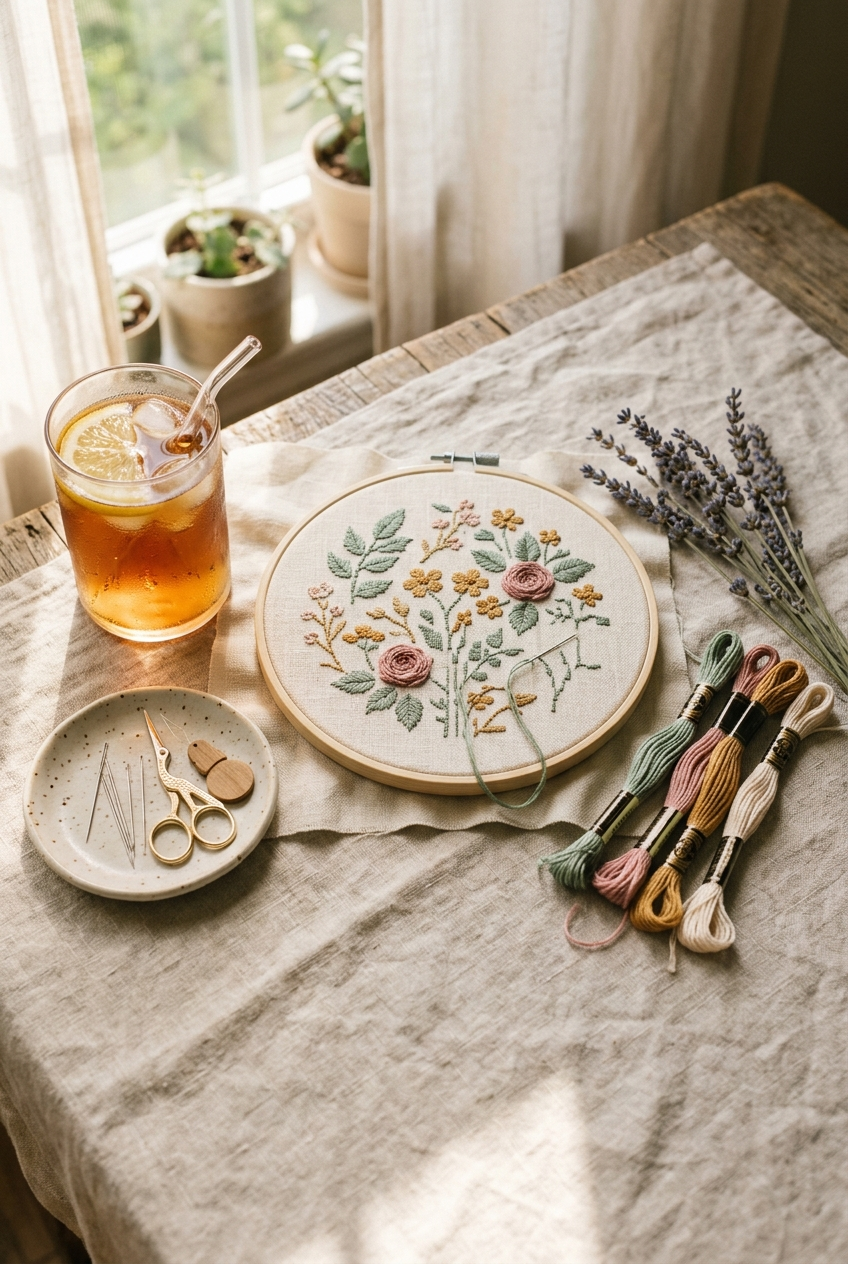
Mindful cross stitch flat lay with hoop linen floss and tea in warm daylight
By Tracey Kramer • • 12 min read
Nobody tells you when you pick up your first needle and hoop that cross stitch can actually become a source of stress. The craft looks so peaceful from the outside—all those tidy little X's, that quiet rhythm, the soft colors slowly blooming on fabric. But if you've been at it for any length of time, you know the truth. You know what it feels like to stitch through clenched teeth because something in your day went sideways. You know the particular frustration of pulling out the same row of stitches three times in a row. You know how a bad chair, a ringing phone, and a half-eaten bag of chips can turn what should be an hour of genuine calm into forty minutes of low-grade misery. I've lived every version of that scenario, and I'm not proud of all of them.
I've been designing and stitching since the early 1990s, and I founded Sunrays Creations in 2004. In all that time, I've come to believe something pretty firmly: cross stitch is not automatically relaxing. It has the potential to be deeply restorative—almost meditative—but that potential doesn't fulfill itself on its own. You have to meet it halfway. You have to be intentional about the conditions you create, the mindset you bring, and the habits you build around the craft. That's what mindful cross stitching actually means to me. Not a trendy wellness buzzword with a pretty Instagram aesthetic, but a real, practical commitment to making your time at the hoop worth something—worth the hours you're giving it, worth the peace you're hoping to find.
So let's talk about all of it. The anxiety that sneaks into your needle hand. The perfectionism that keeps you up past midnight when you should have put the hoop down hours ago. The environment that either lifts you or quietly drags you down. And the small, consistent rituals that can genuinely transform an ordinary stitching session into something you look forward to all day. I'm going to be specific. I'm going to be personal. And I'm not going to sugarcoat the parts where I've gotten it wrong, because that's where the real lessons live.
Anxiety at the Needle: When Your Emotional State Shows Up in Your Stitching
Here's something I've observed firsthand, and it still catches me off guard when I see it in someone else: anxiety has a physical signature in your stitching. It's not abstract or metaphorical. It shows up in broken needles, in uneven tension that you can't explain, in that strange phenomenon where your needle starts to turn black from the sweat on your fingertips. I've watched my daughter sit down to stitch when she's wound tight about something—school stress, friendship drama, just the accumulating weight of being a young person navigating a complicated world—and within twenty minutes, she's snapped a needle clean in half. She's not stitching badly. She's just gripping too hard because her whole body is braced against something she's trying not to feel. That grip tells the whole story, if you know what you're looking at.
When we're anxious, we tense up in ways we don't consciously notice. The shoulders creep toward the ears. The jaw sets. The fingers tighten around the needle as if holding on for dear life. And then we wonder why our stitches look uneven, why our arms ache after an hour, why the whole session left us more tired than when we started. The craft didn't do that to you. The emotional state you carried into it did. Those are different problems with different solutions, and conflating them is how people end up convinced that cross stitch isn't for them—when really, the conditions just weren't right.
Cross stitch doesn't fix anxiety on its own, and I want to say that plainly, because I think we sometimes expect too much of our hobbies. If you're dealing with something heavy—real grief, serious worry, a mental health struggle that goes beyond an ordinary hard day—please talk to someone who can actually help. A counselor, your pastor, a trusted friend who will tell you the truth. God didn't design us to carry everything alone, and no amount of beautiful stitching is going to substitute for that kind of genuine care. I say that not to dismiss the craft but to protect it. If you consistently use stitching as a way to push down feelings you haven't processed, the craft will start to absorb that association, and one of the best things in your life will start to feel complicated.
That said, once you've addressed the root, stitching can absolutely be part of your recovery and your daily peace. The act of focusing on a small, contained task—counting squares, pulling thread, watching a design emerge stitch by stitch—is genuinely calming for a regulated nervous system. The key phrase is regulated. If you sit down to stitch while you're still in the middle of emotional upheaval, you're not going to have a good time, and you might actually reinforce the idea that stitching is stressful. So do yourself a favor: take ten minutes before you pick up the hoop. Breathe. Put the phone down. Make a cup of tea. Let your shoulders drop. Arrive at the craft instead of just landing on it.
A simple breathing practice before you begin can genuinely shift the entire session, and I say that as someone who came to it out of desperation, not wellness enthusiasm. During one particularly hard week several years ago, I started doing four slow counts in through the nose, hold for four, release for four—three rounds before I touched the hoop. It sounds almost embarrassingly simple. But it works because it signals to your nervous system that you're safe, that this is a moment of rest rather than another demand. I've kept the habit ever since, not because it's trendy, but because it actually works. Three breaths. That's the whole practice. Start there.
Perfectionism, Stubbornness, and the Honest Truth About Both
I am a perfectionist. I say that not as a humble brag but as a genuine confession, because perfectionism has cost me sleep, peace, and more than a few pleasant evenings that should have ended at nine o'clock. If I make a mistake in a piece—even a small one, even one that nobody else on earth would ever notice from three feet away—I cannot move forward until it's corrected. The needle comes out. The stitches get frogged. I'll do it three times if I have to. And the entire time, some running commentary in my brain is narrating the error in the most unflattering terms possible. I am my own harshest critic, and I have known that about myself for a long time without being fully willing to do anything about it.
The story that illustrates this most vividly isn't even about cross stitch—it's about crochet. A while back I was trying to learn a new stitch for a pattern I wanted to attempt. I could not get it right. And instead of setting the project down and coming back to it after a good night's sleep, I stayed up until two o'clock in the morning, then three, running the same motion over and over, getting increasingly frustrated, increasingly tired, and increasingly bad at the very thing I was trying to master. By the time I finally got it, I was too exhausted to feel any satisfaction. The next day I was wrecked. I lost a whole useful day to stubbornness dressed up as perseverance. There is nothing virtuous about that kind of late-night tunnel vision.
What I've learned—slowly, reluctantly, because perfectionism doesn't loosen its grip easily—is that there's a productive version of high standards and a destructive version, and the line between them matters enormously. The productive version says: do your best work, care about quality, be genuinely willing to take the time to do something right when it matters. That version produces beautiful stitching and a deep satisfaction at the finish. The destructive version says: you are not allowed to stop until this is flawless, and if it isn't flawless, something is wrong with you. That version produces misery and a sore neck at two in the morning. Learning to tell the difference in the moment—when you're tired and frustrated and the light is bad and you've made the same mistake twice—is a genuine skill. It takes practice, just like the stitching itself.
On the other end of the spectrum, and I say this gently but honestly, there are stitchers who don't care much about quality at all. Floss tails left unsecured on the back, uneven tension front and center, no particular attention paid to whether the X's cross consistently in the same direction. That's a choice, and the craft belongs to you. But I'd encourage anyone who loves this craft to aim a little higher than that—not because of competitions or judges or what anyone else thinks—but because there is a genuine, quiet satisfaction in a well-executed stitch that you simply cannot get from a careless one. Quality, pursued sanely and without cruelty to yourself, is its own reward. Let that be enough motivation.
The practical move, when you feel perfectionism curdling into self-punishment, is to set a hard stop time before you begin. Decide in advance: I'm stitching until nine o'clock, and then I'm putting it down. Write it on a sticky note if you have to. When the time comes, honor it—even if the row isn't finished, even if you spotted a mistake you want to fix. The mistake will still be there tomorrow. Your peace of mind tonight is worth more than perfect stitches on a project you won't finish until next spring. I've had to learn this the hard way, and I keep relearning it, but it gets easier with practice.
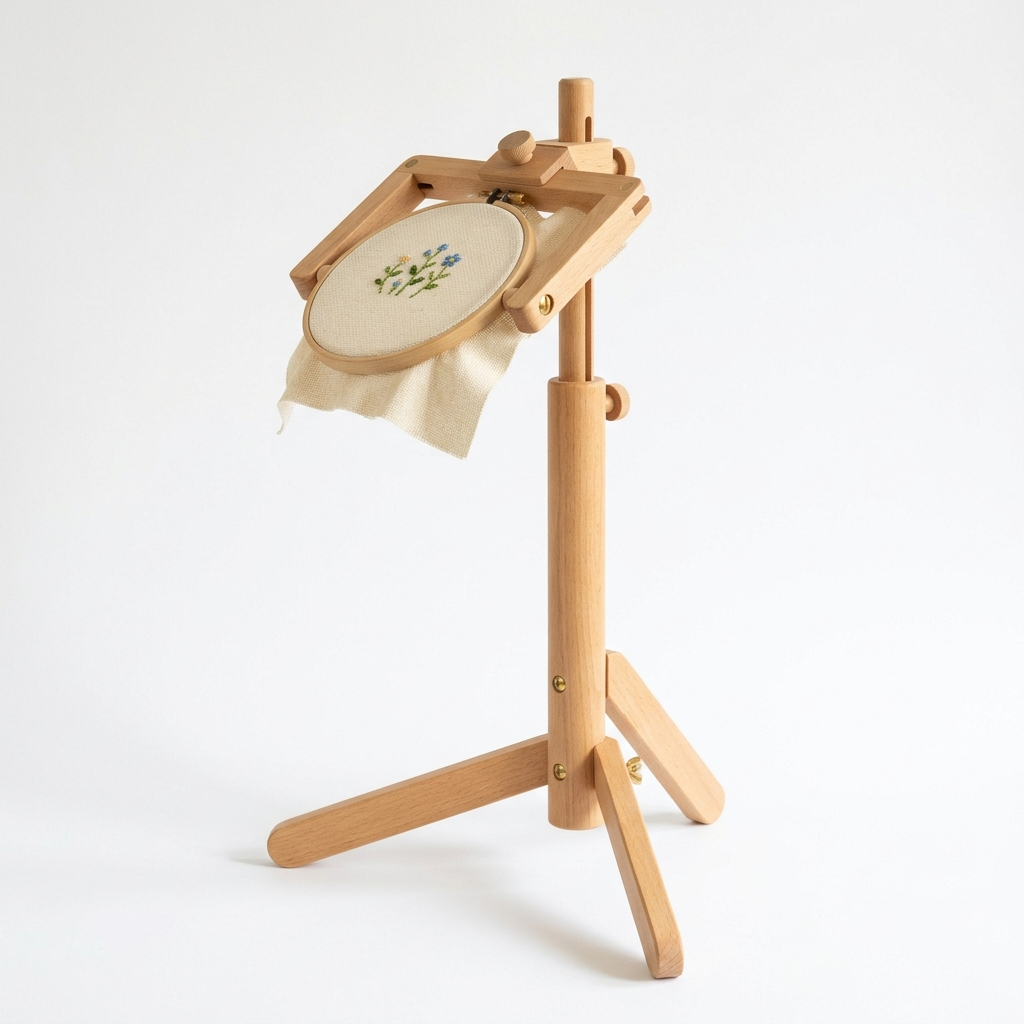
Tracey Recommends
Floor Stand or Lap Frame for Cross Stitch
Using a floor stand or lap frame changed my long stitching sessions completely. When you're not gripping the hoop, your shoulders relax, your hands move more freely, and you can stitch longer without fatigue or tension. If you're doing serious stitching, this is the upgrade your body will thank you for.
See on AmazonCross stitch is not automatically relaxing. It has the potential to be deeply restorative—almost meditative—but you have to meet it halfway. You have to be intentional about the conditions you create and the mindset you bring.
Posture and Body Mechanics: Your Body Is Part of the Project
I have watched my daughter stitch on her bed, cross-legged, hunched forward over her hoop like she's examining something under a microscope, with zero back support and her neck bent at an angle that makes me wince just looking at it. She's young, so she doesn't feel it much yet. But I've been at this long enough to know that bad posture is a debt you eventually have to pay, and the interest compounds. Aching shoulders, a stiff neck, forearms that feel like they've been wrung out after a two-hour session—these are not inevitable costs of the craft. They're the cost of bad mechanics that accumulate over years until your body finally sends you an invoice you can't ignore.
When you stitch with your back unsupported, your muscles have to work constantly just to keep you upright. The ones in your lower back, your shoulders, your neck—they're doing extra labor the entire time you're stitching, labor that has nothing to do with the actual needlework. As they tire, you unconsciously tense up to compensate. That tension travels all the way down your arms and into your hands, which means your needle grip gets tighter, your stitches become less even, and the whole experience gets less enjoyable without you being able to put your finger on exactly why. Your body is not separate from your stitching. It is part of it, and it deserves the same consideration you give your thread count.
The ideal setup isn't complicated, but it requires intentionality: back fully supported by the chair, feet flat on the floor so your hips sit at a neutral angle, shoulders consciously relaxed and dropped away from your ears, elbows close to your body rather than winged out to the sides. If you use a floor stand or lap frame for cross stitch (find on Amazon)—which I strongly recommend for any session longer than thirty minutes—your hands can work more freely because they're not also tasked with gripping a hoop. I use a large floor frame, and it genuinely changed the quality of my long stitching sessions in a way I hadn't anticipated. The work got better because my body got more relaxed. Those two things are connected in ways we tend to underestimate.
Set a timer if you need reminding. Get up every forty-five minutes to an hour, stand fully upright, roll your shoulders back deliberately, and let your spine decompress for two or three minutes before you sit back down. Do slow wrist circles—ten in each direction—and open your hands wide, then make a soft fist, several times to restore circulation to your fingers. These are not optional luxuries for people with chronic pain. They're maintenance for everyone who stitches seriously. Your future self will thank you for building the habit now rather than after the first injury makes you stop for six weeks.
After a long session, soaking your hands in warm water with a few drops of lavender essential oil is genuinely soothing. It's a small ritual, but it closes the stitching session in a way that feels intentional—a signal to your body that the work is done for now, and that you took care of it. I started doing this somewhat accidentally during a stretch of very intensive design work, and I've kept it because the transition it creates is real and reliable. The warmth relaxes your tendons, the lavender settles your nervous system, and the deliberateness of the act tells your brain the creative part of the day is over. Small rituals like this do more than you'd think.
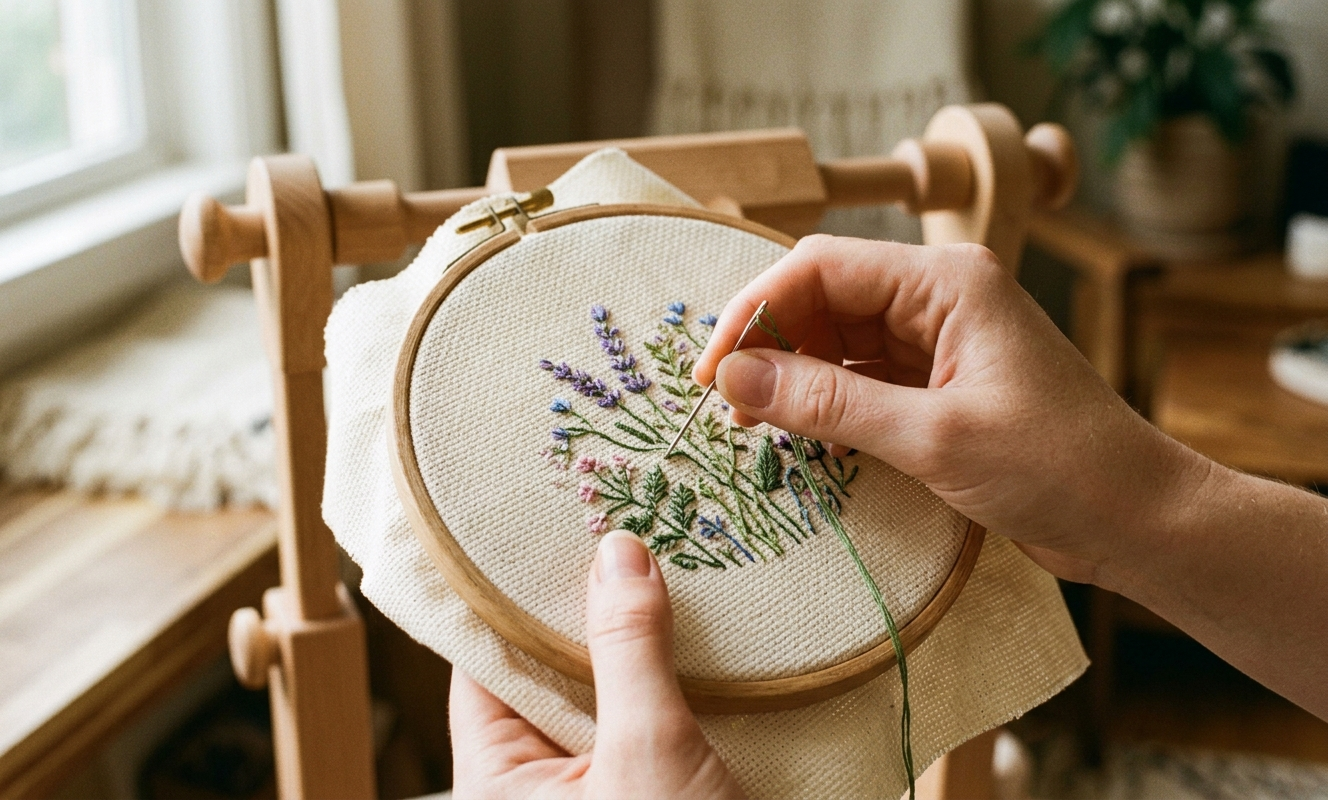
Close up cross stitch needle pulling dusty rose floss through cream aida cloth
Creating the Environment That Actually Lets You Stitch Well
Let me paint you a picture of my ideal stitching environment, because I've thought about it in probably more detail than is strictly necessary, and I think it will resonate. I'm in my loft in Marysville, positioned near a large window. The light outside is that particular golden Ohio afternoon light that makes everything look a little warmer than it actually is. Beyond the window there's a view I love—trees, a sense of space, something green and alive to rest my eyes on when I look up from the work. I'm sitting in a well-padded chair with good back support, wearing something loose and comfortable, nothing with a waistband that's going to become my enemy after an hour. On the small table beside me is a glass of sweet tea. Classical music is playing softly, or sometimes a good documentary murmuring from the television at low volume.
At the foot of my floor frame, curled up in a warm little loaf, is my lop-eared rabbit. If you've followed Sunrays Creations for any length of time, you've probably heard me mention her. She is the most peaceful stitching companion imaginable. She doesn't bark. She doesn't demand attention every three minutes. She doesn't knock things off surfaces or try to eat my floss—well, mostly. She just exists near me, occasionally accepting a small treat when I take a break, and her presence is calming in a way I can't fully rationalize but fully trust. I stop every now and then to give her something, and when I look back at my work, I've made more progress than I realized. That's the particular magic of a calm environment—time moves differently. You sink into the work instead of fighting it.
Now let me describe the bad version, because contrast is clarifying. Same loft, but the weather is gray and flat, natural light is gone, and I'm squinting under overhead illumination that makes thread colors look subtly wrong. The chair is a fold-up with a seat that goes hard after twenty minutes. I ate something too big too recently and my waistband is staging a protest. The phone has rung four times in the last half hour, none of the calls important. Someone in the house is playing music I didn't choose at a volume I didn't ask for. I've got a faint grease smudge on my aida cloth from a snack I'm pretending not to see. None of these things is catastrophic on its own. But they stack. And the combined weight of a dozen small miseries is enough to turn a session that should have been restorative into something that leaves you more depleted than when you sat down.
Noise, specifically, is a particular enemy of the meditative quality of stitching. Loud, unpredictable sound—a barking dog, a sudden argument, a television blaring something aggressive or anxiety-producing—triggers a low-level stress response whether you consciously register it or not. Your shoulders tense. Your concentration fragments. The careful counting gets harder. If you can carve out a quiet space for your stitching—even just a corner of a room with headphones in and the door closed—do it. You deserve that container of peace. Soft music, an audiobook read in a calm voice, ambient nature sounds from the window or a small speaker—these are all genuinely compatible with stitching and can deepen the meditative quality of the session rather than disrupting it.
Light is the other non-negotiable. Ohio skies are not always cooperative, and I learned the hard way that stitching under bad overhead lighting causes two separate problems: my eyes strain trying to differentiate thread colors, and I make color-matching errors that I don't catch until I'm three hours further into a piece than I'd like to be. A good daylight LED craft lamp (find on Amazon) sitting beside my floor frame has been genuinely transformative for my evening sessions. True-color illumination means I can trust what I see, work longer without eye fatigue, and make confident decisions about thread swaps and color placement. If you're working on dark fabric especially, good light isn't optional—it's the difference between enjoying the session and dreading it.
|
Patterns from the Sunrays Collection Tracey's picks — hand-charted designs since 2004 |
|||||
|
|||||
| Browse the full Sunrays collection → |



Choosing the Right Project for Your Current Self
This is something I don't see talked about enough in stitching circles, and it matters enormously: the project you choose should match not just your skill level, but your current emotional and mental bandwidth. Those are two genuinely different things, and both of them are real. On a hard week, even an experienced stitcher with thirty years of muscle memory can find a complex pattern with specialty stitches and thirty-two colors overwhelming to the point of tears. On a good week, a beginner riding a wave of confidence and curiosity might surprise herself with what she's willing to attempt. Neither of those is wrong. The key is reading yourself honestly before you sit down to start something new, and being willing to honor what you find.
For beginners especially—and I say this with genuine warmth, not condescension—please don't start with a 28-count evenweave and a thirty-color botanical masterpiece because it looks spectacular on the cover. Start with something achievable. Fourteen-count aida cloth, a clean simple design with five or six colors, a finished size you can realistically complete in a few weeks. The reason this matters so directly for mindfulness is straightforward: if you're constantly frustrated by a project that outpaces your current skills, the project doesn't just stay unfinished. It becomes a symbol of failure. It gets shoved in a drawer. And every time you walk past that drawer, your relationship with the craft takes a small quiet hit. I have seen this happen more times than I can count, and it breaks my heart every time, because it's entirely preventable.
Subject matter is equally important, and far more personal than people usually acknowledge. The subject you stitch should genuinely delight you—should be something you actually want to look at for the twenty or forty or eighty hours it takes to bring it to life. If you're stitching a design because someone else loves it, or because it came in a gift kit that didn't thrill you, or because it was on sale and seemed like a reasonable purchase at the time—that tepid motivation will show up in your work and in your attitude toward it. When I design a new pattern for Sunrays Creations, I design things I personally love: animals, botanicals, Victorian portraits, holiday imagery that genuinely moves something in me. I believe that energy is real, and I believe it transfers.
There's also a specific technique I want to name for the hard days, the depleted days, the days when life has taken more than it's given and you're running on empty. On those days, this is not the time to start a challenging new pattern with specialty stitches you've never attempted. Pull out something simple. Something repetitive and soothing—a background fill on a piece already in progress, a small ornament design you've stitched before and know well. The familiar rhythm of a project you understand is genuinely calming in a way that a steep learning curve simply is not. Save the ambitious new starts for when you've got something to give. Your craft will benefit from it, and so will you.
I'll also say this: it's completely acceptable to have multiple projects on the go at different difficulty levels precisely for this reason. I almost always have something ambitious on the main frame and something small and comfortable tucked nearby for the days when ambition has left the building. There's no rule that says you have to finish one thing before starting another, and having options gives you the flexibility to match the project to the moment rather than forcing yourself through a hard pattern on a day when you needed something gentle. That flexibility is itself a form of mindfulness.
Get Stitching Tips & New Patterns from Tracey
Honest advice, new Sunrays designs, and occasional VIP-only offers. No fluff.
No spam. Unsubscribe any time.
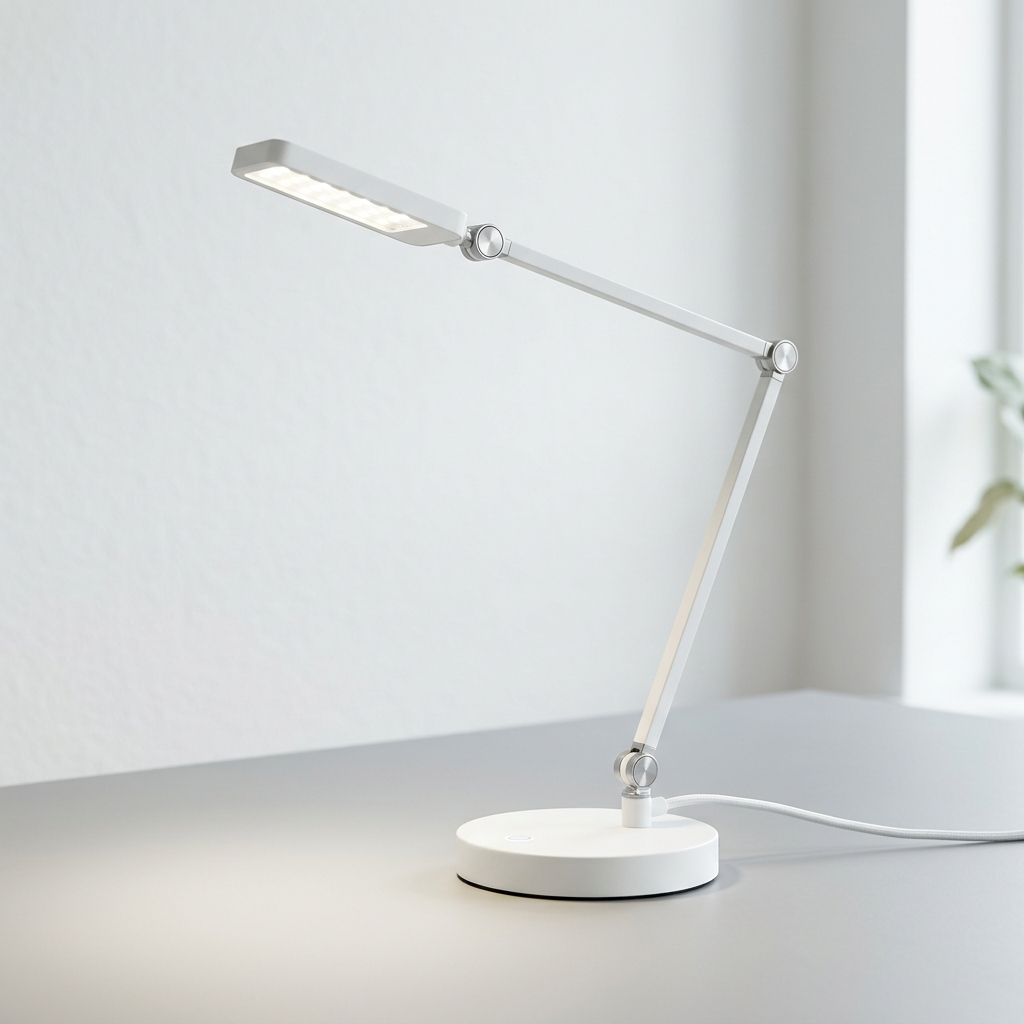
Also Worth Having
Daylight LED Craft Lamp for Stitching
Natural light is ideal, but Ohio skies don't always cooperate. A good daylight lamp gives you true-color illumination that makes a real difference when you're counting tiny squares or matching thread colors. Don't ruin a beautiful piece—or your eyes—by squinting under bad light.
See on AmazonThe Ritual of Stitching: Making the Craft a True Practice
There's a meaningful difference between stitching when you happen to have a free moment and making stitching a genuine practice—something you return to with intention, that has a recognizable shape and rhythm you can rely on. The second version is what actually delivers the restorative benefits people associate with the craft and sometimes can't quite access. And like any practice worth having, it benefits from ritual. Ritual sounds more elaborate than it is. What I mean is simply the small, consistent actions that bracket the activity and tell your brain clearly: this is stitching time. This is rest. This is yours. You're allowed to be here.
For me, the ritual looks like this: I make my tea first, every time, without exception. I settle the rabbit—find her, make sure she has water, give her a little something, let her settle near the frame. I put my phone on the other side of the room before I pick up the hoop. I take three slow breaths. These things take maybe ten minutes combined, but they do something genuinely important: they create a transition. They move me from the mode of doing and managing and responding—the mode most of us live in for most of the day—into the mode of creating and being. That transition doesn't happen automatically just because you sat down with a needle. You have to build it, deliberately, until it becomes its own kind of reliable comfort.
A stitch-and-bee with friends is one of the most underrated forms of this ritual, and I want to make a case for it. There's something about stitching in the company of other people who also stitch that's qualitatively different from stitching alone. The conversation is easy and unforced because everyone's hands are occupied with something else—there's no pressure to perform or entertain. You can talk or not talk. You can show each other your work, share what you're struggling with, admire someone else's color choices, laugh about the pattern that defeated you. The social warmth and the creative warmth layer on each other in a way that's genuinely nourishing. I've had some of my most encouraging stitching conversations at informal gather-rounds with friends, the kind that go longer than planned and end with everyone promising to do it again soon. Just—and I say this from direct experience—try not to let anyone start a heated disagreement, because all that lovely relaxation will evaporate in approximately ninety seconds.
The right embroidery floss organization system (find on Amazon) is also more a part of ritual than people realize. When your threads are sorted, labeled, and easy to find, the session begins without friction—no hunting through a tangled pile, no frustration before you've even threaded your needle. I use bobbins wound by color family and stored in a divided case, and the simple act of opening that case and selecting my colors for the day has become part of the opening ritual. Order in your supplies creates calm before you've made a single stitch. It's a small thing with an outsized effect.
And finally, I want to say something that might sound old-fashioned but that I mean with complete sincerity: for me, stitching has always been connected to something larger than craft. There's a quality of attention it requires—the counting, the presence, the genuine willingness to slow down and stay in one place—that I experience as a form of communion. Communing with myself, with the work, and with God. I don't need to make that complicated or theological. It's simply that when I'm stitching well, in a good environment, with a project I genuinely love, there's a quality of gratitude and peace that feels like something more than hobby. I think that's available to anyone willing to be present enough to receive it. That's the real heart of mindful stitching—not the technique, not the tools, not the perfect chair or the perfect light. The willingness to actually show up. To be there. To let the work matter.
Stitching has been one of the great constants of my adult life—through hard seasons and good ones, through the years I was building this business and the quieter years when I just needed something to do with my hands. It has given me more than I've given it, and I think that's only possible when you approach it with some intention. If any part of this resonated with you, I'd love for you to come browse the patterns at Sunrays Creations—designed with care since 2004, for stitchers who take their craft seriously and their peace of mind even more so.
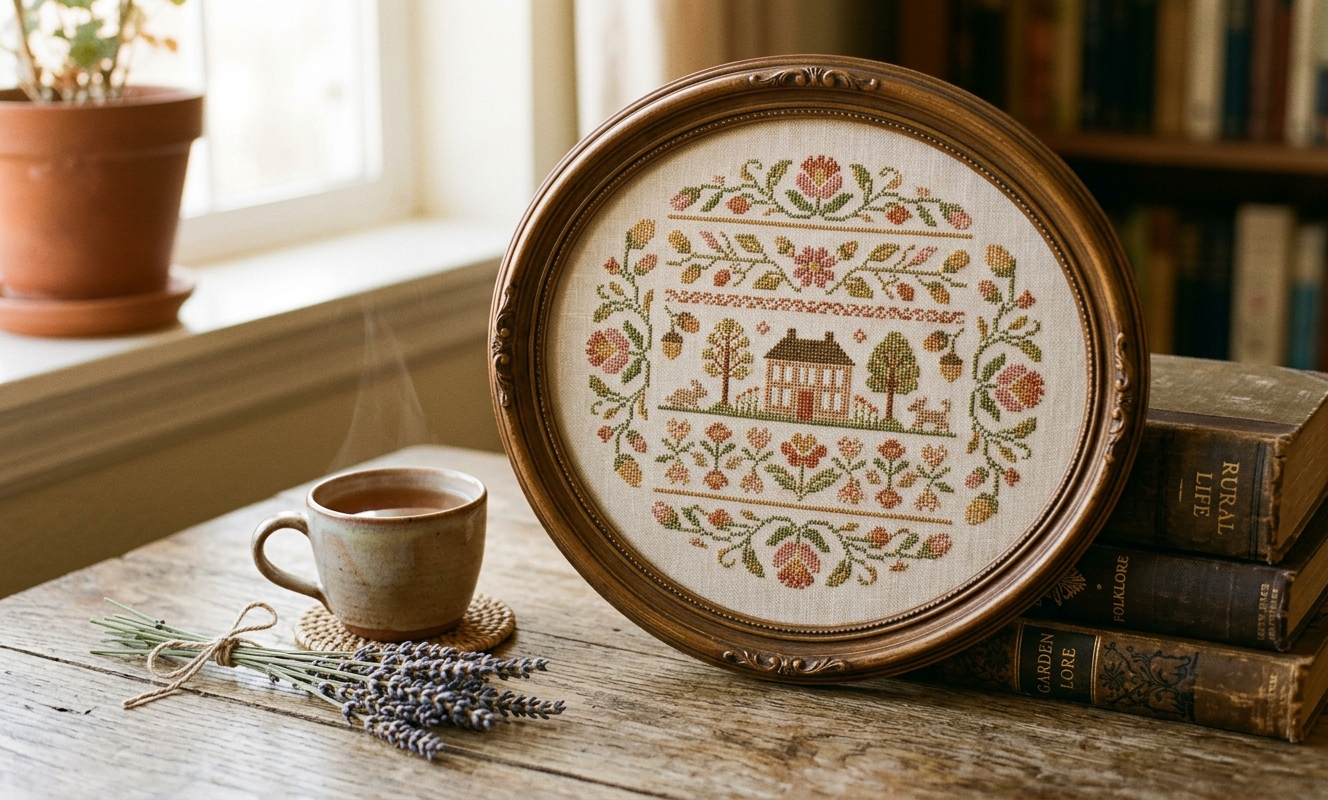
Finished cross stitch botanical sampler in oval walnut frame with dried wildflowers
Keep Reading
What Do You Need to Cross Stitch?
Before you can create a mindful stitching environment, you need the right foundational tools. This guide covers everything a stitcher actually needs to get started well and stay comfortable.
READ THE GUIDEThe Types of Cross Stitch Patterns I Prefer
Choosing the right subject matter is a core part of mindful stitching. Read about the kinds of patterns Tracey designs and why she believes the subject you stitch should genuinely move you.
READ THE ARTICLECross Stitch FAQs
Got questions about technique, materials, or where to start? This comprehensive FAQ answers the questions stitchers ask most—practical, honest, and straight from thirty years of experience.
READ THE GUIDEFrequently Asked Questions
Can cross stitch really help with anxiety and stress?
It can, but with an important caveat: cross stitch is most effective as a calming tool when you come to it from a place of relative stability, not acute distress. The repetitive motion, focused attention, and sense of small steady progress all support relaxation for a regulated nervous system. If you're dealing with serious anxiety, please also seek support from a counselor or trusted person—stitching is a wonderful complement to real care, not a substitute for it.
How do I stop breaking needles while I stitch?
Broken needles are almost always a tension problem—specifically, you're gripping the needle too tightly, which usually means your body is carrying stress it hasn't released. Check in with your shoulders: are they up near your ears? Is your jaw clenched? Take a few slow breaths, consciously release your grip, and notice whether that changes things. Switching to a slightly thicker needle size can also help while you work on relaxing your technique overall.
What is the best sitting position for cross stitching?
Back fully supported against the chair, feet flat on the floor with hips at a neutral angle, shoulders relaxed and dropped low, elbows close to your body. Using a floor stand or lap frame so you're not also gripping a hoop makes this much easier to maintain for longer sessions. Avoid stitching hunched in bed or on a couch without back support—the strain accumulates quietly even when you don't feel it immediately.
How often should I take breaks when cross stitching?
Every 45 minutes to an hour is a good general guideline, but listen to your body rather than waiting until you're numb or aching. When you stand, do it with intention: straighten your spine, roll your shoulders back deliberately, do slow wrist circles in both directions, and open and close your hands several times to restore circulation. Your eyes need a break too—look at something at least 20 feet away for 20 seconds before returning to close work.
How do I choose a cross stitch project that won't frustrate me?
Match the project to both your skill level and your current mental bandwidth—they're not always the same thing, and both matter. On hard weeks, even experienced stitchers benefit from simpler, familiar work. For beginners, start with 14-count aida and a design with fewer than ten colors. Most importantly, choose a subject you genuinely love, because you'll be looking at it for many hours, and indifference toward your subject makes stitching a chore rather than a pleasure.
Is perfectionism bad for cross stitching?
Not inherently—high standards drive excellent work and there's real satisfaction in a well-executed piece. The problem starts when perfectionism crosses into self-punishment: staying up until 2am forcing a skill, refusing to stop until something is flawless, making yourself miserable in the name of excellence. The productive version cares about quality and corrects mistakes calmly. The destructive version makes the craft exhausting and steals the joy right out of it. Learning to tell the difference in the moment is a skill worth developing deliberately.
-- Tracey Kramer
Founder & Designer, Sunrays Creations Needlearts
Hand-charted designs since 2004 • Marysville, Ohio