
Pattern Mills and AI "Slop": How to Spot a Bad Chart Before You Buy
Posted by Tracey M. Kramer on 16th Nov 2026
A Note from Tracey Kramer
I have been designing counted cross-stitch patterns since 2004. This guide pulls together what you need to know about this topic, so you can stitch with confidence.
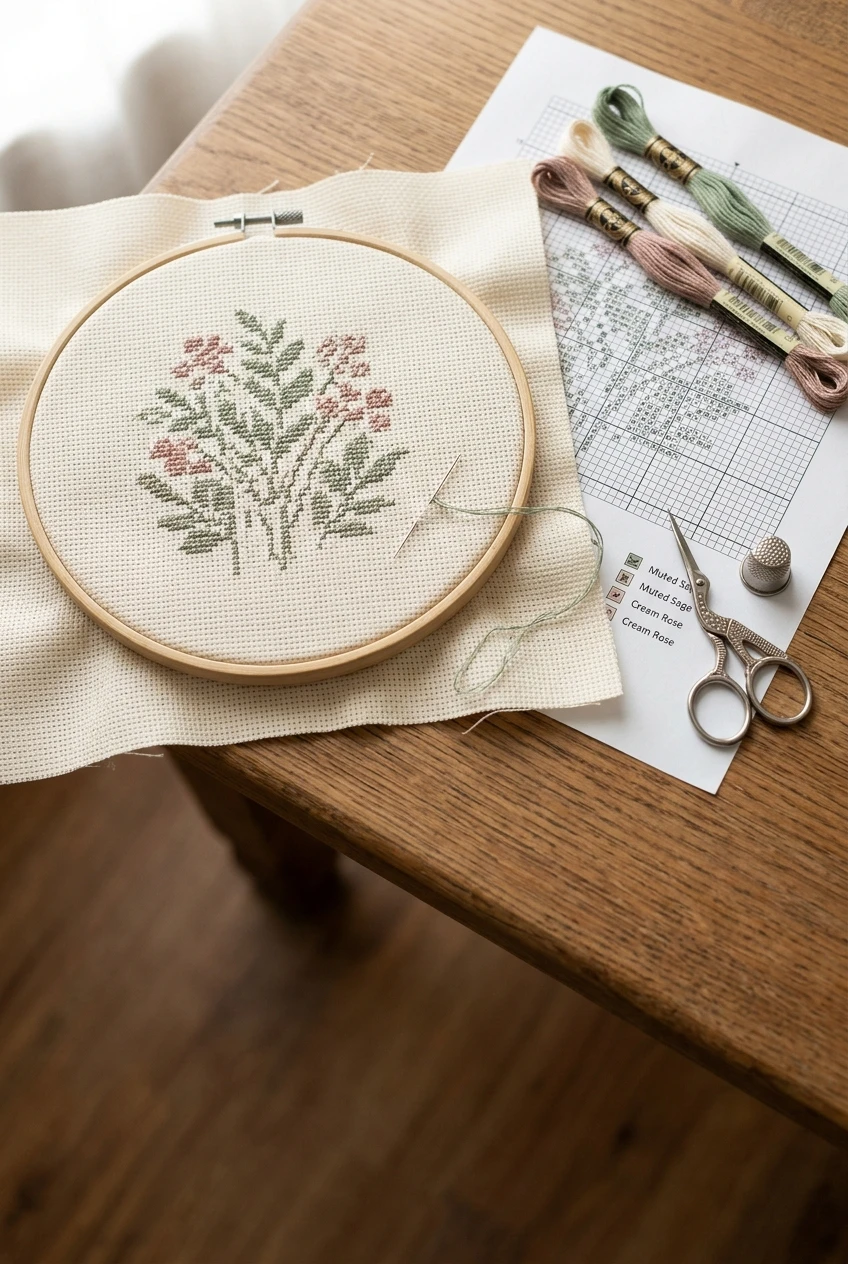
Cross stitch chart page and hooped Aida on a table illustrating how to spot a bad chart
By Tracey Kramer • • 12 min read
If you have ever bought a cross stitch pattern that looked gorgeous in the listing photo and arrived as a 180-color mess with no symbol key, you already know the problem. Pattern mills and AI "slop" listings are easy to spot once you know what to look at: the cover image, the listing details, and the seller behind it. The issue is not that a chart was made on a computer or started from a painting, because most modern charts do. The issue is whether the listing is honest about what you are buying and whether a real person made it stitchable.
The Ten-Second Scan: A Quick Checklist Before You Buy
Before anything else, here is the short version. Run these checks in about ten seconds and you will filter out most bad listings without reading a word of the description.
1. Look at the cover image for fabric. A photographed stitched piece shows Aida texture, slightly uneven stitch tops, and a visible grid. A smooth, airbrushed, impossibly detailed image is a render or an AI mock-up, not a finished piece.
2. Check the color count. A small design with 90 or 120 floss colors is almost always an auto-converted photo nobody cleaned up.
3. Check stitch count against finished size. The listing should tell you stitch dimensions and the finished size at a given fabric count. If it only says "8x10 inches" with no count, that is a gap.
4. Look for a symbol key and a chart preview. Honest sellers show at least one page of the actual chart, or a sample of the key with DMC numbers.
5. Look for a human. A designer name, a shop history, a way to ask a question. Shops with thousands of near-identical listings at rock-bottom prices did not design thousands of patterns.
If a listing passes all five, you are probably fine. If it fails two or more, close the tab. The rest of this article explains what each red flag looks like in detail and what to do about it.
What a Pattern Mill Actually Is (and What It Is Not)
A pattern mill is a shop that mass-uploads charts it did not meaningfully design, usually by typing a prompt into an AI generator and listing whatever chart comes out with no cleanup, no design work, no testing of readability, and often no legal right to the source art. The giveaway is volume and sameness: hundreds or thousands of listings posted in a short window, identical mockup templates, prices low enough that nobody could have spent time on the file.
I have been designing counted cross stitch patterns since 2004, and I want to be clear about something that gets muddled in these conversations. Charting software is not the villain. Nearly every modern designer uses a computer. Fine-art reproductions and landscape conversions can produce beautiful, stitchable charts when a person sits with the file afterward and does the work: reducing the palette, cleaning up stray single stitches, choosing symbols that read clearly at size, building the key, and laying out the pages.
The difference between a good conversion and slop is entirely that cleanup step. An AI generator will happily hand you a chart with 140 colors and confetti scattered across every square inch of sky. That is not a design. That is a raw export.
Since this article is about honesty, here is ours. Our fine-art conversions never use AI. On fewer than 2 percent of our patterns, AI was used to create a starting image, and that image was chosen with great care. From there, the full chart is designed by Tracey, without AI. AI has never charted a Sunrays pattern.
The honest standard
Judge a listing by two questions. Is the listing honest about what you are buying? And has a person actually built a stitchable chart out of it? Those two questions cover AI mock-ups, auto-converted photos, stolen artwork, and missing keys all at once. You do not need to become a forensic analyst. You just need those two questions running in the back of your head while you scroll.

Tracey Recommends
Dimensions Gold Collection Counted Cross Stitch Kit, Northern Night, 16 Count Dove Grey Aida, 16'' x 11'', Multicolored, Large
If you want a safe bet rather than a gamble, a boxed kit from a long-established maker takes the guesswork out. This Gold Collection kit arrives with a printed chart and full symbol key, sorted floss, needle, and 16-count dove grey Aida at a generous 16 by 11 inches. Everything is listed on the box before you buy, which is exactly the transparency a sketchy download listing never gives you.
Check Current Price →An AI generator will happily hand you a chart with 140 colors and confetti scattered across every square inch of sky. That is not a design. That is a raw export.
Red Flag #1: The Cover Image Was Never Stitched
This is a common problem on large marketplaces, Etsy included. The listing shows a radiant, perfectly even piece in a hoop on a rustic table, and it was generated or rendered, never stitched. You are being sold a promise the chart cannot keep.
What to look for in the image
Fabric texture. Real Aida has a visible woven grid, and stitches sit on it in a consistent rhythm. Zoom in. If the "stitches" blur into a smooth gradient with no fabric holes behind them, it is a render.
Detail finer than the fabric allows. On 18-count Aida (find on Amazon) you get 18 stitches per inch. A face with crisp eyelashes in a two-inch-tall portrait is physically impossible at that count. If the detail is finer than the grid could carry, the picture is not stitching.
Warping and garbled text. AI images struggle with repeating structure. Look for hoop rings that go oval in one spot, a stitch grid that drifts diagonally across the piece, floss skeins with nonsense band labels, scissors with four finger holes, or lettering that almost spells a word.
Shadow and edge errors. Fabric edges that melt into the table, a hoop screw that does not connect to anything, a needle entering fabric at an impossible angle.
The same image in many shops. Run a reverse image search on the cover. If that exact mockup shows up under five different shop names with five different pattern titles, you have found a mill.
What to do
Not every un-stitched cover is dishonest. Plenty of legitimate designers show the source artwork or a software-rendered preview of the finished chart, and they say so. The problem is a render dressed up as a photograph of a completed piece on linen in someone's sunroom. If the shop labels the image honestly, that is a good sign. If it is pretending, assume the chart is pretending too.
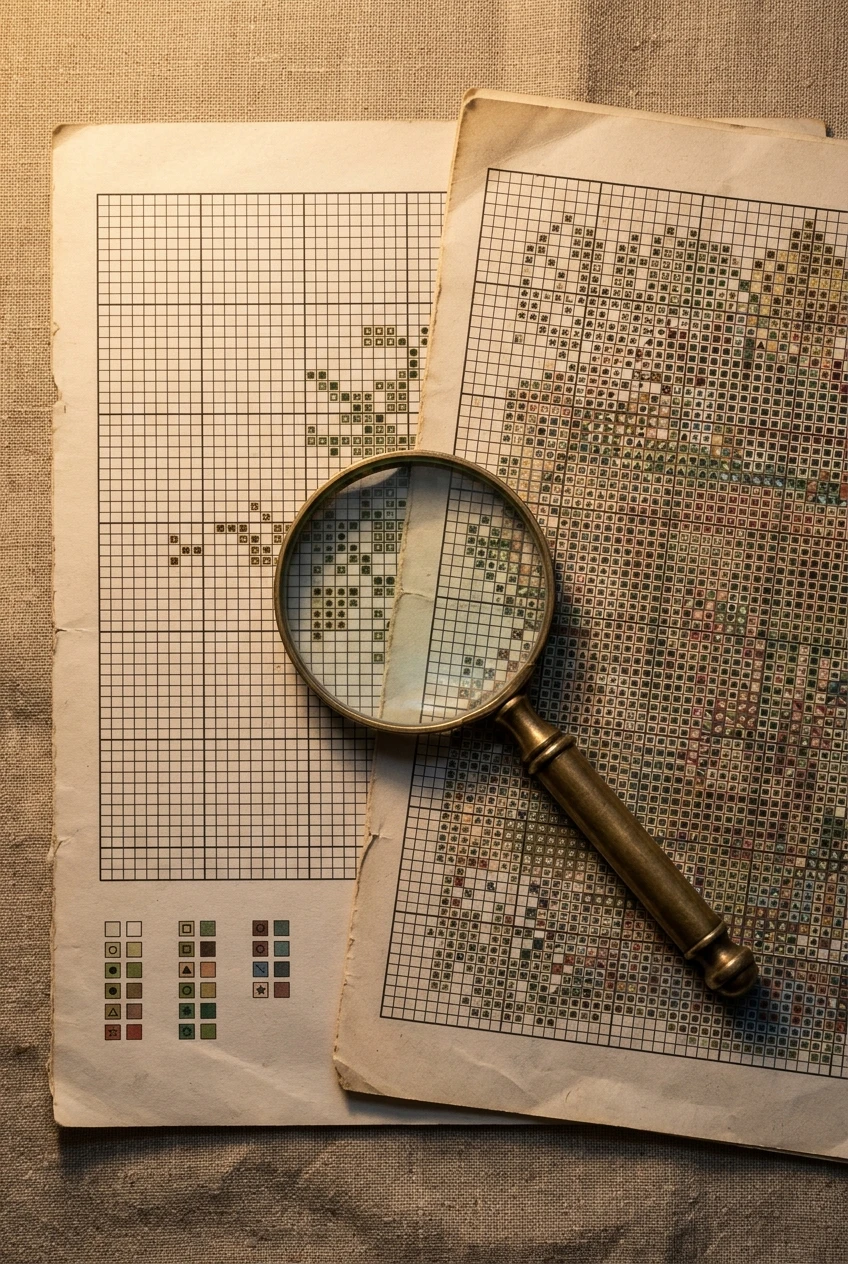
Two printed cross stitch chart pages compared side by side with a magnifying glass
Red Flag #2: The Chart Was Auto-Generated and Never Cleaned Up
A raw photo conversion has a very particular look, and once you have seen it you will never mistake it. Vast fields of single scattered stitches. Fifteen barely-different greys. Muddy brown areas where the software tried to blend a shadow. Symbols assigned at random so that a filled circle sits next to a filled dot next to a filled square and you cannot tell them apart under lamplight.
The numbers that tell you
Color count. There is no single magic number, but context matters. A large, detailed landscape may genuinely need 60 to 90 colors. A 5x7 floral listing claiming 110 colors has not been reduced at all. When a palette is that big, many of those colors appear a dozen times in the whole design and you will spend more time threading needles than stitching.
Stitch count versus design size. The listing should give both: stitch dimensions, and finished size at one or more fabric counts. If a shop lists only inches with no fabric count mentioned, you cannot tell what you are getting. The fabric count changes the finished size dramatically: the same design comes out noticeably smaller on 18-count than on 14-count.
Page count. A detailed chart printed at readable size runs many pages. A 300x400 stitch design delivered as a single PDF page has been shrunk to the point where no one can read the symbols.
Confetti is not automatically a crime
Some gorgeous, fully legitimate designs include scattered single stitches, especially fine-art reproductions where a stray highlight genuinely carries the image. The difference is intent. In a good chart, confetti appears where it does work. In slop, it is everywhere because nobody filtered it. If you want to stitch detailed work, learning to manage scattered stitches is a worthwhile skill rather than a reason to avoid a chart.
One more practical note: a usable modern chart should be a real PDF with selectable symbols or clean vector output, not a photograph of a chart or a low-resolution scan. If a file will not open properly in your charting app, that is often a sign of how it was produced in the first place.
|
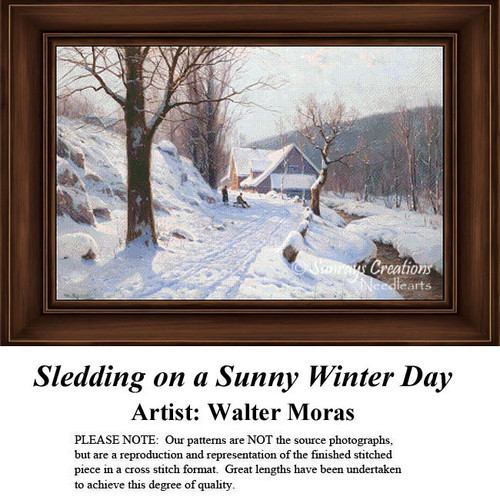
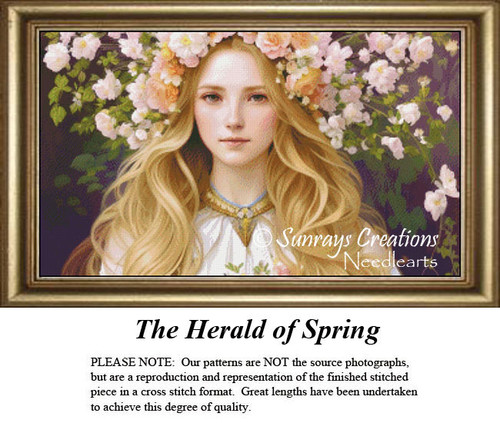
Patterns from the Sunrays Collection Tracey's Picks, designing cross stitch patterns since 2004 | |||||
| |||||
| Browse the full Sunrays collection → |

Red Flag #3: Stolen Artwork, Missing Keys, and Anonymous Sellers
Artwork the seller has no right to use
Film stills. Album covers. Photographs lifted from a nature photographer's portfolio. Paintings by famous living artists. If a listing is charting a character, a frame from a movie, or a recognizable contemporary artwork and the shop is selling it for a few dollars with no licensing mentioned, the seller almost certainly has no permission. Beyond the ethics, these listings vanish. When they are removed, your download link often goes with them, and so does any support.
Public-domain fine art is a different situation entirely. Classic paintings whose copyright has expired are fair game, and reproducing them in thread is a tradition that goes back generations.
No symbol key, no floss list
A chart without a key is not a pattern. It is a picture of squares. The listing should tell you there is a full symbol key with floss numbers, and it should name the brand. DMC six-strand (find on Amazon) is the common standard, and I design using it with two strands on 18-count Aida. If a listing says "colors included" but never names a brand or shows a key sample, assume there is no usable key.
Also look for: a stated number of strands, whether backstitch is charted separately, whether French knots or fractional stitches are used, and whether a black-and-white symbol version is included for those who find color blocks hard to read.
No human behind the shop
Look for a designer name. Look for how long the shop has been selling and whether listings were added steadily over years or dumped in a single week. Read the one-star and three-star reviews specifically, because that is where the truth lives. Phrases like "nothing like the photo," "symbols unreadable," "no color key included," or "way more colors than listed" tell you everything. A shop with 4,000 listings and no replies to a single question is not a design studio.
Independent designers answer email. That is not a small thing. When you hit a confusing section at 10 p.m., being able to message the person who charted it is worth more than the two dollars you saved.
Get Stitching Tips & New Patterns from Tracey
Honest advice, new Sunrays designs, and occasional VIP-only offers. No fluff.
No spam. Unsubscribe any time.

Tracey Recommends
Dimensions Gold Collection Counted Cross Stitch Kit, Hydrangea in Bloom, 18 Count Ivory Aida, 5'' x 7''
A smaller 5 by 7 design on 18-count ivory Aida, a lovely fine finish for framed wall art. The kit includes the chart, key, floss and fabric, so there is no mystery about what shows up. A good gift-sized option when you want a complete project in one box.
Check Current Price →What to Do Before You Buy and After a Bad Purchase
Before you buy
Ask for a sample chart page. Message the seller and ask to see one page of the actual chart and the key. A real designer will send it or point you to a preview already posted. Silence, or a reply that dodges the question, is your answer.
Confirm the fabric count assumption. Ask what count the design was charted for and what the finished size would be on the fabric you plan to use. If you are buying a kit, confirm what fabric and floss are included, and whether an embroidery hoop (find on Amazon) is part of the package or something you supply.
Check the delivery format. Instant download PDF, printed pattern mailed to you, or a full kit with supplies. Each is fine; you just want to know before you pay.
Buy the small one first. If a shop is new to you, start with an inexpensive design rather than a 400x500 stitch BAP. You will learn more about their chart quality from one small purchase than from any amount of listing-reading.
If you already bought a bad one
First, contact the seller directly and describe the specific problem: no key included, symbols illegible at printed size, color count wildly different from the listing. Many disputes end right there with a refund or a corrected file.
If that goes nowhere, most major marketplaces have a buyer protection or dispute process. Check whether it covers digital downloads, since the rules for digital items vary by platform. Open the case through the platform rather than your card issuer first, keep your screenshots of the listing, and be specific about what was promised versus delivered.
Then leave an honest, factual review. Not angry, just accurate: what the listing claimed and what the file contained. Reviews are how the next stitcher avoids the same purchase, and honest ones protect the whole community.
The safe-bet option, especially for gifts
December brings a lot of pattern buying, both for holiday projects and as gifts, and a gift is exactly when you do not want to roll the dice. Two safe routes: buy from an independent designer whose work you can see and whose name you know, or buy a boxed kit from a long-established maker. A kit from a company with decades of track record arrives with a printed chart, a full key, sorted floss, and fabric in the box. Add a 5-6 inch embroidery hoop and a pair of sharp cross stitch scissors (find on Amazon) and the recipient can start the same evening.
Either way, the principle holds. You are paying for someone's judgment, not just an image file. Judgment is what turns a picture into something you can actually stitch for the next eighty hours without wanting to throw it across the room.
Learning to read a listing the way you read a chart takes about a week of practice and saves you years of frustration, not to mention the money. You are paying for a person's judgment, and the shops worth your time make that judgment easy to see. If you would like to browse charts with a designer's name attached, a full DMC key, and clear sizing information, the Sunrays Creations collection is always open.
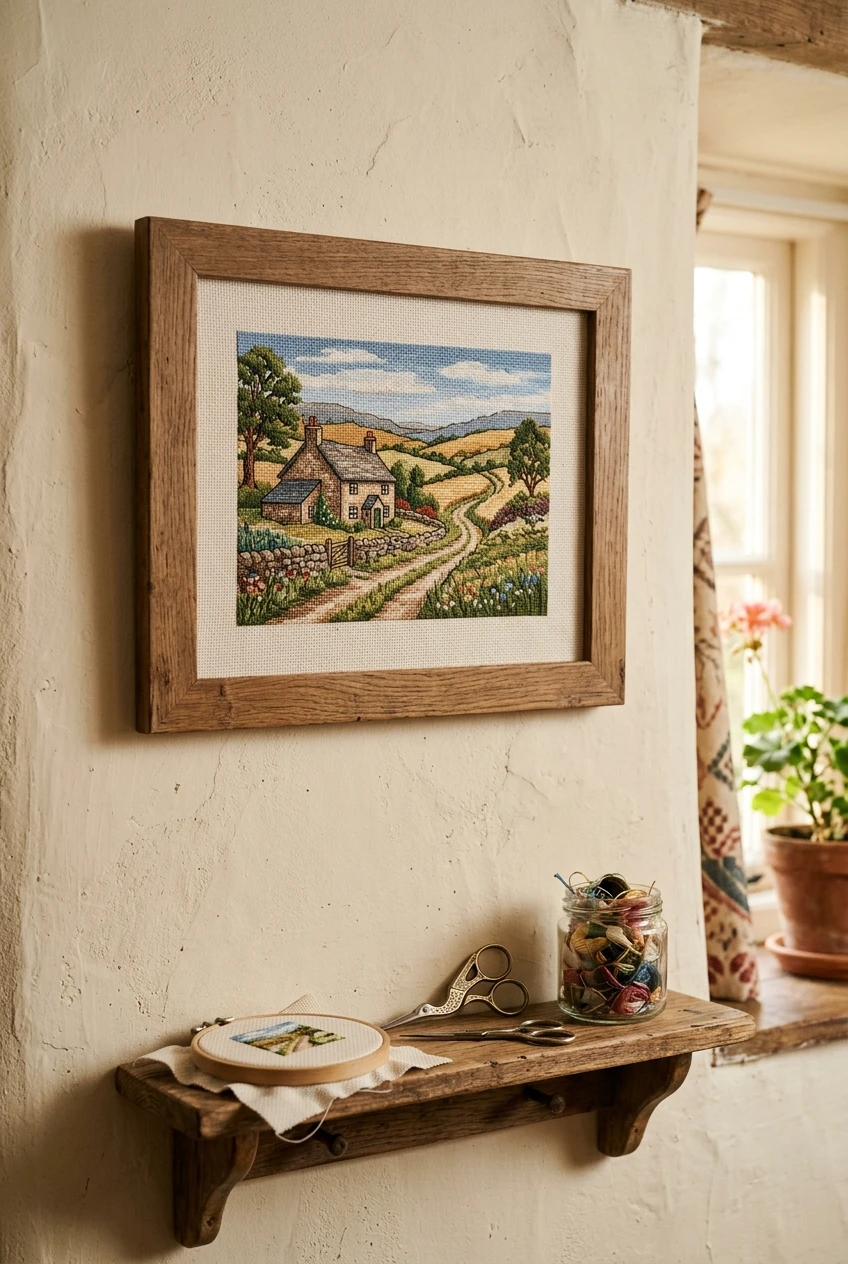
Framed finished cross stitch landscape on a wall above a shelf with hoop and scissors
Keep Reading
Where to Buy Cross Stitch Patterns: A Honest Guide
Once you know what a bad listing looks like, the next question is where to shop instead. This guide walks through the places worth your money.
See Where to ShopWhy Buy Cross Stitch Patterns from an Independent Designer
The case for buying from a named human who answers email, builds a real key, and stands behind the chart you downloaded.
Read Why It MattersHow to Read a Cross Stitch Pattern: A Complete Guide for New Stitchers
Knowing how a good chart is supposed to be laid out makes a bad one obvious in seconds. Start here if symbols and keys still feel confusing.
Learn to Read a ChartFrequently Asked Questions
How can you tell if a cross stitch pattern cover photo is AI-generated?
Zoom in and look for fabric. Real stitching shows a woven Aida grid with slightly uneven stitch tops, while an AI render blurs into a smooth gradient with no fabric holes behind it. Other tells are detail finer than the fabric count could carry, hoop rings that warp, garbled lettering, and floss labels that spell nothing.
Are AI or computer-converted cross stitch patterns always bad?
No. Almost every modern chart is made with software, and conversions from artwork can produce beautiful, stitchable designs. The problem is the cleanup step being skipped: no palette reduction, no confetti filtering, random symbols, and no readable key. Judge the result, not the tool.
How many floss colors is too many in a cross stitch pattern?
There is no single cutoff, but context matters. A large detailed landscape might legitimately use 60 to 90 colors, while a 5x7 floral listing claiming 110 colors almost certainly came straight out of an AI generator with no palette reduction by a person. When a palette is that big, many colors appear only a handful of times in the whole design.
What should a legitimate cross stitch pattern listing tell you?
Stitch dimensions, the fabric count it was charted for, finished size, the floss brand and whether a full symbol key is included, the number of pages, and the delivery format. A preview of an actual chart page is a strong good sign. A listing that gives only inches with no fabric count is leaving out something you need.
What are the warning signs of a pattern mill shop?
Thousands of near-identical listings posted in a short window, rock-bottom prices, no designer name, no replies to questions, and the same mockup image appearing under multiple shop names. Reading the one- and three-star reviews for phrases like "nothing like the photo" or "symbols unreadable" usually confirms it.
What can you do if you already bought a bad cross stitch chart?
Contact the seller first and describe the specific problem, such as a missing key or symbols that are illegible at printed size. If that goes nowhere, most major marketplaces have a dispute process, though the rules for digital downloads vary by platform. Keep your listing screenshots and leave an honest, factual review afterward.
Is it safe to buy a cross stitch pattern as a gift?
Yes, if you stick to a named independent designer or a boxed kit from a long-established maker. A kit arrives with a printed chart, a full key, floss and fabric, so there is no mystery about what is inside. Add a hoop and sharp scissors and the recipient can begin that evening.
-- Tracey Kramer
Founder & Designer, Sunrays Creations Needlearts
Hand-charted designs since 2004 • Marysville, Ohio