
Where to Find Vintage Cross Stitch Magazines on eBay
Posted by Tracey M. Kramer on 30th Apr 2018
A Note from Tracey Kramer
I have been collecting cross stitch magazines since before most people had internet access, and I still believe a dog-eared back issue from 1997 holds more stitching inspiration than most of what you can find with a single search today. This article is my love letter to the vintage finds hiding in plain sight on eBay — and a practical guide to hunting them down for next to nothing.

Vintage cross stitch magazines and calendar spread on a wooden table with tea and a small stitching project
By Tracey Kramer • • 12 min read
If you have been stitching for any length of time, you already know that the hunt for new patterns is almost as satisfying as the stitching itself. There is something deeply pleasurable about flipping through a magazine or a calendar and landing on a design that makes you stop and say, yes — that one. That feeling does not expire. A pattern that moved you in 1998 will move you just as much today, and that simple truth is the foundation of everything I am about to share with you.
Most stitchers, when they want new patterns, go straight to the internet — Etsy, Amazon, independent designer shops like mine. And that is perfectly reasonable. But there is an entire secondary market that the cross stitch community is largely sleeping on, and it has been sitting there for years just waiting to be discovered. I am talking about eBay. Specifically, I am talking about vintage cross stitch magazines, mail-order catalogs, and cross stitch calendars available in lots — sometimes dozens of issues at a time — for prices that work out to literal cents per pattern. I am not exaggerating. Fifty cents a magazine is a bad deal on eBay. You can do better.
I want to walk you through every category worth searching: the magazines that defined this craft for a generation, the mail-order catalogs that doubled as free pattern books, and the calendars — oh, the calendars — that most people toss at the end of the year without realizing the pattern booklet tucked inside is a small treasure. Grab your tea. Let's talk about building a pattern library the smart way.
Cross Stitch Magazines in Lots: Building a Pattern Library for Pennies
Let me start with the one that still makes me a little sad to talk about, because it deserves to be named and honored properly. Cross-Stitch and Needlework Magazine — C-S&N to those of us who subscribed — was, without any qualification in my mind, the best cross stitch publication that ever existed. I do not say that lightly. I have been stitching for over thirty years and I have seen a lot of magazines come and go. Nothing came close. It introduced me to artists like Jill Gordon and Kaffe Fassett. It balanced humor with serious technique. Every single issue had at least three or four projects I bookmarked to stitch someday. I have saved every copy I ever received, from the very first issue of my subscription, and I will never throw a single one away. When it closed, I genuinely grieved it. And I know I was not alone.
The good news — and this is the part people are missing — is that back issues of C-S&N are sitting on eBay right now in lots. Ten, fifteen, twenty issues at a time. People who subscribed and are now downsizing their stash are listing them in groups, and because not enough people know to search for them, they are going cheap. I have seen lots of ten issues sell for five dollars. That is fifty cents a magazine. Each of those magazines has anywhere from eight to fifteen patterns inside. Do the math. You are acquiring patterns at a price per design that is almost embarrassing.
Beyond C-S&N, there are other titles absolutely worth hunting. Just Cross Stitch Magazine — which is still publishing today and offers a cross stitch magazine subscription (find on Amazon) you can get fresh — has an enormous back catalog perfect for stitchers who prefer small to medium projects without overwhelming complexity. Cross Stitch and Country Crafts was a beloved title with a warmer, more rustic aesthetic that suits botanical and farmhouse designs beautifully. Better Homes and Gardens published cross stitch specials periodically — those thick newsstand-style issues — that were packed with projects from cover to cover. All of these show up in eBay lots regularly.
The lot format is the key insight here, and I want to make sure you really hear it. You are not buying one magazine. You are buying a pattern library. When someone lists twenty issues of a cross stitch title, they are handing you years of curated design work in a single transaction. Even if only half the patterns appeal to you, you have still walked away with a collection that would have cost you ten times as much buying them individually in their original publication year. Search the phrase cross stitch magazine lots (find on eBay) on eBay and start browsing. Set a saved search so new listings notify you. This is a slow and patient hobby — the deals come if you are watching.
One important note on the lot format versus singles: cross stitch needlework magazines (find on eBay) listed individually tend to attract more competition from collectors who recognize specific issues. Lots, by contrast, often fly under the radar because they require more storage space and more commitment. That is exactly why lots are the better value. The person listing ten issues of C-S&N probably just wants them gone. You want exactly what they have. It is a happy arrangement.
Vintage Mail-Order Catalogs: The Pattern Books Nobody Talks About
Here is something I will wager you have never thought to search for on eBay: vintage cross stitch mail-order catalogs. Not the patterns themselves — the actual shopping catalogs that companies mailed to customers' homes in the 1980s and 1990s. Herrschners. The Stitchery. Dimensions. Needlecraft Industries. These catalogs were sent out free, and their entire purpose was to sell you kits and supplies. But here is what that means in practice: they are full of photographs and illustrations of finished cross stitch designs. Full color. Detailed. Beautiful. And in many cases, the catalog listing included enough detail about thread colors and general construction that an experienced stitcher could work backward from the image.
Even setting aside the reverse-engineering angle, these catalogs are a window into design trends across several decades. Herrschners in particular ran a massive operation and their catalogs from the late eighties and early nineties are thick, glossy affairs that read more like a specialty magazine than a shopping circular. If you love that era of design — the warm country-style animals, the folk art Santas, the garden samplers — these catalogs will feed that love in a very specific way that modern pattern databases simply cannot replicate.
The practical advantage of catalog lots over magazine lots is that condition matters less. With a magazine, the charts must be legible — more on that in a moment. With a catalog, you are mostly browsing photographs and descriptions. A little yellowing or a soft crease does not diminish the value at all. That makes catalog lots even more of a bargain, because sellers often price them lower assuming buyers will be put off by age. Search cross stitch catalog lots (find on eBay) on eBay and you will find them grouped with general needlework and crafting ephemera. Dig a little. The finds are there.
I have heard from stitchers who have used vintage Dimensions catalogs specifically as a sourcing guide — identifying a kit they love from the catalog photo, then tracking down the actual kit on eBay separately. That is a clever approach. The catalog becomes a wish list. The beauty of it is you can build that list for almost nothing, flip through at your leisure with a cup of tea, and shop at your own pace. There is a rhythm to that kind of hunting that feels very much like the hobby itself — slow, deliberate, rewarding when you find something that speaks to you.
Tracey Recommends
Just Cross Stitch Magazine Subscription
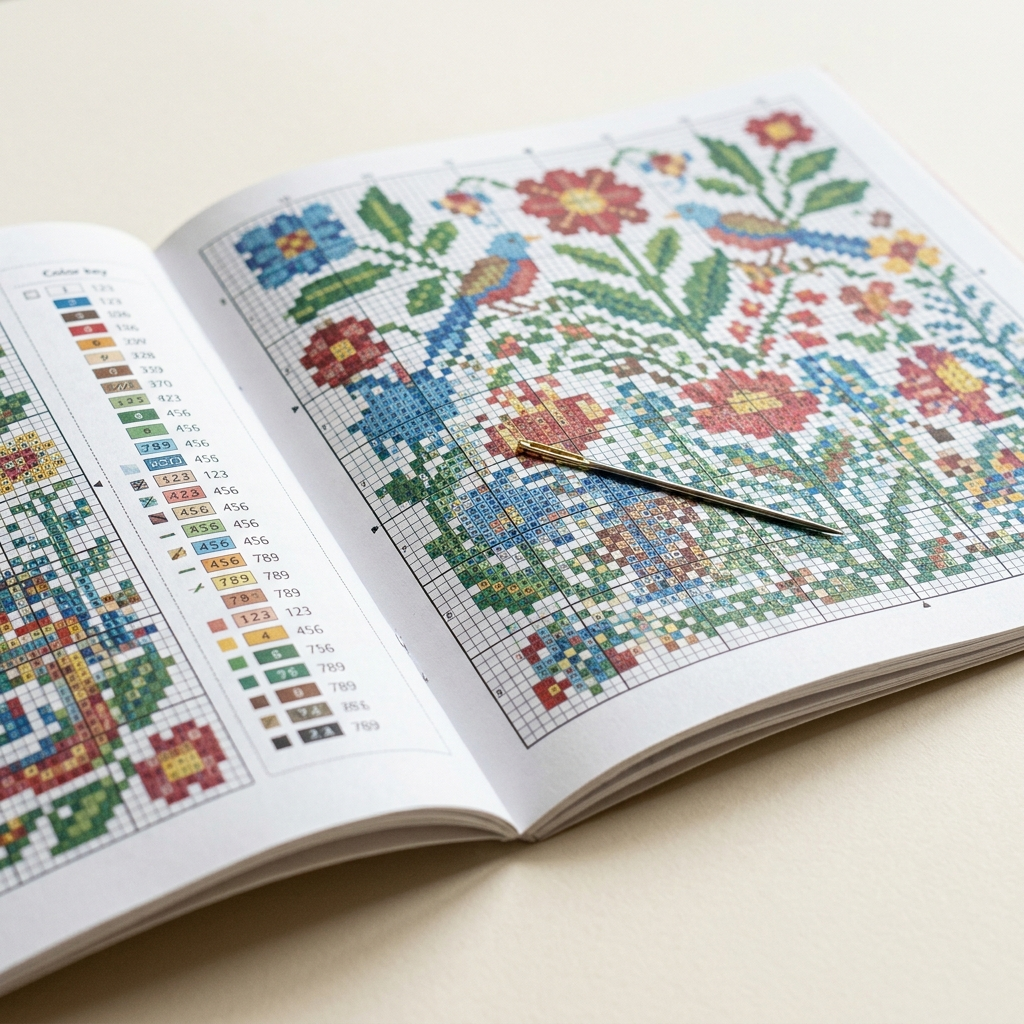
While you build your vintage collection on eBay, a current subscription to Just Cross Stitch keeps brand-new patterns arriving every issue. Small to medium projects, clean charting, and a consistent publication schedule — this is the best active cross stitch magazine running today.
See on AmazonA cross stitch calendar from 2009 has twelve designs you can stitch today just as beautifully as you could in 2009. The date on the cover is completely irrelevant — the patterns inside are timeless.
Cross Stitch Calendars: The Date on the Cover Is Completely Irrelevant
Every year, my wife receives a cross stitch calendar. That is a tradition in our house that I do not see ending anytime soon. There is something genuinely lovely about turning the page on the first of the month and being greeted by a beautiful charted design — a reminder that the craft is always there, always waiting, always something to look forward to. The calendar we love most is the Keepsake Calendar, formerly produced by Cross-Stitch and Needlework Magazine and carried on through Embroidery.com. It comes with a separate pattern booklet — actual charted instructions for every design in the calendar — plus a bonus purse-size calendar as a little gift. Twenty-four dollars for a year of beauty and a dozen patterns. That is an extraordinary value even at full price.
But here is the angle I want you to really sit with: a cross stitch calendar from 2009 has twelve designs in it. Those designs are just as stitchable today as they were in 2009. The date on the cover is completely and utterly irrelevant to the patterns inside. Nobody is going to look at your finished piece and say, well this was designed for January of 2009 so I cannot hang it on my wall. The designs are timeless. Florals are timeless. Animals are timeless. Seasonal motifs are timeless. A vintage cross stitch calendar is not a dated artifact — it is a pattern booklet with a pretty cover.
Vintage cross stitch calendars on eBay regularly sell for under five dollars, sometimes for two or three dollars with shipping included. The Accord Publishing Easy Cross Stitch Day-to-Day Calendar series — which I adored and which is sadly no longer being produced — featured small, punchy designs perfect for cards, ornaments, and small gift pieces. I have an entire folder of those designs and I pull from it regularly. Those desktop calendars show up on eBay now and then, and when they do, they are worth snapping up.
Better Homes and Gardens also produced calendar specials with cross stitch content that are worth searching for. They do not appear as frequently as the dedicated needlework calendars, but when they do, they tend to have that familiar warm, approachable BHG aesthetic — designs that feel like home, which is exactly what you want when you are stitching.
One critical note for calendar buyers specifically: make sure the pattern booklet is included, not just the wall calendar pages. The calendar pages are lovely but they are not the prize. The pattern booklet — with the actual charts, thread color keys, and instructions — is what you are really after. Any eBay listing for a Keepsake Calendar or similar should specify that the booklet is present. If the listing does not mention it, ask the seller before you bid. A calendar without its booklet is like a pattern without its key. Pretty but not very useful.
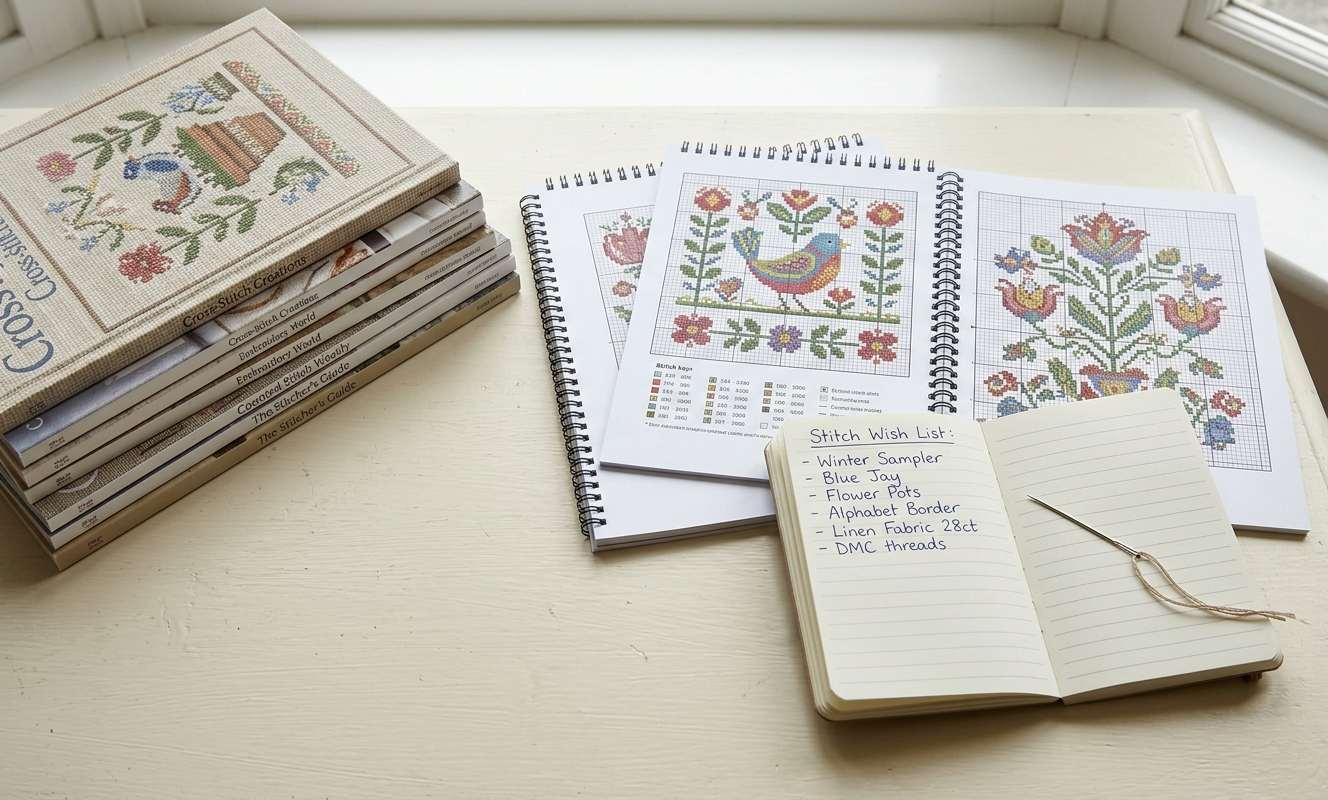
Stack of cross stitch magazines beside open vintage cross stitch calendar showing a charted design and a notebook
How to Search eBay Effectively for Cross Stitch Vintage Finds
eBay searching is a skill, and like most skills, it rewards practice and a little strategic thinking. The phrases that work best for our purposes are specific and consistent. For magazines, use cross stitch magazine lots — the plural in 'lots' signals that you want grouped listings rather than individual issues. For the C-S&N specifically, try 'cross stitch needlework magazine' as a phrase. For calendars, search vintage cross stitch calendars (find on eBay) — adding 'vintage' filters out current-year stock that will be full price. For catalog lots, use cross stitch catalog lots. Save each of these as a search so eBay emails you when new listings match. I check my saved searches a few times a week. It takes thirty seconds and has led to some genuinely excellent finds.
Before you bid on anything, check the completed listings. eBay lets you filter by 'sold' items so you can see what things actually changed hands for, not just what sellers are asking. This is invaluable for calibrating your expectations and your ceiling. If lots of ten C-S&N issues are consistently selling for six to eight dollars, do not pay twelve just because someone listed it that way. Be patient. Another lot will come along.
When evaluating individual listings, I have a few personal filters. I prefer US sellers for vintage magazines and calendars because shipping is faster, cheaper, and the items are less likely to have been stored in dramatically different conditions. International listings can be fine but they add cost and uncertainty. Look at the photos carefully — a good seller will show you the covers of multiple issues and ideally a sample interior page. If the photos are blurry or show only a single cover shot, that is a yellow flag. Ask for more photos before committing.
Condition notes matter enormously for magazines and very little for catalogs, as I mentioned earlier. For magazines specifically, you are looking for readable charts. Faded or water-damaged charts are essentially worthless because the color symbols wash out and you cannot accurately identify the thread keys. A seller who notes 'charts clean and readable' or 'pages bright, no water damage' is telling you something valuable. A listing that says 'estate sale find, sold as-is' with no interior photos is telling you something too — just something different. Proceed with caution on those.
Lots are almost always better value than singles, but there is one exception: if you are hunting for a very specific issue — say, a particular C-S&N that featured a designer you love — then a single issue listing is fine and you may need to pay a small premium. For general pattern-building purposes, though, lots win every time. More variety, lower per-issue cost, and often a more forgiving seller who just wants the collection to go to someone who will appreciate it.
|
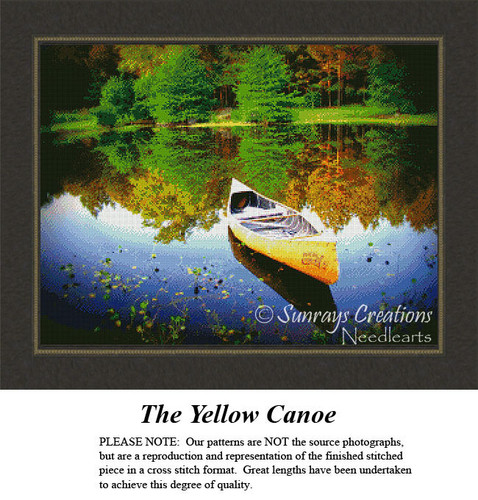
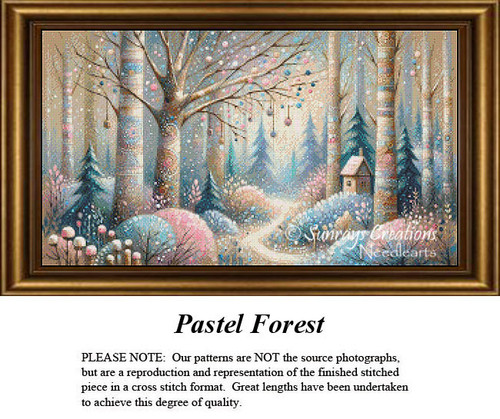
Patterns from the Sunrays Collection Tracey's Picks, designing cross stitch patterns since 2004 |
|||||
|
|||||
| Browse the full Sunrays collection → |

What Is Worth Buying and What to Skip
Not every eBay lot is a good deal, and after years of buying vintage craft materials online I have learned a few things the hard way. Let me save you the tuition. Magazine condition is the single most important factor in the equation. The charts must be legible. If the colors are faded, if the symbols are blurring into the background, if there is mold or water damage — the magazine has no practical stitching value. It might still be interesting as a historical artifact, but if you are buying it to stitch from, condition is non-negotiable. Always ask for an interior photo of a chart page if the seller has not provided one.
Catalog condition, as I have said, is much more forgiving. A yellowed Herrschners catalog from 1991 is still fully useful for browsing and inspiration. Soft covers, bent corners, even some writing on the interior pages — none of that affects the value to you as a stitcher. Price catalog lots accordingly and do not pass on a good catalog lot just because someone notes light wear.
For calendars, the checklist is simple: wall calendar pages present, pattern booklet present, charts readable, no water damage. If all four boxes are checked, it is probably worth buying. If the booklet is missing, pass unless the listing is priced low enough that the wall calendar pages alone give you some decorative value. The real content of a cross stitch calendar is always in that separate booklet. Do not let anyone convince you otherwise by offering a discount on a booklet-free listing — the booklet IS the product.
Avoid listings described as 'large estate sale lot — crafts, magazines, sewing' with no photos of the cross stitch items specifically. Estate sale lots can be wonderful, but they can also mean a box of water-damaged magazines that sat in a garage for fifteen years. The best finds consistently come from stitchers who clearly cared for their collection — someone who is downsizing after years of dedicated practice, who stored their magazines properly, and who writes a listing that reflects genuine knowledge of what they are selling. Look for sellers who use correct terminology, who know the magazine names, and who have positive feedback from buyers of similar items. Those are your people. Buy from them happily and leave good feedback in return.
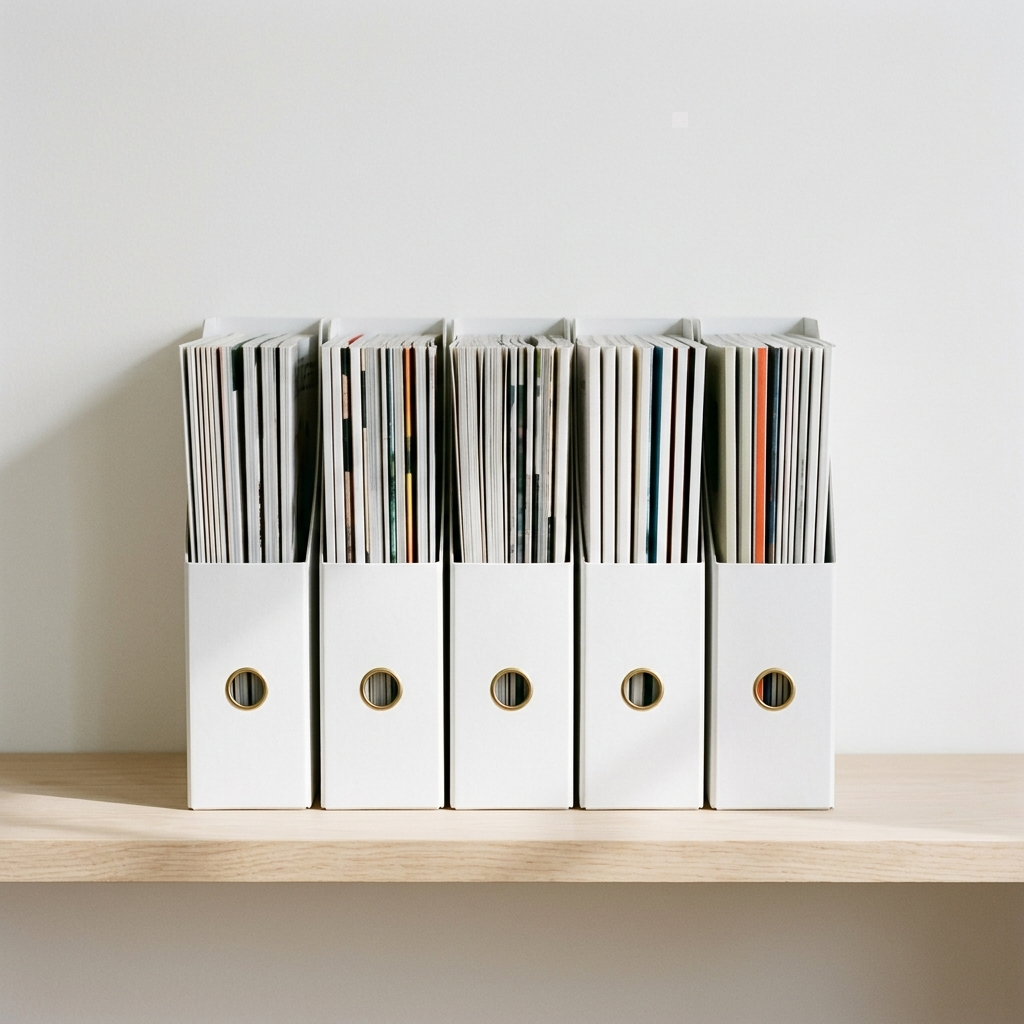
One last thought on the cross stitch pattern book (find on Amazon) category: bookstores and Amazon carry a huge range, and a good cross stitch pattern book with four or five designs you genuinely want to stitch is worth every penny at full price. The vintage eBay hunt and the new-purchase market are not in competition — they are complementary. I keep a magazine storage binder (find on Amazon) system specifically for the back issues I have accumulated, organized by year and title, so I can find what I need when I need it. If you are going to build a collection — and I think you should — invest in a proper organization system from the start. Your future self will thank you. And while you are hunting vintage lots on eBay, a current subscription to Just Cross Stitch keeps fresh patterns arriving at your door so the well never runs dry. Also, keeping your embroidery floss storage (find on Amazon) organized matters just as much as organizing the patterns themselves — when you pull a design from a 1997 issue and sit down to stitch it, you want to find your colors quickly.
Get Stitching Tips & New Patterns from Tracey
Honest advice, new Sunrays designs, and occasional VIP-only offers. No fluff.
No spam. Unsubscribe any time.
Tracey Recommends
Magazine Storage Binders & File Systems
Once you have built a collection of fifty or a hundred back issues, you need a proper home for them. A good magazine storage binder system keeps your finds organized, protected, and findable when inspiration strikes at eleven o'clock at night.
See on AmazonThe cross stitch community is full of generous people quietly passing their collections on to the next generation of stitchers — one eBay lot at a time. That feels right to me. God made this craft to connect people across time, and there is something beautiful about sitting down with a magazine from twenty years ago and feeling the same spark the original reader felt when they first flipped to that page. Start your hunt, build your library, and when you are ready for something fresh and original, come browse the patterns at Sunrays Creations — hand-charted, detailed, and made with that same love for the craft.
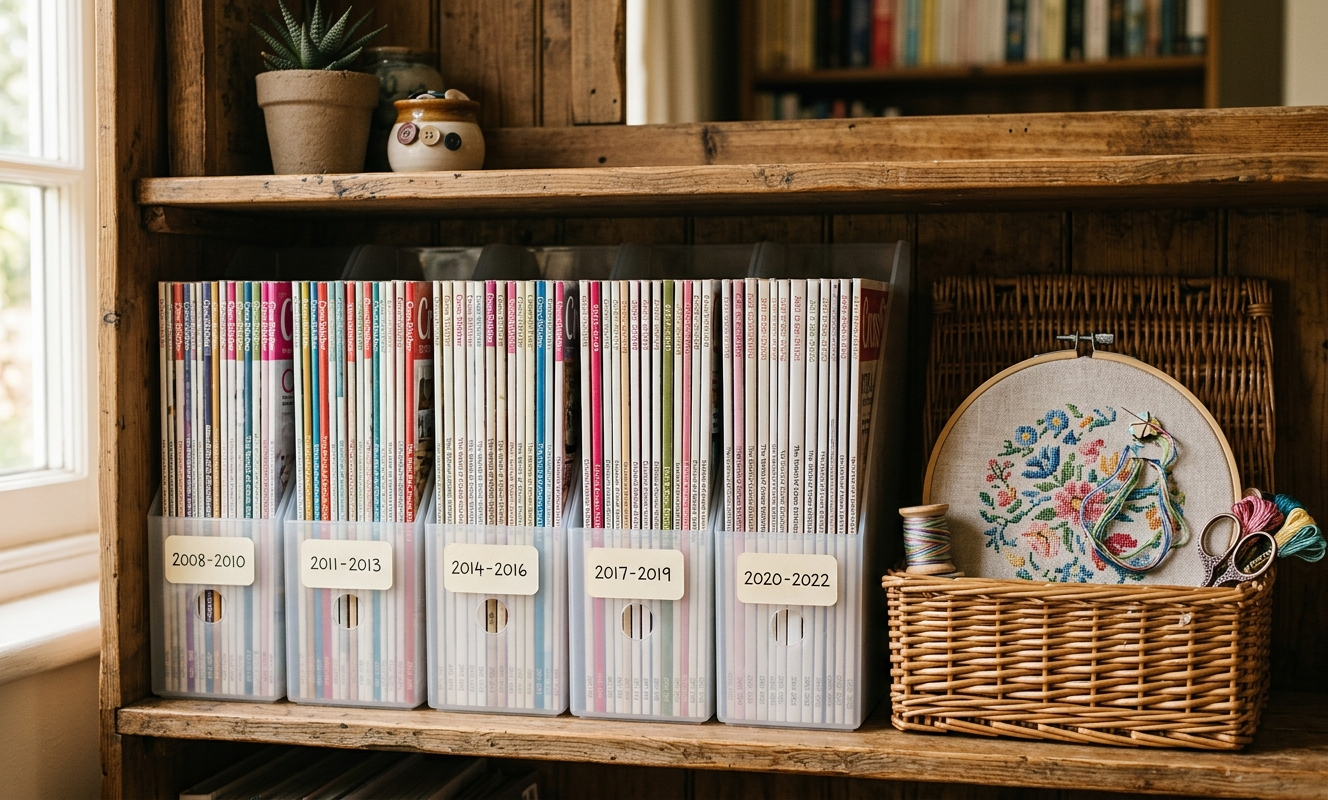
Organized cross stitch magazine collection on wooden bookshelf beside a small basket with a current stitching project
Keep Reading
Where to Buy Cross Stitch Patterns Online
The companion guide to this article — covering independent designers, Etsy shops, and Amazon sources for brand-new cross stitch patterns when you want something fresh off the design table.
READ THE GUIDEHow to Score DMC Embroidery Floss Deals
If you are already buying smart on eBay for patterns, you should be doing the same for your thread. This guide covers exactly how to find DMC floss at a fraction of retail.
READ THE GUIDEWhy Cross Stitch Is So Addictive
That treasure-hunting feeling you get scrolling through eBay lots? It is the same instinct that makes cross stitch so impossible to put down. Tracey explores the deeper pull of the craft.
READ THE ARTICLEFrequently Asked Questions
Where can I find vintage cross stitch magazines for sale?
eBay is the best source, particularly lot listings that bundle ten or more issues together. Search 'cross stitch magazine lot' and save the search for new alerts. See the full search strategy section above.
Is Cross-Stitch and Needlework Magazine still being published?
No — C-S&N is no longer in business, which is a genuine loss for the community. Back issues appear regularly on eBay in lots and are well worth buying. The article covers exactly how to find them.
Are cross stitch calendars from previous years still useful?
Absolutely. The date on the cover is irrelevant — the patterns inside are timeless. A 2009 cross stitch calendar has twelve fully stitchable designs that are just as beautiful today. See the calendar section for what to look for.
What should I check before buying a vintage cross stitch magazine lot on eBay?
Chart legibility is the most important factor — faded or water-damaged charts are unusable. Ask for interior photos if the seller has not provided them. Full details are in the buying guide section.
Do vintage mail-order cross stitch catalogs have actual patterns in them?
Not charts specifically, but they are rich in design photography and inspiration, and experienced stitchers can work from the images. Condition matters less for catalogs than for magazines. The catalog section covers this in depth.
What is the Keepsake Calendar and where can I get it?
The Keepsake Calendar is an annual cross stitch wall calendar that comes with a separate pattern booklet containing charts for every design. It was originally produced by C-S&N and continues through Embroidery.com. Vintage editions appear on eBay — just confirm the booklet is included.
-- Tracey Kramer
Founder & Designer, Sunrays Creations Needlearts
Hand-charted designs since 2004 • Marysville, Ohio