
Cross Stitch Crafting Space Ideas That Actually Work
Posted by Tracey M. Kramer on 25th Sep 2019
A Note from Tracey Kramer
I have stitched on every flat surface in my house and a fair number of chairs, waiting rooms, and concert halls besides. This one is for every stitcher who is still searching for the perfect space — and stitching beautifully in the meantime.
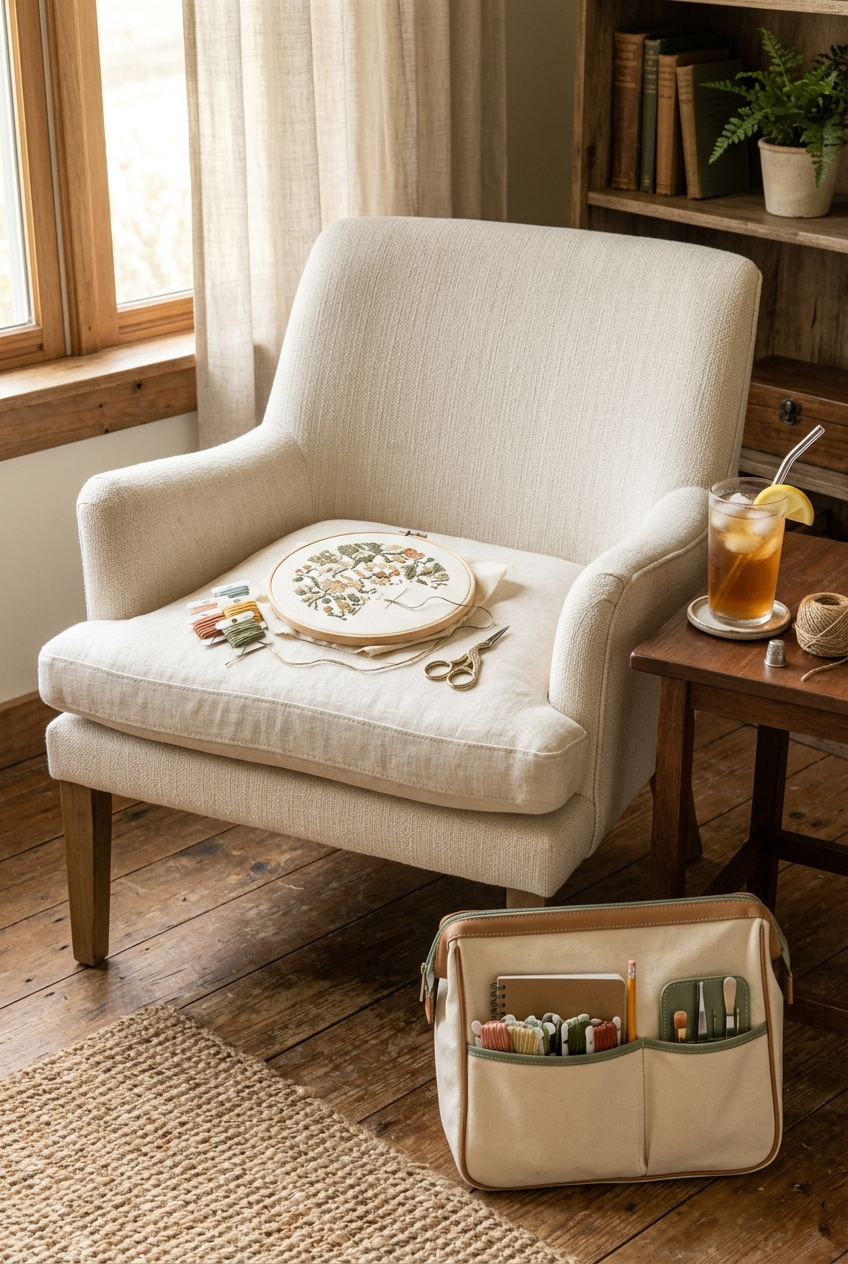
Cozy cross stitch stitching corner with upholstered chair, project bag, and afternoon window light
By Tracey Kramer • • 12 min read
Let me tell you something I have believed for a long time: there is no single perfect stitching space. There is only the space that works for you right now. I know that is not the answer people want when they are dreaming about a dedicated craft room with a skylight and a rocking chair and all their floss organized on wooden bobbins in a giant display rack. I have that dream too — mine involves a screened-in back porch, a ceiling fan, and a pitcher of lemonade, and I will tell you all about it shortly. But after more than thirty years of stitching in spaces that were, shall we say, improvised, I can tell you with complete confidence that the space is not what makes the stitching. The stitching makes the stitching.
I have had projects going in my bedroom, on the kitchen table, in the spare room, parked next to my recliner in the living room, and propped on my lap in a doctor's waiting room. I have stitched at classical music concerts while the musicians warmed up. I have stitched at monthly church gatherings and in the passenger seat on long road trips. My craft bag has been to more places than some people's suitcases. And every single one of those spaces taught me something — about the light I need, the seating that actually supports my back, the supplies I genuinely cannot leave at home, and the kind of quiet (or not-so-quiet) that helps me do my best work.
This article is my honest account of that journey. I am going to walk you through how my stitching spaces have evolved over the years, paint you a picture of the dream I am still working toward, and share the practical reality of what it looks like to stitch well in whatever space you actually have. Whether you are a beginner trying to figure out where to sit with your first project or a seasoned stitcher eyeing that empty corner of the spare room, I hope something here lands for you. Pull up a comfortable chair — preferably near a good lamp — and let's talk.
The Quest: How My Stitching Spaces Have Evolved
When I started stitching seriously — and I mean the kind of serious where you are charting your own designs and ordering specialty thread and thinking about fabric count before you go to sleep — my stitching space was wherever I could wedge myself in. A corner of the bedroom was usually first. It was quiet enough after the house settled down for the night, and I had a small lamp on the nightstand that I would angle toward my hoop. It was not ideal. The light was too warm, the chair was a straight-backed thing I had dragged in from the hallway, and I was constantly getting up to find scissors or a needle threader I had set down somewhere. But I stitched there, and I finished projects there, and I learned what I liked and did not like about the setup.
The kitchen table became a regular station too, especially for larger projects that needed to lie flat or for any time I was working on a pattern that required me to keep a chart nearby and reference it constantly. After dinner, once things were cleared away, I would spread out and settle in. The overhead light in my kitchen is better than most, and the table gave me room to work. The downside is obvious to anyone who has tried it: the kitchen table is communal property, which means your project gets interrupted by breakfast, by company, by someone needing to pay bills, by the hundred small claims that a kitchen table absorbs in a busy household. I got good at packing up fast and protecting my place on the chart.
As my stitching got more serious — bigger projects, more complex patterns, more colors in play at once — I started paying closer attention to what I actually needed from a space. The number one thing, which I will talk about at length in a later section because it deserves its own spotlight, is light. Good light is not a luxury; it is a working condition. But close behind it is seating. I have the kind of lower back that will remind me, loudly, if I have been sitting wrong for two hours. A chair with proper lumbar support, arms at the right height, and enough cushion to get comfortable without sinking in too deep — that combination took me years to find and I protect it fiercely now. My living room recliner, positioned near the floor lamp I moved specifically for this purpose, has become my primary stitching throne.
All of this evolution — the bedroom corner to the kitchen table to the carefully positioned living room chair — has been pointing me somewhere. There is a north star in my stitching life, and it is a screened-in back porch in the late afternoon with a ceiling fan turning slowly overhead and a pitcher of something cold on the table beside me. I have never had it. I am working toward it. Every space I have stitched in has been a step closer to understanding exactly what that porch needs to have — and exactly what I can live without.
The Dream: A Screened Porch, a Ceiling Fan, and a Pitcher of Lemonade
Here is the dream in full, because I think every stitcher deserves to name their version of it. Mine is a screened-in back porch — not a sunroom, not a deck, a proper screened porch where the air moves through and the bugs stay out. It is late afternoon. The light coming through the screens is that particular golden-hour light that makes every color look the way it is supposed to look. There is an upholstered chair — something with wide armrests and a cushion that has been broken in just right — angled so the light falls over my left shoulder. A ceiling fan turns slowly overhead, just fast enough to keep the air moving. On the small table beside the chair, there is a pitcher of lemonade — the real kind, not the powder kind — with condensation on the glass and a few sprigs of mint if I am feeling fancy. My current project is in my lap. My floss is organized on the table beside me. There is no phone, no television, no one who needs anything.
In the corner of this porch — and this is the detail that makes the whole thing perfect — there is a hammock. Not for stitching. For after stitching, when the light gets too low and I have put in a good hour or two and earned a rest. There is something about the idea of finishing a session of good work and then simply lying down in the afternoon air that feels like the best possible reward. I believe God put that particular vision in my imagination as encouragement — keep going, the porch is coming. Until it does, I stitch in what I have. But the hammock is waiting.
The honest truth is that this dream has been clarifying for me. Every time I have adapted a space — moved a lamp, repositioned a chair, cleared a table, packed a bag — I have been figuring out which parts of the dream are non-negotiable and which parts are pleasant extras. The lemonade is an extra. The ceiling fan is an extra. The hammock is a beautiful extra. The light is not optional. The comfortable chair is not optional. The ability to be uninterrupted for a stretch of time is not optional. Every space I have ever stitched in has taught me something about what I actually need versus what I merely want, and that knowledge is worth more than any room I could be handed fully furnished. When I finally have that porch, I will know exactly what to put in it.
Tracey Recommends
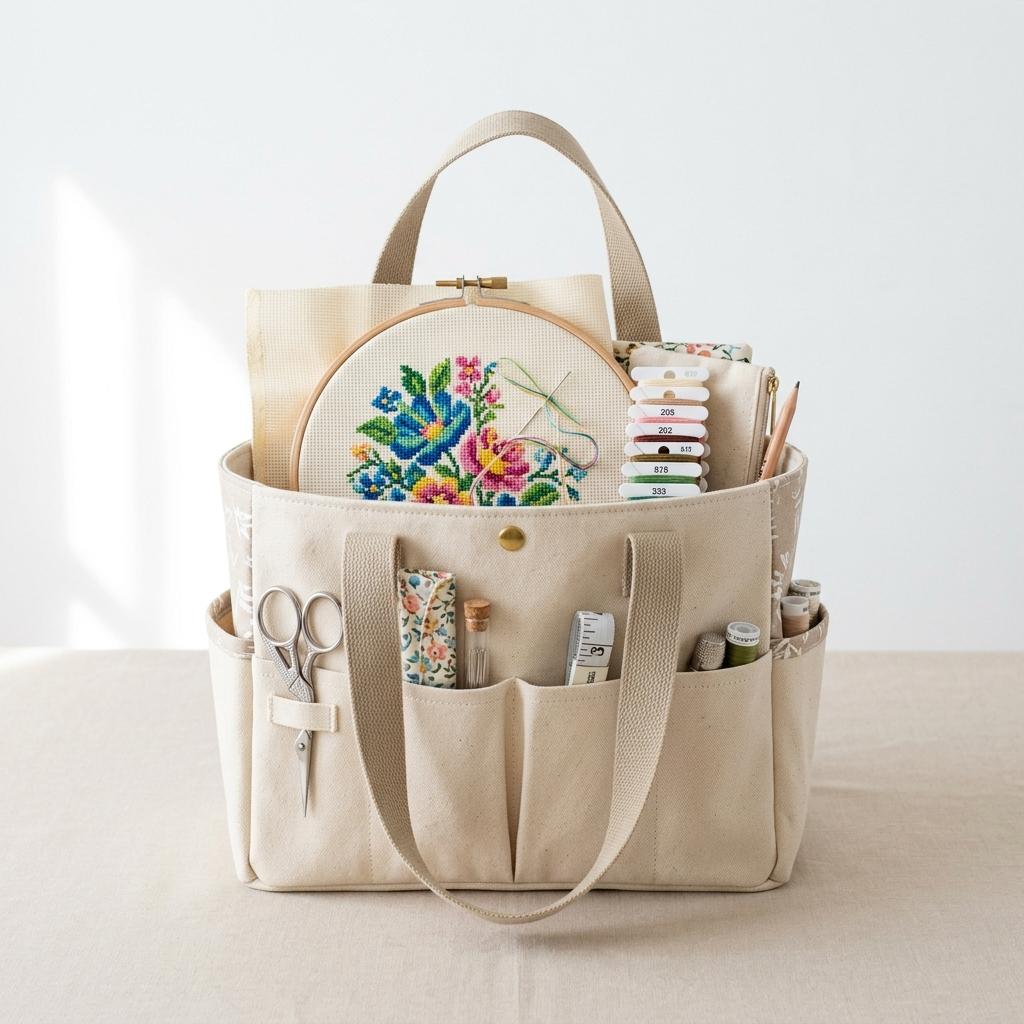
Craft Project Tote Bag with Pockets
This is the portable stitcher's best friend — enough room for a medium-sized project, dedicated pockets for scissors, needles, and a bobbin case, and sturdy enough to throw in the car and grab on your way out the door. I keep mine packed and ready at all times so there is never a reason to leave it behind. The doctor's office, the concert hall, the monthly craft gathering — this bag makes all of it possible. When your bag is always ready, you stitch more. Simple as that.
See on AmazonThe perfect stitching space is wherever the light is good, the seat is comfortable, and you have your project in front of you. Everything else is extra.
The Portable Stitcher: Anywhere Is a Stitching Space
Some of my best stitching hours have happened away from my house entirely, and I think this is one of the most useful things I can tell a newer stitcher who is waiting until conditions are perfect before they start a project. Conditions are never perfect. But a doctor's office waiting room? That is an hour of uninterrupted focus that most stitchers are leaving on the table. I have a project bag that lives packed and ready by the door, and whenever I am going somewhere where I will be sitting for more than twenty minutes, that bag comes with me. The waiting room at my doctor's office has seen me put in some genuinely beautiful work. I sit down, pull out my hoop, and there is something about the permission that comes from being somewhere you cannot do anything else — no dishes to wash, no laundry calling your name — that makes the stitching cleaner and more focused than almost anywhere at home.
I have also stitched at classical music concerts, which I realize sounds either eccentric or completely logical depending on who you are. I arrive early, get settled in my seat, and stitch through the house music and the pre-concert warming up. Sometimes I keep going through the quieter opening pieces, depending on what the program is. There is something about stitching with music — especially orchestral music — that puts me in a flow state I can barely achieve anywhere else. The rhythm of the needle through the fabric matches the rhythm of the music in a way that is hard to explain but immediately recognizable if you have ever experienced it. I am not being rude to the musicians; I am paying them the highest compliment, which is that their music is making my hands move better.
My craft bag is always packed. This is the single most practical piece of advice I can offer the portable stitcher. Not almost always packed, not packed when I remember — always. Scissors, needles, a needle threader, the current project, the chart, a small bobbin case for the colors I am working with. An embroidery hoop carry case (find on Amazon) keeps my hoop from getting dinged in my bag. A portable craft organizer bag (find on Amazon) means everything has a place and nothing gets lost in the chaos of a large tote. When the bag is always ready, I never have to decide whether to bring it. It just comes.
There is a side effect of stitching in public that nobody warned me about and that I have come to genuinely love: people stop and look. They are curious. Sometimes they are a little awed — the idea that someone can make something that detailed and that beautiful, stitch by stitch, with their hands, is genuinely surprising to people who have grown up in a world of fast production. I have had some of my best conversations about craft, about patience, about what it means to make something by hand, while sitting with a hoop in my lap in a waiting room or a concert hall. Stitching in public is not just a way to use your time — it is a quiet argument for the value of handwork, made visible every time someone walks by and stops to look.
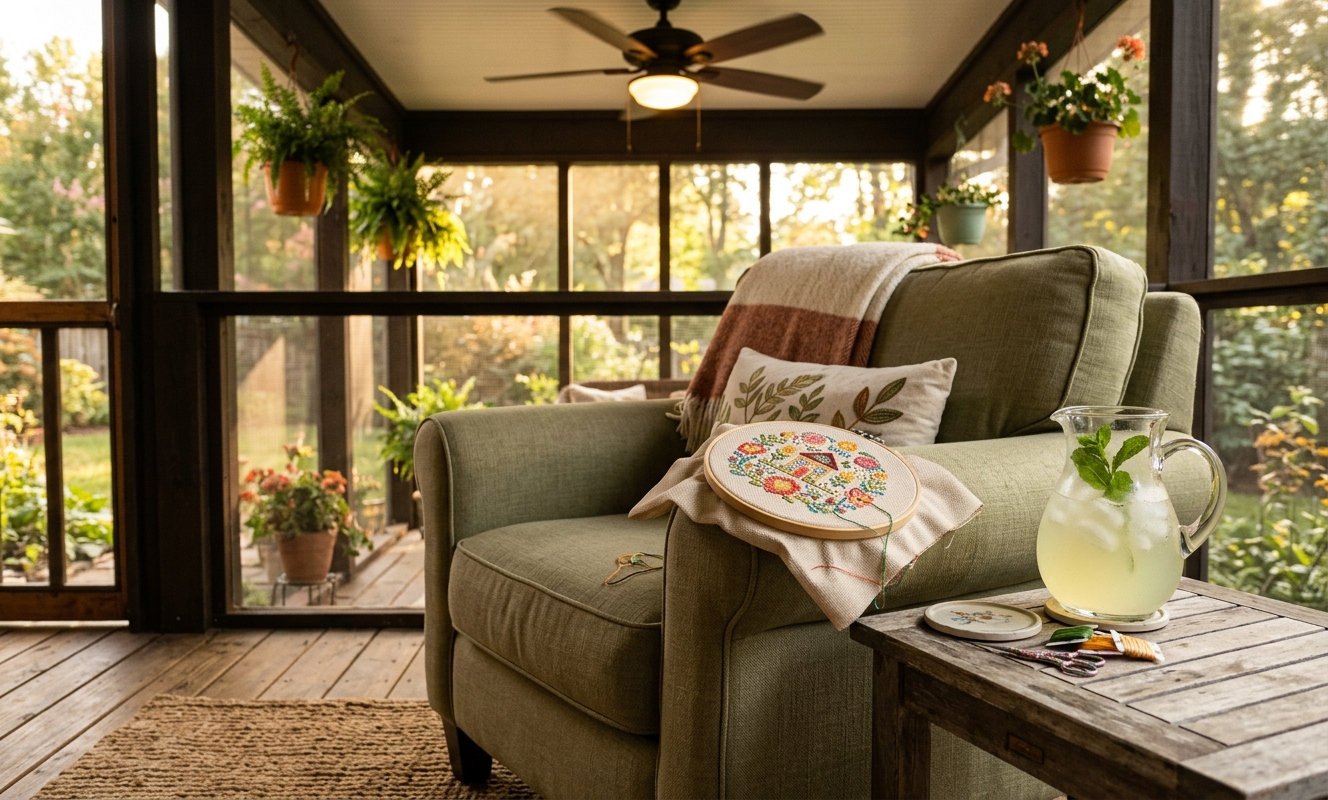
Screened porch stitching space with cross stitch project, ceiling fan, and pitcher of lemonade in afternoon light
The Social Stitcher: Why Stitching With Others Changes Everything
I run a prayer shawl ministry at my church, and on the first Tuesday of every month, a group of women gathers to crochet together. We bring our projects, we share patterns, we drink coffee, and we sit in the fellowship hall and make things with our hands while we talk. It is not a cross stitch group — the ministry is specifically about crocheted prayer shawls that go to people in need — but the dynamic is identical to any craft circle. There is something that happens when you sit down with other makers in a room and simply start working. The conversation flows differently than it does over a meal or in a committee meeting. Hands that are occupied seem to free the mind and the mouth in equal measure.
I have thought about why this is, and I think it comes down to permission. When everyone in the room is working on something, nobody has to perform sociability. You can be quiet for a few minutes, focused on a tricky row or a color change, and that is completely acceptable. Then you look up and say something, and the conversation picks back up, and nobody has been rude or awkward. The project gives you somewhere to put your hands and your eyes when the talking pauses, which means the pauses are comfortable instead of awkward. For anyone who finds large social gatherings exhausting, a craft circle is the most comfortable form of community I know.
For stitchers who do not have a local group — and I know that is a lot of you, because cross stitch groups are wonderful but not evenly distributed — the online version is real and it matters. There are Zoom stitching sessions where people gather from different time zones and simply stitch together over video call, chatting about their projects and their lives. There are Instagram communities where people post their daily progress and encourage each other through difficult stretches. There are Facebook groups where stitchers share finishes and commiserate over frogging disasters. (If you are not familiar with the term, my article on what frogging is in cross stitch and how to handle it covers everything you need to know about those particular moments.) The community is out there regardless of your zip code. A lap stand for stitching (find on Amazon) and a good internet connection and you can stitch alongside someone on the other side of the country.
I will say this plainly: stitching with other people changed my relationship to the craft. It moved cross stitch from a solitary hobby — pleasant, but solitary — to a genuinely social practice. I look forward to the first Tuesday of every month the way I look forward to very few things. The projects we make for other people through the prayer shawl ministry are a part of it, but honestly, even if we were just making things for ourselves, the gathering would be worth it. Find your people, wherever they are. They are stitching right now, waiting for you to show up with your project bag.
|
Patterns from the Sunrays Collection Tracey's Picks, designing cross stitch patterns since 2004 |
|||||
|
|||||
| Browse the full Sunrays collection → |



The One Thing That Is Never Optional: Good Light
In thirty years of stitching in improvised spaces, I have adapted to a lot of things. A small table. An awkward chair. Background noise. Limited storage. A pattern propped up on a cookbook stand because I had nowhere better to put it. I have made peace with all of those compromises at one point or another. But there is one thing I have never successfully adapted to, and that is bad light. Bad light slows you down because you cannot see your fabric clearly. It strains your eyes to the point where a two-hour session feels like four. It causes counting errors — you miscounted the row because you could not quite see where you were — and counting errors cost you frogging time you did not have to spend. Good light is not a comfort feature. It is a working condition, the same as a surgeon needing adequate lighting in an operating room. The scale is different. The principle is the same.
Natural light near a window is the gold standard, and when I can arrange my seating to take advantage of it, I do. The quality of light near a window — especially in the morning or in that beautiful late afternoon hour I keep dreaming about on my imaginary porch — is genuinely different from artificial light. Colors read true. The weave of the fabric is visible. Your eyes relax rather than strain. If you can position your primary stitching chair near a window, even a modest one, do it before you do anything else to improve your space. It is free and it is immediately effective. A needle minder set (find on Amazon) keeps your needles from disappearing into the upholstery while you are working in your newly well-lit corner.
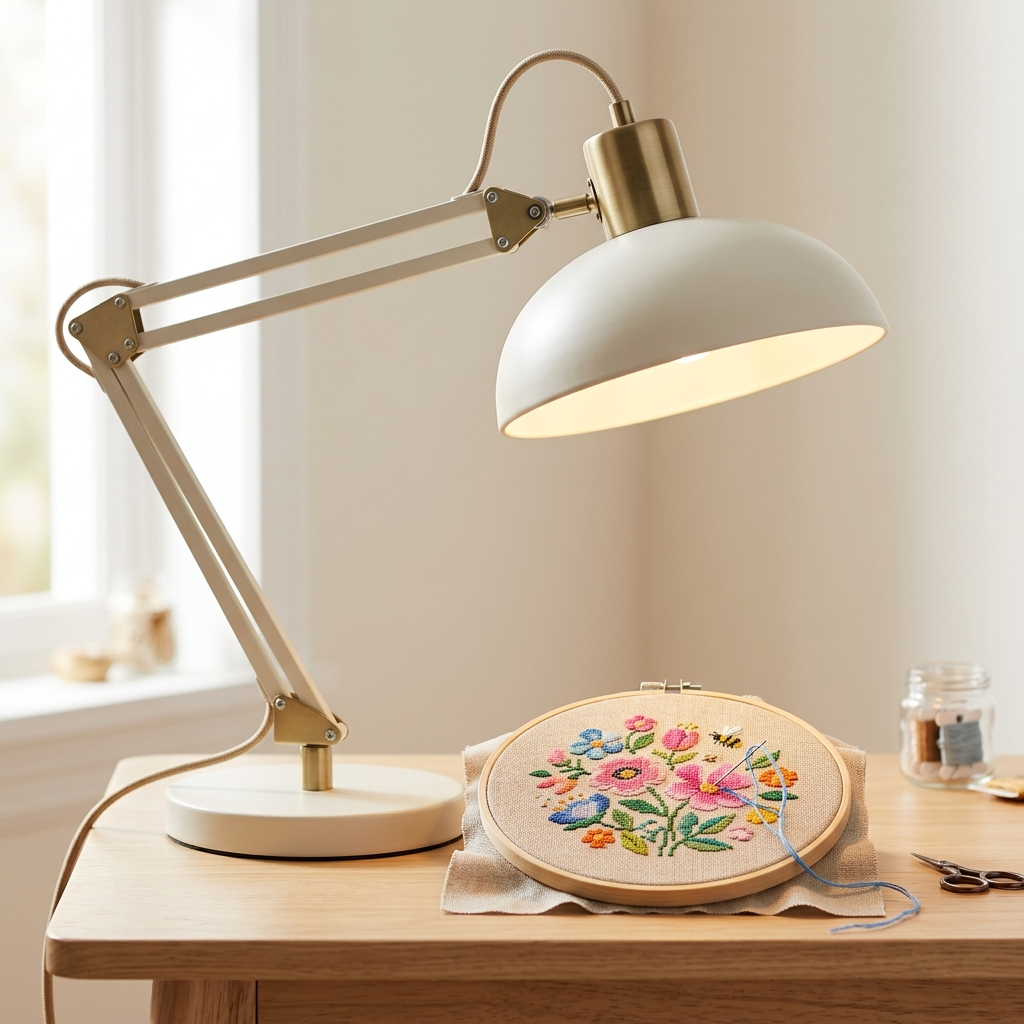
For evening stitching, or for rooms where the natural light is simply insufficient, a dedicated craft lamp is the single best upgrade you can make to any stitching space. I am talking about the kind that replicates natural daylight spectrum — the OttLite-style lamps that are specifically designed for needlework and craft. The difference between stitching under one of these and stitching under a standard household lamp is not subtle. Thread colors match the way they are supposed to match. Your eyes do not tire at the rate they would otherwise. You can stitch longer and more accurately. I consider a good daylight craft lamp non-negotiable regardless of where I am stitching — whether it is my living room chair, a corner of the bedroom, or, someday, that screened-in back porch. Everything else about a stitching space is negotiable. Light is not. The perfect stitching space is wherever the light is good, the seat is comfortable, and you have your project in front of you. Everything else is extra.
Get Stitching Tips & New Patterns from Tracey
Honest advice, new Sunrays designs, and occasional VIP-only offers. No fluff.
No spam. Unsubscribe any time.
Tracey Recommends
OttLite Natural Daylight Craft Lamp
The single upgrade that improves every stitching space — whether you are working in a dedicated craft room or a corner of the bedroom. The natural daylight spectrum means true color accuracy for thread matching and zero eye strain during long sessions. I have stitched under standard household lamps and I have stitched under a proper daylight craft lamp, and the difference is not subtle. Your eyes will thank you after an hour; your finished work will thank you after a project. This is the one tool I consider non-negotiable regardless of where I am stitching.
See on AmazonYour perfect stitching space exists right now — it is the one where you are sitting with good light and a project you love. I am still working toward my screened porch and my ceiling fan and my pitcher of lemonade, and I am completely at peace with that because I know what I need to stitch well and I carry it with me wherever I go. If you are looking for a project worth settling into whatever space you have, come browse the patterns at Sunrays Creations — there is something in the shop for every stitcher, every style, and every corner of the house you have claimed as your own.
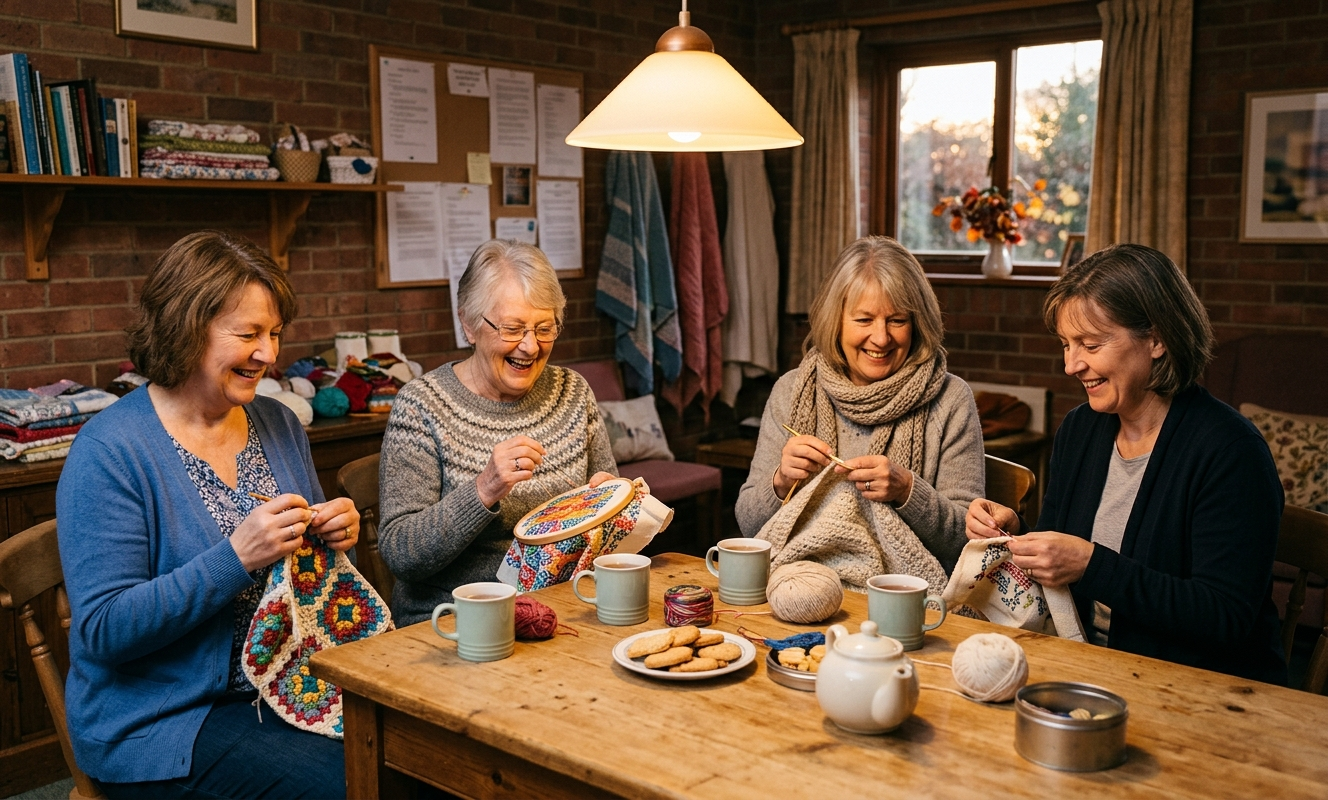
Women gathered around a table in a church hall stitching and crocheting together at a monthly craft group
Keep Reading
Craft Room vs. Craft Closet: Which One Do You Need?
This article plants the dream — that one helps you build it. If you are ready to think seriously about a dedicated stitching space, this is your next read.
READ THE GUIDECraft Supply Organization Ideas
Once you are inspired about your space — whether it is a whole room or a well-packed bag — organization is the next logical step. Practical ideas for both home and portable setups.
READ THE GUIDECross Stitch Tips for Beginners
New to stitching and still figuring out where and how to set yourself up? This guide covers the fundamentals, including how to make any space work for your first projects.
READ THE ARTICLEFrequently Asked Questions
Do I need a dedicated craft room to cross stitch seriously?
Not at all. As covered in the body of this article, some of the best stitching happens in improvised spaces — a living room chair, a kitchen table, even a doctor's waiting room. Light and comfort matter far more than a dedicated room.
What is the most important thing to have in any stitching space?
Good light — it is the one non-negotiable Tracey identifies after 30+ years of stitching. See the full section on natural light and daylight craft lamps for details.
How do I stitch on the go without losing supplies or damaging my project?
A well-organized project tote bag and an embroidery hoop carry case are the key tools discussed in the portable stitching section. Keep the bag packed and ready at all times.
Are there stitching groups I can join if there is nothing local near me?
Yes — online Zoom stitching sessions, Instagram communities, and Facebook groups all exist for exactly this purpose, as covered in the social stitching section.
What kind of lamp is best for cross stitch?
A natural daylight spectrum lamp — the OttLite style — is the recommendation covered in detail in the lighting section. It reduces eye strain and gives true color accuracy for thread matching.
What should I keep in my portable cross stitch bag?
As described in the portable stitching section: scissors, needles, a needle threader, your current project, the chart, and a small bobbin case with the colors you are working with.
-- Tracey Kramer
Founder & Designer, Sunrays Creations Needlearts
Hand-charted designs since 2004 • Marysville, Ohio