
Why Cross Stitch Is So Addictive (A Love Letter)
Posted by Tracey M. Kramer on 15th Oct 2018
A Note from Tracey Kramer
I have been stitching for over thirty years and I still feel the same giddiness opening a new kit that I felt the very first time. This article is my honest attempt to explain why — to stitchers and to anyone who has ever watched us and wondered what on earth we are so excited about.
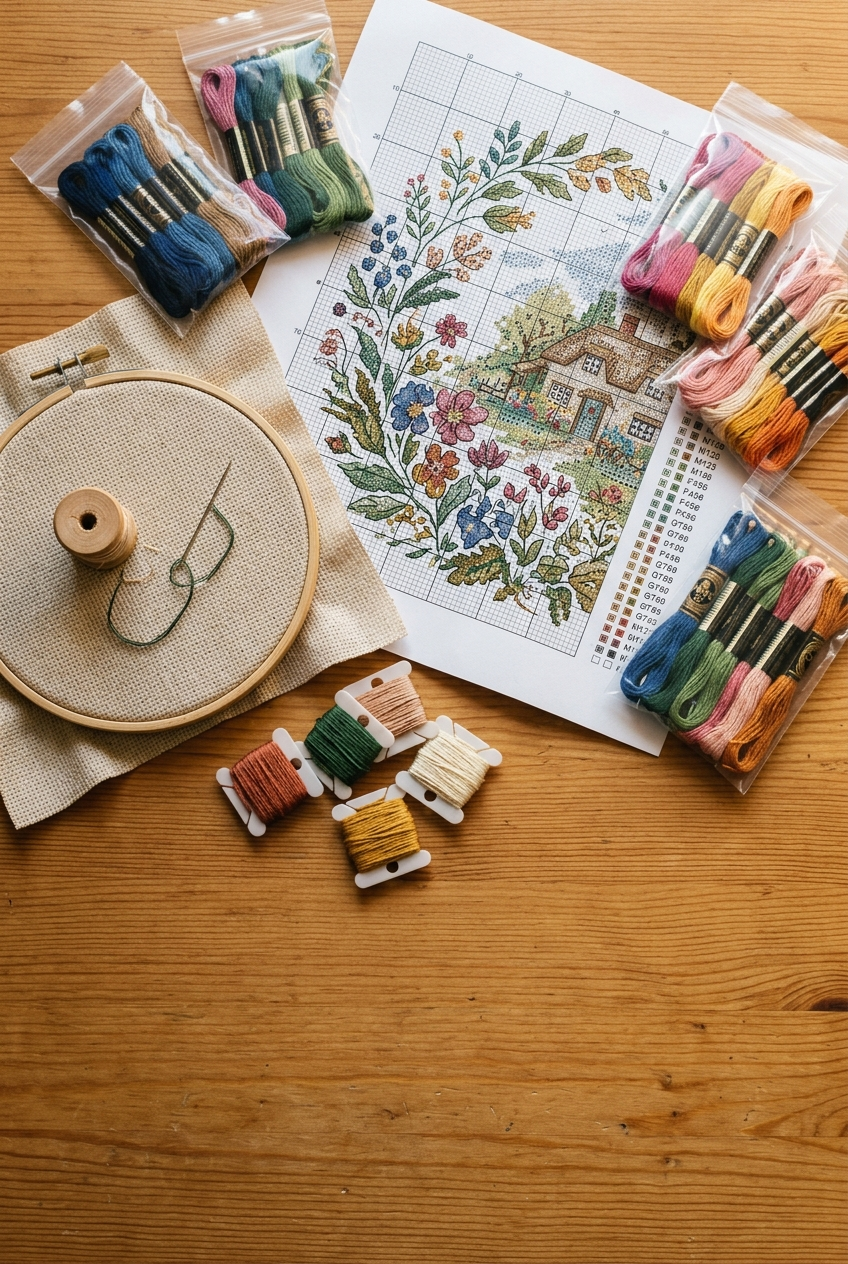
Cross stitch kit opened on a wooden table with DMC floss bags and floral pattern chart in morning light
By Tracey Kramer • • 12 min read
If you have never been a cross stitcher, you probably look at us and think we are a calm, quiet, patient sort of people. And maybe we are, in the middle of a project. But you should see us at a needlework shop, or standing at the mailbox, or hovering over an eBay listing at eleven o'clock at night. We are not calm. We are obsessed. Lovingly, joyfully, completely obsessed — and most of us would not change a thing.
I have been stitching since the early 1990s, and in all that time the feeling has never gone stale. The craft has grown with me. The projects have gotten more ambitious. My stash has grown to fill an entire walk-in closet, with room to spare. And yet every time I open a new pattern, thread a new needle, or sit down at the end of a long day with my hoop in my lap, it feels exactly like coming home. That is not an accident. There is something built into this craft that keeps pulling you back — and I want to try to name every part of it.
This is not a how-to article. I am not going to tell you what count of Aida to use or how to do a quarter stitch. This is a love letter. It is for everyone who already stitches and wants to feel understood, and for anyone on the edges who is curious about why the rest of us are so far gone. Come on in. The water is warm.
The Anticipation: Wanting It Before You Have It
It starts before a single stitch is made. For years, it started at the mailbox. Going out to get the mail used to be an event in my house — still is, if I am honest — because in that stack of bills and grocery circulars and things nobody asked for, there was occasionally a cross stitch catalog. And the moment I spotted it, everything else in that pile ceased to exist. I would bring the whole stack inside and set the rest of it on the counter unread while I sat down with that catalog like it was a letter from an old friend.
Every page gets examined. Certain designs get bookmarked — dog-eared if it is a physical catalog, favorited if it is online. A short list forms. Then the short list quietly becomes a longer list because, well, you cannot just order one. The justifications come naturally: this one would make a beautiful gift, that one is exactly the right size for the bathroom wall, this other one I simply cannot live without. Then comes the order. And then comes the waiting. I have checked my mailbox more times than I can count in the forty-eight hours after placing a cross stitch order. Each time I go out and find it has not arrived yet, there is a genuine pang — a small disappointment that is almost funny, except that it is completely real. It's like waiting to see someone you love.
The modern version of this is the email notification. I follow designers I admire on Instagram, and sometimes I am in the middle of something else entirely when a new design stops my scroll cold. Something about the colors, the subject, the level of detail — and suddenly I am in the same state I was in flipping through that catalog thirty years ago. The wanting is identical. What has changed is how fast you can act on it. Digital downloads solved the waiting problem entirely. You see it, you want it, and within sixty seconds of clicking the link the pattern is on your screen and printing before the impulse has even had a chance to cool. That immediacy is its own specific thrill, and it is a real part of why I made sure Sunrays Creations offers digital PDF downloads alongside printed patterns. The urge is real. It deserves to be met.
I want to be clear that the waiting itself is not entirely bad. There is something sweet about the days between ordering and receiving — a sustained excitement that keeps the project feeling special before it has even begun. But I will not pretend the digital download is a lesser experience. It is a different one. The anticipation compresses into a single bright flash of satisfaction, and then you are already printing and planning and your scissors are already in your hand. Both versions are wonderful. Cross stitch is full of these small pleasures that compound on each other, and it all starts here — with wanting.
The Acquisition: New Kits, Jackpot Stashes, and eBay Lots
There is a ritual to opening a new kit that I do not think gets talked about enough. The slight resistance of the packaging. The way a new kit smells — fresh fabric and cardstock and the faint waxy scent of new floss. The small labeled bags of sorted thread, each one a specific DMC number waiting to become part of something. The pattern chart, rolled or folded, unrolled for the first time and held up to the light so you can take in the whole design at once. I do this every time. It never gets old. Before I stitch a single cross, I lay everything out. I sort the floss by DMC number, wind each skein onto bobbins, label them, and clip the chart to my stand. The preparation is part of the pleasure. The anticipation that built for days or weeks does not release all at once — it releases slowly, deliberately, through the ritual of getting organized and ready to begin. Some stitchers tell me they find the setup as satisfying as the stitching itself. I understand that completely.
But there is a completely different kind of acquisition thrill that veteran stitchers know — and it is one that the beginning stitcher has not discovered yet. I am talking about the inherited stash. When a relative can no longer hold a needle. When a neighbor is downsizing a sewing room built over thirty years. When a garage sale table turns out to hold someone's entire cross stitch life packed into a single cardboard box. This is not shopping. This is something else entirely. You are not just acquiring supplies — you are being trusted with someone's passion. A stash that passes from one stitcher to the next carries something the original owner would have wanted: for those kits to be finished, for those threads to be used, for that work to carry on in someone else's hands.
I have hit jackpots this way, and so has my family. A box that looks completely ordinary from the outside opens to reveal a full floss collection sorted by number, vintage kits in their original unopened packaging, half-finished projects on hoops that were set down by hands that simply got too unsteady to continue. My wife experiences the same thing with yarn — crocheters who can no longer hold the hook but cannot bear to throw a lifetime of craft away pass it to someone they trust will use it. This is makers taking care of each other across generations. It is one of the most generous things I have witnessed in this community, and every time it happens I feel the weight of it. I sit in the middle of someone else's stash and I think: I am going to finish what you started. That is a privilege.
eBay lots are the digital version of exactly this same thing. Someone liquidating a loved one's stash. A stitcher downsizing before a move. Decades of collecting finding its way to the right next owner through a listing with bad photographs and a description that does not do justice to what is actually in the box. Searching for cross stitch kits lot (find on eBay) on eBay is not just a deal — it is a discovery. You never fully know what you are getting until it arrives, and that is part of what makes it so compelling. The same giddiness that hits at the mailbox hits when a mystery lot lands on the doorstep. If you have never shopped eBay for cross stitch supplies, you are missing one of the great stash-acquisition experiences this hobby has to offer. I say this as someone who has a walk-in closet full of evidence.
Whether it comes from a catalog order, a shop, a garage sale, or an eBay lot, the cross stitch project pattern organizer binder you use to keep track of all of it becomes essential fast. I cannot tell you how many times I have gone looking for a specific chart and had to dig through a drawer before I had a system in place. Now everything has a home. The hunt is more fun when you know where to look — and when your stash is large enough to get genuinely lost in, organization stops being optional.
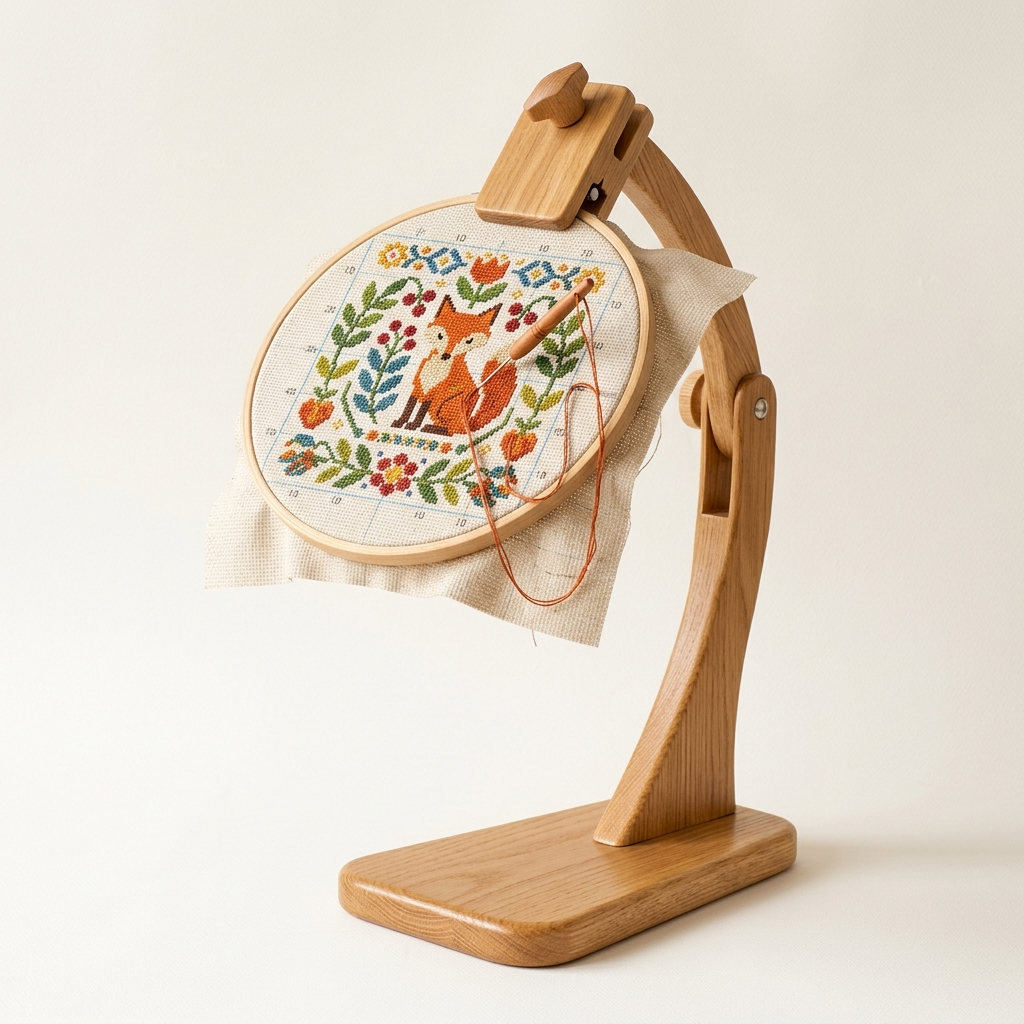
Tracey Recommends
Cross Stitch Lap Stand or Floor Stand — Both Hands Free
When you are in the zone on a large project, holding the hoop for hours is the one thing that breaks the spell. A good lap stand or floor stand solves it completely — your tension stays consistent, your pace increases, and your shoulders thank you by morning. I use one for any project that deserves a serious sit-down session.
See on AmazonIt's like waiting to see someone you love. And when it finally arrives — the giddiness of beginning is worth every impatient trip to the mailbox.
The First Stitch: Courage, Blank Fabric, and the Parking Method
There is a specific kind of giddiness that comes with beginning a new project — especially a challenging one, when you are ready for it. The blank Aida stretched across the hoop with nothing on it but a pencil mark at the center. Threading the needle for the first time on a new chart. Choosing your starting color. Making the first cross and stepping back to look at it — one tiny X on a field of white — and knowing that somewhere underneath all that blank fabric, the finished design is already waiting. You just have to uncover it, one stitch at a time.
For the first two hundred stitches, most projects look nothing like the picture on the chart. It is just a small scatter of color on white fabric, a few dozen crosses that could be anything. Then something shifts. The image begins to emerge. Shapes form. A color you could not figure out in the chart suddenly makes perfect sense in context. This is the moment I think about when I am picking up a brand-new project — not the finished piece, but that moment when it clicks into focus. Every project has it. I have never stitched one that did not.
I will be honest with you: some projects get set aside for the day when I have enough courage to tackle them. I have a few of those right now. They are beautiful, ambitious, and slightly terrifying — the kind of designs where you look at the color count and take a deep breath. Every serious stitcher has at least one project like this. It sits in the drawer and waits, patient as anything, while you work up to it. The thing that changed everything for those intimidating projects — for me and for a lot of stitchers I know — is the Parking Method. Instead of looking at the full canvas and feeling overwhelmed by every color simultaneously, you work one color at a time across the entire canvas, parking your threaded needles as you go and picking them back up on the next pass. The chaos organizes itself. The intimidating project becomes something you can actually navigate. The courage required turns out not to be the grand kind — it is just the willingness to begin one color at a time, and trust the process.
A good cross stitch pattern organizer binder (find on Amazon) is what keeps me sane during those complex, multi-color projects. When I am working a canvas with forty or fifty DMC colors and I am parked across a dozen of them at once, I need my chart notes, my color key, and my progress tracking all in one place. If you are new to complex projects, do yourself a favor and get a system in place before you start. The stitching itself is meditative — your organization should be too, so it never interrupts the flow.
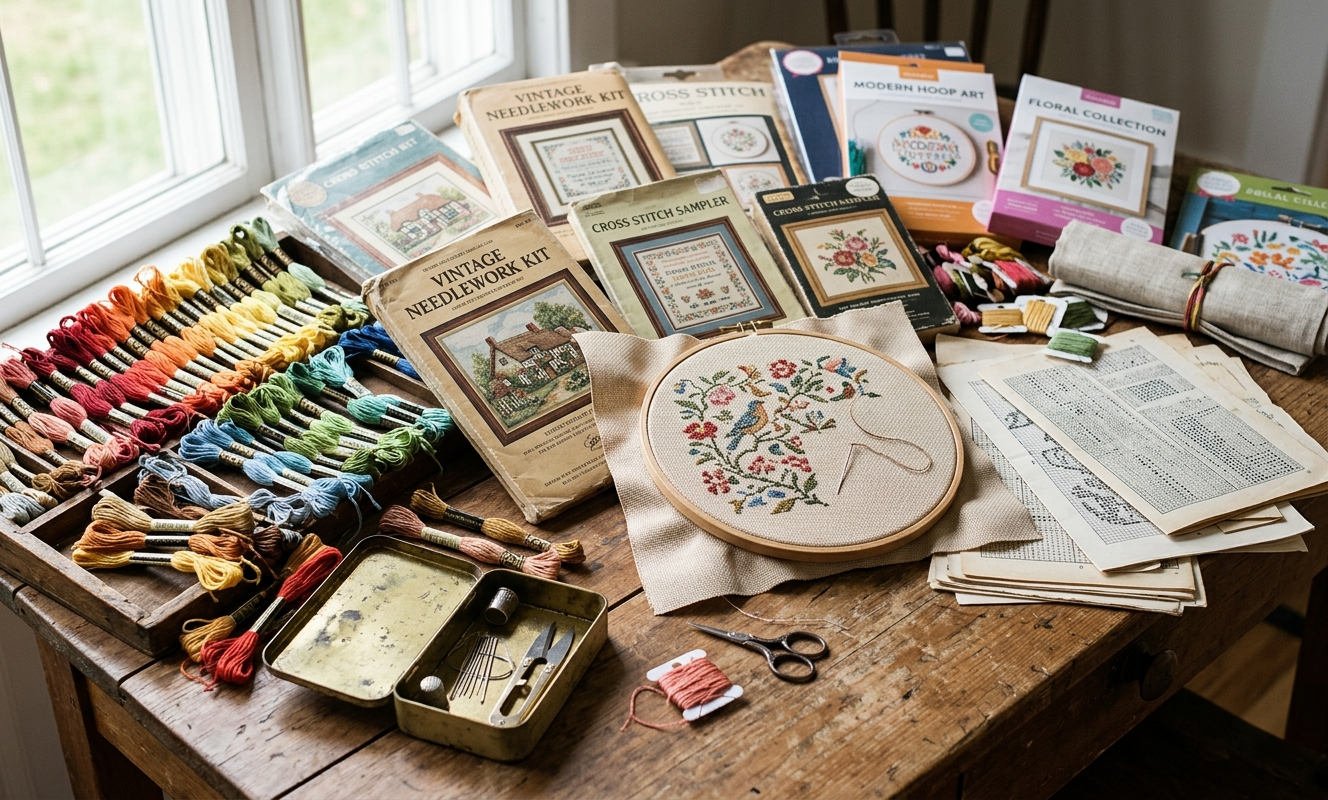
Vintage and new cross stitch kits spread across a wooden table like a discovered stash treasure in warm natural light
The Zone: Why You Can't Put It Down
I can pop in a good movie, sit in my favorite chair and pick up where I left off because I've used the Parking Method. This is one of the things I try to explain to people who have never stitched — cross stitch requires just enough concentration to crowd out everything else, but not so much that it exhausts you. You are counting, placing, following, checking. Your hands are busy. Your eyes are moving between the fabric and the chart. There is no room in that mental space for whatever was worrying you before you sat down. The anxiety gets filed away while you work. That is not an accident of the craft — that is the craft.
After a long and stressful day, picking up my hoop is the fastest reset I know. It is not passive rest — I am doing something, I am making something, I am making visible progress on something that matters to me. That distinction is important. Watching television is passive; it lets the noise in as easily as it lets it out. Stitching engages just enough of me that the noise cannot get in. I find I can divide my concentration equally between what is on screen and what is on my canvas in a way that feels natural and balanced. I have finished entire seasons of shows while working on a single large project. I do not think I could have sat still for those shows without the stitching. They needed each other.
Yes, God even works through our crafts to help us stay sane in an insane world. I mean that plainly. I have had evenings where I sat down to stitch with nothing but tension in my shoulders and stood up an hour later genuinely at peace. Something in the rhythm of it — the repetition, the small satisfactions accumulating one after another, the visible progress — works on a person in a way that I can only describe as grace. I am not the first stitcher to feel it. I will not be the last.
The other thing about being in the zone is the tangible progress. In a world where so much of our work is invisible — emails sent, meetings held, tasks checked off a list that fills back up immediately — watching a design emerge stitch by stitch is profoundly satisfying. When I take my highlighter and mark off a completed section on the pattern chart, I feel it in a way that checking a digital task box never gives me. The work is visible. It is accumulating. You can hold it up to the light and see what you have done. For long sessions in the zone, a good lap stand or hoop stand makes an enormous difference — when both hands are free, your tension stays consistent and your pace increases naturally. A quality OttLite keeps the colors true when the natural light fades. These are the tools that make staying in the zone possible for hours at a stretch, not just minutes. A needle minder for cross stitch (find on Amazon) keeps your spare needle from vanishing into the couch cushions — small thing, but when you are deep in a project, you do not want to break the spell looking for a needle.
|
Patterns from the Sunrays Collection Tracey's Picks, designing cross stitch patterns since 2004 |
|||||
|
|||||
| Browse the full Sunrays collection → |


The Finish — and Why You Are Already Starting the Next One
The last stitch. There is nothing quite like it. You make that final cross, you secure the thread on the back, and then you hold the finished piece up to the light and look at what weeks or months of patient work became. The colors you agonized over, the section that fought you for three sessions, the corner you had to frog twice — all of it resolved into something whole and beautiful and entirely yours. If it is going to the framer, you carry it carefully, maybe wrapped in acid-free tissue, with a specific kind of pride that is very quiet and very real. If it is a gift, you think about the face of the person who will receive it. These projects become heirlooms. I have seen that happen. A finished piece goes into a frame and forty years later it is still hanging in the same house, or it has been passed to the next generation with the story of who made it. You stitched something that will outlast you. That is not nothing. That is everything. And if you need a fresh set of small embroidery scissors (find on Amazon) to finish trimming those last tails cleanly — because yours have gone mysteriously missing, as scissors always do — go ahead and treat yourself. You earned it.
But here is the thing about finishing: it does not feel like an ending. It feels like a beginning. Almost before the last stitch is secure, there is a familiar itch — a reaching toward the stash, a mental scan of what is waiting, an awareness that the next project has been patient long enough. Cross stitchers always have a WIP pile and a wish list because finishing one project creates a craving for the beginning of the next. This is the cycle, and it is the point. The collector in me means my stash is always larger than my project queue, and I am not apologetic about that. Those kits sitting in my walk-in closet are not clutter. They are potential. They are waiting for the right moment, the right mood, the right season. Some of them I have owned for years and have not touched yet — and when I finally open them, it will be exactly the right time, and I will know it.
Sunrays Creations exists because I design the patterns I want to stitch myself — animals, botanicals, Victorian portraits, landscapes — the more realistic the better. Everything in the shop is hand-charted, original, and made with the same love for the craft that has been driving me since the early nineties. If you are browsing and something catches your eye, do not overthink it. A digital download means you can have it in sixty seconds. The urge does not have to wait. Go find your next obsession — I made it for you.
Get Stitching Tips & New Patterns from Tracey
Honest advice, new Sunrays designs, and occasional VIP-only offers. No fluff.
No spam. Unsubscribe any time.
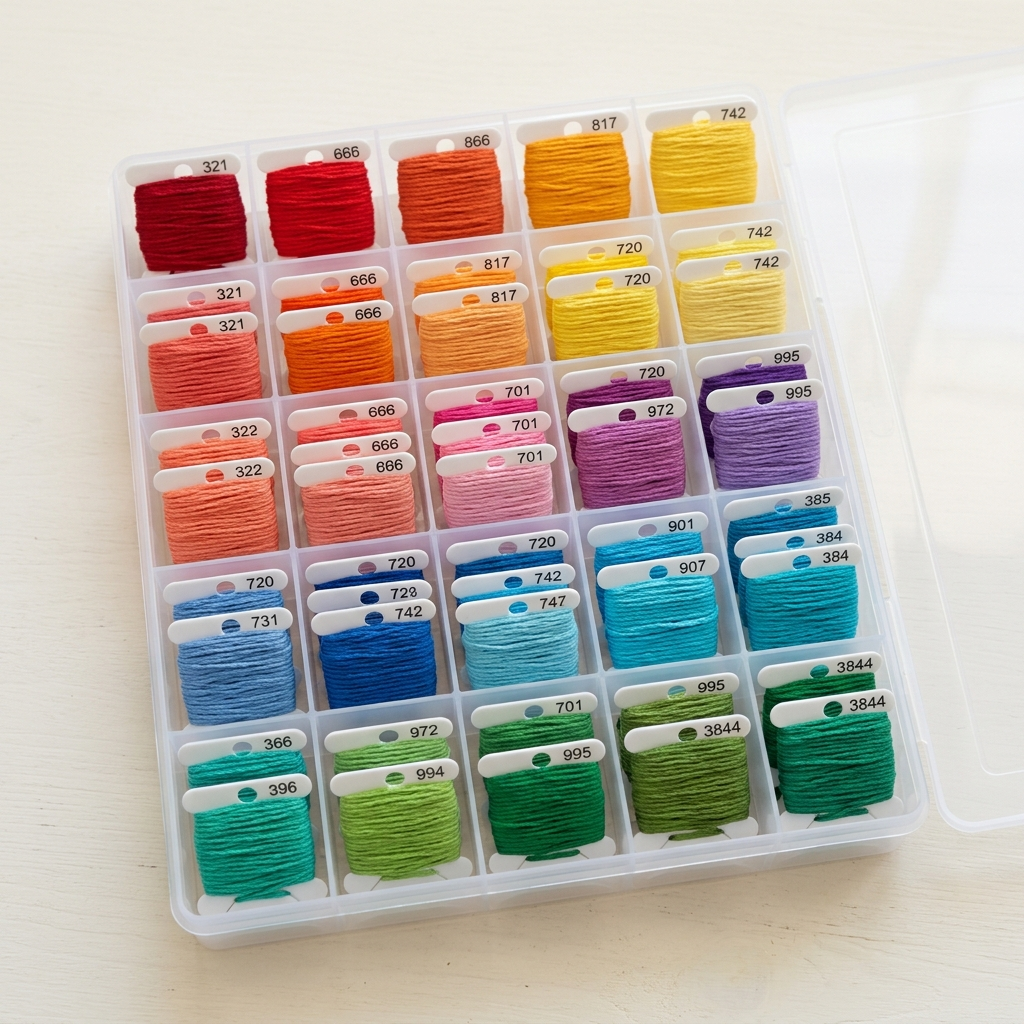
Tracey Recommends
DMC Plastic Bobbins and Floss Storage Box Set
The opening ritual deserves a proper system. Winding each new skein onto a labeled bobbin before the first stitch is part of the pleasure — and it means your stash stays organized and ready for whatever project begins next. Once you start bobbin-winding you truly cannot go back to tangled skeins.
See on AmazonThirty-plus years in and I am still the person hovering at the mailbox, still the one who stops cold mid-Instagram-scroll when a design hits just right. I do not think that ever changes, and I would not want it to. If any part of this felt familiar — the obsession, the stash, the giddiness, the zone — you are my people. Come browse the pattern collection at Sunrays Creations and find what you need to start your next love affair. If something catches your eye right now, a digital download means you can have it in sixty seconds. The urge does not have to wait.
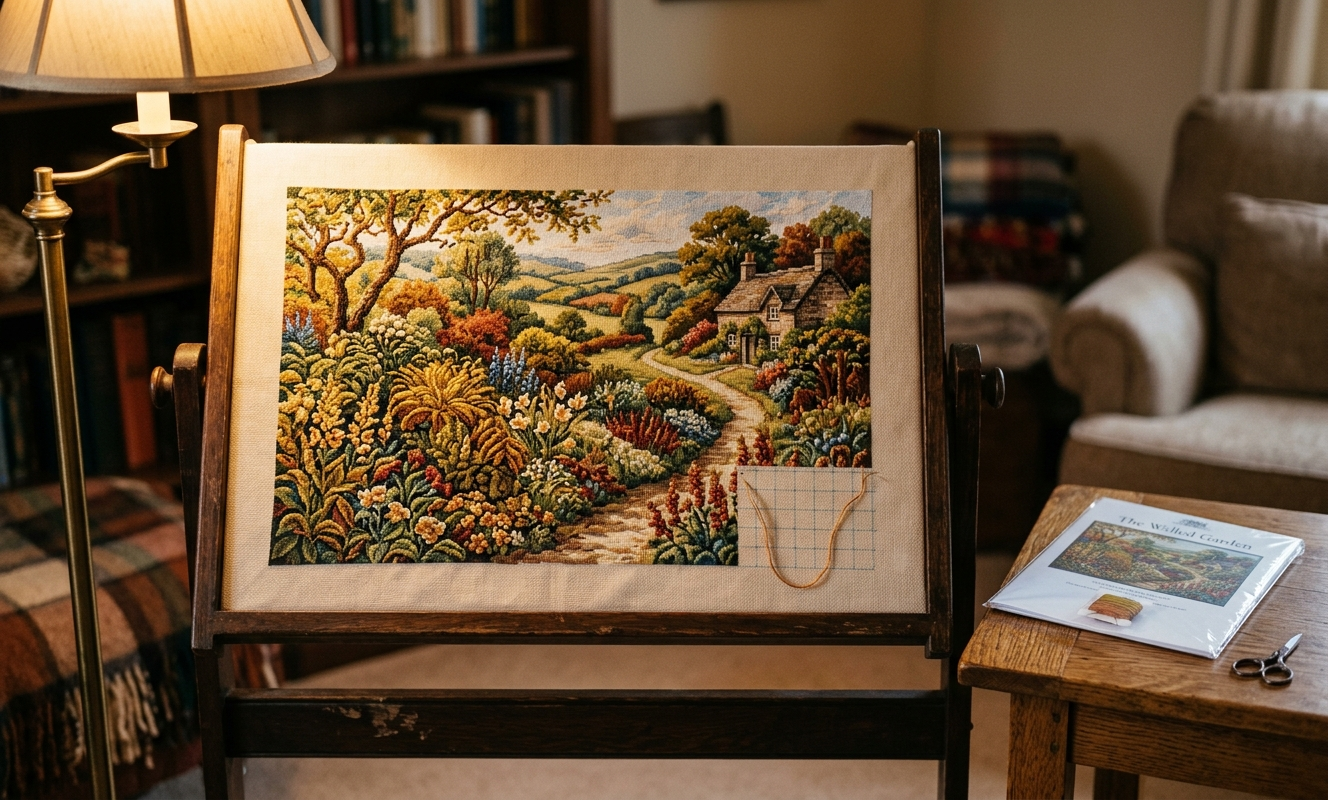
Large cross stitch nearly finished in a floor stand under warm lamp light with a new kit waiting beside it
Keep Reading
The Parking Method in Cross Stitch
The technique that makes intimidating large projects actually manageable — work one color at a time across the entire canvas and never feel overwhelmed again.
READ THE GUIDECross Stitch Floss Storage — How to Organize Your Stash
Once your stash grows — whether from your own collecting or an inherited windfall — you need a system. Here is how to build one that actually works.
READ THE GUIDEIt's in the Blood — My Love for Cross Stitch and How It All Began
The origin story. Where the obsession started, who passed it down, and why thirty years later it still feels exactly the same.
READ THE ARTICLEFrequently Asked Questions
Why is cross stitch so addictive?
It hits a specific emotional rhythm at every stage — the wanting, the acquiring, the starting, the meditative zone, and the pride of finishing. The body sections above name each of those stages in detail.
Why do cross stitchers get so excited about catalogs and new patterns?
The anticipation of a new design — whether from a catalog, an email notification, or a digital download — carries a genuine emotional charge that veteran stitchers describe as similar to waiting to see someone you love. See the first section for more.
What is the Parking Method and why does it help with hard projects?
The Parking Method lets you work one color at a time across the entire canvas, parking threaded needles as you go. It makes complex, intimidating projects feel manageable. The third section covers it in full, with a link to the complete guide.
Is it worth buying cross stitch kits in bulk lots on eBay?
For stash-building stitchers, eBay lots are one of the best finds in the hobby — often the contents of an inherited or downsized collection, full of vintage and hard-to-find kits. The acquisition section covers this in detail.
How do I organize a large cross stitch floss stash?
Winding onto labeled DMC bobbins sorted by number is the foundation of a good system. The acquisition section touches on this, and the full floss storage guide is linked in the internal links section below.
Is cross stitch good for stress and anxiety?
Many stitchers — including Tracey — find it genuinely therapeutic. The counting and repetition crowd out anxious thoughts without exhausting you. Section four covers the meditative pull of the craft in full.
-- Tracey Kramer
Founder & Designer, Sunrays Creations Needlearts
Hand-charted designs since 2004 • Marysville, Ohio