
Cross Stitch Fabric Guide: Aida vs. Linen vs. Evenweave — Which Is Right for You?
Posted by Tracey Kramer on 8th May 2026
A Note from Tracey Kramer
After 22 years of designing cross stitch patterns from our Marysville studio, I've learned that the best guides come from real stitching — not theory. This is what I'd tell a friend.
Cross Stitch Fabric Guide: Aida vs. Linen vs. Evenweave — Which Is Right for You? | Sunrays Creations
If you've ever stood in a craft store staring at bolts of fabric wondering which one will actually work for your cross stitch project, you're not alone. The short answer: for most stitchers, especially beginners, 18-count Aida is the right cross stitch fabric because it has clearly defined holes, a stable weave, and produces crisp framed wall art every time. After 22 years of designing patterns and running Sunrays Creations, I've stitched on all three major fabric types, and I want to walk you through what actually matters when you're choosing.
Why Fabric Choice Matters More Than You Think
When I first started stitching decades ago, I thought fabric was just fabric. You poke a needle through it, you make an X, you move on. I was wrong, and I learned the hard way after a few projects that fought me from the first stitch to the last.
The fabric you choose affects three things that will determine whether you finish a project or shove it in a drawer: visibility of the holes, finished size of the design, and how your eyes feel after an hour of stitching. Get the fabric right and stitching becomes meditative. Get it wrong and you'll be squinting, frogging, and wondering why you ever picked up a needle.
Every pattern I design at Sunrays is charted for 18-count Aida and finished as framed wall art. That's not arbitrary. It's the result of two decades of watching what works for stitchers at every level, from someone picking up their first needle to a seasoned BAP-stitcher tackling a 200,000-stitch reproduction.
The three fabrics you'll see most often
Walk into any cross stitch shop or scroll through any stitching site and you'll see the same three categories: Aida, linen, and evenweave. They all let you stitch counted cross stitch, but they behave very differently under your needle. Let me break down each one the way I wish someone had broken it down for me.
Aida Cloth: The Workhorse Fabric
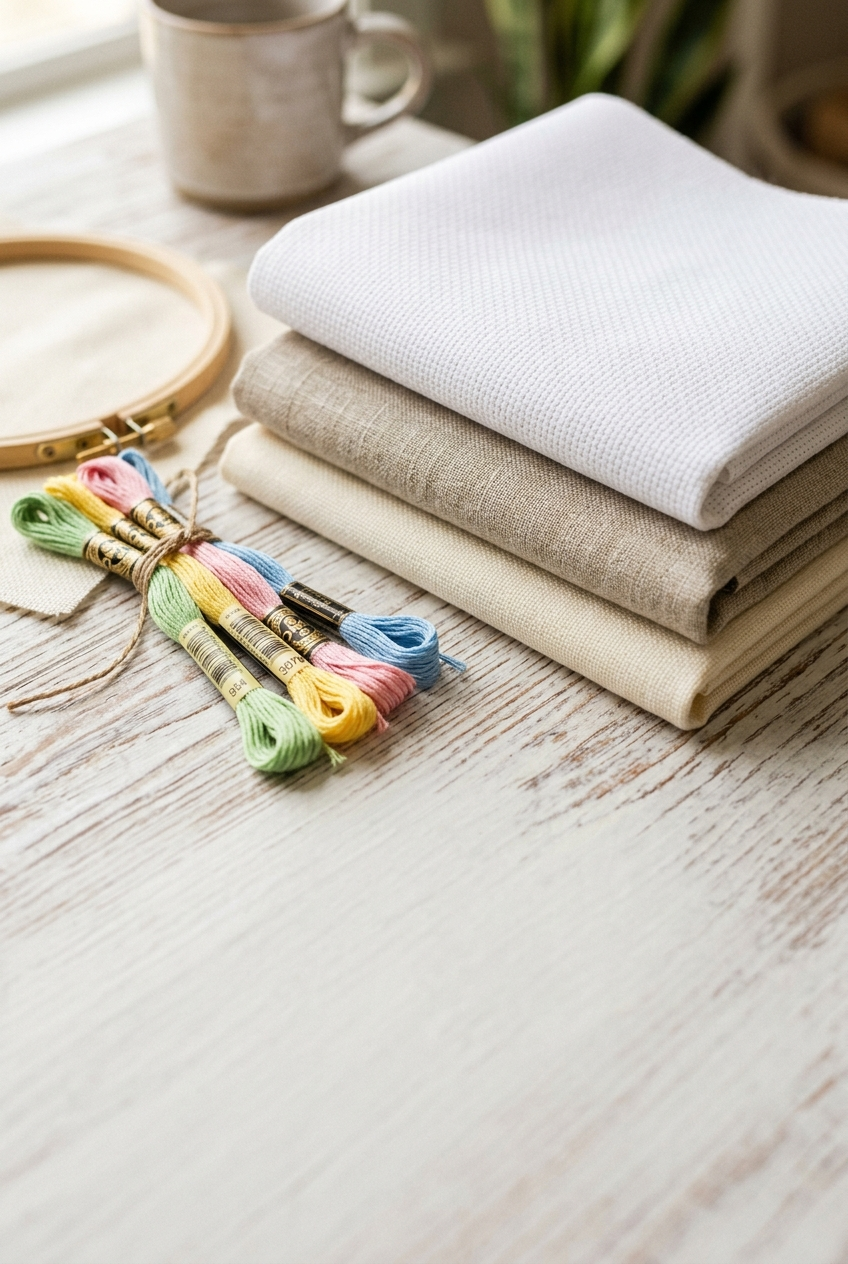
Aida is the fabric I design on, the fabric I stitch on, and the fabric I recommend to every single beginner who asks me where to start. It's woven in a basketweave pattern that creates obvious, visible holes at every intersection. You can see exactly where your needle goes. There's no counting threads, no squinting at a smooth weave trying to figure out if you're in the right spot.
Aida comes in different counts, and the count refers to how many stitches you get per inch. The higher the count, the smaller the stitches and the more detail you can fit into a design.
Why I design exclusively for 18-count Aida
I've stitched on 11-count, 14-count, 16-count, 18-count, and 22-count over the years. Eighteen-count is my sweet spot, and here's why it's the standard for every Sunrays pattern.
Eleven-count is too chunky for the level of detail my designs carry. Fourteen-count is the most common beginner fabric, but the stitches feel a little oversized for fine-art reproductions and detailed scenes. Sixteen-count is fine, but the jump to 18-count gives you noticeably more refinement without making the holes too small to see comfortably.
At 18-count, you're using two strands of DMC six-strand floss - (find on Amazon), and the coverage is gorgeous. The X's lay flat and full. The finished piece looks like the design I drew, not a pixelated approximation of it. When I frame a finished 18-count piece behind glass, the detail holds up at viewing distance and rewards the close-up look too.
What Aida feels like to stitch
Crisp. Predictable. Forgiving. The holes are obvious enough that you can stitch while watching a movie or chatting on FlossTube without losing your place. If you make a mistake, frogging is straightforward because you can see exactly where each leg of each X went in.
For dark designs, black 18-count Aida is its own challenge, but with the right tools it becomes very manageable. I've written about that elsewhere on the blog if you want to dig in.
Linen: Beautiful, But Not for Beginners
Linen is the fabric a lot of stitchers graduate to once they've got Aida down and they're chasing a softer, more historical look. I'll be honest with you: linen is gorgeous when finished and framed. It has a natural texture, a subtle slubby character, and an old-world quality that Aida simply can't replicate.
But linen is not beginner fabric, and I want you to know that going in.
How linen works
Linen is woven from individual flax threads in a plain weave, which means the threads cross over and under each other one at a time. There are no obvious holes. To stitch on linen, you have to count threads, usually working over two threads for each stitch. So a 28-count linen, stitched over two, gives you the same finished size as 14-count Aida.
That over-two technique is what makes linen feel intimidating at first. You're not aiming for an obvious hole, you're aiming for a specific intersection of threads, and on a smooth weave that takes practice. Many stitchers also find that linen has more variation in thread thickness, which can make some stitches sit higher or lower than others.
When linen makes sense
If you've stitched a few projects on Aida, your tension is consistent, and you're drawn to sampler-style or historical reproduction designs, linen can be a beautiful next step. Just don't make it your first fabric. I've seen too many new stitchers buy a piece of 32-count linen, get overwhelmed within an hour, and walk away from the craft entirely. That breaks my heart, because cross stitch should hook you, not defeat you.
Evenweave: The Middle Ground
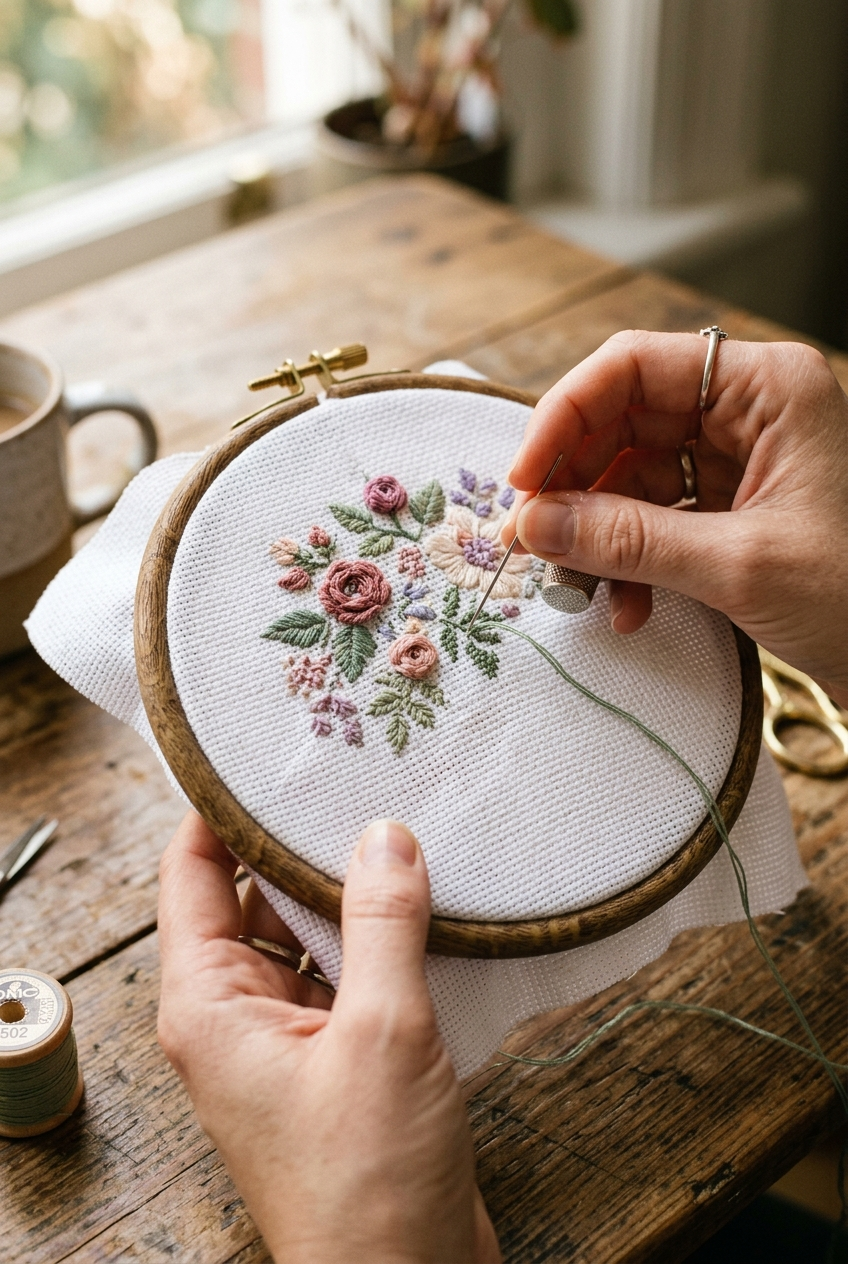
Evenweave -(find on Amazon), is exactly what the name suggests: a fabric where the threads are spun and woven evenly, with consistent thickness in both directions. It looks smoother than Aida but more uniform than linen. It's often made from cotton, modal, or a cotton-blend, and it comes in counts like 25, 28, and 32.
Like linen, evenweave is typically stitched over two threads. Unlike linen, the threads themselves are uniform, so your stitches sit more predictably. A lot of stitchers describe evenweave as the bridge between Aida and linen — easier to count than linen, prettier and more delicate than Aida.
Why I still come back to Aida
I've stitched on evenweave. It's lovely. But for the kind of detailed, fine-art designs I create at Sunrays, 18-count Aida gives me the visibility I want during stitching and the polish I want after framing. Evenweave is a personal preference fabric. If you fall in love with it, fantastic. If you never touch it, you're not missing anything essential.
What About Stamped or Pre-Printed Fabric?
You may have seen kits at big-box craft stores where the design is already printed onto the fabric and you just stitch over the printed X's. That's stamped cross stitch - (find on Amazon), and it's a different category from what we do at Sunrays. Counted cross stitch, which is what every Sunrays pattern is built for, uses a blank piece of Aida and a chart you read as you go. There's also needlepoint, which is a separate craft entirely on canvas, finished as pillows, chair seats and wall art. People mix the two up all the time, but they aren't interchangeable.
I mention this only so you know the landscape. Every pattern in our shop is counted cross stitch on plain Aida, finished as framed wall art. That's the lane we've stayed in for 22 years and it's the lane I know inside and out.
How to Pick the Right Fabric for Your Next Project
Here's the simple decision tree I give friends and customers when they ask.
- If you're new to cross stitch: buy 18-count Aida. White or ivory for most designs, black for designs with light or metallic threads on a dark background. You'll see your stitches, you'll finish your project, and you'll fall in love with the craft.
- If you've finished a few projects on Aida and you want to try something new: pick up a piece of 28-count evenweave and stitch a small design over two threads. See how it feels.
- If you're chasing a sampler look or historical reproduction: linen is calling your name, but go in with patience and a small project first.
One more thing about fabric prep
Whatever fabric you choose, prep it before you stitch. I always serge or zigzag the edges to stop fraying, and I press it gently before I hoop up. A few minutes of prep saves you a lot of grief 40 hours into a project when the edges have unraveled into your stitching area.
Pair good fabric with two strands of DMC floss, a 5- or 6-inch wooden or plastic embroidery hoop (find on Amazon), and a chart you actually love stitching, and you've got the foundation for a piece that'll hang on a wall for generations. That's the part I love most about this craft. The fabric is just the beginning.

Classic Reserve 18-Count Aida Cloth, 59 x 39 InchesThis is the size and count I recommend for almost every project. The large cut means you can fit a big design with generous margins for framing, and the 18-count weave gives you crisp, visible holes that make stitching feel like a relaxing flow instead of a hunt. White Aida is the most versatile starting point. → Shop on Amazon |

Caydo Wooden Embroidery Hoops, 3 to 10 Inch SetI've used wooden hoops for 22 years and they're still my go-to. This set gives you a range of sizes so you can match the hoop to the project, and the smaller hoops are perfect for working confetti-heavy areas where you want maximum tension. A 5- or 6-inch hoop is what I reach for most. → Shop on Amazon |
From the Sunrays Pattern Library
- Flowers in a Basket on a Marble Ledge, FL-30 → View Pattern
A fine-art floral that shows off everything 18-count Aida does best — rich color blending and crisp detail. - Emerald Archway, TR-04 → View Pattern
A perfect mid-size project for testing out a new piece of 18-count Aida. - Dismal Castle, AL-29 → View Pattern
An architectural design where the structured 18-count weave really makes the linework sing.
Keep Reading
Cross Stitch Fabric Types | How to Choose For Your Cross Stitch ProjectIf you want to go even deeper on fabric counts and which suits which design, this companion piece walks through specific examples. Read Article → |
The Best Way to Prepare Your Cross Stitch Fabric for StitchingOnce you've picked your fabric, prep it properly so your edges don't fray and your finished piece frames cleanly. Read Article → |
Cross Stitch for Beginners: Everything You Need to Start Your First Project TodayBrand new to the craft? Start here for the full kit list and first-project walkthrough. Read Article → |
Frequently Asked Questions
What is the best cross stitch fabric for beginners?
Eighteen-count Aida is the best fabric for beginners. The holes are clearly visible, the weave is stable, and you can stitch comfortably without counting individual threads. Pair it with two strands of DMC floss and you'll have a smooth first-project experience.
What is the difference between Aida and linen?
Aida has a basketweave structure with obvious holes at every intersection, so you can see exactly where to place each stitch. Linen is a plain weave with no visible holes, and you stitch over two threads at a time. Linen looks softer and more historical when finished, but it requires more experience.
What count Aida should I use?
For most patterns, 18-count Aida is the sweet spot. It gives you fine detail and a polished finished look without making the holes too small to see. Fourteen-count is a common beginner option but the stitches are larger and the design will finish bigger.
How many strands of floss do I use on 18-count Aida?
Two strands of DMC six-strand floss. Pull a length of about 18 inches, separate two strands from the six, and stitch with those two. The coverage is full and the X's lay flat without crowding the holes.
Can I use linen if I've never cross stitched before?
I don't recommend it. Linen requires you to count threads on a smooth weave and stitch over two, which is much harder to learn alongside the basics of cross stitch. Get comfortable on Aida first, then try linen if it appeals to you.
What color Aida should I choose?
White or ivory works for the majority of designs and lets the floss colors read true. Black or dark Aida is best when the design is meant to be stitched on a dark background, often for night scenes or designs with metallic accents. Always follow what the pattern recommends.
Do I need to wash or prep my fabric before stitching?
I always finish the edges with a serger or zigzag stitch to prevent fraying, and I press the fabric lightly before hooping. You don't need to wash quality Aida before stitching, but make sure your hands are clean and your workspace is free of food and lotion.
What is evenweave and how is it different from Aida?
Evenweave is a fabric with uniformly spun threads in a plain weave, usually cotton or a cotton blend. It's smoother than Aida but more consistent than linen, and it's stitched over two threads. Many stitchers see it as a bridge between Aida and linen.
Join the Sunrays stitcher's circle
New patterns, seasonal promos, and Tracey's studio notes — delivered to your inbox.
About Tracey Kramer: Tracey is the lead designer and co-owner of Sunrays Creations, a counted cross stitch business she has run from Marysville, Ohio for over 22 years. Her patterns are stitched in homes around the world and finished as framed wall art. Visit sunrayscreations.com to explore her pattern library.