
Easy Cross Stitch Patterns for Beginners That Actually Work
Posted by Tracey M. Kramer on 17th Jan 2018
A Note from Tracey Kramer
I taught both of my daughters to cross stitch, and everything I know about starting beginners right came from watching them succeed — and watching what happened when the pattern was wrong for the moment. This article is what I wish every new stitcher could read before they buy a single thing.
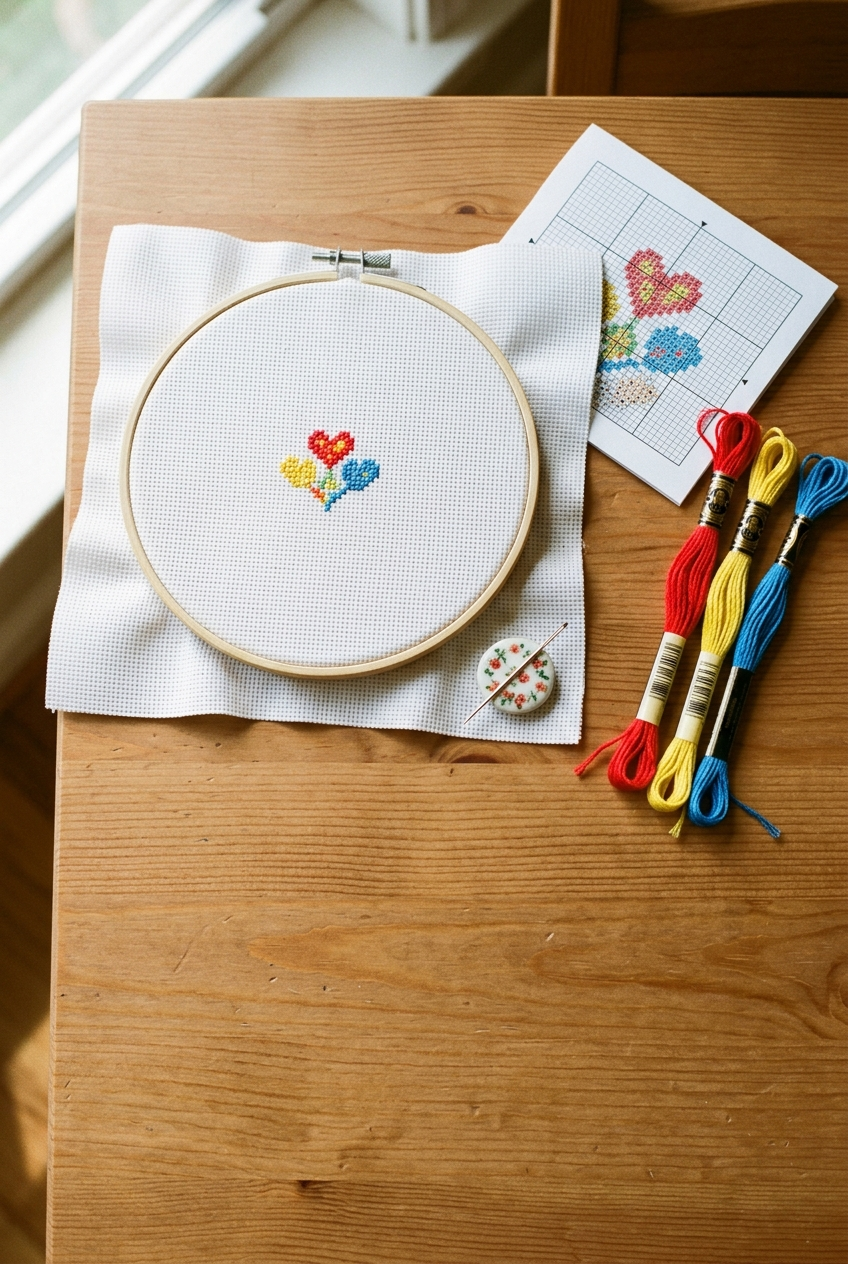
Beginner cross stitch setup with 14-count Aida hoop, printed pattern chart, and bright DMC floss skeins on wooden table
By Tracey Kramer • • 12 min read
I have been stitching for more than thirty years, and I have taught exactly two students from scratch: my daughters. Not strangers at a shop class. Not students in a structured setting with matching supplies and a handout. My own kids, at the kitchen table, with whatever I had on hand and the full weight of a mother wanting them to love something she loves. I can tell you with complete honesty that what determined whether they stuck with it or gave up was not talent, not patience, and not even interest. It was the pattern I put in front of them first.
That is the thing nobody talks about clearly when they write beginner guides. They tell you to buy Aida cloth and get some DMC floss and find a cute design you like. What they skip is the part where the wrong pattern — even a genuinely pretty one — will make a new stitcher feel stupid and defeated inside of an hour. The first finish is what hooks you. If you never get to a first finish, you never find out whether you would have loved this craft. So the pattern choice at the very beginning is not a small decision. It is the whole game.
What I want to do in this article is walk you through what actually makes a pattern beginner-friendly — not just shorter or simpler, but genuinely set up for a first win. Then I want to show you exactly where to find patterns like that, starting with free ones, moving into the designs I sell at Sunrays Creations Needlearts, and covering what to look for if you want to start with a complete kit. I also want to be direct about the traps, because there are several common mistakes new stitchers make that have nothing to do with skill and everything to do with starting conditions. Let's get into it.
What Makes a Pattern Actually Beginner-Friendly
When I sat down with my older daughter and handed her a pattern for the first time, I did not choose it because it was labeled 'beginner.' I chose it because I looked at it through her eyes. Small stitch count. Bold, cheerful colors. A chart that was easy to read without squinting or flipping back and forth between symbols. A design she could see herself finishing in one or two sittings. Those criteria are not arbitrary. Each one removes a specific obstacle that will stop a new stitcher cold.
The color count is probably the most overlooked factor. A true beginner-friendly pattern has fifteen colors or fewer — and ideally fewer than ten for your very first project. Every time you have to stop, find your place, switch to a new color, and reorient yourself on the chart, you are spending mental energy that should be going toward learning the actual stitch. A pattern with twenty-five colors sounds rich and exciting on the cover. At the table, it is exhausting and disorienting for someone who is still figuring out how to form a clean X.
Blended colors are another trap entirely. Blending means threading your needle with one strand of one color and one strand of a different color to create a transitional shade. It is a beautiful technique. It is also completely wrong for a first project. The results are harder to read, the thread tangles more easily, and the visual feedback you get as you stitch is muddier. You want the satisfaction of watching a solid color build into a clear shape. That visual feedback is what keeps a beginner motivated. Solid colors only for your first several projects — I am firm on this.
The fabric matters just as much as the pattern. Fourteen-count Aida cloth is the standard recommendation for beginners, and the reason is practical: the holes are large enough to see clearly, the weave is stiff enough to hold its shape without a hoop pulling it taut, and it takes a standard two strands of floss without puckering or looking sparse. Once you move to higher counts — 18, 22, 28 — the holes get smaller, the thread management gets trickier, and your eyes will tire faster. Evenweave and linen fabrics have their own beautiful qualities, but they require you to count over two threads instead of one, which doubles the opportunities for error. Start on 14-count Aida cloth (find on Amazon) and stay there until stitching feels automatic.
The chart itself has to be readable. A good beginner chart uses a clean grid, large clear symbols, a color key that stays on the same page as the chart, and enough contrast between the symbols that you can tell a circle from a square from a triangle without staring. If the chart is printed small, or if the PDF resolution is poor, you will spend as much time deciphering the chart as you will stitching. This is a real problem with some free patterns online and even a few commercial kits. Before you start any pattern, print or display the chart at a size where you can read it comfortably at arm's length. Your future self will thank you.
Start Free — No Money, No Risk, Just Real Patterns
One of the things I am genuinely proud of at Sunrays Creations Needlearts is that we have a free patterns category. I want to be clear about what that means, because 'free pattern' online can mean a lot of things — a blurry black-and-white chart someone scanned twenty years ago, a partial pattern with a watermark pushing you toward a purchase, or a design so simple it barely qualifies as needlework. Our free patterns are none of those things. They are real Sunrays designs. Hand-charted by me. The same quality as anything you would pay for in the shop.
The reason I offer them free is exactly what you might expect from a woman who taught her daughters at the kitchen table: I want you to try. I want you to see what you can do before you commit a dollar or an ounce of doubt to this craft. There is something powerful that happens when a beginner works through a real design and gets to the end and holds up a finished piece and thinks — I did that. That moment is worth everything. And I would rather you have it with a free Sunrays pattern than have it with something I am not proud of.
You can browse the full free patterns category at https://www.sunrayscreations.com/free-printable-cross-stitch-patterns/. Download one. Print the chart. Pull out your supplies. The only thing you are risking is an evening of your time, and if you end up with a finished motif at the end of it, I think you will agree that was time well spent. I have had customers email me after finishing a free pattern to say it was the first thing they had ever completed in their stitching life. That never gets old to read.
Beyond Sunrays, there are a few other online sources worth knowing. The Spruce has a dedicated beginner section at their website that offers free patterns with clear instructions. Tiny Modernist is a beloved name in the cross stitch community — their free downloads section on their blog offers small, charming designs that work up quickly and are genuinely lovely. I have saved physical copies of patterns from the old Cross Stitch & Needlework magazine for years because simple, well-designed motifs like the ones they published are genuinely hard to replace. These external sources are good places to build your pattern library without spending money while you are still learning what styles and subjects you love to stitch.
The goal with free patterns is not to stay free forever. It is to remove the financial friction from the learning phase so that when you do invest in a paid pattern, you are doing it from a place of confidence rather than uncertainty. You already know you can do this. You already have a finish or two under your belt. Now you are choosing a pattern because you love it, not because it is the cheapest option available. That is a much better place to be making decisions from.
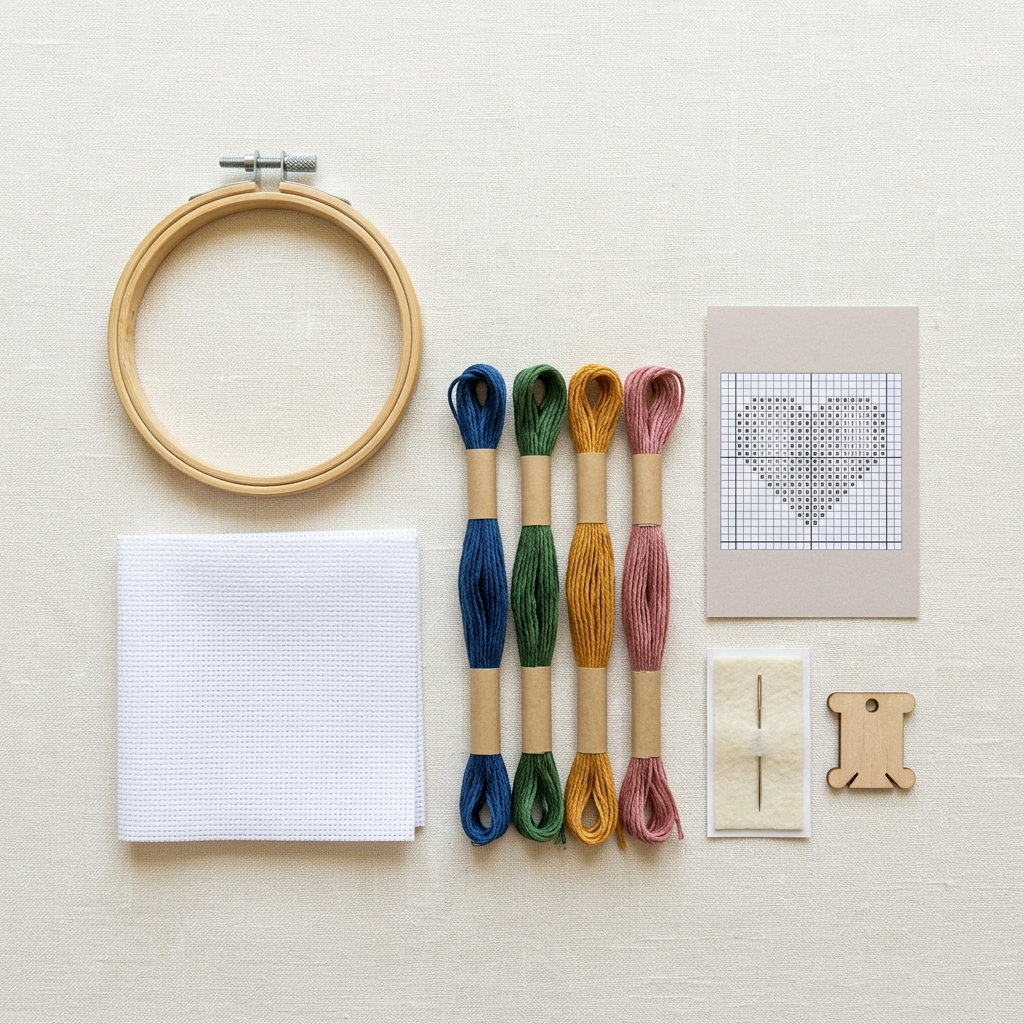
Tracey Recommends
Complete Beginner Cross Stitch Kit
Everything you need to start stitching today — Aida cloth, sorted floss, needle, hoop, and a printed pattern — all in one box. No research, no separate orders, no excuses. Open it, sit down, and stitch your first X.
See on AmazonThe first finish is what hooks you. If you never get to a first finish, you never find out whether you would have loved this craft. So the pattern choice at the very beginning is not a small decision — it is the whole game.
When You Are Ready to Buy: Level 1 Easy at Sunrays
There comes a moment — and I have watched it happen with my daughters, with customers, and with friends I have introduced to stitching — where the free patterns feel like a warm-up and you are ready for something that is yours. Something you chose, something you paid for because you wanted it, something that is going to hang on your wall or sit in a frame on your shelf. That is the moment I designed the Level 1 Easy category at Sunrays Creations Needlearts for.
Every pattern in the Level 1 category is something I charted with the newer stitcher specifically in mind. That does not mean they are boring or dumbed down. My design philosophy has always been that a pattern should be interesting to stitch, not just manageable. The level rating tells you something about the technical complexity — solid colors, a contained stitch count, a clean chart — but the subject matter and the composition are still given the same care I put into every design in the shop. Animals, botanicals, small holiday pieces, simple portraits. You will find something you genuinely want to stitch.
The practical difference between a Level 1 pattern and something harder comes down to the decision-making load. When you are still learning, every decision costs energy. Should I use one strand or two? Where does this color stop and that one begin? Did I count that section right? A Level 1 pattern is designed to keep those questions to a minimum so your brain can spend its energy on the stitch itself, on building muscle memory, on learning to read the chart fluently. Once those things become automatic — and they will, faster than you think — you will be ready to move up. But there is no rush.
You can browse all the Level 1 Easy designs directly at https://www.sunrayscreations.com/level-1-easy/. Take your time looking through them. My honest advice is to choose something you feel an emotional pull toward — an animal you love, a flower that reminds you of something, a holiday design you want to give as a gift. The motivation to finish a project is not purely about skill level. It is about caring about the outcome. Pick something you will be genuinely pleased to have finished, and let that pull you through the hard parts.
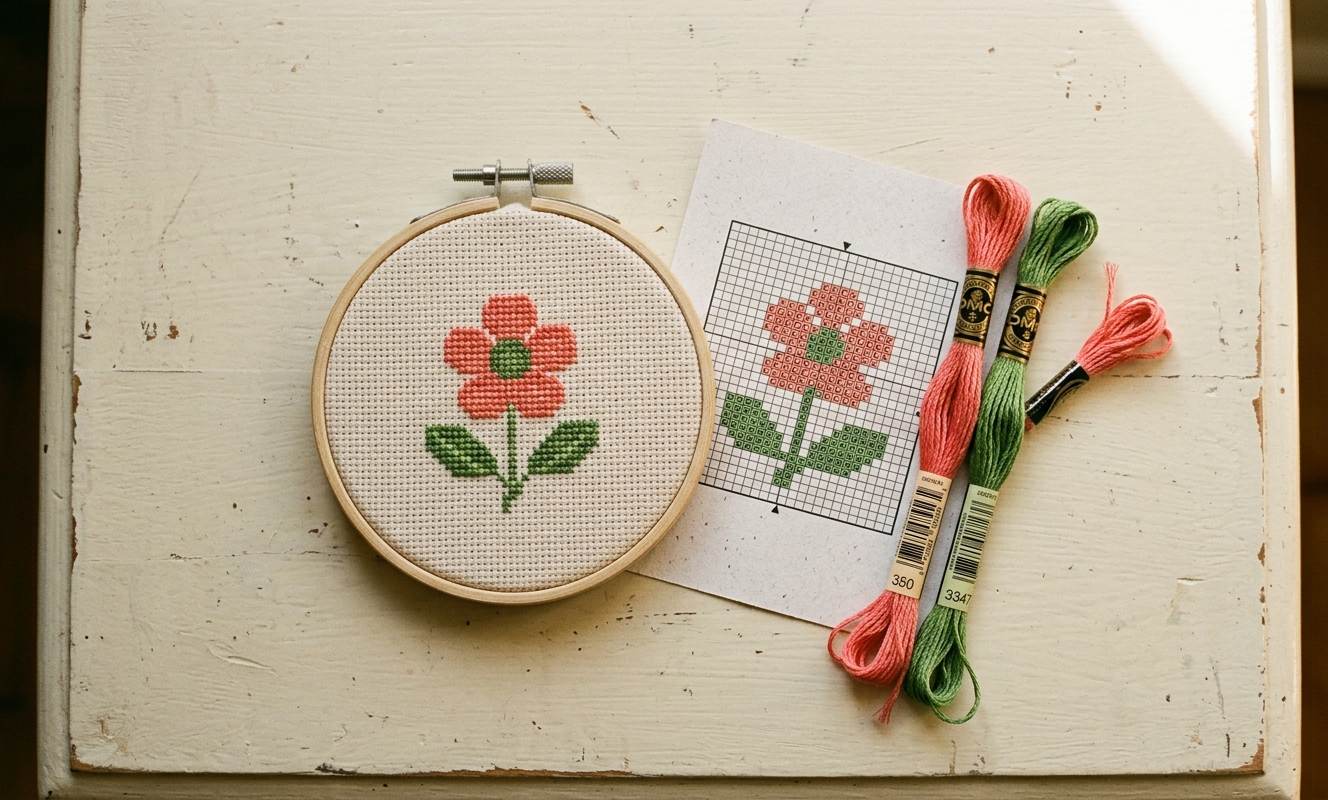
Small finished beginner cross stitch flower motif in a 4-inch hoop beside its pattern chart and DMC floss skeins
Complete Beginner Kits: The Zero-Friction Starting Point
Here is a question I get regularly from people who are brand new to cross stitch: what exactly do I need to buy? It is a fair question, and the full answer involves several separate purchases — fabric, floss, needles, a hoop, and scissors at minimum. If you want the comprehensive rundown, I have written a full guide to cross stitch supplies that covers everything, and I would point you there. But if you are the kind of person who wants to just start today without researching every individual component, a beginner cross stitch kit (find on Amazon) is the most direct answer.
A good beginner cross stitch kit comes with everything bundled together: a piece of 14-count Aida cloth pre-cut to size, a selection of DMC embroidery floss already sorted by color, a tapestry needle or two, a small embroidery hoop, and a printed pattern. Everything you need from first stitch to finished piece, in one box. The quality varies considerably between kits, so look for ones that include real DMC thread rather than generic floss, and check that the chart is printed clearly rather than photocopied small. Amazon has a solid selection, and a beginner cross stitch kit is a great search to start with.
The reason I recommend kits to absolute beginners is not that they are cheaper or better than buying separately — they often are not, on either count. The reason is friction. When you have to research and order six separate things before you can start, the gap between deciding to try cross stitch and actually stitching your first X is wide enough that life gets in the way and it never happens. A kit closes that gap entirely. You open the box, you sit down, and you stitch. The hobby either hooks you or it does not, but at least you found out.
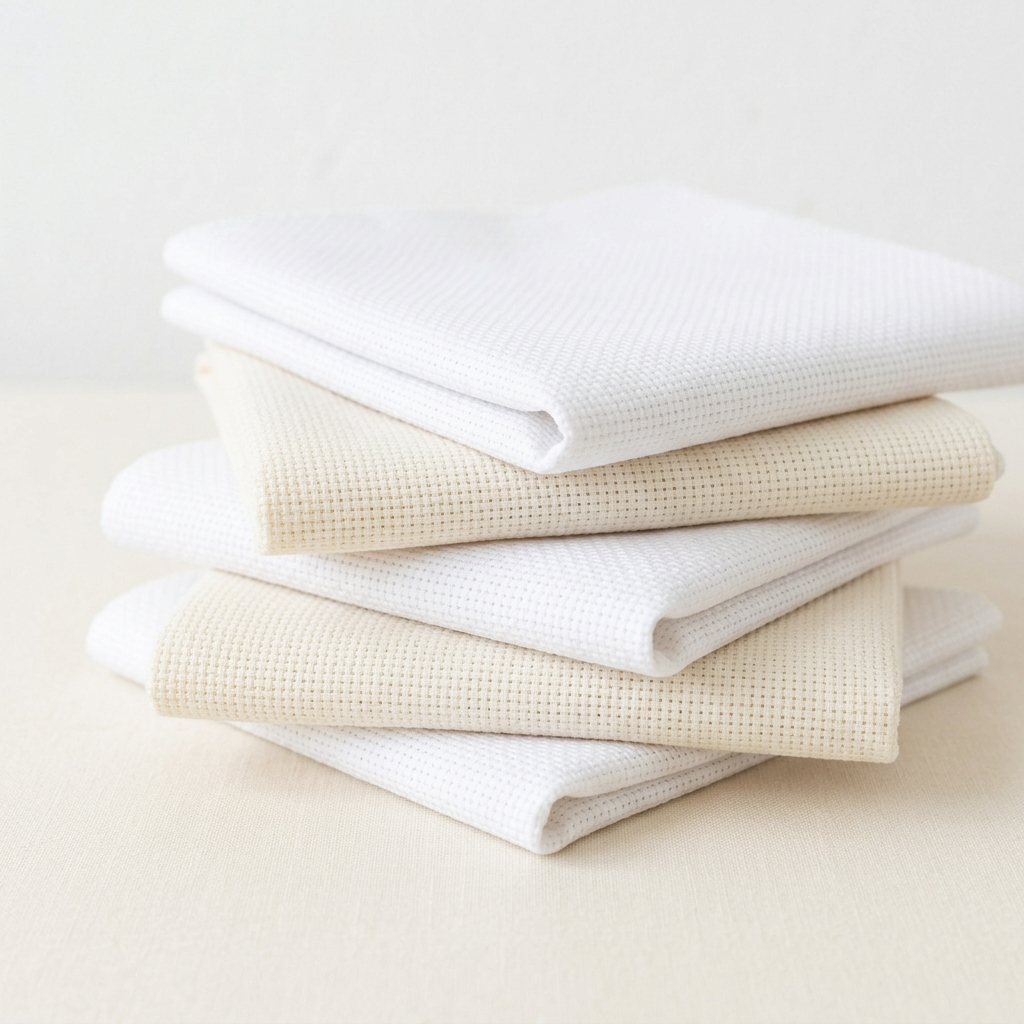
If you already have a hoop and some basic supplies, or if you are the kind of person who prefers to choose your own floss colors and pick your own pattern, you might prefer to buy your fabric and supplies separately. In that case, a 14-count Aida cloth starter pack is the most important individual purchase. Get it in white or cream for your first project — both read clearly, and the contrast between the fabric and the stitched thread is encouraging and satisfying. Dark Aida fabric has its place, but that place is not at the beginning. I will explain why in the next section.
Whatever route you take to gather your supplies, do not let the supply question stop you from starting. I have seen people spend three weeks researching the perfect floss organizer before they have stitched a single stitch. The supplies matter — I have written enough about good tools to mean that sincerely — but they are servants to the stitching, not a prerequisite to it. Get what you need to start, start, and refine your setup from there. God has a funny way of making the best version of a hobby reveal itself through practice rather than preparation.
|
Patterns from the Sunrays Collection Tracey's Picks, designing cross stitch patterns since 2004 |
|||||
|
|||||
| Browse the full Sunrays collection → |


What to Avoid as a Beginner — The Traps Worth Naming
I want to spend some time here being direct, because there are specific beginner mistakes that are not about skill or effort — they are about starting conditions. And starting conditions are something you can control before you ever put thread to needle. The first and biggest trap is choosing a pattern that is too large for your current patience level. This is not an insult — it is physics. A large pattern requires you to sustain focus, motivation, and accuracy over weeks or months before you see a finished result. Beginners need a finish. The dopamine of a completed piece is not trivial; it is what tells your brain that this is worth continuing. Start small. Motifs, small designs, simple subjects. You can graduate to the large Victorian portrait later, and you will do it better for having practiced.
The second trap is choosing a pattern with blended colors, fractional stitches, or specialty techniques before you have the basics down. I mentioned blended colors earlier in this article, but it bears repeating: blending is a beautiful technique that belongs in the intermediate toolkit. Same goes for quarter stitches and three-quarter stitches. They are used to create curved edges and fine details, and they are perfectly learnable — after you have stitched a few hundred solid full crosses and they feel natural. If your first pattern requires fractional stitches before you have gotten comfortable with whole ones, you will spend more time confused than stitching.
The third trap is the fabric. Dark Aida cloth — black, navy, dark green — requires you to use a light box or hold your work up to a lamp to see the holes clearly. It also makes it significantly harder to count accurately, because you cannot see the grid as easily. I love dark fabric. Several of my designs are specifically charted for dark backgrounds. But it is not beginner fabric. Start with white or cream 14-count Aida and give yourself every visual advantage you can.
The fourth trap is a poorly printed chart. This one sneaks up on people because you do not realize it is a problem until you are twenty minutes in and you cannot tell whether that symbol in row fourteen is a square or a diamond. Good charts have high resolution, clearly differentiated symbols, and a color key that stays on the same page as the chart section you are working. If you are printing a digital pattern at home, print it at the largest size your paper allows. If a chart comes in a kit and it is printed small with poor contrast, photocopy it enlarged before you start. Do not try to stitch from a chart that makes you squint.
The fifth trap — and this one is purely psychological — is comparing your early work to finished pieces you see online. The cross stitch community on social media is wonderful and generous, but it is also full of work done by people with ten, twenty, thirty years of experience. Those pieces represent hundreds of hours of accumulated skill. Your first finish does not have to be beautiful by those standards. It has to be yours. My daughters' first pieces were not perfect. Mine was not either. What mattered was that we made them, and that we kept going. If you need a DMC embroidery floss set (find on Amazon) to get started, get one. If you need a couple of extra embroidery hoop set (find on Amazon) options to find what size you like working in, buy them. Remove every friction point you can, but do not let perfect be the enemy of started.
Get Stitching Tips & New Patterns from Tracey
Honest advice, new Sunrays designs, and occasional VIP-only offers. No fluff.
No spam. Unsubscribe any time.
Also Worth Having
14-Count Aida Cloth Starter Pack
If you already have floss and a hoop, the right fabric is the most important individual purchase you can make. White or cream 14-count Aida gives you the clearest grid, the easiest counting, and the most forgiving start.
See on AmazonBuilding Momentum: From First Stitch to Your Own Style
Something I have watched happen with every stitcher I have ever known — my daughters included — is the moment where the craft stops feeling like a skill you are acquiring and starts feeling like a language you speak. It does not happen all at once. It creeps up on you. You are working through a pattern and you realize you have not looked at the chart in twenty minutes. Your hands know where to go. You are counting automatically. You are making decisions about color placement without stopping to think about them. That is the moment stitching becomes truly enjoyable rather than just satisfying.
Getting there requires volume. Not speed, not pressure — just enough finished pieces that the mechanics become automatic. In my experience, that usually means somewhere between three and six completed projects, assuming they are appropriately sized for a beginner. That is three to six trips through the full cycle: choosing a pattern, gathering supplies, starting, managing the middle, finishing. Each pass teaches you something the previous one did not. By the sixth project, you will have opinions. You will know which needle size you prefer, which fabric count feels most natural, whether you like stitching in hand or on a stand. Those opinions are the beginning of your own style.
When you are ready to explore beyond Level 1, the Sunrays shop has patterns organized by difficulty level so you can move through the progression intentionally rather than accidentally. I design across a wide range of subjects — animals, botanicals, Victorian portraits, seasonal and holiday pieces — so there is almost certainly something in a higher level category that will pull you forward when the time is right. And if you ever hit a project that gives you trouble — if you lose your place, make a mistake, have to take out stitches — that is just part of the craft. We call it frogging, and every stitcher does it. It does not mean you are doing it wrong.
If you take nothing else from this article, take this: start with the right pattern, give yourself a real first finish, and let the craft show you what it can be. Everything I know about teaching cross stitch I learned at my own kitchen table with my daughters, and the lesson was always the same — the right starting point changes everything. When you are ready to find yours, come browse the patterns at Sunrays Creations Needlearts. The free designs are waiting for you right now, and the Level 1 category is there whenever you want to take the next step.
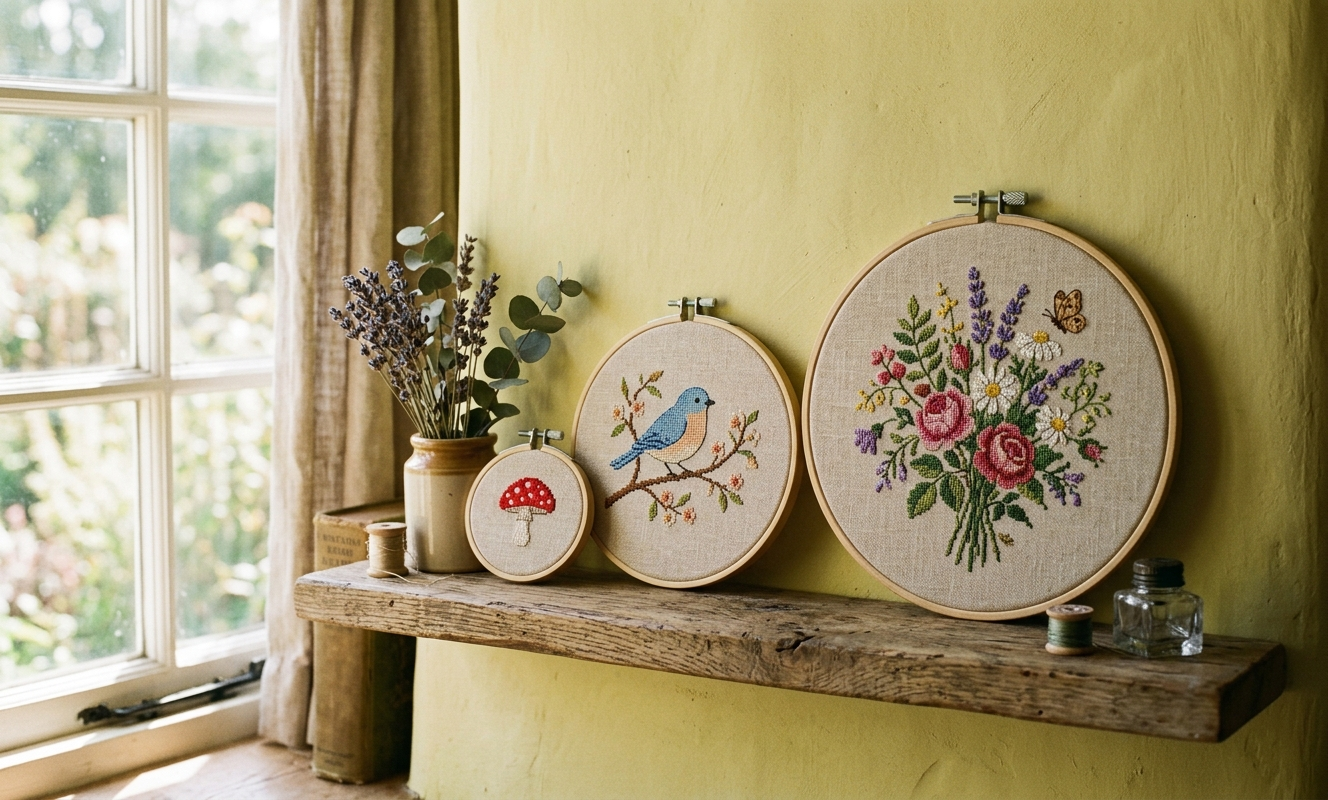
Three graduated completed cross stitch hoops on wooden shelf showing beginner stitcher progress from motif to small design
Keep Reading
What Do You Need to Cross Stitch?
The complete supply list for new stitchers — fabric, floss, needles, hoops, and everything else explained clearly before you buy a thing.
READ THE GUIDEHow Many Strands of Floss for Cross Stitch?
The strand count question hits every beginner immediately — here is the clear, practical answer so you can start with confidence.
READ THE ARTICLEIs Cross Stitch Hard?
If self-doubt is keeping you from starting, this article addresses every anxiety beginners bring to the craft — honestly and without sugarcoating.
READ THE ARTICLEFrequently Asked Questions
What makes a cross stitch pattern actually beginner-friendly?
Fifteen colors or fewer, solid colors only (no blending), a small stitch count, 14-count Aida fabric, and a clean readable chart. See the first section for the full breakdown.
Where can I find free cross stitch patterns for beginners?
Sunrays Creations has a free patterns category with real hand-charted designs at no cost. The Spruce and Tiny Modernist also offer free beginner-friendly options online.
What is a Level 1 cross stitch pattern?
Level 1 at Sunrays means solid colors, a manageable stitch count, and a clean chart — designed for newer stitchers who want a real design without being overwhelmed.
Should I start with a cross stitch kit or buy supplies separately?
A complete kit removes all friction and gets you stitching the same day — ideal if you are brand new. If you already have some supplies, buying 14-count Aida cloth separately and choosing your own pattern works well too.
What should beginners avoid when choosing a cross stitch pattern?
Avoid blended colors, fractional stitches, large patterns, dark Aida fabric, and poorly printed charts. Starting conditions matter more than most guides admit — the body sections cover each trap in detail.
How many projects does it take before cross stitch feels natural?
Most stitchers hit a turning point somewhere between three and six completed beginner-sized projects, when the mechanics become automatic and personal preferences start to emerge.
-- Tracey Kramer
Founder & Designer, Sunrays Creations Needlearts
Hand-charted designs since 2004 • Marysville, Ohio