
How to Read a Cross Stitch Pattern: A Complete Guide for New Stitchers
Posted by Tracey Kramer on 25th May 2026
A Note from Tracey Kramer
After 22 years of designing cross stitch patterns from our Marysville studio, I've learned that the best guides come from real stitching - not theory. This is what I'd tell a friend.
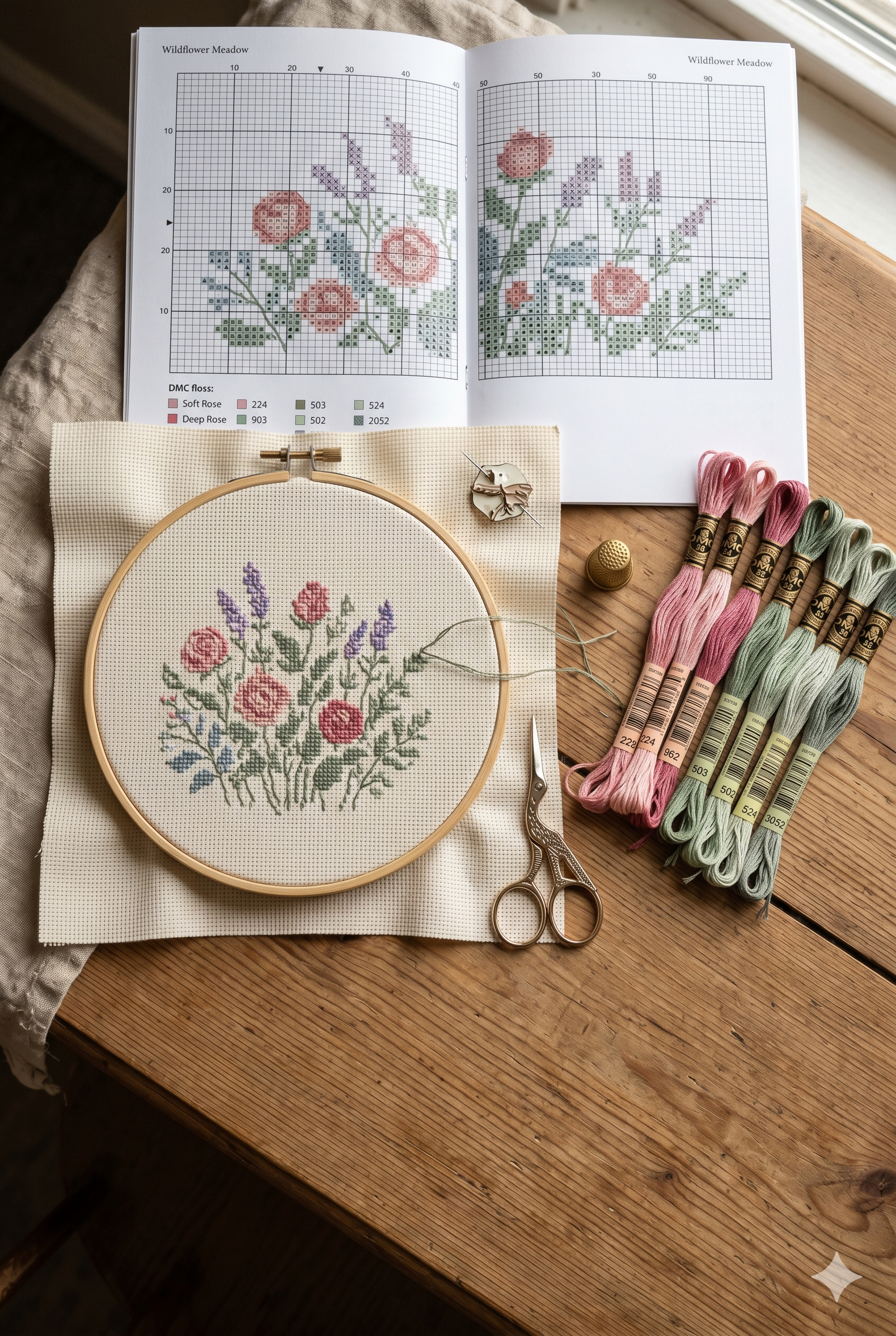
How to Read a Cross Stitch Pattern: A Complete Guide for New Stitchers | Sunrays Creations
Learning how to read a cross stitch pattern is the single biggest hurdle between you and your first finished piece, and the good news is it clicks faster than you think. A cross stitch pattern is a gridded chart where each square equals one stitch, each symbol represents a specific DMC floss color, and the color key tells you exactly which thread goes where. After 22 years of designing patterns and watching new stitchers find their footing, I can promise you this skill becomes second nature within an hour of practice. Pull up a chair, grab a cup of coffee, and let's walk through every line, symbol, and number on that chart together.
What a Cross Stitch Pattern Actually Is
Before we get into symbols and color keys, let's settle what you're holding in your hands. A counted cross stitch pattern is a printed or digital chart made up of a grid, where each tiny square corresponds to one X-shaped stitch on your fabric. The squares contain symbols, and those symbols map to specific floss colors listed in a key. That's it. The whole craft hinges on counting squares on the chart, counting holes on your Aida cloth (find on Amazon), and matching them up.
I want to clear up one thing right at the start because new stitchers ask me about this constantly. Counted cross stitch is not stamped cross stitch. Stamped cross stitch has the design pre-printed onto the fabric, so you just stitch over the marks. It's a different beast. Counted, which is what every Sunrays pattern uses, requires you to read the chart and translate it onto blank fabric yourself. It's also not needlepoint, which is a separate craft worked on canvas with different stitches and finished as pillows or chair seats. We are 100% counted cross stitch here, designed for framed wall art on 18-count Aida.
Once you understand the chart is just a map and the fabric is the territory, the rest is mechanical. You're matching squares to holes, one stitch at a time.
Cross Stitch Pattern Symbols Explained
Open any pattern of mine and you'll see a grid filled with symbols. Hearts, triangles, dots, slashes, little Xs, stars, circles with lines through them. Every symbol you see represents a different color of DMC floss. One symbol equals one color equals one full cross stitch in that square.
Why symbols instead of colored squares?
Some patterns do print in full color, and they look gorgeous on screen. The trouble is that two greens or two blues can look almost identical when printed, especially if you're stitching under warm lamplight in the evening. Symbols remove the guesswork. A heart is a heart whether your printer ran low on cyan or your eyes are tired at 10 p.m. After designing patterns for over two decades, I lean heavily on symbol-based charts because they're the most accurate way to communicate a design.
Reading the symbol grid
Start at a logical anchor point, usually the center of the design (most charts mark the center with arrows along the top and side edges). Find the matching center on your fabric by folding it in quarters and creasing lightly. From that anchor, count outward and match each square's symbol to a color in the key. When you stitch, you make a full X for every square that contains a symbol. Empty squares mean no stitch - that's just background fabric showing through.
One trick I always recommend to new stitchers: use a highlighter or a colored pencil to mark off rows as you complete them. It saves your sanity on anything bigger than a 4-inch design.
Decoding the Cross Stitch Color Key
The color key is the legend that turns symbols into actual thread. Every Sunrays pattern includes one, and once you know how to read it, you'll never get lost on a chart again.
What's in a typical color key
A standard color key has four columns: the symbol as it appears on the chart, the DMC floss number, the color name (like "Medium Rose" or "Dark Forest Green"), and sometimes a small color swatch for reference. Some keys also include the number of skeins you'll need for that color, which is incredibly helpful when you're shopping for floss or pulling from your existing stash.
How to use the key while you stitch
I work one color at a time when I'm starting a new section. I look at the key, pick a color (let's say DMC 815, a deep garnet red), find every square on the chart with that symbol, and stitch them all before moving on. This is sometimes called cross-country stitching, and it's faster than constantly threading and re-threading different colors. For larger or denser designs, you might prefer the parking method instead, which keeps multiple needles threaded and "parked" in the fabric near where they'll be used next.
What if my key lists DMC numbers I can't find?
DMC occasionally retires colors. If you run into a number that's no longer available, don't panic - there are well-established replacement charts for every discontinued shade. I keep a running guide on the blog so you can swap colors without breaking the design.
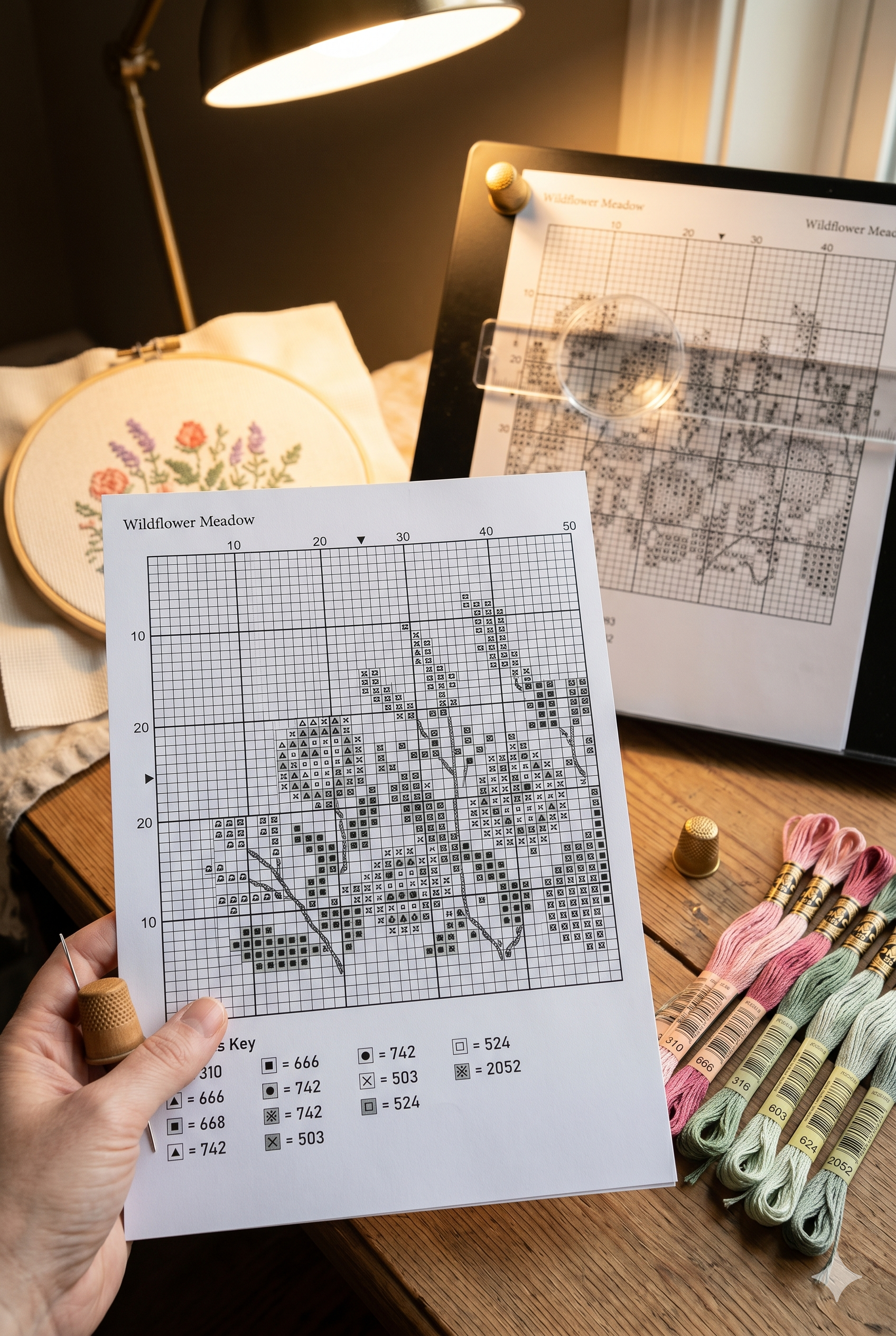
Counting Squares and Translating to Fabric
This is where the magic happens, and where most new stitchers stumble for the first ten minutes before it clicks.
Match the chart grid to the fabric grid
Your 18-count Aida has 18 holes per inch in both directions, forming a perfect grid of squares. Your pattern is also a perfect grid of squares. Each square on the chart equals one square on the fabric. To stitch, you bring your needle up through the bottom-left hole of a square, down through the top-right, up through the bottom-right, and down through the top-left, forming an X. Two strands of DMC floss on 18-count gives beautiful coverage without bulk - that's been my go-to combination for 22 years of designs.
Use the heavy gridlines
Most patterns, including all of mine, have heavier lines every 10 squares. These are gridlines, and they exist purely to help you count. Instead of counting one-two-three-four-five up to thirty, you count three blocks of ten. Big charts get exponentially easier when you trust the gridlines.
Gridding your fabric
For larger projects, many stitchers grid their blank Aida in 10x10 squares with water-soluble pen or temporary thread before they begin. It mirrors the chart's gridlines and basically eliminates miscounts. I don't grid small designs, but anything over 100 stitches wide gets gridded on my frame before I touch a needle.
Backstitch, French Knots, and Special Symbols
Once you've got the main cross stitches down, you'll notice some patterns include extra elements that aren't full Xs.
Backstitch lines
Backstitch is shown on the chart as solid lines running along or between grid squares, not inside them. These are outline stitches - typically used to define edges, add facial features, or sharpen lettering. The color key will list backstitch colors separately, often with a notation like "BS" or a different line color. You stitch backstitch last, after all your full crosses are done, using one strand of floss instead of two for a finer line.
French knots
French knots show up as small filled dots on the chart, usually with their own symbol in the key. They add texture for things like flower centers or eyes. Don't fear them. Wrap the floss twice around the needle, hold it taut, and pull through. The first three feel awkward; the rest feel natural.
What I don't include in my designs
You won't find half stitches, quarter stitches, or fractional stitches in Sunrays patterns. I design for full cross stitch only, on 18-count Aida, finished as framed wall art. It keeps the stitching meditative instead of fiddly, and the finished pieces look crisp and intentional on the wall. If you're coming from a pattern that uses fractionals and finding them frustrating, you're not alone - full-cross designs are a relief.
Tools That Make Reading Patterns Easier
I've been at this long enough to know which tools genuinely help and which are just clutter. Here's what actually earns space on my stitching table.
A magnetic chart holder
If you stitch from paper patterns, a magnetic board changes your life. You slap the chart on the metal surface, then use a magnetic strip to mark the row you're currently working. No more losing your place when the cat jumps on the couch. It also keeps the paper flat instead of curling.
A good light source
Reading symbols at night under a regular lamp is a recipe for eye strain. A daylight-balanced LED with a magnifier built in lets you stitch comfortably for hours and read tiny symbols on dense charts without squinting.
A 5-6 inch wooden or plastic hoop
I use a traditional embroidery hoop (find on Amazon), 5 to 6 inches, wood or plastic. It keeps fabric tension even, which makes counting holes far easier than working on slack fabric. My full guide to hoops and frames goes deeper if you're outfitting your kit.
Highlighters and pencils
Print your digital pattern, then highlight finished sections as you go. Some stitchers use colored pencils to lightly shade in completed rows. Whatever helps you keep your place - patterns aren't sacred, they're working documents.
Common Mistakes New Stitchers Make Reading Patterns
I've taught this craft long enough to spot the same five errors over and over. None of them are fatal, all of them are fixable.
Mistake 1: Starting at a corner instead of the center. Always start near the middle of the design. If you start at the top-left corner and miscount by even one square, your design will run off the fabric. Centering gives you margin in every direction.
Mistake 2: Confusing similar symbols. A heart and a teardrop can look alike on a dense chart. Slow down on the first few stitches of each new color and double-check the key. Frogging (ripping out stitches) is a fact of life in this craft, but it's avoidable with a five-second pause.
Mistake 3: Ignoring the gridlines. Trust the heavy lines every 10 squares. Counting in tens is exponentially faster than counting one by one.
Mistake 4: Working in poor light. If you're squinting, you're miscounting. Better light pays for itself in saved hours.
Mistake 5: Comparing your pace to FlossTube creators. Reading a pattern fluently takes a few projects. Be patient with yourself. Everyone in this community started exactly where you are.

Magnifying LED Lamp for Cross Stitch & Detail WorkReading symbols on a dense chart at 9 p.m. is brutal without proper light. This clip-on LED with 4X and 6X magnification lets me see every symbol clearly and stitch comfortably for hours. The flexible neck means I can angle it exactly where I need it. Shop on Amazon |

Dritz Magnetic Pattern Board with Ruler & MarkersIf you stitch from printed patterns, this is the upgrade I tell every new stitcher about. The magnetic strip marks your current row so you never lose your place, and the board keeps the chart flat instead of curling on your lap. Shop on Amazon |
From the Sunrays Pattern Library
- Chasing Butterflies, NS-01 ? View Pattern
A gentle, manageable design that's perfect for practicing pattern-reading on a project you'll actually finish. - Emerald Archway, TR-04 ? View Pattern
A mid-size design with a clear color key and approachable symbol density once you've got the basics down. - Flowers in a Basket on a Marble Ledge, FL-30 ? View Pattern
When you're ready to stretch your skills, this fine-art floral has a rich color key that rewards confident chart-reading.
Keep Reading
Cross Stitch for Beginners: Everything You Need to Start Your First Project TodayOnce you can read a pattern, this guide walks you through every supply and first-stitch step you need to get started. Read Article |
Cross Stitch Tips for Beginners, 8 Valuable Tips on How to Get StartedEight beginner tips that pair beautifully with pattern-reading skills, from thread length to starting position. Read Article |
DMC Discontinued Floss Colors: List & Replacements | Sunrays CreationsWhen your color key lists a DMC number you can't find anymore, this is where you'll find the right replacement. Read Article |
Frequently Asked Questions
How do you read a cross stitch pattern for beginners?
Find the center of the chart (marked with arrows on the edges) and the center of your fabric (fold it in quarters). Match each symbol on the grid to its DMC color in the key, then stitch one full X for every symbol-filled square. Empty squares stay unstitched. Start in the middle and work outward so your design fits the fabric.
What do the symbols on a cross stitch pattern mean?
Each symbol on a cross stitch chart represents one specific DMC floss color, and one symbol-filled square equals one full cross stitch in that color. The color key tells you which symbol goes with which floss number. Symbols are used instead of colored squares because they're easier to distinguish under different lighting.
What is a cross stitch color key?
The color key is the legend that translates chart symbols into actual DMC floss. It typically lists the symbol, the DMC number, the color name, and sometimes the number of skeins required. You'll reference it constantly while stitching, so I recommend keeping it next to your fabric or printed at the top of your working chart.
Where do I start stitching on a cross stitch pattern?
Always start at the center of the design, not a corner. Fold your Aida fabric in quarters to find the middle, then locate the center on your chart (marked with arrows on the top and side edges). Starting from center guarantees the design fits within your fabric with even margins on all sides.
What do the dark lines on a cross stitch chart mean?
The heavy or darker lines that appear every 10 squares are gridlines. They're a counting aid, not stitching instructions. Instead of counting individual squares one by one, you count blocks of ten, which dramatically speeds up reading larger charts. Solid lines running along the edges of squares (not inside them) typically mean backstitch.
How many strands of floss should I use to follow a pattern?
On 18-count Aida, which is what I design every Sunrays pattern for, two strands of DMC floss gives you beautiful, full coverage for cross stitches. Backstitch is typically worked with just one strand for a finer outline. Always check the pattern instructions, but two-over-eighteen is the standard I've used for 22 years.
Do I need to grid my fabric before stitching?
For small designs under a few inches, gridding isn't necessary. For larger projects, gridding your blank Aida in 10x10 squares with water-soluble pen or temporary thread mirrors the chart's gridlines and prevents miscounts. I grid anything over 100 stitches wide before I start, and I recommend new stitchers try it on their second or third project.
Join the Sunrays stitcher's circle
New patterns, seasonal promos, and Tracey's studio notes - delivered to your inbox.
About Tracey Kramer: Tracey is the lead designer and co-owner of Sunrays Creations, a counted cross stitch business she has run from Marysville, Ohio for over 22 years. Her patterns are stitched in homes around the world and finished as framed wall art. Visit sunrayscreations.com to explore her pattern library.